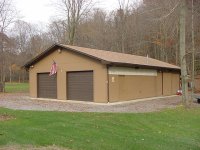
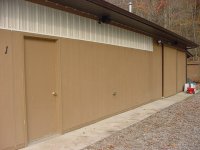
slab in pole barn. what to do with poles?

   / slab in pole barn. what to do with poles? #1  

kevinO

New member
Joined
Aug 9, 2004
Messages
7
New member here. I want to build a workshop and am leaning towards pole barn construction.

I have spent lots of time pouring over many of the messages on this board about pole barn construction and have learned a lot. But I'm still not sure what to do with the poles in a pole barn when a slab is poured.

I have read that it is best to not pour the concrete directly against the poles as the concrete will trap water and cause the poles to rot. Suggestions were to put a concrete cookie in the bottom of the hole or possibly pour a concrete "necklace" around the post and then fill with gravel, dirt, etc - but not concrete!

But what do you do with the poles when you pour the slab in the barn?

I asked a buddy of mine that has poured concrete for twenty years. He said to just concrete the whole thing up from bottom to top. I said "what about water getting in and rotting the poles?".

He said "you are going to put a roof, walls, etc on the barn aren't you?". I replied "yes". He asked how then were the poles going to get wet?

I couldn't answer!

He said that the "don't pour concrete around posts" logic apples to decks, fence posts, etc which are exposed to the elements, but enclosed posts are a different story. He said that the slab adds a lot of side to side strength to the building when poured against the poles.

So I'm confused. I like this guy a lot (and he volunteered to help with my slab for free!), but his argument seems to be contrary to what I've read here.

One thing I thought of as a compromise: I figure that with all the water coming off the eaves when it rains, the ground on the side walls can get very wet. Perhaps this water can make its way into any cracks in the concrete around the posts. Maybe a compromise would be a concrete necklace at the bottom, then fill with gravel, dirt, etc and then four of five inches of concrete at the top (the slab). This would allow the bulk of the pole to drain, and the top part should not get wet unless some soaks in from the bottom, but I'd assume that it would also then dry out when conditions change.

I don't want to goof this up! My wife already thinks that I don't know what I'm doing!!!

Thanks for any tips!

Kevin
 
   / slab in pole barn. what to do with poles? #2  
You could always use telephone poles for the poles. I never saw one of these rot at ground level or below.
 
   / slab in pole barn. what to do with poles? #3  
How about pouring footers for the poles up to the level that the floor will be poured? Or pour the floor first then set the building on that.
 
   / slab in pole barn. what to do with poles? #4  
Excellent question Kevin, and welcome to the list!

I've wondered the same thing as I'm starting to kick the tires on a new workshop and am considering using pole barn construction.

I do not recommend that you put the poles on top of the slab. All of the tie-downs that I have seen will hold a pole to the slab, but they will not do a good job of preventing the pole tiping over. One of the big benefits of a pole building is that the poles resist forces from wind. You lose this benefit if you put the poles on top of the slab. If you do that, you might be better off just going with conventional stick frame construction...

Mark
 
   / slab in pole barn. what to do with poles? #5  
I think I agree with your buddy ... fill the post hole with concrete and be done with it. It always seemed to me that backfilling around a post with gravel, sand or dirt, which will be very porous and permeable in the case of gravel, more so than the surrounding earth, will allow the water to gather and pool around the post and that's the very thing you are trying to avoid. Cement, on the other hand, is basically impermeable when set and won't allow the water to contact the post in the first place.

I don't know if this will help but I'll throw it out there for discussion.

Fill bottom of hole with concrete. Set cardboard tube (from box store or builder's supply) in concrete to 2" above sub base. Set pressure treated posts inside tube and fill space with concrete. Bend rebar to 90 degrees and set in cement in top of tube facing in towards slab. Backfill around tube with dirt and tamp. Set out rest of rebar for slab. Pour 4" concrete slab.

That would allow the post to be totally surrounded with concrete and tied back into the slab. Framing the slab might be a bit of a pain with having to notch around the tubes or you could just frame to the outside of the tubes. Assuming that the level of your slab is slightly higher than the surrounding ground, there should be no way for water to get trapped around the the posts.

Sounds a bit like overkill but I think it'll work and should be good for your lifetime.
 
   / slab in pole barn. what to do with poles? #6  
</font><font color="blue" class="small">( Maybe a compromise would be a concrete necklace at the bottom, then fill with gravel, dirt, etc and then four of five inches of concrete at the top (the slab). This would allow the bulk of the pole to drain, and the top part should not get wet unless some soaks in from the bottom, but I'd assume that it would also then dry out when conditions change.
)</font>

You are on the right track. Only thing I would do is put a 'sleeve' around the pole (post) of 1/2" strip (used to separate concrete poured against a building that allows a pad to move) to allow the floor to move independent of the wood post.

Gravel packed and tamped around a post sitting on a concrete pad will stay pretty dry under a covered building, and I would want to allow some movement of the posts independent of the concrete floor (that gets into the mechanics and wind loads applied).

Wood needs to remain dry, although the treated wood you most likely are using will last a long time if 'under roof'. I wouldn't (nor would anyone understanding wood) set a post in concrete. Sometimes it is easier, and quicker, and it feels real solid after its done, but it doesn't last (and is a bear to remove when it rots off).

Good luck with the doubtful wife. /forums/images/graemlins/wink.gif
 
   / slab in pole barn. what to do with poles? #7  
</font><font color="blue" class="small">( But what do you do with the poles when you pour the slab in the barn? )</font>

When I put the plastic down over my base I covered the poles as well. Then poured the floor.

As far as your friends comment on how thier going to get wet?
Pretty simple really, only part of the pole is inside. The rest is in the dirt on the outside edge of the building. If you don't have your slope right from the building they will go from getting wet to getting soaked.
 
   / slab in pole barn. what to do with poles? #8  
Hi...


As suggested... I'd keep a gap between the poles and concrete slab allowing them to move independantly... and also help prevent that being a moisture trap...

Regarding moisture... concrete is not waterproof... even if there is no direct contact with water from outside... the poles and concrete are exposed to moisture in the soil... moisture in the air...

Water penetraits even 8" thick concrete basement walls... they can sweat from the moisture in the air...

Also as suggested... treated utility poles typically have a long in-ground service life...


Dave...
 
   / slab in pole barn. what to do with poles? #9  
one of the bigger things to cisider is when pouring crete over and or around poles is the wind shear load, the poles while in-ground can move some sideways and not have much shear load as the load disapates as the post sways back and forth a bit. when it is poured up/around it it creats a spot where a good gust can cause the poles to SNAP OFF at the level of the concrete. also the moisture will codnese inside on the poles near or at ground level often and wall poles will get wet form ground moisture. water is fine on the poles and will not damage them it is the leaching of the concrete that is more damaging! it is acidic or alkalie (forget which) but that is what mixes with the water and causes the rott more so than just water, which does little to offend the TREATED wood...

watch how many telli poles are preplaced from rott vs ones on or in sidewalks from same rott and or damage form wind?

I do know that pouring on the pole is a no-no... as for FIX?
best bet is to use styrofoam to insulate the slab from the poles this let water vapor and such to stay away from the pole... this would be a guess on my part, only so maybe others know better way?

I will be having to deal with this same inssue soon, as I have center poles in my 40' wide pole barn, that need to be addressed. I've let it set comming up on 2 years and have back tamnped with spud bar on all the poles. (after first tamping it has settled nearly 10" next to the poles, using clay, sand & gravel as back fill on the poles, (stuf that came out of the holes with gravel mix.) it's my understanding that the friction of the material around the pole will keep it from slipping out and the wiggeling back & forth helps keep the post settled all the way ON the pad at the bottom of the hole. (below frost heave required!) dust/dirt will keep entering into the wiggled spots untill it can't wiggel anymore and friction keeps it there wqith above barn weight.

anyhow I'm reading with passion too for my OWN peace of mind!

Mark M /forums/images/graemlins/smile.gif
 
   / slab in pole barn. what to do with poles? #10  
I'm not familiar with pole barn specifics, but one thing that is basic to construction---wood never contacts concrete unless the wood is treated. Take a look at the first floor sill plate on any home built in the last 20 years. (that's what is between the basement wall and the floor joists.

I don't know what type of wood you're using for the posts. But if you're going to set it on the concrete make sure you treat the bottom with tar or some equivalent. Even if its cedar or pressure treated.

Personally, I would use a Simpson strong tie base plate that gives an inch between the wood and the concrete. Someone mentioned that the interior columns experience a rotational moment force. This sounds odd, but again, I'm not that familiar with pole barns. In conventional framing the wind forces or racking of the house is resisted by the sheathing or diagonal bracing of the outside walls.

The structural affect of the slab around the poles is nothing and should not be considered.

I would welcome the help but not the advice. I have always offered to help people for free when its something I've never done before. That is because I want to learn on their house first, before I tried it on mine.
 
   / slab in pole barn. what to do with poles? #11  
Don't set the posts in concrete, I've pulled posts in both instances, the posts that were set in dirt and compacted with a digging bar looked like new after 15 years, the posts that were set in concrete were almost rotted in half, both posts were treated 6x6 posts 16' tall in a pole barn used to store round bales. As far as pouring your slab against them I would nail an expansion joint material right to the post, you can buy it at any Home Depot or Lowes or simalar, it is 4" high and 1/2" wide and comes in 10' lengths, a tar soaked fiber membrane which can be cut to length with a utiliy knife and nailed to the bottom band board and around all 3 sides of the posts with 1 1/4" roofing nails. An added advantage of using this expansion material is that you set it to grade at the top of the slab and it creates a ledge for the screed board ride on.
 
   / slab in pole barn. what to do with poles? #12  
I agree with Pete. For what it's worth CCA treated poles rated for constant salt water immersion are still available. I suspect you could pour concrete around them and they wouldn't rot.
 
   / slab in pole barn. what to do with poles?
  • Thread Starter
#13  
Thanks a lot for all of the pointers. I'm still planning. And saving. The materials costs is going up at about the same rate that I'm putting $$$ aside! /forums/images/graemlins/frown.gif

Here's another, related question: I saw wroughtn_harv's barn and saw that he used steel pipes instead of poles. Looks like a neat idea.

So I assume that there is no problem putting steel pipes in concrete?

Assuming that this is OK, then my next question is regarding the size and thickness of the poles. I've read many times that if you're using wood, go with 6x6 for corners and 4x6 for non-corner supports, eight foot on center.

What would be a reasonable steel replacement for the poles, eight foot on center? I'm thinking that for my needs, square tubing would be easier to work with instead of round. What size? My garage has steel supports for the garage door that are 3x3x3/16". Would that be big/heavy enough to replace a 6x6 wooden post in a pole barn?

I have lots of questions and few answers!

Kevin
 
   / slab in pole barn. what to do with poles? #14  
Hi Kevin-

</font><font color="blue" class="small">( What would be a reasonable steel replacement for the poles, eight foot on center? )</font>

I'm no expert, but I've been studying questions similar to yours for a while and have a little to offer. Disclaimer - I'm not a structural engineer. I am an electrical engineer, but that really doesn't help much here! /forums/images/graemlins/smile.gif

A while back, I bought this book on building trusses, etc out of wood and steel members. In that book (and one other at home), I found a table listing the maximum load for wood members in compression. For an unbraced length of 12 feet, it lists a max load of 6,200lbs for a 4x6 and 17,400 lbs for a 6x6.

Flipping a few pages to information on members made of structural steel tubing, and running some figures involving, L, A, r, I and other letters of the alphabet ( /forums/images/graemlins/smile.gif ) reveals a maximum compression load of 18,700 lbs for an unbraced (12 ft long) 3x3x3/16. Stepping up to a 1/4" thick 3x3 and you get 22,900lbs.

A 3.5x3.5x3/16 jumps to 29,000.

So certainly something as "small" as 3x3x3/16 looks adequate in this area. There is also a consideration of both bending and compression forces applied at the same time which would be the case for a post in a building that is subject to live and dead loads and also wind forces.

The calculations here are a little more lengthy so I took the short route and ran the numbers in some finite element analysis software that I have that is for just this purpose.

Applying a dead load of 6,000lb at the top of a 12 foot member with a 300lb/ft wind force being applied along its length resulted in a displacement in the X direction (top of post bent to side) as below:

3.5x3.5x3/16 steel tube: displacement: 12.7in
5 1/4 x 6 glulam wood post: 13.5in
6x6 post: 14.9in
4x6 post: 23.2in

So these numbers also suggest that something along the lines of a 3 1/2 x 3 1/2 post should handle both compression and bending forces better than a 6x6 post or a 5.5x6 Glulam.

For those that have talked about glulam posts in the past, this test suggest that they can indeed outperform (slightly) larger "normal" posts!

Can steel posts be planted in concrete without worry about rust? I don't know?!? If you're as **** as I am, you might slap some oil base paint on them before you stick 'em in the crete if you'll lie in bed worrying about such things! /forums/images/graemlins/wink.gif

I guess that one question that I have is, if steel would work as a replacement for wooden posts, (and it looks to me like it should), why doesn't anybody use it???

Maybe somebody else can weigh in on this...

Best,


Mark
 
   / slab in pole barn. what to do with poles?
  • Thread Starter
#15  
Thanks for the update. I'm still thinking on what way to go RE the poles.

Here's another question for folks with some (any is more than I have) experience with building pole barns:

How do you attach the (I think they're called) "eave girts" to the poles? The "eave girts" are the 2x12's (or something close) that the roof trusses sit on at each wall. If you are using a 6x6 post and have two eave girts that butt at that pole, you only have 2.5 inches or so of overlap between the girt and the pole - that's not much area to put nails, bolts, screws, etc. Given that the eave girts carry all of the weight of the roof, this connection needs to be strong.

Are there any tricks/hints to make this connection strong? Any connectors to help with this?

Thanks in advance.

Kevin
 
   / slab in pole barn. what to do with poles? #16  
Whenever I set posts I usually give them a few heavy coats of oil based paint to about 8 to 10 inches above where the final ground level will be before putting them in the hole and pouring around them. That way they are protected from moisture. I typically pick up some OOPS paint at my local Lowes or Home Depot for this purpose.

Kevin
 
   / slab in pole barn. what to do with poles? #17  
</font><font color="blue" class="small">( How do you attach the (I think they're called) "eave girts" to the poles? )</font>

I would notch the poles to accommodate the width and height of the beams and bolt them to the posts. Roof loads are usually vertically compressive, but there is some sideways loading as well. This way the bulk of the support will be in the vertical direction, but still provide some lateral support.

Kevin
 
   / slab in pole barn. what to do with poles? #18  
OK, I'll throw out my 2 cents.

KevinO
Welcome to TBN.
Please fill out your profile. Your location "may" have some impact. (e.g. freezing and stuff).
Can you give us a little more info on this project? How big is the building going to be? Are you going to run any posts up the middle or leave it wide open?

Now, again, this is just my 2 cents but I've built several things similar.
These references are based on one of my pole buildings (32'x48', 10' ceilings)

For the posts. I went 6x6's on the corners, 4x6's 8' on-center inbetween.
To set the posts, I went all the way to ground level with concrete, directly on the posts. Although I didn't coat with anything, take the advise of others here and paint or something.

For the concrete slab:
First, do any plumbing... needed below the floor. Floor drains and the like.
Lay about 4" of gravel over everything, including the concrete holding the posts.
(optional, but I did it) - put down plastic sheeting as a vapor barrier.
Put expansion joint (the stuff Woodsman_Pete mentioned) around everything that the concrete will come in contact to vertically. Posts, sill plates...
Pour your concrete. Also consider a threshold around the perimeter that's at least 1' wider than your overhangs. Slope these thresholds about 1" to keep water away. Gutters on top, drain tile at the end of the thresholds will help get the water away.

For what you called "eave girts" (I call headers), using 16 penny nails, nail directly to the side of the posts. On a 2x12, about 8 nails should do it. The shear strength on a nail is awfully high.

What are you going to use for siding?

OK, after writing all that, I thought I'd take a couple pictures of one of mine to give you an idea. Here's the first pic just to give you an idea of the building.
 

Attachments

  • 519332-MVC-668S.JPG
    519332-MVC-668S.JPG
    37.4 KB · Views: 1,019
   / slab in pole barn. what to do with poles? #19  
This picture is a little closer.
Around the perimeter, the concrete extends past the roof and gutters and is sloped away from the building. Underground is 4" drain tile just off the end of the concrete to catch whatever the gutters don't.
 

Attachments

  • 519333-MVC-669S.JPG
    519333-MVC-669S.JPG
    37.9 KB · Views: 933
   / slab in pole barn. what to do with poles? #20  
Here's a view of the top of the post with the 2x12's
 

Attachments

  • 519334-MVC-670S.JPG
    519334-MVC-670S.JPG
    37 KB · Views: 1,483

Tractor & Equipment Auctions

2024 YANMAR TL100VS SKID STEER (A60429)
2024 YANMAR...
2019 CATERPILLAR 930M WHEEL LOADER (A60429)
2019 CATERPILLAR...
2020 PRINOTH PANTHER T14R ROTATING CRAWLER DUMPER (A60429)
2020 PRINOTH...
2015 Peterbilt Dump Truck (A55973)
2015 Peterbilt...
2013 Dodge Durango (A53317)
2013 Dodge Durango...
UNUSED FUTURE HYD HEDGE TRIMMER (A52706)
UNUSED FUTURE HYD...
 
Top