10 Hours later . . . an update

   / 10 Hours later . . . an update #21  
darn JJ where were you two weeks ago......haha........I will remember that for the next time...thanks.....Jack
 
   / 10 Hours later . . . an update #22  
I see. That would be helpful at times.
Sometimes its helpful when pushing snow up and over the top of a pile that you can't climb up or drive through.
 
   / 10 Hours later . . . an update #23  
Did Yogi once say that? :)

Wet rubber does cut better. I thought everyone knew that.

Dry rubber does not cut as well. I thought everyone knew that also.

Cut rubber is not good unless you need it cut.

Dry rubber is only dry at certain times.

I am just rambling. Please forgive me.

Use soapy water on the blade
 
Last edited:
   / 10 Hours later . . . an update
  • Thread Starter
#24  
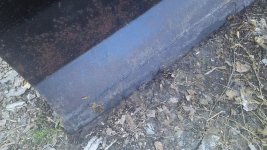
Well, I finally got home long enough to measure my blades - the short one is 60", and has the QA plate. The larger one, which has the 3 pin connection, is 72" but the leading edge is not removeable - it's welded onto the blade body as you can see in the pic. I guess that makes it hard to attach a rubber lip, even if my 425 was big enough to push it through snow. Maybe it would be worth it to still put a QA plate on it to back drag dirt for leveling, otherwise I just can't picture what the previous owner had in mind . . . DSC_0049.jpg
 
   / 10 Hours later . . . an update #25  
I have chains on my back wheels but can't put chains on the front because of clearance problems........
Reverse your tires. That gives you 2-3" of clearance.

Yes, folks will pile on and say that is bad for your wheel motors, etc. But I don't think a few hours per year pushing snow is going to kill them.

Either that or turn a spacer to fit in the wheel. I looked all over and couldn't find an existing spacer that would fit the wheel's bolt pattern. It has been on my list for a while, but where I live now doesn't get as much snow as where I used to live.
 
   / 10 Hours later . . . an update #26  
my problem isn't side clearance....it's on the top.....the tall boys have a steel fender welded on top of the wheels and the front fender was welded just a little below the rear one and that prevents me from getting chains on the front tires........I guess I could let some air out of the tires but the pressure is already so low I'm hesitant to do that so short of taking the fenders off and re-welding them higher up I'm stuck.......I just deal with the crabbing and my neighbors deal with my cursing.....at least they know where I am and that I'll be by soon to clear their drive.......haha.........Jack
 
   / 10 Hours later . . . an update #27  
I've never had much luck in grading by pushing with this machine........I usually just angle the bucket and back drag........so you might want to consider selling the 72 blade and using the proceeds to buy a different attachment......there's lots to choose from.......haha......Jack
 
   / 10 Hours later . . . an update
  • Thread Starter
#28  
Yes, I would love to trade it for a box blade. I'm a little intimidated to start my next project - trenching about 3000' of drainage pipe and refilling the trench. I'm not confident in my ability to trench for the first time and to get a downhill slope to the trench so it actually drains. After that, I have to move half of a hill, install a retaining wall and level out the low side of the retaining wall. I keep looking at it, some day I just need to dig in - excuse the pun.

So if someone needs a 72" 3 pin blade, I have one!
 
   / 10 Hours later . . . an update #29  
I remember the first real project I did with the machine....digging a trench........really had no experience in using a backhoe........probably took me five times as long as it should have.........but whenever I'd start to get frustrated I'd smile and say you know what....this sure beats digging it by hand........haha.......Jack
 
   / 10 Hours later . . . an update #30  
I would by or rent a laser level to make sure you know where the trench needs to go. Then spray paint a line to follow. The PT wobbles when the soil density changes or if the operator nudges something, so you need to be actively controlling the cut location, and the angle of the trencher. I did a couple thousand feed of 2-4' deep subsurface drains with the PT. I can't imagine that all by hand. Refilling took me awhile, because I used backfilled with gravel, compacted it, added soil, and compacted that. I'm sure that with different soil types, it probably goes faster than my clay.

I do a lot of box blade like work by pulling the 4N1 to cut to a depth. Generally, it is pretty quick to cut, filling the bucket, close the bucket, move the soil, dump, and repeat. When needed, I run a tiller over the area to loosen the soil up.
 
   / 10 Hours later . . . an update
  • Thread Starter
#31  
Ponytug, I'm planning on undertaking the same type of drain - with gravel in the bottom. How did you end up compacting the gravel and the soil? My plan, which is unencumbered by experience, is to cut a trench, fill with gravel, install 4" drain pipe and then put the topsoil back over the top. I also have to ensure that all of the trenches get deeper as I go so the water flows down hill. Essentially, I have to put 5-6 drains in, each about 300' to drain a field.
 
   / 10 Hours later . . . an update #32  
Dear Digger258,
I would recommend that you think about what will clog your system before you start. Something will eventually, you just want it to be later, rather than sooner, e.g. silt, sand, roots. Plan to minimize the clogging and your system will last longer. If you backfill soil on top of the drain pipe, you run the risk of the drain pipe getting clogged from the soil. You might want to think about sand/gravel for some of the backfill. I was told that french drains with corrugated pipes and no geotextile have a short life. If you can have a design that enables you to run a hose into the drain to flush it, the system will last longer.

I surveyed the site first, then laid out the french drains and cross drains on the appropriate slopes. I went with 6" trenches because some of the cross drains were pretty deep, and the estimated flow necessitated 6" drains. The hardest part (after the design/planning stage) was probably clearing the trenched soil without dribbling it back into the trenches.

I used about 4" of 1/4" gravel, then laid geotextile wrapped drain pipe (I used Multi-Flow, but no particular endorsement- talk to me in ten years.), with a surrounding layer of ~10" of gravel, then filled the trench to the surface with 1/4" gravel. The soil surface was covered with geotextile at a 24" overlap. If I were doing it again, I would have used 100% overlap. By filling in layers, I was able to ensure that it was all bedded in in sequence. I compacted by leaving the gravel about 1-2" high, and running the tractor wheels along the gravel ridge. Not much happened.

If you are doing this in a lawn, I would look at some of the designs at Multi-Flow for ideas on sand vs gravel and designs.

All the best,

Peter
 
   / 10 Hours later . . . an update
  • Thread Starter
#33  
Thanks for the detail - I am doing this across a large lawn that is currently very swampy, but has a creek running along the low end. I'll be digging trenches running from the house to the creek, intersecting the creek at 90 degrees. Not sure if I need to run any drainage parallel with the creek . . . Using the geotextile (landscaping cloth) makes sense. Based on my rudimentary google images search, and your description, it seems I'll line the 6" wide trench with landscape cloth, insert about 4" of gravel (making sure to keep a downhill slope to the creek), put in perforated pipe, fill the rest of the trench with gravel, wrap the landscape cloth liner over the top of the gravel, put on a layer of top soil, compact, and plant seed. I'm sure the hard part is the planning, measuring and figuring slope under grade. Now I just have to order those 6" trencher teeth . . .
 
   / 10 Hours later . . . an update #34  
the cursing will start once you begin cutting the horse mat.....haha.......I have tried everything......circular saw blades gum up to quickly......sawzall very difficult to control and also bind up.......jig saw works ok but takes freaking forever.......I've used the clamping method but once the rubber strip is started it takes on a mind of it's own...

Try a bandsaw - the constant downforce really helps. I use a 5-6 TPI bimetal blade at 1100 SFM and it cuts great. I run it dry. You do need a large table for support, but it makes all the difference. I'd tried all of the above, before it dawned on me to fire up the Grob.
 
   / 10 Hours later . . . an update #35  
If it were me, I would just run them straight down toward the creek on some constant slope, with a perforated cap on the end. You could always run a pressure washer hose and nozzle up every so often to clean things out. Recess the ends so you can mow over it, and mark it so you can find them later...

Around here, most rental places rent laser levels, or leveling telescopes. You can lay out the level lines and add slope, or just lay out the slope. Lots of how to dos out there. I bought mine for the project because I didn't have the time do it in one go. Yours sounds simpler.

All the best,

Peter

Thanks for the detail - I am doing this across a large lawn that is currently very swampy, but has a creek running along the low end. I'll be digging trenches running from the house to the creek, intersecting the creek at 90 degrees. Not sure if I need to run any drainage parallel with the creek . . . Using the geotextile (landscaping cloth) makes sense. Based on my rudimentary google images search, and your description, it seems I'll line the 6" wide trench with landscape cloth, insert about 4" of gravel (making sure to keep a downhill slope to the creek), put in perforated pipe, fill the rest of the trench with gravel, wrap the landscape cloth liner over the top of the gravel, put on a layer of top soil, compact, and plant seed. I'm sure the hard part is the planning, measuring and figuring slope under grade. Now I just have to order those 6" trencher teeth . . .
 

Tractor & Equipment Auctions

2018 LARK UNITED MANUFACTURING S/A GUARD SHACK (A55745)
2018 LARK UNITED...
UNUSED FUTURE FT-180H HYD ROTARY TILLER (A52706)
UNUSED FUTURE...
2008 DOOSAN G25 GENERATOR (A58214)
2008 DOOSAN G25...
UNUSED FUTURE SB45 HYD SILENT BREAKER (A52706)
UNUSED FUTURE SB45...
Lone Star dump trailer (A55973)
Lone Star dump...
2016 JOHN DEERE 35G EXCAVATOR (A60429)
2016 JOHN DEERE...
 
Top