1965 MF 135 with Z145 gas engine: Timing mark question

   / 1965 MF 135 with Z145 gas engine: Timing mark question #1  

Cedarsnapp

New member
Joined
Jul 19, 2016
Messages
14
Location
Kenmore, WA
Tractor
1965 MF 135 with Continental Z145
I want to time my 1965 MF 135 with Z145 gas engine. I removed the timing mark cover, hooked up my timing light to the battery and to the #1 spark plug wire and aimed it into the timing mark hole. I can see the fixed mark on the crankshaft cover, but nothing lights up on the crankshaft. I know with older cars I would put chalk on the crankshaft timing marks so I could see TDC and the before and after TDC marks when the timing light illuminated them. I twisted the distributor by "sound" but it's not perfect and it occasionally misses. Are there TDC marks on the crankshaft? Do they normally need to be chalked to be visible?

The attached photos show the distributor and in the lower right of the engine, the timing mark hole, plus two closer shots of the timing mark hole.

Does anyone have any suggestions how to find and mark the crankshaft timing marks to make them easy to see with the timing light. I haven't timed an engine for decades and may have forgotten an important step. Thanks.
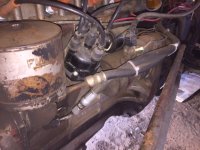
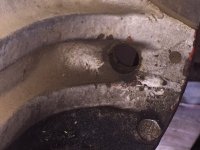
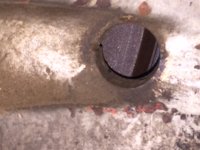
Timing marks and Distributor.JPGTiming marks hole closeup3.JPGTiming marks hole closeup.JPG
 
   / 1965 MF 135 with Z145 gas engine: Timing mark question #2  
I have a MF 135 with the Z-145. Timing marks should be visible in the port.
Yes it helps very much to use white chalk or paint to illuminate the mark.

Rotate the crankshaft until Cylinder 1 is at TDC; the TDC mark should be visible (you may have to inspect closely to see it).
If the TDC mark isn't visible, slowly rotate the crankshaft (using a wrench on the crankshaft pulley bolt) to see if you can locate it. If everything is as it should be, the TDC mark will be there.
Hope this helps.
 
   / 1965 MF 135 with Z145 gas engine: Timing mark question #3  
I have a MF 135 with the Z-145. Timing marks should be visible in the port.
Yes it helps very much to use white chalk or paint to illuminate the mark.

Rotate the crankshaft until Cylinder 1 is at TDC; the TDC mark should be visible (you may have to inspect closely to see it).
If the TDC mark isn't visible, slowly rotate the crankshaft (using a wrench on the crankshaft pulley bolt) to see if you can locate it. If everything is as it should be, the TDC mark will be there.
Hope this helps.

Make sure the #1 cylinder is on the compression stroke when you look for the timing mark!
 
   / 1965 MF 135 with Z145 gas engine: Timing mark question #4  
Make sure the #1 cylinder is on the compression stroke when you look for the timing mark!

Jerry:
Keep in mind Cedarsapps' question: "Does anyone have any suggestions how to find and mark the crankshaft timing marks to make them easy to see with the timing light."

In a 4-stroke engine each piston will hit TDC twice in the course of a full combustion cycle, once between the exhaust and intake strokes, and once between compression and combustion. My suggestion was intended to help locate & chalk the timing mark quickly - nothing more.
 
   / 1965 MF 135 with Z145 gas engine: Timing mark question #5  
Jerry:
Keep in mind Cedarsapps' question: "Does anyone have any suggestions how to find and mark the crankshaft timing marks to make them easy to see with the timing light."

In a 4-stroke engine each piston will hit TDC twice in the course of a full combustion cycle, once between the exhaust and intake strokes, and once between compression and combustion. My suggestion was intended to help locate & chalk the timing mark quickly - nothing more.

That's why I reminded the OP that he needs to be on the compression stroke for # 1 because he can also find the timing mark 180 crankshaft degrees away. I guess your point that it's the same timing mark. However if you want to statically time an engine, you need to be on the compression stroke.
 
   / 1965 MF 135 with Z145 gas engine: Timing mark question #6  
That's why I reminded the OP that he needs to be on the compression stroke for # 1 because he can also find the timing mark 180 crankshaft degrees away. I guess your point that it's the same timing mark. However if you want to statically time an engine, you need to be on the compression stroke.

Not true: the TDC mark aligns with the timing mark whenever #1 cylinder is at TDC - period. You will never find the TDC mark 180 degrees away from TDC on a correctly built 4-stroke engine.
Your posts make it appear as though you believe that a 4-stroke engine's crankshaft rotates 360 degrees to complete one operating cycle.
 
   / 1965 MF 135 with Z145 gas engine: Timing mark question #7  
Compression stroke as Jerry mentioned. One can plug #1 with a tight wad of paper and as it hit #1 it will blow it out. Timing make should be close to that event.
 
   / 1965 MF 135 with Z145 gas engine: Timing mark question #8  
Not true: the TDC mark aligns with the timing mark whenever #1 cylinder is at TDC - period. You will never find the TDC mark 180 degrees away from TDC on a correctly built 4-stroke engine.
Your posts make it appear as though you believe that a 4-stroke engine's crankshaft rotates 360 degrees to complete one operating cycle.

My bad! I said 180° and I should have said 360° of crankshaft rotation. 180ï° would be distributor shaft rotation.

No I quite well understand the 4stroke cycle. Certainly the timing mark appears at every rotation but since the 4 stroke takes 720° of crankshaft rotation to complete the cycle, the timing mark will appear twice in the cycle. But the ignition is timed to near the top of the compression stroke. As far as ignition timing is concerned, the other part of the cycle is not important. There are plenty of people on these forums that have attempted to time their engines without realizing this and they wonder why they can get them started.
 
Last edited:
   / 1965 MF 135 with Z145 gas engine: Timing mark question #9  
My bad! I said 180ー and I should have said 360ー of crankshaft rotation. 180? would be distributor shaft rotation.

No I quite well understand the 4stroke cycle. Certainly the timing mark appears at every rotation but since the 4 stroke takes 720ー of crankshaft rotation to complete the cycle, the timing mark will appear twice in the cycle. But the ignition is timed to near the top of the compression stroke. As far as ignition timing is concerned, the other part of the cycle is not important. There are plenty of people on these forums that have attempted to time their engines without realizing this and they wonder why they can get them started.

Whew. Finally we agree: if all you are trying to do is locate the crankshaft timing mark (i.e. to put paint or chalk on it), then just put #1 at TDC - the engine stroke doesn't matter.
To illustrate this point let's assume Cedarsnapp's engine has no visible TDC mark and it has to be determined. A TDC mark can be located, completely independent of engine stroke, using a piston stop bolt :
  1. Screw the piston stop into cylinder #1.
  2. Slowly rotate the engine until the piston comes up against the stop.
  3. Mark the crankshaft.
  4. Rotate the engine in the opposite direction until the piston again hits the stop.
  5. Mark the crankshaft.
  6. Exactly halfway between the two marks is the location of the TDC (0) timing mark.
If one is setting ignition timing or valve lash, then obviously TDC and the engine stroke on which they coincide does matter. I assume that most forum members will know that.
 
   / 1965 MF 135 with Z145 gas engine: Timing mark question #10  
Whew. Finally we agree: if all you are trying to do is locate the crankshaft timing mark (i.e. to put paint or chalk on it), then just put #1 at TDC - the engine stroke doesn't matter.
To illustrate this point let's assume Cedarsnapp's engine has no visible TDC mark and it has to be determined. A TDC mark can be located, completely independent of engine stroke, using a piston stop bolt :
  1. Screw the piston stop into cylinder #1.
  2. Slowly rotate the engine until the piston comes up against the stop.
  3. Mark the crankshaft.
  4. Rotate the engine in the opposite direction until the piston again hits the stop.
  5. Mark the crankshaft.
  6. Exactly halfway between the two marks is the location of the TDC (0) timing mark.
If one is setting ignition timing or valve lash, then obviously TDC and the engine stroke on which they coincide does matter. I assume that most forum members will know that.

Why would there be a difference in the location of the stop point? Back lash? Most of these engines are not initially timed at TDC. They are usually times at 5° to 7° BTDC so you would have to know the flywheel diameter, calculate the arc length from TDC to the initial timing point and mark off the distance to the initial timing point.
 
   / 1965 MF 135 with Z145 gas engine: Timing mark question #11  
Why would there be a difference in the location of the stop point? Back lash? Most of these engines are not initially timed at TDC. They are usually times at 5ー to 7ー BTDC so you would have to know the flywheel diameter, calculate the arc length from TDC to the initial timing point and mark off the distance to the initial timing point.

The angular difference between the stop points is due to the stop bolt extending beyond TDC:
Angular difference = 360 x (1 - (S-D)/S)​
where
S = Piston Stroke​
D = Distance the stop bolt extends beyond TCD​

The Continental Z-145 ignition timing specification is:
6 degrees BTDC at idle (or static) advancing to 30 +/- 2 degrees at 2000 RPM.​
I suppose you could locate 6 and 30 degrees BTDC using the flywheel diameter, but most mechanics I know would simply use a degree wheel (on the crankshaft pulley). However all of this is beside the point. The fact is that locating the TDC mark is independent of which stroke in the operating cycle the engine happens to be on. That someone might mistime an engine because they don't understand what they are doing doesn't change this fact. That's my story and I'm sticking to it.
 
   / 1965 MF 135 with Z145 gas engine: Timing mark question
  • Thread Starter
#12  
Thanks everyone for a very informative discussion about the timing marks. Would it also work to find TDC by looking at the rotor in relation to the #1 spark plug? Would that be approx. TDC so I could then be close enough to find it by slightly rotating the crankshaft with a wrench?

Also, it sounds like there is just a single timing mark on the crankshaft, representing TDC. If true, do I just estimate where 6 degrees BTDC would be (at idle using a timing light)? Or is there a separate mark showing 6 degrees BTDC?

Thanks, Cedarsnapp
 
   / 1965 MF 135 with Z145 gas engine: Timing mark question #13  
Thanks everyone for a very informative discussion about the timing marks. Would it also work to find TDC by looking at the rotor in relation to the #1 spark plug? Would that be approx. TDC so I could then be close enough to find it by slightly rotating the crankshaft with a wrench?

Also, it sounds like there is just a single timing mark on the crankshaft, representing TDC. If true, do I just estimate where 6 degrees BTDC would be (at idle using a timing light)? Or is there a separate mark showing 6 degrees BTDC?

Thanks, Cedarsnapp

No - the flywheel should be stamped with individual marks that start at "30" degrees BTDC and proceed to "DC". "5" is stamped at 5 degrees BTDC. You should be able to see the marks and quite accurately time the ignition.
 
   / 1965 MF 135 with Z145 gas engine: Timing mark question
  • Thread Starter
#14  
Thanks, Klancf51. That will, of course make it much more accurate than if I had to estimate it.

Will rotating the crankshaft until the rotor points at the #1 spark plug wire get me close to the timing marks, so I can mark them? In other words, does the rotor pass by #1 plug wire at times other than when it fires for #1? I don't think it could, but am not sure.

Thanks, again. Cedarsnapp
 
   / 1965 MF 135 with Z145 gas engine: Timing mark question #15  
Thanks, Klancf51. That will, of course make it much more accurate than if I had to estimate it.

Will rotating the crankshaft until the rotor points at the #1 spark plug wire get me close to the timing marks, so I can mark them? In other words, does the rotor pass by #1 plug wire at times other than when it fires for #1? I don't think it could, but am not sure.

Thanks, again. Cedarsnapp

With the transmission in neutral, use a ratchet with a 1 1/4" socket on the crankshaft pulley bolt to slowly rotate the crankshaft clockwise. Using a flashlight, you should be able to pretty quickly locate the flywheel timing marks in the inspection hole.
Yes - rotating the crankshaft until the rotor points at the #1 spark plug wire should get you close to the timing marks. But you shouldn't have to do that.
 
   / 1965 MF 135 with Z145 gas engine: Timing mark question
  • Thread Starter
#16  
Klancf51, that is awesome and very helpful information. Thank you much!
 

Marketplace Items

PALLETS OF HEAVYEQUIPMENT (A58214)
PALLETS OF...
2018 Freightliner M2 106 Cab and Chassis Truck (A59230)
2018 Freightliner...
2017 Ford Explorer AWD SUV (A59231)
2017 Ford Explorer...
LIMA MAC 30KW GENERATOR (A58214)
LIMA MAC 30KW...
2012 JACK COUNTY TANK 130 BBL STEEL (A58214)
2012 JACK COUNTY...
UNUSED RAYTREE RMBG72-72" HYD ROOT GRAPPLE (A60432)
UNUSED RAYTREE...
 
Top