3pt hitch help

/ 3pt hitch help #21  
Eric, I agree with you that the 3PH system needs updating. I use to dread changing attachments. Too much work and too dangerous with someone else moving the tractor while you get in between the tractor and attachment and attempt to push the pins in place.

Two weeks ago I bitthe bullet and order a Freedom Hitch for my tractor and one female end for each implement. Now I can only say the "Life Is GOOD". I don't even get out of the seat if the implement has NO drive shaft. I did order the hydraulic top cylinder from Freedom Hitch at the same time. Now I just back up to the implement and lift it up and it SNAPS in place and I'm off. To disconnect you just set it down and lean back and push the lever. Then down a little more with the 3PH and if OFF....

It really does work... GREAT!!!!!!!!!!!!!!!!!!!!

Take a look at their web site... Freedom Hitch

Charles
 
/ 3pt hitch help #22  
I found it helpful to set my implements down on a pallet. They can be slid around a little easier on the wood than on the dirt.

One of your lift arms (usually the right one) should have a height adjustment. Hook up the non adjustable one first, because you can raise & lower the 3PH as needed to line it up. Then the top link, after which you can use it's adjustment range to help line up the second lift arm fore & aft. Then on the adjustable lift arm, adjust the height as necessary to line it up vertically. Once I started using this sequence, my hitching started going a lot faster. Before, however, when I had a lot of trouble, I understood why so many farmers had several tractors: one per implement!
 
/ 3pt hitch help #23  
Agree with prior posts re. mounting sequence - come on, it's not all that hard.
For 4 years, I changed implements, and the FEL, on reasonably level dirt, with frequent assistance from a 2X4 and a large rubber mallet. It can be a pain, especially when you're a novice (as I was - took darn near 1/2 an hour the first FEL change, less for the brush cutter), but after a dozen or so times you'll get facile, and can change out a brush cutter in under 10 minutes, including the darn pto shaft (the Woods shafts are way too balky). Now I've a garage with a level floor and 2X6 dollies with large wheels - really easy, except for the pto shaft, BUT I remember my "roots" in the dirt. An uneven FEL position on dirt is something I never want to experience again (can break a 2X4 trying to wedge the FEL around).
 
/ 3pt hitch help #24  
Been reading this thread with much interest. Just finished installing the 3-pt hitch on my new KK 48" brush hog today. Have to backfill electrical trenches tomorrow, but plan to hook up the hog on Wednesday to my equally new B7510HST.

I'm a complete newby to tractors and implements and, like most novices, have read the operating manuals for the tractor and hog and have spent a lot of time in the TBN safety forum getting educated, mostly, on what not to do if you don't want your tractor to turn on you.

In particular, it's been drilled into my brain that under no circumstances should I get off the seat without shutting down the tractor completely and putting the key in my pocket.

However, I notice in this thread that several of the old pros recommend operating the tractor while standing on the ground in order to get the 3 pt hitch aligned when attaching implements.

It's OK to get off a running tractor when hitching up implements, but, otherwise, turn it off before getting out of the seat? It's OK to give the gas pedal on an HST tractor little gooses while standing on the ground in order to get that **** hitch aligned and attached?

What am I missing here?
 
/ 3pt hitch help #25  
Well I park my bush hog on an old tire and wheel. Just put a marker where the stump jumper is centered on the wheel. Now when hookin' or unhookin' it is simple to give the hog a little turn so it hooks up to the lift arm. The key in your pocket thing is really a requirment when dealin' with the pto, Otherwise brakes locked and tranny in neutral seems to be sufficient.
Other implements get the furniture dolly treatment. /forums/images/graemlins/wink.gif
 
/ 3pt hitch help #26  
Ray,
Of course you are right… BUT the safest approach is not ALWAYS the most practical or expedient. Until you have become VERY familiar with your equipment I would never suggest that you try any “short cut”.
There are many things through out your weekly routine that you have developed work arounds to get your project at hand completed. (In your home in your car in your life)…This is not to say anyone is trying to find reckless ways to accomplish things. To the contrary, as you become familiar with things, you realize the exact dangers involved and you work within these parameters.

Don’t try any easier way to do anything until AFTER you have became comfortably familiar with the methods that accompany the operators manuals that come with the equipment. The bottom line is ONLY you can be responsible for what you do. After a few decades you may find yourself taking some well thought out solutions to life’s smaller problems. If you still feel the need to remove the key before you get off your tractor that’s ok too… don’t forget to curb the wheels, lower all raised implements and set the parking brakes. KennyV.
 
/ 3pt hitch help #27  
In my opinion, operating the tractor in gear (HST or not) from the ground is not a smart idea.

Peddles and controls can stick, snag on clothing, snag on branches, etc. Operators have been known to push reverse when they want forward, panic and mash even more reverse again, etc. If the tractor starts moving uncontrollably and you don't have room or time to get out of the way, bad things can happen quickly. You don't want to be one of those guys they find squished under their own tractor.

Nobody is going to be impressed when you show them how quickly you can disconnect the implement AND run yourself over in one operation.

It doesn't take that much effort to climb on and off the tractor.

Some advice on how to do it safely - mostly from the seat:

On my smaller JD 4100, I can reach back from the seat and reach down with a rubber mallet or a short 2x4 and lightly tap the arms on or off the pins while simultaneously driving the tractor slight forward or back and lifting or lowering the 3-pt to align it up. With practice, I can now usually get the arms at least started on the pins without leaving the seat. One key is to always at least partially engage the low side pin of a non-level implement first (if you try to hook up the high side first, its hard to get the other arm to go down - they are connected together). Then use the 3-pt to lift the implement roughly level so that the other arm can be connected. You can also push or pull slightly with the one connected side dragging and twisting the implement, fine-tuning the front to back alignment for the other side.

Top link is last. Use the top-link length adjust to align the pin and slide it in easy.

- Rick
 
/ 3pt hitch help #28  
Hello Rick.
I, like others was just addressing Eric’s question and then following up to Ray’s question.
I, nor anyone else suggested it was a ‘smart idea to operate the tractor from the ground’… it is necessary at times. Smart would be never changing attachments, have enough cash flow to dedicate a tractor to each implement, that would be smart.

The possibility of operator error is always going to be present (on or off the seat).
I also don’t recall anyone stating they were out to impress anyone in their ability or lack of it. These are all expressions of how different folks apply different methods to accomplish similar tasks. If you re-read the posts, I think no one has stated doing anything that is completely reckless. It all amounts to getting familiar, not careless, with the operation of the gear with which you are working. Only you will know how careful and attentive you are, the responsibility of doing anything ultimately rests on the individual.

Oh, and be carefull not to pinch your fingers while snapping the cinch pins. /forums/images/graemlins/smile.gif KennyV
 
/ 3pt hitch help #29  
I, too, frequently must hitch up to implement on non-level ground, and advice about first hooking up the lower arm is absolutely right ...then, trick of moving/raising implement helps bring other arm to proper position ...but, top link is not necessarily last for me, and with it and one arm attached, lifting implement brings things into alignment quite nicely.

As for keeping the tractor running, while I appreciate the safety factor in a pocketed key, I tend to let it run while I hook up the lower arm and top link, then operate lift lever from ground ...and, for the ultimate in efficiency, I try to offload the implement with lift-lever side uphill to save a few steps between lifting and securing the higher arm.

But (a big but), I shut down and pocket the key (which I can easily do from the ground on the lift-lever side) when I go to attach the PTO, primarily for safety, but also because I can then turn the shaft on the tractor freely to line up the splines. (Don't try it, but if when running, my HST will only turn the tiniest fraction, i.e., the "backlash".)

Have used the bucket curl trick, on occasion, but with a toothbar, you can make a heck of a mess quite easily.
 
/ 3pt hitch help #30  
All quick hitches don't fit all implements. Case in point.
I have a JD Quick hitch I will sell reasonable. Hardly used. It doesn't fit my bush hog.
 
/ 3pt hitch help #31  
</font><font color="blue" class="small">( Wood is a little less damaging than metal pry bars )</font>

Thats one reason I use copper or brass mauls.. the metal is way softer than the steel.

soundguy
 
/ 3pt hitch help #32  
</font><font color="blue" class="small">( I absolutelty agree..."pick a nice flat spot...". If I had one, or a leveled equipment shed floor, I'd be in 7th heaven. However, on a side hill in VT (a bit more hilly and rocky than FL) I'm luck if I can find a spot within 5 deg. of level (and no rocks). )</font>

You have a tractor.. you have implements... you can MAKE a flat spot... /forums/images/graemlins/tongue.gif


</font><font color="blue" class="small">( but I'll take the quick hitch approach and not have to carry any "persuaders )</font>

I believe you will find that quick hitches are a tad limiting in what they can and can't attach to lickety split. They also add a new calculation to implement sizing.. weight, distance from hitch, and pto length.
Many implements may not be 100% sized correctly for quick hitches.. Quick hitches also effectively limit your ability to modify equipment.. like turning pins 'in' for example.

As for carrying a persuader.. I leave all my implements 'planted' in one location.. a small area away from the horses.. My persuaders live with the implements.

</font><font color="blue" class="small">( The time saved backing up to the Grooming mower or Rear Blade and mostly just lifting the I-Match and throwing the latches, compared to persuading attachments onto the 3PH gives me more time to make a few $'s cutting neighbor's lawns, or avoid all the cussing and just get some work done here )</font>

As i said before.. Alot of it is practice and placement. Just because you have a quick hitch.. won't guarantee 100% drive up and go attachment on implements.. if the implement isn't perfectly inline with the tractor.. and on the same plane ( remember that 5' problem you spoke of? ).. then the hitch may not latch up. Also.. you will always have pto shafts to hook up. I've hooked up and unhooked so many implements.. that I can do it in about a minute or so on the 5' mower, and less on the plow, or box blade, or rear scoop, or boom pole.. etc.

Heck.. My 2500# category 2 mower can be hooked / unhooked in about 3 minutes...

Lotsa practice...

</font><font color="blue" class="small">( I still vote for any reasonable quick hitch system over beating on expensive equipment (IMHO).
)</font>

Again.. Finesse.. I'm not advocating taking a sledge hammer and standing on top of your mower and just beating the cr@p out of it till it magically fits /forums/images/graemlins/confused.gif A little leverage goes along way. A 4' prybar under the edge of a 500-700# mower can nudge it a couple inches by flexing your arm a bit... no 'beating' required. If you are beating.. try a brass or copper hammer... doesn't mark up steel.

When i first got my tractors.. it would take me forever to hook up something like a box blade... thats not even a 45 second job now. You also have to use the built in tractor options to your advantage. If you have a bit of a mismatch.. hook up the fixed link arm first.. then use the adjustable link arm to allow for the difference.. pin it up.. then readjust the arm. Samre with the toplink.. adjust it to hook up.. then readjust to fit.

I usually paint a band around my adjustable link and toplink so if I move it.. i can get back to the 'sweet' spot without measuring or thinking

The few seconds a quick hitch would save me.. would take a lifetime to average out the price.

If I ever become disabled, or injuried.. i may change my mind about the price/value they offer.

Soundguy
 
/ 3pt hitch help #33  
</font><font color="blue" class="small">( I understood why so many farmers had several tractors )</font>

Got to admit..that's pretty handy too!

Soundguy
 
/ 3pt hitch help #34  
</font><font color="blue" class="small">( btw, I have some devout Ford fans as neighbors and relatives. All I know is I have spent more time and money working on any Ford I have had than other brands.
)</font>

In my experience fords are just as easy to work on as other brands.. and all brands break just as much.

I've got quite a few flavors of tractors to base this on as well.

Soundguy
 
/ 3pt hitch help #35  
</font><font color="blue" class="small">( You have a tractor.. you have implements... you can MAKE a flat spot... )</font>

I absolutely love your sense of humor. /forums/images/graemlins/grin.gif

Soundguy does have an advantage over most of us. In Florida there are a LOT of flat spots....... where there used to be houses and barns. /forums/images/graemlins/crazy.gif /forums/images/graemlins/frown.gif
 
/ 3pt hitch help #36  
Eric, I take my boxblade on/off quite often. Believe me, you get better at it all the time. The flat spot that Soundguy mentions is the most important. What I've done is laid a couple of 4x4's down in my flat spot and set the boxblade down on them. It makes moving the BB around an awful lot easier. Mine weighs 550 pounds plus another 100 for the big (rock) weight on it. So kicking it just results in injury to me. But it slides around a lot easier only resting on the 4x4's. I have them set down in a V shape so when I drop the BB, the side panels and the tail blade are resting on the 4x4's. This also keeps the scarifiers off the ground.

When I back up to the BB, I look behind me and line up the fixed length link arm (left on my CUT) as I'm backing up. I can raise/lower the arms while standing on the ground. Once the fixed arm is attached, I attach the adjustable arm. I slide the BB if I can, or adjust the turnbuckle if necessary. Then I get the toplink.... again, using the turnbuckle. Once attached, then I readjust the turnbuckles to set the blade. If your flat spot isn't (flat), it makes it a lot tougher getting both arm lined up.

Mine is typically on/off in 5 minutes.
 
/ 3pt hitch help #37  
The adjustable length 3pt hitch arms and the auxillary lift lever in the rear of the tractor have made hooking up attachments so much easier and safer. Back the tractor up close, lower the arms, adjust the length of the arms to reach the attachment, move the lift up or down from the back of the tractor for final hookup, and away you go. Sometimes the 3pt hitch arms need a good kick to slide on those rusty pins. Don't get between the tractor and the attachment and have somebody try to ease the tractor back to the attachment. I did that and got lucky, that time. Never again. Wet shoes slip off clutch pedals very easy and quick. /forums/images/graemlins/shocked.gif
 
/ 3pt hitch help #38  
KennyV, my comments were mostly directed towards this snippet posted by OkieG:

"Back the tractor an inch at a time (With my hydrostat trannie, I do this while standing beside the tractor), and the lift arms will slide right off (no hammer, no kicks, no muss, no fuss), easy as can be...very impressive to female neighbors. "

I agree that "safe" and "expedient" are often at odds with one another, and everybody needs to make their own decisions as to the tradeoffs they are comfortable with.

Personally, I find it helpful to remind myself how silly my explanation will sound to my wife if an accident were to happen (assuming it was a non-fatal accident). For example, "Yes, honey, I know that crushing my foot between the tractor and the pallet full of stone I didn' see back there is an inconvenience to the whole family, but you have to give me credit for all those times I saved 2 minutes getting the mower un-hitched!".

- Rick
 
/ 3pt hitch help #39  
keeney, kennyV, Eric and others,
My post earlier in this thread does not, perhaps, come across as intended. I agree with those of you who consider operating the hydrostat while standing beside the tractor as potentially dangerous. I would not want anyone to try it and get hurt. By the way, the reference to impressing the female neighbor was in context for the thread the post came from.

Please forgive my weak defense, if you consider my approach indefensible.

First, walking across the street is dangerous, especially at first. Doesn't mean it can't be done safely. Doesn't mean that with experience you get so good at it you don't worry about it anymore.

Next, when attaching/detaching an implement, something has to move. A hammer, prybar, swift kick can sometimes persuade the implement to move. On the other hand, the tractor is made to move.

Next, I wouldn't try my technique with a gear tractor, but the hydrostat makes it easy. On my Deere, there is a seat switch. When no weight is in the seat and the hydrostat pedal is depressed the tractor moves, but just barely...perfect (for me) for adjusting for implements. Of course, when you remove your hand from the pedal, the tractor stops immediately. Potentially dangerous??...yes.

Next, I do not use a hammer or prybar of any kind. Level ground is nice, but not necessary. My "persuader", is an occacional shot of WD-40. In all honesty I must say that I've come much closer to hurting myself, when I use a hammer or prybar or try to physically move the implement...not to mention the frustration of trying and failing. I hate coaxing implements.
Dollies might be the best solution. The only implement dolly I built was for the PostHole Digger. It works great. The rest of the implements are strewn about my backyard, all on dirt, which is not the best surface for a dolly.

I apologize if my descripton of my approach comes across as unconsidered and too cavalier. It is inherently dangerous and great caution should be used if anyone attemps it. But, it works for me and might save a few bruises, choice words, and your back for you, too.

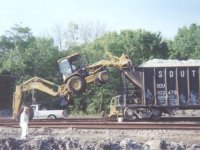
This discussion reminds me of a sequence of photos posted here sometime ago:

691998-stupidb.jpg


I wonder if this guy, thinks he's being unsafe?

OkieG
 

Attachments

  • 691998-stupidb.jpg
    691998-stupidb.jpg
    88.6 KB · Views: 120
/ 3pt hitch help #40  
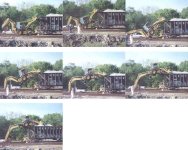
I tried get the series of pictures to post with no luck. Here's another try.

692577-Stupid%21%21.jpg


OkieG
 

Attachments

  • 692577-Stupid!!.jpg
    692577-Stupid!!.jpg
    93.4 KB · Views: 107
 

Marketplace Items

2021 CATERPILLAR 300.9D MINI EXCAVATOR (A62129)
2021 CATERPILLAR...
Rock Bucket Skid Steer Attachment (A61567)
Rock Bucket Skid...
2020 PETERBILT 567 (A58214)
2020 PETERBILT 567...
Pallet of Four Pivot Wheels & Tires (A62177)
Pallet of Four...
KBH Tender Trailer (A63118)
KBH Tender Trailer...
2006 John Deere 250D 25 Ton Articulated Dump Truck (A59228)
2006 John Deere...
 
Top