You are using an out of date browser. It may not display this or other websites correctly.
You should upgrade or use an alternative browser.
You should upgrade or use an alternative browser.
48x39x14 shop build
- Thread starter ovrszd
- Start date
- Views: 73915
More options
Who Replied?
/ 48x39x14 shop build
#221

dieselcrawler
Elite Member
No changing it now.
Why not? I dont see why you couldnt drill a hole into the cement, say 3/4" dia, install the thermostat probe, pack the hole with sand, and get the desired effect. (Packing with sand would allow removal if failure occurred, but maintain similar temp as concrete) Naturally, youd want to not hit your embedded pipes, but doing so now, while the memory of thier location is fresh(er) in your memory, and you likely have pictures to guide you as well. Drilling the hole inside your utility room, near the interior partition wall would give a better status, but not a big deal either way.
You always have options!

fordmantpw
Veteran Member
What type of heat do you have?
The house I've lived in for 40 years is heated with elecgric baseboard. Thermostat in every room. I really like having that choice.
We have geothermal.
OP

ovrszd
Epic Contributor
- Joined
- May 27, 2006
- Messages
- 33,727
- Location
- Missouri
- Tractor
- Kubota M9540, Ford 3910FWD, Ford 555A, JD2210
Why not? I dont see why you couldnt drill a hole into the cement, say 3/4" dia, install the thermostat probe, pack the hole with sand, and get the desired effect. (Packing with sand would allow removal if failure occurred, but maintain similar temp as concrete) Naturally, youd want to not hit your embedded pipes, but doing so now, while the memory of thier location is fresh(er) in your memory, and you likely have pictures to guide you as well. Drilling the hole inside your utility room, near the interior partition wall would give a better status, but not a big deal either way.
You always have options!
Oh, I was referring to zones.
OP
ovrszd
Epic Contributor
- Joined
- May 27, 2006
- Messages
- 33,727
- Location
- Missouri
- Tractor
- Kubota M9540, Ford 3910FWD, Ford 555A, JD2210
My concrete guy came by this morning to remove thr porch forms and power wash the stamped floor.
We discussed wall thermostat versus concrete. He said the ones he has saw separate the functions. Wall thermostat controls the pump. Concrete thermostat controls the heater. Idea being to keep from overheating the slab. Overheating causes temp rise after the system shuts off. Positive is less fluctuation in room temp. Negative is slower to react and more pump run time.
We discussed wall thermostat versus concrete. He said the ones he has saw separate the functions. Wall thermostat controls the pump. Concrete thermostat controls the heater. Idea being to keep from overheating the slab. Overheating causes temp rise after the system shuts off. Positive is less fluctuation in room temp. Negative is slower to react and more pump run time.
ultrarunner
Epic Contributor
- Joined
- Apr 6, 2004
- Messages
- 29,046
- Tractor
- Cat D3, Deere 110 TLB, Kubota BX23 and L3800 and RTV900 with restored 1948 Deere M, 1949 Farmall Cub, 1953 Ford Jubliee and 1957 Ford 740 Row Crop, Craftsman Mower, Deere 350C Dozer 50 assorted vehicles from 1905 to 2006
How well does floor heat work?
I've worked in shops with forced air of all kinds, not bad.
Worked with radiant heat - I hate it. I understand why,but don't like it. Our indoor gun range has it because the exhaust fans would make forced air impractical, but you end up on fire at the head/neck area and everything else is still cold.
I would think heating a slab of concrete would be pricey - impractical to turn it on when needed so you'd leave it on all the time - and that would be pricey. Does it heat the area above the floor at all? Tools, tables, etc?
Maybe pricey but radiant is the standard where I worked in Europe... both radiators and in slab...
Huge cabinets shops and auto repair shops all with radiant... so are most new homes.
The least desirable to their thinking is forced air... they call them dust blowers and similar...
truckdiagnostics
Platinum Member
Overszd,
I think you will want to use a manifold in your house that will allow for flow control on the individual loops. I believe on the newer electronic thermostats there is a setting for radiant floor, forced air ect, make sure that is on radiant floor that will help with the swings. You will not get rid of it completely in the shop. Radiant floor heat is going to give you nasty swings in temp if you open and close the doors a lot. If that becomes an issue you can(maybe) add a zone in the shop for water to air exchanger, such that when air temp drops a lot it turns on the forced air, brings it up to say 4 degrees below the floor thermostat. Then the radiant floor brings it up the rest of the way. With the doors closed you would run off just the floor heat. (i am guessing that boiler is big enough)We had to do that in one of our shops. Don't get me wrong radiant floor heat is still the way to go. Once you work on warm concrete you will never go back. I do like your shop boiler
On your house.....? if it is a ranch and the flow through each part of the loop is the same, I don't think you will need to zone control it. Radiant floor heat is an even heat and a lot different that any of the others. However, zone control the bathroom, shower the wife uses(big bathrooms). Consider adding tubes behind the walls for the tiled shower. In areas of large heat loose they should have you put the loops closer together. So, for individual rooms, short of the full baths, if the loops are layed out correctly I do not believe you need to zone control. Typically your heating contractor gives your house plans to his radiant floor tubing supplier and they give him the plans for the tubing layout.Then with a manifold where you can control the flow in each loop making it the same(not like your shop) you should be ok.
We have done radiant floor personally three times, house garage, shop and just recently new room in the barn. I have gotten smarter each time. The kid went into the business also so that helps.
I think you will want to use a manifold in your house that will allow for flow control on the individual loops. I believe on the newer electronic thermostats there is a setting for radiant floor, forced air ect, make sure that is on radiant floor that will help with the swings. You will not get rid of it completely in the shop. Radiant floor heat is going to give you nasty swings in temp if you open and close the doors a lot. If that becomes an issue you can(maybe) add a zone in the shop for water to air exchanger, such that when air temp drops a lot it turns on the forced air, brings it up to say 4 degrees below the floor thermostat. Then the radiant floor brings it up the rest of the way. With the doors closed you would run off just the floor heat. (i am guessing that boiler is big enough)We had to do that in one of our shops. Don't get me wrong radiant floor heat is still the way to go. Once you work on warm concrete you will never go back. I do like your shop boiler
On your house.....? if it is a ranch and the flow through each part of the loop is the same, I don't think you will need to zone control it. Radiant floor heat is an even heat and a lot different that any of the others. However, zone control the bathroom, shower the wife uses(big bathrooms). Consider adding tubes behind the walls for the tiled shower. In areas of large heat loose they should have you put the loops closer together. So, for individual rooms, short of the full baths, if the loops are layed out correctly I do not believe you need to zone control. Typically your heating contractor gives your house plans to his radiant floor tubing supplier and they give him the plans for the tubing layout.Then with a manifold where you can control the flow in each loop making it the same(not like your shop) you should be ok.
We have done radiant floor personally three times, house garage, shop and just recently new room in the barn. I have gotten smarter each time. The kid went into the business also so that helps.
prof fate
Platinum Member
- Joined
- May 30, 2018
- Messages
- 684
- Location
- beaver pa
- Tractor
- kioti ck3510 Cub Cadet 149, 2146, Toro Zero Turn
I replaced radiant (hot water radiators and baseboards) with forced air in my house.
More dust? slightly. Dust is still in the house, just with radiant not being blown around as much I guess. the filter traps stuff that with radiant is laying about somewhere.
For heat-rise, say, taking a 65d room and making it 72d, nothing works like forced air. HOWever, my studio is not used much in the winter so I keep the temp there about 55. when I need to work in there I"ll turn it up to 70 - it gets working-warm in 10-15 minutes..BUT - furniture and such is still cold to the touch, the 55F it's been kept at.
I've nto lived/worked ina radiant heated floor to know how that is to actually live with - is it warm?
And does efficiency differ by type of heating? Forced air I can turn back when I'm not there and heat it bck up quickly..the radiators never did very well at that. So it's more comfortable to keep it warm 24/7.
And if the tools/floor/tables are heated by radiant, great - but if you have to wear a coat due to air temp it's not comfortable (IMO).
And if the slab is hot, it's unlikely to heat up quickly..so it's going to need to be kept warm 24/7..not efficient to warm an empty space.
And if takes 50,000 BTU to warm/maintain temps, does it matter what the method is? Cost wise to make the heat will vary by fuel, but 50k btu is 50k btu. Now can a radiant heater FEEL more comfortable over force air (or vice versa) with less BTU being used for heating?
THAT is the question
More dust? slightly. Dust is still in the house, just with radiant not being blown around as much I guess. the filter traps stuff that with radiant is laying about somewhere.
For heat-rise, say, taking a 65d room and making it 72d, nothing works like forced air. HOWever, my studio is not used much in the winter so I keep the temp there about 55. when I need to work in there I"ll turn it up to 70 - it gets working-warm in 10-15 minutes..BUT - furniture and such is still cold to the touch, the 55F it's been kept at.
I've nto lived/worked ina radiant heated floor to know how that is to actually live with - is it warm?
And does efficiency differ by type of heating? Forced air I can turn back when I'm not there and heat it bck up quickly..the radiators never did very well at that. So it's more comfortable to keep it warm 24/7.
And if the tools/floor/tables are heated by radiant, great - but if you have to wear a coat due to air temp it's not comfortable (IMO).
And if the slab is hot, it's unlikely to heat up quickly..so it's going to need to be kept warm 24/7..not efficient to warm an empty space.
And if takes 50,000 BTU to warm/maintain temps, does it matter what the method is? Cost wise to make the heat will vary by fuel, but 50k btu is 50k btu. Now can a radiant heater FEEL more comfortable over force air (or vice versa) with less BTU being used for heating?
THAT is the question
Maybe pricey but radiant is the standard where I worked in Europe... both radiators and in slab...
Huge cabinets shops and auto repair shops all with radiant... so are most new homes.
The least desirable to their thinking is forced air... they call them dust blowers and similar...
prof fate
Platinum Member
- Joined
- May 30, 2018
- Messages
- 684
- Location
- beaver pa
- Tractor
- kioti ck3510 Cub Cadet 149, 2146, Toro Zero Turn
How warm is comfortable varies by person, and perhaps time of day, and activity.
You can sleep in a 60f room just fine. Sit in one and watch TV for 3 hours and you won't be comfortable.
Water temp of radiant is one thing - but how much radiant material is in a room matters as much or more as well. A smaller room gets less than a bigger room of course, but does it in the floor do as well under furniture? You'd not run it under the tub or kitchen cabinets, right? So what about a bedoorm or living room? Under the room perimiter would be under the tv, sofa, etc.
You can sleep in a 60f room just fine. Sit in one and watch TV for 3 hours and you won't be comfortable.
Water temp of radiant is one thing - but how much radiant material is in a room matters as much or more as well. A smaller room gets less than a bigger room of course, but does it in the floor do as well under furniture? You'd not run it under the tub or kitchen cabinets, right? So what about a bedoorm or living room? Under the room perimiter would be under the tv, sofa, etc.
Overszd,
I think you will want to use a manifold in your house that will allow for flow control on the individual loops. I believe on the newer electronic thermostats there is a setting for radiant floor, forced air ect, make sure that is on radiant floor that will help with the swings. You will not get rid of it completely in the shop. Radiant floor heat is going to give you nasty swings in temp if you open and close the doors a lot. If that becomes an issue you can(maybe) add a zone in the shop for water to air exchanger, such that when air temp drops a lot it turns on the forced air, brings it up to say 4 degrees below the floor thermostat. Then the radiant floor brings it up the rest of the way. With the doors closed you would run off just the floor heat. (i am guessing that boiler is big enough)We had to do that in one of our shops. Don't get me wrong radiant floor heat is still the way to go. Once you work on warm concrete you will never go back. I do like your shop boiler
On your house.....? if it is a ranch and the flow through each part of the loop is the same, I don't think you will need to zone control it. Radiant floor heat is an even heat and a lot different that any of the others. However, zone control the bathroom, shower the wife uses(big bathrooms). Consider adding tubes behind the walls for the tiled shower. In areas of large heat loose they should have you put the loops closer together. So, for individual rooms, short of the full baths, if the loops are layed out correctly I do not believe you need to zone control. Typically your heating contractor gives your house plans to his radiant floor tubing supplier and they give him the plans for the tubing layout.Then with a manifold where you can control the flow in each loop making it the same(not like your shop) you should be ok.
We have done radiant floor personally three times, house garage, shop and just recently new room in the barn. I have gotten smarter each time. The kid went into the business also so that helps.
OP
ovrszd
Epic Contributor
- Joined
- May 27, 2006
- Messages
- 33,727
- Location
- Missouri
- Tractor
- Kubota M9540, Ford 3910FWD, Ford 555A, JD2210
All of this is good discussion.
Being new to it I can't speak to it I can't speak to operational cost efficiency.
The pipe in my shop is equal lengths of loops. No attention paid to location since it's one large room. The entire floor is covered equally. Outside perimeter pipe is about a foot from the outside edge of concrete.
The pipe in the house slab looped more with area of the house in mind. With valves on the manifold I think I can regulate general temp in certain areas. We'll see I guess.
In regards to piping under furniture or kitchen cabinets etc. You must understand the goal which is to uniformly heat the slab. As in the shop the house slab is consistently piped.
In regards to comfort. Nothing I have encountered compares to this type of heat. It's the most non-intrusive heat I've saw. My current house has electric baseboard. I like it. When it cycles you'll hear a "tink" sound as the heater expands. If the TV is on or a conversation happening you'll never hear it. No draft. No temp rise and fall. With this heat there's nothing. It's so quiet in here right now my ears are ringing.
My current shop has forced air and wood stove. When I get back home I'll take some temp readings of various areas. I kust did that here. The floor is 72.8F. The ceiling is 70.1F. The thermostat says 70F. Not sure when the system ran last. The manifolds in/out are the same temp.
I spend a lot of time in my shop(s). I go in the house to eat and sleep. My old shop hasn't been under 60F since it was built. I don't want fluctuating temps or a system with a quick temp rise. My old shop's thermostat is set on 65F. New shop is set on 67F. Old shop feels like the humidity is higher. New shop air feels very comfortable.
I can't explain Hydronic Radiant Floor Heat to someone that's not experienced it.
I'm not pimping it or trying to convince anyone. I'm simply trying to express it. I've claimed my one concern which is temp rise during the day. It's a much smaller spread as the outside temps are colder. Low last night was 12F. High today was 27F. Hard winds for the past 30 hours. Half of that time they were 30mph with 40-45mph gusts. I think the smaller fluctuation is heat loss from the building.
Being new to it I can't speak to it I can't speak to operational cost efficiency.
The pipe in my shop is equal lengths of loops. No attention paid to location since it's one large room. The entire floor is covered equally. Outside perimeter pipe is about a foot from the outside edge of concrete.
The pipe in the house slab looped more with area of the house in mind. With valves on the manifold I think I can regulate general temp in certain areas. We'll see I guess.
In regards to piping under furniture or kitchen cabinets etc. You must understand the goal which is to uniformly heat the slab. As in the shop the house slab is consistently piped.
In regards to comfort. Nothing I have encountered compares to this type of heat. It's the most non-intrusive heat I've saw. My current house has electric baseboard. I like it. When it cycles you'll hear a "tink" sound as the heater expands. If the TV is on or a conversation happening you'll never hear it. No draft. No temp rise and fall. With this heat there's nothing. It's so quiet in here right now my ears are ringing.
My current shop has forced air and wood stove. When I get back home I'll take some temp readings of various areas. I kust did that here. The floor is 72.8F. The ceiling is 70.1F. The thermostat says 70F. Not sure when the system ran last. The manifolds in/out are the same temp.
I spend a lot of time in my shop(s). I go in the house to eat and sleep. My old shop hasn't been under 60F since it was built. I don't want fluctuating temps or a system with a quick temp rise. My old shop's thermostat is set on 65F. New shop is set on 67F. Old shop feels like the humidity is higher. New shop air feels very comfortable.
I can't explain Hydronic Radiant Floor Heat to someone that's not experienced it.
I'm not pimping it or trying to convince anyone. I'm simply trying to express it. I've claimed my one concern which is temp rise during the day. It's a much smaller spread as the outside temps are colder. Low last night was 12F. High today was 27F. Hard winds for the past 30 hours. Half of that time they were 30mph with 40-45mph gusts. I think the smaller fluctuation is heat loss from the building.
OP
ovrszd
Epic Contributor
- Joined
- May 27, 2006
- Messages
- 33,727
- Location
- Missouri
- Tractor
- Kubota M9540, Ford 3910FWD, Ford 555A, JD2210
How warm is comfortable varies by person, and perhaps time of day, and activity.
You can sleep in a 60f room just fine. Sit in one and watch TV for 3 hours and you won't be comfortable.
Water temp of radiant is one thing - but how much radiant material is in a room matters as much or more as well. A smaller room gets less than a bigger room of course, but does it in the floor do as well under furniture? You'd not run it under the tub or kitchen cabinets, right? So what about a bedoorm or living room? Under the room perimiter would be under the tv, sofa, etc.
Oh, I meant to discuss this radiant thing. I think my shop temp might be more stable if it was full. The heat soaking items would help maintain temps. Kinda like they say about a freezer. Takes less energy to keep it at freezing temp if it's full rather than empty.
Again, in regards to piping under things. The things,that absorb the heat are what's radiating that comfort to me. There's no efficiency loss if the floor is warm under the sofa.
Friend of mine has cattle and a mechanic shop. His shop and house are floor heated. He says if you come in the house and are cold, grab a blanket and lay on the floor. Within a couple minutes the cold is gone. Totally the opposite of any other heat type.
ultrarunner
Epic Contributor
- Joined
- Apr 6, 2004
- Messages
- 29,046
- Tractor
- Cat D3, Deere 110 TLB, Kubota BX23 and L3800 and RTV900 with restored 1948 Deere M, 1949 Farmall Cub, 1953 Ford Jubliee and 1957 Ford 740 Row Crop, Craftsman Mower, Deere 350C Dozer 50 assorted vehicles from 1905 to 2006
I replaced radiant (hot water radiators and baseboards) with forced air in my house.
More dust? slightly. Dust is still in the house, just with radiant not being blown around as much I guess. the filter traps stuff that with radiant is laying about somewhere.
For heat-rise, say, taking a 65d room and making it 72d, nothing works like forced air. HOWever, my studio is not used much in the winter so I keep the temp there about 55. when I need to work in there I"ll turn it up to 70 - it gets working-warm in 10-15 minutes..BUT - furniture and such is still cold to the touch, the 55F it's been kept at.
I've nto lived/worked ina radiant heated floor to know how that is to actually live with - is it warm?
And does efficiency differ by type of heating? Forced air I can turn back when I'm not there and heat it bck up quickly..the radiators never did very well at that. So it's more comfortable to keep it warm 24/7.
And if the tools/floor/tables are heated by radiant, great - but if you have to wear a coat due to air temp it's not comfortable (IMO).
And if the slab is hot, it's unlikely to heat up quickly..so it's going to need to be kept warm 24/7..not efficient to warm an empty space.
And if takes 50,000 BTU to warm/maintain temps, does it matter what the method is? Cost wise to make the heat will vary by fuel, but 50k btu is 50k btu. Now can a radiant heater FEEL more comfortable over force air (or vice versa) with less BTU being used for heating?
THAT is the question
No doubt radiant is better suited to occupied structures... like schools, offices and such or with someone home day and night.
I had to laugh with my ceramic tile wood fired oven... magnificent radiant heat as well as efficient and safe... my friends would say crank it up... I would say takes about 3 to 4 hours to make a difference... now, if someone is home... twice a day and the home is always nice even on the coldest days... once a day for simple cold... but no such thing as cranking it up.

dstig1
Super Member
- Joined
- Apr 7, 2010
- Messages
- 5,608
- Location
- W Wisc
- Tractor
- Kubota L5240 HSTC, JD X738 Mower, (Kubota L3130 HST - sold)
Been reading along and have some pointers/info from my experience the past 5 winters in my shop and 4 in the house, heated the same as yours - via a tankless heater. Sorry about the length but I have some significant learnings...
The first winter was pretty great (shop only). Towards the end of the season I started to hear the heater buzzing/vibrating when it was running and it got pretty bad. In my research I learned this was cavitation - where the water is actually boiling in spots. This is not good for the heater at all. I called the place that I got the supplies from and he suggested that the regular 15 psi was insufficient for a tankless heater and to take it up to 25-30 psi. He was right (sort of - I'll get to that next). Now to take the system up in pressure, you first need to take the pressure off the air bladder expansion tank, and pump it up to the higher pressure you are targeting. Then top off the system and flush the air from the lines, then pressurize.
Anti-freeze. I did not start with anti freeze, just water. I started to get concerned that if the heat went down or something happened, the system might freeze up. That would be super bad. So I calculated the system total volume and then pumped in enough radiant system anti freeze to make up approx half of that while pumping out water. Shooting for the 50/50 ratio. This was when the cavitation problem really became pronounced and I made the call I described above.
Yrs 2-3-4 saw some cavitation occurring but it was much milder than before. I also ran into problems with the little filter plugging up and choking flow so I had to take it down to clean that out a few times over the heating seasons. Every time you do this, it is the same old top off, flush air, repressurize routine. That gets old. Then something else happened in year 4 that woke me up. A little background is needed: I have radiant in the shop and house, and a tankless heater for the house domestic HW. The shop unit is 95% efficient but the house ones are 97% and the 2 in the house are identical to each other (1 on radiant, 1 on DHW). The DHW started leaking and it turned out the be the heat exchanger. Well within warranty but I was not pleased and puzzled. The manufacturer (Takagi for all these) had good support and sent me a heat exchanger but I had to install it. That was VERY painful as everything has to come out to swap that, plus a lot of wiring. Thank gawd for their detailed instructions with photos. So he sent it as a "goodwill" gesture at the start, and that seemed odd. He wanted me to send back photos of the underside of the HX after I got it out. There were blackened areas on it and he said that was from hard water and that it did not fall under warranty, but they would allow me this one time freebie, but not again. So the water... When we moved in, i had not yet put a softener in thinking I would get to it soon. Well within 2-3 months, shower heads and valves were plugging up with hard water deposits. Got a testing kit and my hardness came in around 26 grains. Well I got a softener in shortly after and so we had run hard water for only about 4 months total. That was enough to kill this heat exchanger a couple years later. Hmmmm.... the other 2 heaters for house and shop radiant were filled with hard water...
So the house radiant had started making cavitation noises also, so before the start of this heating season, I did a descale on the 2 radiant heaters. AHA! Now all of a sudden everything is nice and quiet. So i believe the cavitation is a combination of the scale build up and the initial low pressure.
So the lessons from this are 1. NO hard water! Or you need to descale from time to time. 2. 25-30 psi is a much better pressure for a radiant system on a tankless vs the standard radiant pressure of 15 psi.
I find it works great for heat. Always nice and comfortable. The floors are never really very warm, except in some spots, like near the manifold. The thing I really notice with it is that the floors don't feel warm, but they never feel cold in bare feet. If I had the floors warm enough to feel significantly warm to the touch, it would be a sauna in here, as the house is well sealed and insulated. The only real downside is that drilling into the shop floor to mount things is pretty much a no-no. I tried to scope it all out with an IR camera one time, but could not tell well enough where the lines were.
The first winter was pretty great (shop only). Towards the end of the season I started to hear the heater buzzing/vibrating when it was running and it got pretty bad. In my research I learned this was cavitation - where the water is actually boiling in spots. This is not good for the heater at all. I called the place that I got the supplies from and he suggested that the regular 15 psi was insufficient for a tankless heater and to take it up to 25-30 psi. He was right (sort of - I'll get to that next). Now to take the system up in pressure, you first need to take the pressure off the air bladder expansion tank, and pump it up to the higher pressure you are targeting. Then top off the system and flush the air from the lines, then pressurize.
Anti-freeze. I did not start with anti freeze, just water. I started to get concerned that if the heat went down or something happened, the system might freeze up. That would be super bad. So I calculated the system total volume and then pumped in enough radiant system anti freeze to make up approx half of that while pumping out water. Shooting for the 50/50 ratio. This was when the cavitation problem really became pronounced and I made the call I described above.
Yrs 2-3-4 saw some cavitation occurring but it was much milder than before. I also ran into problems with the little filter plugging up and choking flow so I had to take it down to clean that out a few times over the heating seasons. Every time you do this, it is the same old top off, flush air, repressurize routine. That gets old. Then something else happened in year 4 that woke me up. A little background is needed: I have radiant in the shop and house, and a tankless heater for the house domestic HW. The shop unit is 95% efficient but the house ones are 97% and the 2 in the house are identical to each other (1 on radiant, 1 on DHW). The DHW started leaking and it turned out the be the heat exchanger. Well within warranty but I was not pleased and puzzled. The manufacturer (Takagi for all these) had good support and sent me a heat exchanger but I had to install it. That was VERY painful as everything has to come out to swap that, plus a lot of wiring. Thank gawd for their detailed instructions with photos. So he sent it as a "goodwill" gesture at the start, and that seemed odd. He wanted me to send back photos of the underside of the HX after I got it out. There were blackened areas on it and he said that was from hard water and that it did not fall under warranty, but they would allow me this one time freebie, but not again. So the water... When we moved in, i had not yet put a softener in thinking I would get to it soon. Well within 2-3 months, shower heads and valves were plugging up with hard water deposits. Got a testing kit and my hardness came in around 26 grains. Well I got a softener in shortly after and so we had run hard water for only about 4 months total. That was enough to kill this heat exchanger a couple years later. Hmmmm.... the other 2 heaters for house and shop radiant were filled with hard water...
So the house radiant had started making cavitation noises also, so before the start of this heating season, I did a descale on the 2 radiant heaters. AHA! Now all of a sudden everything is nice and quiet. So i believe the cavitation is a combination of the scale build up and the initial low pressure.
So the lessons from this are 1. NO hard water! Or you need to descale from time to time. 2. 25-30 psi is a much better pressure for a radiant system on a tankless vs the standard radiant pressure of 15 psi.
I find it works great for heat. Always nice and comfortable. The floors are never really very warm, except in some spots, like near the manifold. The thing I really notice with it is that the floors don't feel warm, but they never feel cold in bare feet. If I had the floors warm enough to feel significantly warm to the touch, it would be a sauna in here, as the house is well sealed and insulated. The only real downside is that drilling into the shop floor to mount things is pretty much a no-no. I tried to scope it all out with an IR camera one time, but could not tell well enough where the lines were.
dstig1
Super Member
- Joined
- Apr 7, 2010
- Messages
- 5,608
- Location
- W Wisc
- Tractor
- Kubota L5240 HSTC, JD X738 Mower, (Kubota L3130 HST - sold)
Some photos of my shop setup. 2 zones - 5 loops on one side, 4 on the other, ~2600 sf total. The shop is 32x80 with the 2 zones split about 32/48 on the length:
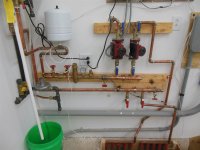
The house is zoned pretty much by room. I lost 2 zones during construction, which was very annoying. One was me being stupid and I screwed into a tube after it was VERY inaccessible. the other one i have no idea what went wrong, but it would not hold air pressure after i got it all together. I think there are now 12 functioning zones in the house. I put down 2x sleepers on the main level and poured 1.5" concrete over the tubing, then an additional layer of subfloor over that
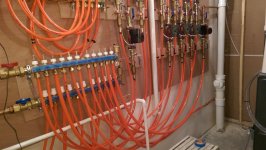
Main floor tubing:

The house is zoned pretty much by room. I lost 2 zones during construction, which was very annoying. One was me being stupid and I screwed into a tube after it was VERY inaccessible. the other one i have no idea what went wrong, but it would not hold air pressure after i got it all together. I think there are now 12 functioning zones in the house. I put down 2x sleepers on the main level and poured 1.5" concrete over the tubing, then an additional layer of subfloor over that
Main floor tubing:

Wakey
Veteran Member
- Joined
- Jul 7, 2013
- Messages
- 1,253
- Location
- Madison Georgia
- Tractor
- John Deere Z915B Zero Turn 54 Deck
Been reading along and have some pointers/info from my experience the past 5 winters in my shop and 4 in the house, heated the same as yours - via a tankless heater. Sorry about the length but I have some significant learnings... <snip>
Thanks for the write up!
prof fate
Platinum Member
- Joined
- May 30, 2018
- Messages
- 684
- Location
- beaver pa
- Tractor
- kioti ck3510 Cub Cadet 149, 2146, Toro Zero Turn
I had hot water radiant heat and found out, long storey, that it was installed incorrectly - it needed an 'idle loop' - if the pump shut off the heating elements/exchanging would overheat unless the water kept circulating. Bad install, 2 other companies, regional manufacturer rep and one from themain office all came and tried to fix the issue...NONE of them saw the missing loop...yet it's in the manual for installation...which after the third failure out of warranty repair guy pointed out right away...
So for heating (based on that furnace, 2 others I've bought, estimates on all those new systems) the level of knowledge and expertise in the heating world is VERY VERY VERY low.
Also, doing research on heat loss/gain and efficiency I found out NOBODY has tested, scientifically, ANYTHING. You can get MPG estimates for cars - they test for that in a standard way. As for well, will oil, natural gas be cheaper to run? Will forced air or radiant be cheaper to run? How much savings will a 97% vs 95% vs 80% be? If I run a heat pump, how much will I save on energy?
This info does not exist. anywhere.
What size furnace do you need? (BTU)? I can find the formulas and do the math - and almost every salesman will try to sell you something 50-100% larger.
And apples are not all apples. I have an LG 'mini split' heat pump and it will put out heat to below zero. The heat pump on my main system gives up the ghost about 37F. HUGE difference in capability. Yet both are heat pumps...
So for heating (based on that furnace, 2 others I've bought, estimates on all those new systems) the level of knowledge and expertise in the heating world is VERY VERY VERY low.
Also, doing research on heat loss/gain and efficiency I found out NOBODY has tested, scientifically, ANYTHING. You can get MPG estimates for cars - they test for that in a standard way. As for well, will oil, natural gas be cheaper to run? Will forced air or radiant be cheaper to run? How much savings will a 97% vs 95% vs 80% be? If I run a heat pump, how much will I save on energy?
This info does not exist. anywhere.
What size furnace do you need? (BTU)? I can find the formulas and do the math - and almost every salesman will try to sell you something 50-100% larger.
And apples are not all apples. I have an LG 'mini split' heat pump and it will put out heat to below zero. The heat pump on my main system gives up the ghost about 37F. HUGE difference in capability. Yet both are heat pumps...
Been reading along and have some pointers/info from my experience the past 5 winters in my shop and 4 in the house, heated the same as yours - via a tankless heater. Sorry about the length but I have some significant learnings...
The first winter was pretty great (shop only). Towards the end of the season I started to hear the heater buzzing/vibrating when it was running and it got pretty bad. In my research I learned this was cavitation - where the water is actually boiling in spots. This is not good for the heater at all. I called the place that I got the supplies from and he suggested that the regular 15 psi was insufficient for a tankless heater and to take it up to 25-30 psi. He was right (sort of - I'll get to that next). Now to take the system up in pressure, you first need to take the pressure off the air bladder expansion tank, and pump it up to the higher pressure you are targeting. Then top off the system and flush the air from the lines, then pressurize.
Anti-freeze. I did not start with anti freeze, just water. I started to get concerned that if the heat went down or something happened, the system might freeze up. That would be super bad. So I calculated the system total volume and then pumped in enough radiant system anti freeze to make up approx half of that while pumping out water. Shooting for the 50/50 ratio. This was when the cavitation problem really became pronounced and I made the call I described above.
Yrs 2-3-4 saw some cavitation occurring but it was much milder than before. I also ran into problems with the little filter plugging up and choking flow so I had to take it down to clean that out a few times over the heating seasons. Every time you do this, it is the same old top off, flush air, repressurize routine. That gets old. Then something else happened in year 4 that woke me up. A little background is needed: I have radiant in the shop and house, and a tankless heater for the house domestic HW. The shop unit is 95% efficient but the house ones are 97% and the 2 in the house are identical to each other (1 on radiant, 1 on DHW). The DHW started leaking and it turned out the be the heat exchanger. Well within warranty but I was not pleased and puzzled. The manufacturer (Takagi for all these) had good support and sent me a heat exchanger but I had to install it. That was VERY painful as everything has to come out to swap that, plus a lot of wiring. Thank gawd for their detailed instructions with photos. So he sent it as a "goodwill" gesture at the start, and that seemed odd. He wanted me to send back photos of the underside of the HX after I got it out. There were blackened areas on it and he said that was from hard water and that it did not fall under warranty, but they would allow me this one time freebie, but not again. So the water... When we moved in, i had not yet put a softener in thinking I would get to it soon. Well within 2-3 months, shower heads and valves were plugging up with hard water deposits. Got a testing kit and my hardness came in around 26 grains. Well I got a softener in shortly after and so we had run hard water for only about 4 months total. That was enough to kill this heat exchanger a couple years later. Hmmmm.... the other 2 heaters for house and shop radiant were filled with hard water...
So the house radiant had started making cavitation noises also, so before the start of this heating season, I did a descale on the 2 radiant heaters. AHA! Now all of a sudden everything is nice and quiet. So i believe the cavitation is a combination of the scale build up and the initial low pressure.
So the lessons from this are 1. NO hard water! Or you need to descale from time to time. 2. 25-30 psi is a much better pressure for a radiant system on a tankless vs the standard radiant pressure of 15 psi.
I find it works great for heat. Always nice and comfortable. The floors are never really very warm, except in some spots, like near the manifold. The thing I really notice with it is that the floors don't feel warm, but they never feel cold in bare feet. If I had the floors warm enough to feel significantly warm to the touch, it would be a sauna in here, as the house is well sealed and insulated. The only real downside is that drilling into the shop floor to mount things is pretty much a no-no. I tried to scope it all out with an IR camera one time, but could not tell well enough where the lines were.
OP
ovrszd
Epic Contributor
- Joined
- May 27, 2006
- Messages
- 33,727
- Location
- Missouri
- Tractor
- Kubota M9540, Ford 3910FWD, Ford 555A, JD2210
Dstig1, thank you very much for taking time to share your experiences. I too have hard water but not sure what it tests. My shop heat is using water straight from the system with no treatment. My pressure regulator is set at 15psi. My heater water temp is set at 115F.
I will use a water softner in the house project.
If you mentioned it and missed it excuse me. Are you using Boilers or Tankless Water Heaters? What temp are they set on?
I will use a water softner in the house project.
If you mentioned it and missed it excuse me. Are you using Boilers or Tankless Water Heaters? What temp are they set on?
dstig1
Super Member
- Joined
- Apr 7, 2010
- Messages
- 5,608
- Location
- W Wisc
- Tractor
- Kubota L5240 HSTC, JD X738 Mower, (Kubota L3130 HST - sold)
These are all tankless
Shop radiant - 120F
House radiant 130F
House DHW - 140F
I started the house radiant at 120F but was having low flow issues (maybe also related to the hard water) so i ended up bumping it up 10 deg as pretty much the only lever i had left to pull on. It worked.
Shop radiant - 120F
House radiant 130F
House DHW - 140F
I started the house radiant at 120F but was having low flow issues (maybe also related to the hard water) so i ended up bumping it up 10 deg as pretty much the only lever i had left to pull on. It worked.
dieselcrawler
Elite Member
Ive had a little exposure to in-floor radiant heat, as my friend the beeman has it in the floor of his new section of his building, about 50'x100' wood shop, and 20'x100' lobby/commons area/lunch room. Powered by wood fired boiler/heater. My dad helped design and install the original system about 15 years ago, I helped maintain it and modified a few things when I worked for him about 5 years ago, but its been a reliable system that he's quite happy with. But this is a commercial situation, business use, heating about 10k feet, all with wood fired boiler, supplemented by a wood stove in the older section.
Ive been trying to absorb what you all have shared, and hope I can use the info someday.
Richard, how's the house project coming? Do you have a thread on it alone? I havent noticed one, but read your posts in other threads that mention it... I'm sure winter weather is slowing down progress.
Ive been trying to absorb what you all have shared, and hope I can use the info someday.
Richard, how's the house project coming? Do you have a thread on it alone? I havent noticed one, but read your posts in other threads that mention it... I'm sure winter weather is slowing down progress.

Here are some similar links:


Buying Advice
What should I buy.
- Replies
- 1
- Views
- 769
