Adding a lean-to

/ Adding a lean-to #1  

Molerj

Platinum Member
Joined
Jul 18, 2001
Messages
609
Location
Eastern Ohio
Tractor
JD 955, 1978 Economy Power King, JD X500
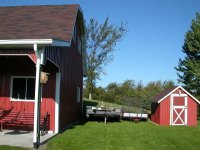
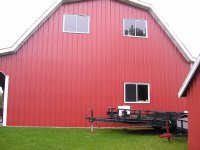
I would like to add a lean to on my pole barn. The pole barn has metal siding. I would like to add on 16'X30'. I will be buying 16' steel sheets for the roof. What would be a sufficient drop on the roof level? From the bottom of the eaves on the edge of the building is 10'6". I was hoping to keep the height of the lean to 8' on the lowest end. Would two foot drop on the 16' length be enough? What type of framing 2x6 or 2X8 or are there trusses that I can buy? I was thinking of buying sheating boards to go lengthwise over the framing to screw the roofing to. This is facing the north so there may be a little snow to deal with in the winter. Any suggestions are welcome. I have attached a few pictures where the lean-to will be located.
 

Attachments

  • 324604-barn pictures2003-09-28_0001.JPG
    324604-barn pictures2003-09-28_0001.JPG
    65.9 KB · Views: 1,241
/ Adding a lean-to
  • Thread Starter
#2  
another picture
 

Attachments

  • 324607-barn pictures2003-10-05_0001.JPG
    324607-barn pictures2003-10-05_0001.JPG
    78.4 KB · Views: 978
/ Adding a lean-to #3  
Don't know about the snow load in Ohio, but in CT where I live, the building inspector won't allow a structure to have much less than a 4" in 12' pitch. With a 4 in 12 pitch, you would have a 64" difference between the highest point and the lowest point of the roof. I would suggest that you consult with the local building official for the requirements in your area, that is unless you are doing this with out a permit. If that is the case, then inquire of the building department in a town that is 4 or 5 towns away from you. It is one thing to build without a permit, but another not to build it to code.
 
/ Adding a lean-to #4  
Another thing to consider, is that in many areas, buildings classified as pole barns are usually exempt from permitting, etc, etc.. if there is no power / water run to them at the time they are built... That isn't to say though to build something unsafe-. If it weren't for his snow load... all he would need is enough drop to shed rain and simple 2x6 construction with some 1x3 or 1x4 purloins for the tin. Figuring for snow, I think he's on the right idea with the 2z6's and the sheeting.. though he needs to keep in mind that he may have a failure during a big snow, and just plan accordingly, and accept any loss of building material/stored items if there is a failure due to snow.
The building materials will probably be a moot point... that project isn't a pocket drainer... what he stores under it may or may not be another story... If it is say... farm implements.. I'm guessing that the worst that would happen is that they would be burried by snow .. but probably intact.. if it is feed/hay... then it may be a loss... etc. He just needs to determine what level of risk is acceptable to him... especailly if he wants the 8' minimum at edgoe of the improvised structure.

Soundguy
 
/ Adding a lean-to #5  
For 16' I'd definitely go with 2x12's. If you put sheeting on there you will have to go with 2x12's. That's alot of load. 2' drop would be the minimum but with your header you are still not going to be 8', more like 7' max.
 
/ Adding a lean-to
  • Thread Starter
#6  
Thanks so far. No inspectors, code etc. where I live. I didn't mean to infer that I would be sheating the whole roof. I was thinking of several rows just to screw the sheating to. Maybe 1X3 or 1X4's as suggested would suffice. I guess I can raise the side that would be against the building, but that would reduce the size due to the angle of the eaves from the pole building.
 
/ Adding a lean-to #7  
Just run purlins. You'll want to put 2x4's on their side. This will give the roof strength.
 
/ Adding a lean-to #8  
</font><font color="blue" class="small">( For 16' I'd definitely go with 2x12's. )</font>
Pretty big stuff.

Around here that isn't even called for in residential construction... Heck.. I don't think I've seen that in flooring.

Must be some heck of a load you are expecting... If he's expecting that much load.. sheeting and/or roof tin ain't gonna cut it.. he'll need timber across that roof.

My -non- snow rated pole barn ( which met codes and had a permit pulled) used 2x6's and 1x4 purloins, and the tin roofing metal. Either 6x6 or 8x8's for the uprights, and 4x4's as intermediate uprights between the interior horse stalls.

Some other misc. lumber sizes were used for non-load portions..like decorative cut soffit/facia, etc, and for stall construction.

I'd second the recomendation that he shorten the run and move higher up on the wall to achive a bit more drop/per/foot.


Soundguy
 
/ Adding a lean-to #9  
I don't think 2x12's sound bad at all.

Tell me exactly where you are located and I will run a snow drift calculation. This would be more prudent than expecting a failure under less than ideal conditions.

Failure should never be considered as an option. Size the rafter for the worse case loading, and live happily ever after.

Send me a private email if you need more help.

Good Luck

Yooper Dave
 
/ Adding a lean-to #10  
Big difference in the snow loads from Iowa to central florida to say the very least!

Fred
 
/ Adding a lean-to #11  
Eastern Ohio...Western Pa...about the same thing...

When building my house I put 2x12 on 24" centers over the living room with a 16' span...

This year on my shed I put 2x8 on a 14 foot span on 24" centers... /forums/images/graemlins/blush.gif

I am sure both will be fine. BUT I don't need a load of snow in the living room in mid winter!

For a 16' span with the roof rafters at 24" on center, to be safe and comfortable I would go with 2x12s. The cost is not all that different...Actually quite small...

I doubt that there is much practical difference between a shallow slope and a 3 in 12 slope as far as snow shedding goes...the bigger concern is water getting back under the shingles and rotting the roofing sheeting, in my opinion.

If you get some of that rubberized material to put on the roof before you shingle it, when it is a shallow slope, you may be OK...

Remember that even if you are lower than you would like to be at the edge of the roof, because it is a slope, you will be gradually higher as you move away from the outside wall...

Just a couple additional thoughts... /forums/images/graemlins/smile.gif

PS...also there is a big difference in leakage between a roof over a heated space and an unheated space...with the unheated space being better since it does not melt the snow an the interface between the shingles and the snow...
 
/ Adding a lean-to #12  
All I know is every building I have put up and the true 3 sided lean-to's I've built have all called for 2x12's in the plans. This last barn I put up I had 16' leans on the side of my barn 120' long and the plans called for double 2x12's or lvl's. I used double 2x12's because they were cheaper.
 
/ Adding a lean-to #13  
Just to add to what Cowboydoc is saying...

One 2x12 on 24" center is equal to two 2x12s on 48" centers...

As mentioned above, there are tables that tell you for a given snow load what you need. 2x12 on 24" centers, or 2x12 on 16" centers, etc.

It all depends on the snow load. Or better termed the live load. The total load the roof is supporting is the dead load[ plywood, shingles, roofing felt, etc] and the live load [ mostly snow, but includes you too if you are up there...].

I agree with what I think Cowboydoc is saying. It is cheap to add a little wood, especially when you are doing it yourself. Err on the conservative side...and be happy for the life of that roof!
 
/ Adding a lean-to #14  
don't forget that the wider the span between rafters, the heavier that the plywood should be. If you use 2 x 8's and space them on 12" centers, you can get away with 1/2" plywood or chipboard. The cost will be about the same for the rafter lumber and you will have a better structure going 12" on center in my opinion... Junkman
 
/ Adding a lean-to #15  
Why does the lower side have to be eight feet? I've seen plenty of side walls that are 6 feet tall that are never a problem. Even for people over 6 feet tall unless the access is through the side, which I don't see.

Lower the wall to six feet and increase you pitch.
 
/ Adding a lean-to
  • Thread Starter
#16  
Thanks again. Some have missed that I will be using steel roofing. So the added weight of pywood, felt, & shingles will not be an issue. The only additional weight besides the steel will be the 1X4's or 2X4's that I run across the girders. Also when using steel the slope usually doesn't have to be that steep due to the fact of less resistance. Altho this is facing north & won't get the sun to melt the snow as fast. Deep snow is not the norm here in Eastern Ohio (70 miles west of Pittsburgh, Pa) altho we have gotten one or two large storms the last few years. But, I know it only takes one big wet snow to ruin my day! I think lowering the down side will be the best, as suggested. I would still like to keep at least 6 1/2 feet headspace on the lower side.
 
/ Adding a lean-to #17  
My goal is to always keep the headers at least 80" in height. That's the standard height of a door; people are used to going through doors, and keeping it at that height tends to reduce surprises. Makes everyone using it feel more comfortable. It's only 2" more than the 6-1/2' you mentioned. My 6'4" tall son helped me to arrive at that; he would clear 6-1/2' by 2", but would feel uncomfortable. The rest of us height-challenged folks would probably not notice.
 
/ Adding a lean-to #18  
</font><font color="blue" class="small">( Tell me exactly where you are located and I will run a snow drift calculation
)</font>

First, my post specified that I was not taking into account regional weather.. i.e. snow loads. I made my statements based on my local.

As for the snow load.. don't worry.. I can run that in my head... as my kitchen freezer can probably hold all the snow that has fallen in central florida for the last decade.. etc.

</font><font color="blue" class="small">( Send me a private email if you need more help.
)</font>

Thanks, think I'll pass.. I already got the t-shirt.

Not trying to be obtuse here.. but the second thing to think about in engineering is cost vs risk ratio. ( first being safety and fit to purpose. ) -Anyone- can design a correct structure.. or overdesign it. But sometimes we just need to design for the 'job at hand'. We don't need to build a 10k$ roof over a water-well pump.. when all it needs is something decorative... etc.

(This is the exact reason why I specifically don't give long-distance engineering advice out. Only speculation and opinion. Hard to comment on something you havn't seen the site and plans & specifications for.)

Soundguy
 
/ Adding a lean-to #19  
Soundguy, I think YooperDave's post was mostly directed at the original poster. Especially the two comments that you quoted.
 
/ Adding a lean-to #20  
Possibly so.

I actually agree with his advice, especially in that area, but see real problems with the owners specs ( what he wants them to be ) and what it will need to be.

In all actuality, the best advice we can give him is to contact a local architect/engineer, have them survey the site, draw up plans.. get a contractor.. pull the permits, get it built.
Absolute safest most correct way possible.

Soundguy
 

Marketplace Items

2012 CHEVROLET IMPALA CAR (A66091)
2012 CHEVROLET...
GROVE RT520 ROUGH TERRAIN CRANE (A67714)
GROVE RT520 ROUGH...
Skidded Fuel Cell (A67714)
Skidded Fuel Cell...
2014 Chrysler 200 Sedan (A64557)
2014 Chrysler 200...
2014 MAC FLAMELESS HEATER TRAILER (A67714)
2014 MAC FLAMELESS...
2017 PETERBILT 579 (A67714)
2017 PETERBILT 579...
 
Top