Adding a second water heater

/ Adding a second water heater #41  
Our house came with a 40 gal water heater. We have 3 bathrooms and four daughters. two of the baths are on one end of the home and the Master is on the other end with the kitchen in between but on the other side of the house (baths are near back while kitchen is near front).

We had an existing 40 gal water heater from our old house (it was only about a year old) so I installed that in the master area. Well, it did some odd things. Seems when the baths on the other end of the house were used it pulled the hot water from the master tank and when we used the master shower, it pulled the water from the other tank. I tried backflow preventers on the outflow but it did not help.

In the end, I had to disconnect the hot at the master tank coming from the other tank and use the master tank for ONLY the master and let the other one handle the rest of the house. It works great!

We have to replace the element in our tanks on a somewhat regular basis due to lime/calcium buildup. After some time we also had to start replacing the controls on the tank that came with the house so our oldest daughter decided to buy a new tank. She went with the largest that would fit the space. It is 80 gallons. Believe it or not, our electric bill went down.
 
/ Adding a second water heater #42  
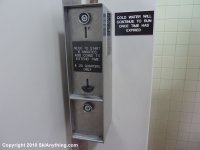
Or this...

It will teach them the value of water conservation, economics, fairness, work ethics all while making money!

8262010-Grant-Village-Coin-Op-Shower.jpg
 
/ Adding a second water heater #43  
Say you've got two 50-gal tanks.

Right, for 100 gallons AT TEMPERATURE.

You use 50 gallons of hot water for your shower. In series, the first heater has to heat up the entire 50 gallons again while the second tank experiences no load. In parallel, both tanks have to heat up 25 gallons.

Either way, you've got 50 gallons to heat, and that's going to take X amount of BTUs to heat it, regardless of whether one unit is doing all the heating or two units are each doing half the heating.

Yes, the energy used is the same, but that is not the only issue...part of the issue is the amount of hot water available at the moment of demand. With parallel tanks you are pulling out hot, but they are being refilled with cold, cooling off all the water in both tanks. So by the end of the 50 gallons of use, the water in both tanks is half as warm. Stratification helps some, but it is still mixing in and cooling off.

In series, the water drawing into the 1st tank being warm to start with means that the chilling effect of the cold water is delayed, and the water stays hotter to the end of your 50 gallons. But if you keep going from there to the end of the 100 gallons, yes it's all cold and it doesn't matter.

So to my mind at least, hooking in series is a way to mess with the timing of availability of hot water, not total energy use.
 
Last edited:
/ Adding a second water heater #44  
Right, for 100 gallons AT TEMPERATURE.


Yes, the energy used is the same, but that is not the only issue...part of the issue is the amount of hot water available at the moment of demand. With parallel tanks you are putting out hot, but they are being refilled with cold, cooling off all the water in both tanks. So by the end of the 50 gallons of use, the water in both tanks is half as warm. Stratification helps some, but it is still mixing in and cooling off.

In series, the water drawing into the 1st tank being warm to start with means that the chilling effect of the cold water is delayed, and the water stays hotter to the end of your 50 gallons. But if you keep going from there to the end of the 100 gallons, yes it's all cold and it doesn't matter.

So to my mind at least, hooking in series is a way to mess with the timing of availability of hot water, not total energy use.
Every double installed hot water tank I have seen is piped in series so the first is preheating and the second heats to final temp. Energy used is the same but the amount of hot water you can get is almost unlimited. Dual hot water heaters can heat water from a 3/4" inlet just about as fast as it can run thru.
 
/ Adding a second water heater #45  
Some good humor in here as well as possible solutions.

It comes to mind that I recall reading that tankless units are efficient to raise temp by about 40 deg or so and not from ground water temp to near boiling.
Perhaps the tank at lower setting combined with tankless unit close to shower could be a solution but that still calls for HD electrical circuit.

The one I liked best was the coin operated timer, but that'll never get you rich besides you'd simply be increasing their allowances.
 
/ Adding a second water heater #46  
Lot of chest thumping in this thread.... ;)

Some very good ideas as well.... Just gotta sort the differences. :)
 
/ Adding a second water heater #47  
Some good humor in here as well as possible solutions.

It comes to mind that I recall reading that tankless units are efficient to raise temp by about 40 deg or so and not from ground water temp to near boiling.
Perhaps the tank at lower setting combined with tankless unit close to shower could be a solution but that still calls for HD electrical circuit.

The one I liked best was the coin operated timer, but that'll never get you rich besides you'd simply be increasing their allowances.

Figured I'd get some humor in this somehow.

I understand your precedent. Like you, I have a large household in my 6k sq ft house. It has two 50g tanks plumbed in series but on natural gas so I couldn't help too much with regards to that BUT,

I once had an electric water heater setup in my shop to heat the radiant floor that would quickly run out of hot water. I took it out (sold it practically new so little loss) and installed a shoe box sized Rheem instant water heater on the wall and I'm far pleased with how well this contraption worked. My unit has a knob which you can dial in how much hotter the water gets. I had it on high, which feels like it's on "Lava" setting but it's set much lower than that because I require a constant temps in the 76° range. HOWEVER,

You're correct that tankless simply raises the water temps and some people fail to recognize the shortcomings from very cold climates. If you have near freezing water, you'd need a bigger unit. There's calculators on the internet that can help you size the right unit if you're inclined to investigate. For sure, prices have come down significantly lately so the benefits may be enough for you to go that route.

Perhaps a few brochures on coin-op showers laying around the house just might do the ticket to get their act together ;-). If I didn't have two tanks, I'd just set a countdown timer in the bathroom. If it goes off, the kids would risk getting a dump of ice water (and their allowance gets donated to charity). Seriously! There's so many creative ways.


Since you can't commit to running another power for the second tank, I should suggest that you look into the tankless idea.
 
/ Adding a second water heater #48  
Every double installed hot water tank I have seen is piped in series so the first is preheating and the second heats to final temp. Energy used is the same but the amount of hot water you can get is almost unlimited. Dual hot water heaters can heat water from a 3/4" inlet just about as fast as it can run thru.

You can get the same result running them in parallel. Either way, you've got twice the BTUs going into the water on it's way through as you would have with a single tank. Cold supply water will come out the other end with the same total temperature rise in either configuration. Well, actually, the parallel setup has the advantage here because both of them are starting with cold water, whereas when in series the second tank will be starting with "half warmed" water resulting in slightly less efficient heat transfer in the second tank. But I'm sure that difference would not be noticeable to the person taking a shower.
 
/ Adding a second water heater #49  
Every double installed hot water tank I have seen is piped in series so the first is preheating and the second heats to final temp. Energy used is the same but the amount of hot water you can get is almost unlimited. Dual hot water heaters can heat water from a 3/4" inlet just about as fast as it can run thru.

Well, that depends on their BTU output size, of course. And of course it can be true for both a series setup and for a parallel setup. For a given water flow...with a series setup the water gets to go through twice, but at full speed...with a parallel setup it's only going through one or the other, but it's in there being heated twice as long. The result at the shower head is the same.

The only really valid reason to pick series or parallel is for serviceability, and I think parallel has the edge unless you want to put in bypass lines/valves on the series setup, in which case it becomes a moot point.
 
/ Adding a second water heater #50  
I just installed my first on demand water heater in my new building and it is the way to go. Cost about a thousand dollars, but it WILL end your hot water shortage problem once and for all.
 
/ Adding a second water heater #52  
Tankless won't work without new wiring. Your little 12-3 wire will barely run a hand sink tankless at less than 1/2 gal per minute. But it will get hot, just runs slow.

There are tankless whole home systems that will do whatever you want but they run into 36 KILOWATT. That's probably triple 4ga wire or bigger and it gets expensive quickly.

They are the best and will work in any climate. Just depends on what you expect and want to spend. Remember they only run when the water is on. Not having to heat 50gal of water 24/7 in the winter while you're at work.
 
/ Adding a second water heater #53  
This one from home Depot will raise incoming temp 65 degree at 3.03 gpm. That's well over shower use.

It's rated at 120 amps, 28kw. You'd probably need another panel just to use it.

uploadfromtaptalk1456868719722.jpg

It's 773.00 plus wire and breakers but you'd never run out of hot water again and probably save money on your bill.
 
/ Adding a second water heater #54  
Gas, be it propane or natural gas will provide you with the fastest recovery rate.
Downside is gas tanks are close to double electric to purchase and probably fail at the same projected 10 year mark.
Naturally you need reasonable gas rates.
If you have or are considering a generator installation gas is also the best and both can share the same gas tank installation.
 
/ Adding a second water heater #55  
This one from home Depot will raise incoming temp 65 degree at 3.03 gpm. That's well over shower use.

Well...I guess if you use one of those modern, legal shower heads. I haven't found one yet that I was willing to live with in its unmodified state.

But anyway, that's 120-amps @ 240-volts. Holy crap. And that's only for one shower. Somebody trying to wash dishes at the same time? Your screwed.
 
/ Adding a second water heater #56  
wow, popular thread.. OP what you mentioned would probably work but an easier and less costly solution is to just go install a new 50 - 80 gallon water heater... here is why..

New efficiency standards for residential water heaters are on the horizon

All new water heaters have flow restrictors that will allow your precious kids to take their 15 minute shower but use less hot water because it pinches back the hot water. They will whine about the flow being less but you will not have to put in two water heaters. I know because I just replaced a 40 year old water heater and I now have more hot water than I can use... just less pressure. Turn the temp up to 150 on the heater.
 
/ Adding a second water heater #57  
Most traditional electric heaters have two elements, but only use one at a time. The bottom one does the bulk of the work. The top one kicks in as the water up top drops in temp by some pre-set amount. When the top one kicks in, the bottom one is shut off. One old trick is to supply each heating element's thermostat with an independent supply, each with its own breaker circuit. I have not tried it, but have heard of it quite a few times.

prs
 
/ Adding a second water heater #58  
Have you tested the elements in your water heater, Use an ohm meter, Disconnect the power to the water heater. Remove the wires from the elements. . First you test for continuity, across the two terminals of the element the meter should indicate full scale if ok, and no reading if defective. next test for a short to ground. Test from each terminal to the tank. If you get a reading to ground you have a bad element, An element with a short to ground will provide some heat depending where the defect is. It is also a hog on hydro usage. This is usually caused by a lightning strike , that blows a hole in the side of the element and fuses the heating filament to the outer coat. It is not a bad idea to make these tests at least once a year, or if your tank doesn't seem to be working right, or if your hydro bill, spikes.


I worked at a electrical utility and did a lot of water heating trouble shooting. Ran into this problem, quite often. old 243
 
/ Adding a second water heater #59  
There is no advantage to that.

Say you've got two 50-gal tanks. You use 50 gallons of hot water for your shower. In series, the first heater has to heat up the entire 50 gallons again while the second tank experiences no load. In parallel, both tanks have to heat up 25 gallons.

Either way, you've got 50 gallons to heat, and that's going to take X amount of BTUs to heat it, regardless of whether one unit is doing all the heating or two units are each doing half the heating.
True. The advantage to series is, considering cyclic use as a norm, it can be set up for better efficiency:

Yes, definitely in series -- the 1st at minimum T setting and the 2nd at your desired hot water temp. Bite the bullet on elec circuits and use the stock elements. You will have unlimited hot water and much more efficient than holding 2 tanks at full desired T.

...... Better yet use an on demand heater as the second. That way youre only storing a tank of water prewarmed and ready for the boost. Very little quiescent heat loss and unlimited hot water.
 
/ Adding a second water heater #60  
PRS, to have the both elements working at the same time . Go to the upper thermostat. There are 4 terminals. move the wire that feeds the bottom element to the upper screw rather than the lower. , you will end up with wires on the upper screw. this will start the lower element as soon as the lower thermostat senses cold water. As the cold return is at the bottom.

We are just two seniors , our hot water usage is lower. A few years ago I disconnected the lower thermostat entirely. We are probably operating on less than 20 gallons on a 40 gallon tank, don't run out. My wife usually has her washer set on the cold setting. Also does her washing on the weekend, when our hydro rates are lower. Call me cheap if you like, don't mind saving a buck.old243
 

Marketplace Items

2011 Kenworth W900 Tri-Axle Sleeper Cab Truck Tractor (A60352)
2011 Kenworth W900...
2022 Mack Pinnacle Day Cab Tractor w/ Wet Line Kit (A61568)
2022 Mack Pinnacle...
2019 BOBCAT SKIDSTEER T740 (A60736)
2019 BOBCAT...
HUSQVARNA RIDING MOWER 46IN DECK (A56859)
HUSQVARNA RIDING...
2000 Hyster S50FT (A55973)
2000 Hyster S50FT...
TOOTHED BUCKET ATTACHMENT FOR MINI EXCAVATOR (A58214)
TOOTHED BUCKET...
 
Top