Adding a second water heater

/ Adding a second water heater #21  
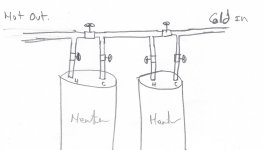
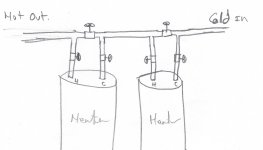
I have a rooms in the shop/barn (meat room, milk room), but most of the time I I use a compact under counter 30 gallon heater, and use that 90% of the time, but when I cut meat, I have a 30 gallon gas heater on the other side of the room there hooked up in series, I have them valve-ed, so I can use one or both, I will run out of hot water when washing up with the electric 30, but with both working I have yet to run out,

but I would hook them up in series, yes one will bear most of the load, but with a little valve-ing one could use one or both and if one dies you will still have hot water, while one repairs or replaces the other,
 

Attachments

  • HW.jpg
    HW.jpg
    145.9 KB · Views: 225
/ Adding a second water heater #22  
So how would doubling the available amount of hot water to 3 teenagers solve the problem?
 
/ Adding a second water heater #23  
This is like using 2 tiny backhoes when you need a 100 ton excavator.

Get a whole house tankless. It never runs out and saves energy. Bite the bullet!
 
/ Adding a second water heater #24  
I've got three teenagers in the house and the 50 gallon electric water heater isn't keeping up, so I'm thinking about adding another. I have two questions I'm pondering.

The first is whether I have to run another circuit, I'd rather not. I have a run of 10-2 right now with a 30A breaker. My understanding is that each 220V device needs it's own circuit so I'm thinking of adding a panel at the water heaters with two 15A breakers. At 80% loading each could get 12A, which is 2600 Watts at 220V. I can get 2500W elements. Would it be OK just to replace all four elements with 2500 Watt ones?

Second question is serial or parallel for the hookup of the water heaters. It seems that with parallel you spread the load, while with serial the back one does all the work while the front one loafs, only coming on when you've exhausted the back. But with parallel you have to somehow balance the load, and if you don't you could drain one tank while the other one still has hot water.

Thoughts?

Thanks.

You are seriously over thinking the remedy that has been done for years.

First you take a shower and put the drain plug in the tub. Then the wife takes a bath, then the oldest kid, then the middle then the youngest. You can do the whole kit and kabootle with 5 gallons of hot water.
 
/ Adding a second water heater #25  
Yea, I sometimes wonder how our family of 9 ever got by on one full bath in the house and one water heater.
I took out a Marathon (still have it) to put in one of the more efficient heat pump / hybrid ones. The heat pump failed just after warranty went out, but they fixed it anyways (since it was a known defect). Now the heat pump has failed again, and I don't plan to have it fixed. Still running on the electric heat elements. Probably will put the Marathon back in, and use this one as a buffer tank from my geothermal.
 
/ Adding a second water heater #26  
I agree with the tankless/on demand suggestions. I installed one 15 years ago and have had great results and 0 problems since. The newer ones are supposedly even better than mine.
 
/ Adding a second water heater #27  
Buy an 80 gallon hybrid heater with heat pump technology, these double as an air conditioner too. Install in the warmest location available and you won't believe the savings over a regular electric hot water heater.

I installed one last Spring and hot water now costs about 10/month in electricity in fact I shut off the wood boiler zoned water tank because the new hybrid is way cheaper.

I have a good friend who is a plumber and he told me I wasn't going to believe the savings, he was right!

Good luck which ever you choose, Fred

Water Heater | Water Heating Systems | State Water Heaters for Hot Water | Premier Heat Pump Family | Products | State Hot Water Heater Systems
 
/ Adding a second water heater #28  
I agree, tankless is the best way to go if you want to fix the hot water issue. I think everyone has crossed this road. My water bill went through the roof so I put the hot water tank on the vacation mode and installed a shower head with a flow restrictor in their shower. On my hot water tank, that setting only gives the enemy 11 minutes of hot water. That fixed the high water bills for me. I tell the enemy the tank is half broke and need $600 for a new one and, I'm accepting donations. They haven't coughed up a penny and its been years. If they leave the lights on, the light bulbs come out. If they slam the door, the door comes off the hinges. The best is the wifi. When they're spending to much time on the web or TV, I barely unplug the router or the line coming in to the house. I tell them "I don't know, the service must be out", call Comcast. They'll go a couple days complaining, I just tell them to read a book. Somehow, it always comes back on the day the service guy is supposed to show up.
 
/ Adding a second water heater #29  
I agree, tankless is the best way to go if you want to fix the hot water issue. I think everyone has crossed this road. My water bill went through the roof so I put the hot water tank on the vacation mode and installed a shower head with a flow restrictor in their shower. On my hot water tank, that setting only gives the enemy 11 minutes of hot water. That fixed the high water bills for me. I tell the enemy the tank is half broke and need $600 for a new one and, I'm accepting donations. They haven't coughed up a penny and its been years. If they leave the lights on, the light bulbs come out. If they slam the door, the door comes off the hinges. The best is the wifi. When they're spending to much time on the web or TV, I barely unplug the router or the line coming in to the house. I tell them "I don't know, the service must be out", call Comcast. They'll go a couple days complaining, I just tell them to read a book. Somehow, it always comes back on the day the service guy is supposed to show up.

They'll be sleeping at their boyfriends house asap....
 
/ Adding a second water heater #30  
... I would hook them up in series, yes one will bear most of the load, but with a little valve-ing one could use one or both and if one dies you will still have hot water, while one repairs or replaces the other,

HW.jpg

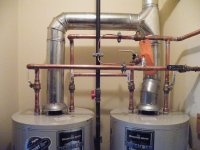
Here's another example that someone posted a while back. It's the same design as the one in the sketch above, but it sure looks a lot more complicated in real life.

DSCF3932.jpg
 
/ Adding a second water heater #31  
I've got three teenagers in the house and the 50 gallon electric water heater isn't keeping up, so I'm thinking about adding another. I have two questions I'm pondering.

The first is whether I have to run another circuit, I'd rather not. I have a run of 10-2 right now with a 30A breaker. My understanding is that each 220V device needs it's own circuit so I'm thinking of adding a panel at the water heaters with two 15A breakers. At 80% loading each could get 12A, which is 2600 Watts at 220V. I can get 2500W elements. Would it be OK just to replace all four elements with 2500 Watt ones?

Second question is serial or parallel for the hookup of the water heaters. It seems that with parallel you spread the load, while with serial the back one does all the work while the front one loafs, only coming on when you've exhausted the back. But with parallel you have to somehow balance the load, and if you don't you could drain one tank while the other one still has hot water.

Thoughts?

Thanks.

I have a rooms in the shop/barn (meat room, milk room), but most of the time I I use a compact under counter 30 gallon heater, and use that 90% of the time, but when I cut meat, I have a 30 gallon gas heater on the other side of the room there hooked up in series, I have them valve-ed, so I can use one or both, I will run out of hot water when washing up with the electric 30, but with both working I have yet to run out,

but I would hook them up in series, yes one will bear most of the load, but with a little valve-ing one could use one or both and if one dies you will still have hot water, while one repairs or replaces the other,
Yes, definitely in series -- the 1st at minimum T setting and the 2nd at your desired hot water temp. Bite the bullet on elec circuits and use the stock elements. You will have unlimited hot water and much more efficient than holding 2 tanks at full desired T.

...... Better yet use an on demand heater as the second. That way youre only storing a tank of water prewarmed and ready for the boost. Very little quiescent heat loss and unlimited hot water.
 
/ Adding a second water heater #32  
Here's another example that someone posted a while back. It's the same design as the one in the sketch above, but it sure looks a lot more complicated in real life.

View attachment 458558
That complex look is because that is a setup with valving that allows every tank combination. ... Either tank alone, or tanks running in series or in parallel.
 
/ Adding a second water heater #33  
That complex look is because that is a setup with valving that allows every tank combination. ... Either tank alone, or tanks running in series or in parallel.

They appear to me to be set up to run in series only. And by the valve orientations. They are plumbed with a bypass so that either one could be removed from the system while the other does the work, but in order to run parallel you would want a valve in the bypass line as well...otherwise you'd be bypassing at least a third of your cold water right to the hot water side.
 
/ Adding a second water heater #34  
Here's another example that someone posted a while back. It's the same design as the one in the sketch above, but it sure looks a lot more complicated in real life.

View attachment 458558

With this setup and the previous sketched drawing, both the cold and hot lines are valved at the water heater, not a safe installation by any means. Each heater could be totally isolated, if the tank stat called for heat, the water would expand causing the relief valve to blow and possibly damage the tank itself. Another note, both water heaters vent with 4" draft hood and combine into a 4" tee, another serious design flaw.
 
/ Adding a second water heater #35  
They appear to me to be set up to run in series only. And by the valve orientations. They are plumbed with a bypass so that either one could be removed from the system while the other does the work, but in order to run parallel you would want a valve in the bypass line as well...otherwise you'd be bypassing at least a third of your cold water right to the hot water side.
Yes. Youre right. The setup only provides sequestered flow for series or individually.
 
/ Adding a second water heater #36  
I've got three teenagers in the house and the 50 gallon electric water heater isn't keeping up, so I'm thinking about adding another. I have two questions I'm pondering.

The first is whether I have to run another circuit, I'd rather not. I have a run of 10-2 right now with a 30A breaker. My understanding is that each 220V device needs it's own circuit so I'm thinking of adding a panel at the water heaters with two 15A breakers. At 80% loading each could get 12A, which is 2600 Watts at 220V. I can get 2500W elements. Would it be OK just to replace all four elements with 2500 Watt ones?

Second question is serial or parallel for the hookup of the water heaters. It seems that with parallel you spread the load, while with serial the back one does all the work while the front one loafs, only coming on when you've exhausted the back. But with parallel you have to somehow balance the load, and if you don't you could drain one tank while the other one still has hot water.

Thoughts?

Thanks.

How about installing a second shower with it's own hot water tank,,maybe in the basement etc. Sounds like you need another bathroom.
 
/ Adding a second water heater #37  
Here's an idea. Put in a Tiny Titan, 2.5 gallon water heater. Feed it from cold water. Tell them this is it.

This is exactly what we have for our outside shower. You can sometimes take 2 showers with it, but usually it's for one. We've a shutoff valve at the shower head. So, while soaping down, the water is just dribbling out the shower head. Takes about 5 or 10 minutes to recover.

Gals might learn to conserve hot water then.

Ralph
 
/ Adding a second water heater #38  
THe big advantage of series is that the 2nd heater inline is drawing in warm/hot water, not cold, so doesn't have to work as hard.

My Dad had a solar setup (80's era) and a stainless jacket in the wood stove which fed a water heater with the elements unhooked through a heat exchanger. The regular electric drew from it rather than directly from the cold. Most of the time, it was at or near the water heater temp, and the heater only had to run enough to cover insulation losses.
 
/ Adding a second water heater #39  
THe big advantage of series is that the 2nd heater inline is drawing in warm/hot water, not cold, so doesn't have to work as hard.

There is no advantage to that.

Say you've got two 50-gal tanks. You use 50 gallons of hot water for your shower. In series, the first heater has to heat up the entire 50 gallons again while the second tank experiences no load. In parallel, both tanks have to heat up 25 gallons.

Either way, you've got 50 gallons to heat, and that's going to take X amount of BTUs to heat it, regardless of whether one unit is doing all the heating or two units are each doing half the heating.
 
/ Adding a second water heater #40  
Some interesting approaches have been listed..... good thread.

Years ago my wife and I were staying with friends, in between selling one house, and finding our next one. We solved a similar problem by re-wiring the conventional electric hot water tank. That tank had the elements originally wired in an Either/Or configuration - meaning they could not be both On at the same time.

Their existing service wiring was up to supplying both elements, so we rewired the tank to have the elements running in parallel.

As my friend and I were congratulating ourselves on our thermal engineering prowess, we noticed a factory note on the inside of the service panel that we picked up off the floor to replace - schematic showed how to optionally re-wire for higher thermal output, just as we did.

OP, you might have checked this out already, but thought I'd share one of my (many) personal lessons about reading factory supplied documentation :) .

Obviously, this fix won't match the high efficiency techniques that have been posted already, but is fast/low cost to implement if not already in place.

Edit - we started into that job years ago with the thinking "Hey, maybe we have a burned out element".... and the job progressed from there. Never hurts (with the power switched OFF) to check.....

Rgds, D.
 

Marketplace Items

TOYOTA FORKLIFT (INOPERABLE) (A60736)
TOYOTA FORKLIFT...
2025 Unused SDLGC80 Electric Golf Cart (A60352)
2025 Unused...
2020 Caterpillar D5K2 LGP Crawler Tractor Dozer (A56857)
2020 Caterpillar...
Forward 10,000lb Two-Post Electric Auto Lift (A55851)
Forward 10,000lb...
2020 FREIGHTLINER CASCAIDA 123 6X4 T/A  SLEEPER TRUCK TRACTOR (A59908)
2020 FREIGHTLINER...
2003 Toro Groundsmaster 7210 72in. Zero Turn Commercial Mower (A61567)
2003 Toro...
 
Top