adding hydraulic thumb kubota B21

   / adding hydraulic thumb kubota B21 #1  

joea99

Platinum Member
Joined
Sep 8, 2014
Messages
688
Location
Marbletown NY
Tractor
Kubota B21, JD 240GT
As I finally close in on finishing the Top and Tilt add, I think I want to convert my mechanical thumb to hydraulic. I found several threads here on exactly that, so I got the gist of it.

I ordered a single spool open center mono block valve, with power beyond, from Summit, thinking to use that. After some thought, planned on mounting it on backhoe, "in line" with the existing BH lines (before or after seems to be just a matter of my convenience), but, since this valve requires a Tank line, I paused realizing the BH itself has no Tank line. That seems to be done in conjunction with the 3pt hitch "maze o' stuff" where I see what appear to be two Tank lines. I guess to do with selector position. Not great at reading hydraulic schematics.

While can run a Tank line (gotta add one anyway for the TNT) and just use two smaller Quick Couplers for when I need to dismount it, it "would be nice" to find a valve that does not require a direct tank line.

Is there such a thing? I was gonna refresh myself on open center vs closed center but am having too much fun playing with fire in the form of plasma cutting and mig welding the valve mount. I'll hold off on the bulkhead until I figure out if I want to allow for a future coupler, based on what I hear back.

I even hear of people adding a section to the BH modular (?) valve, but that seems WAY beyond my skills and budget.
 
   / adding hydraulic thumb kubota B21
  • Thread Starter
#2  
Does anyone know if there is such a spool valve, that does not need/have a return to tank and would work? I've no idea what it would be called.
 
   / adding hydraulic thumb kubota B21 #3  
A hydraulic thumb requires fluic flowing from the control valve in order to open or to close.
So no matter which way the thumb is moving, one side of the hydraulic cylinder moving that thumb is getting fed pressurized fluid from the control valve to fill an increasing volume in one side of the cylinder, while the other side of that cylinder is having its volume reduced. The fluid in that other side of the cylinder getting smaller has to go somewhere - and it goes back to the control valve and from there it is returned to the tank. There isn't any other option.

OK. I take that back. Technically there is an option called a "regenerative" system that add a small portion of that return fluid back to the pressurized side of the cylinder, but you don't want to go there in a simple system..... and anyway even regenerative systems are not 100%; they still require a return to the tank.

However, the good news is that the return to the tank doesn't have to be a bundle of discrete lines. Several smaller return lines can "Y" into a single larger return line.

I'm a little bit concerned on just where in the circuit you are gong to put this valve in the first place....
My own preference for simplicity would be to put a manual selector valve somewhere in your T&T circuit. Turn the lever one way for T&T flow and the other way for Thumb flow.

rScotty
 
   / adding hydraulic thumb kubota B21
  • Thread Starter
#4  
A hydraulic thumb requires fluic flowing from the control valve in order to open or to close.
So no matter which way the thumb is moving, one side of the hydraulic cylinder moving that thumb is getting fed pressurized fluid from the control valve to fill an increasing volume in one side of the cylinder, while the other side of that cylinder is having its volume reduced. The fluid in that other side of the cylinder getting smaller has to go somewhere - and it goes back to the control valve and from there it is returned to the tank. There isn't any other option.

OK. I take that back. Technically there is an option called a "regenerative" system that add a small portion of that return fluid back to the pressurized side of the cylinder, but you don't want to go there in a simple system..... and anyway even regenerative systems are not 100%; they still require a return to the tank.

However, the good news is that the return to the tank doesn't have to be a bundle of discrete lines. Several smaller return lines can "Y" into a single larger return line.

I'm a little bit concerned on just where in the circuit you are gong to put this valve in the first place....
My own preference for simplicity would be to put a manual selector valve somewhere in your T&T circuit. Turn the lever one way for T&T flow and the other way for Thumb flow.

rScotty

I've had a few different ideas on this. Right now, the idea is that I will never use the thumb and T&T at the same time. I may not be describing this properly, but, when the BH is disconnected, it's essentially bypassed by connecting the tractor supply that goes to the BH, into the "return" which feeds the 3PT circuits. So, I was simply going to add the T&T stuff right there. That is, a 2 spool valve and two appropriate quick connects and plug the tractor supply into that and have the PB from the valve plug into the QC going on to the 3PT circuits. And of course a third line back to tank, plus the lines to the T&T cylinders.

When putting the BH into use, I would just connect it normally, put the dust caps on the T&T QC's and tuck them out of the way. Obviously having removed the 3PT implement and hoses, etc.

I was thinking to put a single spool valve on the BH, with a PB adapter in it and plumb in into the supply or outlet of the existing BH controls as convenient. I guess I have to add another set of QC's and hoses for the tank line and T that into some convenient place, maybe the same place as the T&T tank return. I'd like to avoid adding the tank return line, but that seems impossible from what I am learning.

Make sense or am I lost?
 
   / adding hydraulic thumb kubota B21 #5  
I've had a few different ideas on this. Right now, the idea is that I will never use the thumb and T&T at the same time. I may not be describing this properly, but, when the BH is disconnected, it's essentially bypassed by connecting the tractor supply that goes to the BH, into the "return" which feeds the 3PT circuits. So, I was simply going to add the T&T stuff right there. That is, a 2 spool valve and two appropriate quick connects and plug the tractor supply into that and have the PB from the valve plug into the QC going on to the 3PT circuits. And of course a third line back to tank, plus the lines to the T&T cylinders.

When putting the BH into use, I would just connect it normally, put the dust caps on the T&T QC's and tuck them out of the way. Obviously having removed the 3PT implement and hoses, etc.

I was thinking to put a single spool valve on the BH, with a PB adapter in it and plumb in into the supply or outlet of the existing BH controls as convenient. I guess I have to add another set of QC's and hoses for the tank line and T that into some convenient place, maybe the same place as the T&T tank return. I'd like to avoid adding the tank return line, but that seems impossible from what I am learning.

Make sense or am I lost?

No, I think that all makes sense. You seem to have thought it out well. It sounds like you already have hydraulic power & return to the rear and that makes the TnT or Backhoe easy. One is connected and the other removed and capped.

For those systems all that remains is to decide on some sort of pressure release gadget for the quick connectors - there are several on the market. Or you can use the old rag and soft hammer method.

Likewise adding the thumb to an existing BH line is just a matter of deciding which line to use. Then you can either interrupt that line with your control and use PB to continue the original flow. Or you can use a manual (or solenoid driven) diverter valve to chose one or the other.

rScotty
 
   / adding hydraulic thumb kubota B21
  • Thread Starter
#6  
The "tank" line continues to cause me confusion. It seems the valves I have, for this and a Top&Tilt, from Summit Hydraulics, and most others from what I can see, have a Tank line even with the PB adapter installed. Still, reading some threads here and elsewhere seem to say this may not be the case. While I don't doubt Summit, it still leaves me confused.

In any event, I will go ahead and plan on installing a return to Tank line, hoping to find a convenient place to T in, but have questions. I've been told there is very little pressure on that line and it does not have to work line a plumbing drain, that is, working by gravity. So there must be "some" pressure, surely?

Also, no mention of what flow rate, hence what size line or hose should be used. I don't want to overspend or overbuild, but, since I have no clue, gotta ask.

Thanks.
 
   / adding hydraulic thumb kubota B21 #7  
When a spool valve is activated to move the piston in a cylinder, the liquid on the other side of the piston is forced out and has to go somewhere.... so the valve simultaneously opens a return passage that allows that displaced fluid to go into the return line and from there it goes to a hydraulic sump tank - which is usually the hydro/transmission sump.

Yes, I agree with that. Gravity isn't quite enough by itself, and without a small amount of pressure there wouldn't be enough flow. But that sump is vented, so the return flow mainly has to overcome the resistance of its own movement through the return line. In this it is aided by the movement of the cylinder piston. The sump being vented, there is no high pressure possible in the return line. So the return does have flow but not much pressure. The return line pressure is farther minimized by the return line being larger diameter than the pressure lines. Approximently double the diameter is common and should be sufficient. . Also a "Y" is used when return lines are joined instead of a "T". It helps that having little pressure, the return line can simply be attached with hose clamps.

LATER EDIT added: Re: flow rate. The return line has to handle the full flow of the hydraulic system when the spool valve is not actuated. For a clue about sizing, think about your garden hose spigot for watering the lawn. Most household spigotsoperate in the 5 to 10 gallons/minute range at 40 to 60 psi. Measure your outside spigot into a 5 gallon bucket to develop a mental picture for a reference. Small tractors operating without restriction are in that same gallon/minute flow range. Garden hoses are typically 5/8 to 3/4" I.D. The return line on your tractor is much shorter than the garden hose, so the fluid friction due to length is proportionately less.

Does any of this help?

rScotty
 
Last edited:
   / adding hydraulic thumb kubota B21
  • Thread Starter
#8  
When a spool valve is activated to move the piston in a cylinder, the liquid on the other side of the piston is forced out and has to go somewhere.... so the valve simultaneously opens a return passage that allows that displaced fluid to go into the return line and from there it goes to a hydraulic sump tank - which is usually the hydro/transmission sump.

Yes, I agree with that. Gravity isn't enough, and without a small amount of pressure there wouldn't be enough flow. But that sump is vented, so the return flow mainly has to overcome the resistance of its movement through the return line. In this it is aided by the movement of the cylinder piston. The sump being vented, there is no high pressure possible in the return line. So the return does have flow but not much pressure. The return line pressure is farther minimized by the return line being larger diameter than the pressure lines. Approximently double the diameter is common and should be sufficient. . Also a "Y" is used when return lines are joined instead of a "T". It helps that having little pressure, the return line can simply be attached with hose clamps.

Does any of this help?

rScotty

Yeah, I think so. Given what you said and taking another look at the spool valve "schematic" it makes sense to me now. Also now assured the over pressure relief goes to tank (where else could it?) so my thought of using small lines is not the way to go.

Thanks for helping clear it up.

joe a
 
   / adding hydraulic thumb kubota B21 #9  
Yeah, I think so. Given what you said and taking another look at the spool valve "schematic" it makes sense to me now. Also now assured the over pressure relief goes to tank (where else could it?) so my thought of using small lines is not the way to go.

Thanks for helping clear it up.

joe a

Joe, I just added an edit on flow rate to my last message.
rScotty
 
   / adding hydraulic thumb kubota B21
  • Thread Starter
#10  
LATER EDIT added: Re: flow rate. The return line has to handle the full flow of the hydraulic system when the spool valve is not actuated. For a clue about sizing, think about your garden hose spigot for watering the lawn. Most household spigotsoperate in the 5 to 10 gallons/minute range at 40 to 60 psi. Measure your outside spigot into a 5 gallon bucket to develop a mental picture for a reference. Small tractors operating without restriction are in that same gallon/minute flow range. Garden hoses are typically 5/8 to 3/4" I.D. The return line on your tractor is much shorter than the garden hose, so the fluid friction due to length is proportionately less.

Does any of this help?

rScotty
Thanks. I can see that being the case when the valve is the last one "in line", but these will each have a PB port in play so when not actuated most, hopefully all, of the flow should be directed to the next valve, right?

Regardless, if I just size them the same as existing tank lines it should be fine. I can see it would be foolish or false economy anyway, to size smaller.

joe a.

EDIT - Now that I think, such as I do, maybe the valve over pressure relief needs to "free dump" via the Tank port and that's the bottom line?
 
Last edited:
   / adding hydraulic thumb kubota B21 #11  
You don't *have* to use a return to tank (eg unpressurized) here

You can use the same valve as a 3rd function, which will have four ports in use: cylinder A, B, power beyond in, power beyound out.

Many of these 3rd function valves are on/off, meaning the valve is kept simple. keep in mind its the pressure *difference* (A to B) that operates the cylinder. if a valve uses a tank port, that pressure is just atmosphere, so the cylinder will see the full line gauge pressure. a 3rd function valve with no tank line is beholden to the rest of the PB circuit being free-flowing, but this is not a problem just a note.
 
   / adding hydraulic thumb kubota B21
  • Thread Starter
#12  
You don't *have* to use a return to tank (eg unpressurized) here

You can use the same valve as a 3rd function, which will have four ports in use: cylinder A, B, power beyond in, power beyound out.

Many of these 3rd function valves are on/off, meaning the valve is kept simple. keep in mind its the pressure *difference* (A to B) that operates the cylinder. if a valve uses a tank port, that pressure is just atmosphere, so the cylinder will see the full line gauge pressure. a 3rd function valve with no tank line is beholden to the rest of the PB circuit being free-flowing, but this is not a problem just a note.

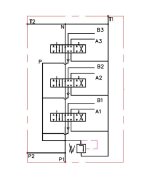
That is kind of what I thought early on, but when I did some asking around and other "research", some said, including the vendor, that Tank must go to tank in all cases. Some mentioned some valves are not built to handle full pressure everywhere internally. I just accepted those statements without really thinking about it, but remained a bit puzzled. Only have the schematic (below) to go by, no idea of the valve internals. I would tend to think the PB should block the T ports (goes into "N") otherwise it would "short" the next in line, but who knows, maybe they are concerned about leakage past internal seals?

I suppose I can hook every thing up with a temporary line from the Tank port to the tank fill and see what happens when I fire it up. If nothing comes out at "center" I
can put the implement through a couple of cycles and watch for any fluid out.

The diagram is for a 3 spool, but same for all, I guess.

mon-block-schematic.jpg
 
Last edited:
   / adding hydraulic thumb kubota B21 #13  
Thanks. I can see that being the case when the valve is the last one "in line", but these will each have a PB port in play so when not actuated most, hopefully all, of the flow should be directed to the next valve, right?

Regardless, if I just size them the same as existing tank lines it should be fine. I can see it would be foolish or false economy anyway, to size smaller.

joe a.

No. That's not correct. I see the problem. Assume that the PB is not involved in return flow. In fact, begin by considering a spool valve assembly that doesn't have a PB at all.

Instead, think of it this way: Every valve assembly - in fact every spool valve within an assembly - will have its own return path which is opened by the movement of the spool. Moving the valve spool always does two things simultaneously - it provides pressure to one end of the cylinder and also provides a return path for fluid from the other end of that cylinder.

To help visualize this, think on what it means when you are not moving the spool valve. When the spool is centered, the oil that is going to become the return oil is trapped in the cylinder because it cannot get past the spool valve to go anywhere. In fact, that trapped oil is helping to hold the loader arms and bucket from flopping as you drive.

Now take another look at your valve schematic. Follow the arrows inside the schematic as the spool valve is moved back and forth. You will see that the arrows are dead-ended until the spool valve is moved laterally. Unfortunately, hydraulic schematics almost never illustrate how the ports line up when the spool is moved laterally. I wish that they did; but you have to either draw it out or use your imagination.

Back in 2017, "www.FluidPowerWorld.com" published a 10 or 20 part monthly tutorial on reading hydraulic schematics. It is inspired teaching and very readable.
starts with:
Hydraulic symbology 101: Understanding basic fluid

I've heard that some folks have successfully used the PB port as a return port, but that is not its function, & connecting it that way doesn't give dependable results. Some valves will work that way and others won't. Most won't. It depends on their internal construction.
At this point in your understanding I think you should just accept that the PB and the Tank return should be completely different circuits. That is simplest.
rScotty
 
Last edited:
   / adding hydraulic thumb kubota B21 #14  
Tank must go to tank in all cases. Some mentioned some valves are not built to handle full pressure everywhere internally.
There are many different types of valves. If the specific valve requires tank(atmosphere drain) then YES it requires it. But this is not the case for all valves. Take this Summit 3rd function valve with EXACTLY FOUR ports. NO tank here. And note that some valves can do BOTH - in this case the valve will typically have a cavity that is shared by tank & PB, and if you want PB (eg pressurized output/return, you need a power beyond "sleeve" adapter

I suppose I can hook every thing up with a temporary line from the Tank port to the tank fill and see what happens when I fire it up.
I STRONGLY recommend against experimenting here. As tough as it is to figure out the specifics, you simply do NOT want to mess with 3000psi unless you're sure you have it wired correctly!
 
   / adding hydraulic thumb kubota B21
  • Thread Starter
#15  
There are many different types of valves. If the specific valve requires tank(atmosphere drain) then YES it requires it. But this is not the case for all valves. Take this Summit 3rd function valve with EXACTLY FOUR ports. NO tank here. And note that some valves can do BOTH - in this case the valve will typically have a cavity that is shared by tank & PB, and if you want PB (eg pressurized output/return, you need a power beyond "sleeve" adapter


I STRONGLY recommend against experimenting here. As tough as it is to figure out the specifics, you simply do NOT want to mess with 3000psi unless you're sure you have it wired correctly!

Point taken.

The vendor has stated I need to hook up the Tank return, so that should have been the end of it, regardless of my own concerns. Not fully understanding "why" always bugs me.
 
   / adding hydraulic thumb kubota B21
  • Thread Starter
#16  
No. That's not correct. I see the problem. Assume that the PB is not involved in return flow. In fact, begin by considering a spool valve assemble without any PB.

Instead, think of it this way instead: Every valve assembly - in fact every spool valve within an assembly - will have its own return path which is opened by the movement of the spool. Moving the valve spool does two things. It provides pressure to one end of the cylinder and it provides a return path for fluid from the other end of that cylinder.

To help visualize this, when you are not moving the spool valve, the oil that is going to become the return oil is trapped in the cylinder because it cannot get past the spool valve to go anywhere. In fact, that trapped oil is helping to hold the loader arms and bucket from flopping as you drive.

Now take another look at your valve schematic. Follow the arrows inside the schematic as the spool valve is moved back and forth. You will see that the arrows are dead-ended until the spool valve is moved laterally. Unfortunately, hydraulic schematics almost never illustrate how the ports line up when the spool is moved laterally. I wish that they did; but you have to either draw it out or use your imagination.

Back in 2017, "www.FluidPowerWorld.com" published a 10 or 20 part monthly tutorial on reading hydraulic schematics. It is inspired teaching and very readable.
starts with:
Hydraulic symbology 101: Understanding basic fluid

I've heard that some folks have successfully used the PB port as a return port, but that is not its function & connecting it that way doesn't give dependable results. Some valves will work that way and others won't. Most won't. It depends on their internal construction.
The PB and the Tank return should be completely different circuits.
rScotty

I'll be sure to go over that tutorial and have already bookmarked it. I was guessing at the lineups and meaning of the symbols, so it should help.

EDIT - BTW, It seems reasonable that in order for the over pressure relief on this valve to protect the valve (?) the Tank port MUST go to tank, rather than rely on anything past the PB port, and be able to pass full pump output, which in this case is just under 9 GPM. If that made sense. (Ignoring that the relief MAY only be to protect against operating mishaps that "spike" the pressure due to hitting something during implement motion. . .)

So, back to routing where the lines will go.

joe a.
 
Last edited:
   / adding hydraulic thumb kubota B21 #17  
I'll be sure to go over that tutorial and have already bookmarked it. I was guessing at the lineups and meaning of the symbols, so it should help.

joe a.


When learning hydraulic schematics it helped me to take the picture of the spool valves in the standard "center-off" position - which is how all schematic show them. And then take out my pencil and draw it again with the spool moved one way and then the other.

Interestingly, this whole hydraulic thread shows the difference between how technical subjects used to be taught, and how they are learned now through social media in the digital age.

It used to be that the student had a textbook that was always correct. A basic understanding of science helped, but there was never any doubt about the technical part of the text book being correct.

Today, a lot of learning is by "researching" opinions from sources online. The student trying to learn by comparing has to judge between competing opinions instead of facts. The student ends up comparing opinions that sound correct with those that are self-serving or just plain wrong. It's tough to learn that way.

rScotty
 
   / adding hydraulic thumb kubota B21
  • Thread Starter
#18  
There are many different types of valves. If the specific valve requires tank(atmosphere drain) then YES it requires it. But this is not the case for all valves. Take this Summit 3rd function valve with EXACTLY FOUR ports. NO tank here. And note that some valves can do BOTH - in this case the valve will typically have a cavity that is shared by tank & PB, and if you want PB (eg pressurized output/return, you need a power beyond "sleeve" adapter
. . .

Just to drag this out a bit more, by "do both" you mean "both", not "either", correct? That is, even with the PB sleeve, which I have installed, it still needs the tank?

That said, the sleeve looks like it would block the internal passage from the P port (pressure supply) to the T "channel", leaving the T ports still open and connected to each other internally as well as to the relief valve outlet.

Does that seem reasonable?
 
   / adding hydraulic thumb kubota B21 #19  
Just to drag this out a bit more, by "do both" you mean "both", not "either", correct? That is, even with the PB sleeve, which I have installed, it still needs the tank?

That said, the sleeve looks like it would block the internal passage from the P port (pressure supply) to the T "channel", leaving the T ports still open and connected to each other internally as well as to the relief valve outlet.

Does that seem reasonable?
It entirely depends on the valve.

I know (because I have one in hand) that W.R.Long sells a 3rd function valve with ONLY 4 ports - NO return to tank. It's generally mounted up right by your FEL valves. This valve would be perfect for your application; put it "in line" with your backhoe. Also, call them - they are the MOST helpful company I've dealt with. If you are still confused, ask to speak with the founder's son (I did, he was very knowledgable).

Other valves do require the atmospheric port. If it requires it, it requires it. I happened to talk to Summit today, it turns out ALL their valves DO require Tank. Sounds like a call to W.R.Long is in order for you :)

keep in mind - if the valve has an overpressure, it WILL require an atmospheric pressured port (eg 'Tank') - otherwise, it would be impossible for the OP valve to function!
 
   / adding hydraulic thumb kubota B21
  • Thread Starter
#20  
It entirely depends on the valve.

I know (because I have one in hand) that W.R.Long sells a 3rd function valve with ONLY 4 ports - NO return to tank. It's generally mounted up right by your FEL valves. This valve would be perfect for your application; put it "in line" with your backhoe. Also, call them - they are the MOST helpful company I've dealt with. If you are still confused, ask to speak with the founder's son (I did, he was very knowledgable).

Other valves do require the atmospheric port. If it requires it, it requires it. I happened to talk to Summit today, it turns out ALL their valves DO require Tank. Sounds like a call to W.R.Long is in order for you :)

keep in mind - if the valve has an overpressure, it WILL require an atmospheric pressured port (eg 'Tank') - otherwise, it would be impossible for the OP valve to function!

You last sentence pretty much sums it up.

I do have a WR Long solenoid valve at the FEL for the 4 in 1 bucket. It is an HVAIR D03S-2C-12D-35. Even has a metal tag with the schematic on it.

It does have a (marked) T port that seems to function as the PB port, which goes to the BH/3PTH. I think that is what set me down the path of wondering if I needed a Tank at all. Short answer, yes, I do, for the valves I bought.

BTW, that valve does specify "High Tank Port Pressure: Up to 3000 psi tank port back pressure", so, I guess that explains some of the other comments I've gotten over the course of my roller coaster ride of "learning hydraulics".

Thanks to all for all the comments.
 

Tractor & Equipment Auctions

2024 CATERPILLAR 255 SKID STEER (A52707)
2024 CATERPILLAR...
2016 Doyle 10T Tender (A56438)
2016 Doyle 10T...
2011 MAGNUM PRODUCTS LIGHT PLANT/TANK TRAILER (A58214)
2011 MAGNUM...
2016 Ford Explorer AWD SUV (A59231)
2016 Ford Explorer...
Club Car Carryall 500 Utility Cart (A59228)
Club Car Carryall...
Dump Truck Body with Tarp System (A55851)
Dump Truck Body...
 
Top