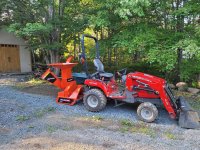
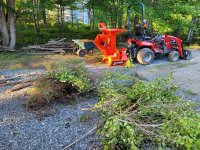
Chipper Advice on PTO Chipper

   / Advice on PTO Chipper
  • Thread Starter
#41  
Thanks guys. That helps me understand the difference but not sure what the actual practical, every day use advantage is.

Also, not sure what the disadvantage of the lower priced mechanical infeed system is.

Finally, not sure why no one seems to make one to run off of a set of remotes on the tractor. That would seem the most economical way to do it for those who already have remotes.
 
   / Advice on PTO Chipper #42  
Finally, not sure why no one seems to make one to run off of a set of remotes on the tractor. That would seem the most economical way to do it for those who already have remotes.

That is exactly how my Wallenstein Chipper works.... connect the 2 hoses to one of my remotes & it runs the Hydraulic feed.... never an issue, simple design... works great....
 
   / Advice on PTO Chipper #43  
A lot of the "does not work at slow speed" problem of the 8H is because they use a flow control valve that is too large. It's a 20gpm unit but the system is 3 gpm. When I replaced it with a 4 gpm valve (per textbook and advice here) it performs much better. I can slow it down to a crawl and set it easily for any speed in between that and max. Unlike the original one which was either max or kinda slow but not really slow, and very difficult to set to anything in between.

Woodmaxx knows the problem with their unit but I think they can't get the lower flow valves in China.
Admittedly it's not a problem for many users, so maybe they feel it's not worth the extra cost to them.
 
   / Advice on PTO Chipper #44  
The advantages of a chipper with hydraulic in-feed. You can chip twisted, angular limbs & trunks without having to cut them into smaller pieces. The hydraulically powered in-feed roller will pull the material into the chipper. Also - you can control the rate of in-feed. There is an advantage to feed slower if you are chipping very hard, dry material or max size material.

If you will be chipping straight, soft material - pine, birch, alder, cedar, etc, etc - it may not be necessary to have this hydraulic in-feed system.

I have never found a need for anything beyond mechanical feed. All the pines I chip are young, straight as an arrow and soft.

There is an advantage to a larger chipper - larger flywheel, higher air flow, larger input and output openings. This has a limit - generally, don't go beyond the recommendations of the chipper manufacturer regarding required Hp.

Another consideration. Larger chippers can handle larger material. That has a limit also. I chip my pines "whole". Butt first - no limbs removed. I chose the BX62S because it was larger but it has a 6" limit.

That is MY LIMIT also. A green pine - 25 feet long -6" on the butt is all I can manhandle. When I finish thinning a stand of young pines - it looks like a gigantic game of Pick-Up-Sticks. There can easily be 120 to 150 cut trees lying all over each other and lying in all directions.

So...... I grab a pine at the butt end and try to weave my way thru this pile without falling. I drag this pine to a growing pile from which I will eventually back the chipper up to and chip.

Dragging to a pile is the PITS. Actual chipping is fun.
 
   / Advice on PTO Chipper #45  
Keep your eyes peeled on searchtempest and Facebook marketplace. I just picked up this woodmax wm8m with 1.0 hours on it for $1400 in Wisconsin.

Gave it a quick test and it chewed a whole 6" butt poplar like nothing. I'm running it on my turbo 1620. Not sure of exact pto hp, but has to be over 30 now.
IMG_20210707_174354550_HDR.jpg
 
   / Advice on PTO Chipper #47  
Good find there. They sold it way too cheap
I had been looking for good a bit and missed 3 used units, but I got lucky on this one! The owner got a short notice transfer for work so they were liquidating the estate.
 
  • Good Post
Reactions: N80
   / Advice on PTO Chipper #48  
We use a lot of mulch. Until recently mulch was free from the county. Unfortunately they stopped their mulch program (backwards rural county can't get anything right and when they do they eventually mess that up). Purchasing mulch at the volume I want is very expensive.

Anyway, looking into pto driven chippers. I have a 45 hp tractor (about 40 hp at pto).

I don't really need one for material disposal. I need it specifically for mulch production. Material supply is not an issue. I cut my own firewood and there are always downed trees on my property.

So I guess my question is this: Will a pto chipper fill that need? If so, I am interested in recommendations on brands, models, features, things to avoid etc.

Thanks.
If you are using the larger trees for firewood. Have you looked at the Wallenstien BXM42. I just purchased a BXM32, mostly because of the shredder part. It doea a great job and the BXM42 will shred a 1 1/2 in branch into mulch and chip a 4 log without any problems.
Here is my BXM32 on a 19hp PTO.
 

Attachments

  • 20210705_191321.jpg
    20210705_191321.jpg
    5.4 MB · Views: 219
  • 20210705_194527.jpg
    20210705_194527.jpg
    6.1 MB · Views: 209
  • 20210705_203925.jpg
    20210705_203925.jpg
    5.2 MB · Views: 199
  • Good Post
Reactions: N80
   / Advice on PTO Chipper
  • Thread Starter
#49  
Update:

My Woodland Mills WC68 arrived today along with my Woodland Mills HM126 saw mill and the 16' trailer.

My wife and I assembled the chipper in about an hour and a half which included cutting the PTO shaft and filling the 5 gallon tank with hydraulic fluid. That part took a long time. It was cold and the fluid was thick and the filler hole has a wire screen in it that made pouring go very slowly.

Anyway, we got it running and ran some brush through it. Works very well. No real issues to speak of. Agree, it makes wood chips more so than "mulch" but the wood chips are what we need.

I had actual decided to buy the saw mill before deciding to buy the chipper. The clincher was that a great deal of the scraps from the mill can go into the chipper.

My daughter and her husband (they are half owners in the saw mill) will help my wife and I assemble the mill and trailer this weekend.

Side note: My Kubota L4400 (with pallet forks on the bucket) was adequate for lifting and moving the chipper (800+ lbs) and the trailer pallet (500+ lbs). It was not adequate for lifting the mill which was about 1000 pounds. It did it but it was dicey and I had to go super slow and barely breath on the joy stick inputs. I had a box blade (maybe 400 pounds) on the back and loaded tires. I think this showed the weakness of bucket forks. The loader is rated at about 1700 pounds at the pins but forks on the bucket are way out there.
 
   / Advice on PTO Chipper #50  
Congrats on the new equipment N80 !!

gg
 
  • Good Post
Reactions: N80
   / Advice on PTO Chipper #51  
Bucket forks are very useful additions. Mine are 32 inches long (80cm), which I made myself from 4 inch steel channel. They fit a european pallet perfectly but you do lose a lot of lifting power with such an extension. I find them very useful for moving piles of branches around the forest after trimming fallen trees.
 
   / Advice on PTO Chipper #52  
N80, As an owner of a WC88 and a HM130MAX stationary site setup with 23 feet of cutting capacity (2 extra bed section) you made a wise choice in Woodland Mills. I also have the blade Sharpener from them. The WC88 amazes me every time I use it. I also use a handheld V type sharpener to to pull across my WC88 chipper knifes periodically. I have never flipped them to the other side yet doing this. With the HM130MAX we lost the first two blades because they came off. The factory blade torque belvel washer setting from WM is not exact. It was too tight flush as prescribed. I now use a torque wrench set to 23 foot lbs and we have adjusted our follower wheel tracking a little and never had another problem. WM even replaced my two trashed blades after discussing my problem with them and they suggested that I use a torque wrench. No sound as disheartening as hearing a metal blade come off and trash itself before cutting wood. I call that a rocky start but now I am loving every day with my HM130MAX sawmill. I started with an Alaskan chainsaw mill and now I use it to process the large logs to get them on the 30 inch limit of the sawmill. Here is a link to the knife sharpener I use on my chipper blades in place on the disk. Takes about 10 minutes to do and really helps them stay sharp. https://www.amazon.com/gp/product/B0051OYT2U/ref=ppx_yo_dt_b_search_asin_title?ie=UTF8&psc=1
 
   / Advice on PTO Chipper
  • Thread Starter
#53  
@norshud . The manual on the mill now suggests using the torque wrench as the preferred method and to only use the belville washer system if you've calibrated and shimmed them based on the proper torque spec. What I'd heard was the original belville washer system worked well but later down the road they had to get a different manufacturer and they didn't have the same properties.

After watching tons of videos it looks like the initial setup/ learning curve can be steep. Hopefully

Thanks for the link to the blade sharpener. Looks handy.
 
   / Advice on PTO Chipper
  • Thread Starter
#54  
Bucket forks are very useful additions. Mine are 32 inches long (80cm), which I made myself from 4 inch steel channel. They fit a european pallet perfectly but you do lose a lot of lifting power with such an extension. I find them very useful for moving piles of branches around the forest after trimming fallen trees.

They are indeed handy moving brush around. And they'll be great for loading the saw mill.
 
   / Advice on PTO Chipper #55  
N80, The learning curve is steep, but worth it. My mill has 24 leveling feet and until I purchased a self leveling green laser the setup was difficult with string. Not as bad with a 12 inch square sitting on the bunk to read the laser line from side to side. I messed with the magnetic scales for a while. Now I setup my blade under tension 3 inches off the bunk and then slid my yellow actual scale to 3 inches to match the actual inches off the bunk to the blade. I then took a sharpie and marked the position of scale to the metal guide it resides in so I can easily move back to "actual inches off the bunk". I took both sets of back log stops and started with the long diagonal cut ones measuring from the peak (top) and labeled them 1 - 9 inches down with lines. That way when I set my log stops at say 6 inches I use a small magnet (one of the hook magnets I had around) I put that on 6.5 inches on my yellow scale. That way when I get carried away making board and get close to my log stop settings I get close to my magnet hook as an indicator on my scale. This will stop you from sawing your backstops unless you run over your magnet with your scale pointer. Another pointer is if you are trying to make exact boards buy you a 6 inch small square. If you are trying to make an exact 3 inch slab you can preset your square to 3 inches and lock it (reverse the way it comes so it reads inches from the bottom) set it on the top of the cant and raise your blade to touch the square. Most precision way I have encountered to insure an exact cut. Also I always go below my target lowering my blade and raise up to insure the mill has settled in the down stroke. Here is a link to the square I use to insure precise cut boards from the top of the blade to the level of the cant. It also shows you the level of the cant. https://www.amazon.com/gp/product/B005XUHI98/ref=ppx_yo_dt_b_search_asin_title?ie=UTF8&psc=1
 
   / Advice on PTO Chipper
  • Thread Starter
#56  
Great pointers, thanks. Mine is on a trailer. I understand that initial set up is difficult but that once done the trailer is pretty rigid. We will see. Fortunately my son-in-law is a surveyor. He has a good mind for this stuff!
 
   / Advice on PTO Chipper #57  
A few years ago, my father in law got several loads of chips from a commercial tree trimming company. He spread them around a half acre of pine seedlings. Within a year, the area was covered with vines and unwanted weeds, including poison ivy. In addition, a few of the seedlings contracted a fungus which eventually killed them. It was a failed experiment at best.

Lesson learned. You just don't know where these chips came from and what seeds & diseases they contain.

The same problem can occur when making your own chips. Make sure the material you feed into your chipper is "clean".
 
   / Advice on PTO Chipper #58  
Just a thought. N80 says he wants mulch. My Wallenstein chipper and most others produce chips. Not mulch. The chip size varies - based upon how dry the trees are. From - 1"x2" to 1 1/2" x 2 1/2".
 
   / Advice on PTO Chipper #59  
Mine is on a trailer. I understand that initial set up is difficult but that once done the trailer is pretty rigid.
It took two of us longer than a weekend to assemble my sawmill and trailer. But I could now do a 2nd one in half the time, of course. I installed the trailer tongue but I intend to remove it-- to prevent someone from towing my sawmill away.

Remember-- the bed needs to be flat, not necessarily level. (Although level is good.) If it's a little out of level, that's just an upslope/downslope thing that won't affect cutting accuracy. But the bed must be flat to accurately cut boards.

Finally, avoid the rookie mistake I did. Silly me, I cut 2x6 lumber at ... 2 inch by 6 inch. You want to add a little for shrinkage as it dries-- so cut at maybe 2 1/8 by 6 1/8.
 
   / Advice on PTO Chipper #60  
You just don't know where these chips came from and what seeds & diseases they contain.
I have some pine trees with gall rust. I was advised to cut them down and burn them. Chipping them would only propagate the disease further ...


Tractor & Equipment Auctions

2019 CATERPILLAR 326FL EXCAVATOR (A52709)
2019 CATERPILLAR...
2013 Land Rover Range Rover Sport 4X4 SUV (A55853)
2013 Land Rover...
2008 Ford Fusion SE Sedan (A59231)
2008 Ford Fusion...
2017 Caterpillar 249D Compact Track Loader Skid Steer (A59228)
2017 Caterpillar...
2021 CATERPILLAR 308CR EXCAVATOR (A60429)
2021 CATERPILLAR...
YANMAR VIO35-6A EXCAVATOR (A59823)
YANMAR VIO35-6A...
 
Top