Ammeter question....

   / Ammeter question....
  • Thread Starter
#61  
I have found a schematic from the IH 1066 Hydrostatic;
https://cdn.compknowhow.com/carterandgruenewald/wiring_diagrams/IH 66 SERIES.pdf

The + from starter (battery) goes to plus on Amp meter, the minus from the Amp meter goes to alternator "B".

It looks to me that the Amp meter shows the lights current from the battery when the tractor is not running and key switch of , and the amp meter shows charging amps only when tractor is running

Then may I conclude that it's showing me what it should be showing?

That would seem to fit what I'm seeing.... key/engine off, lights on meter showing nothing because lights are riding on battery power. Engine running, it shows alternator trying to charge battery and when the lights are on, (powered by the battery) the alternator is putting out more power to feed the battery.

If I moved (whichever wire is feeding juice to the lighting system) to the OTHER Ammeter post, would that shift those items from the battery power to the alternator power?


Big question..... "does it really matter???"
 
   / Ammeter question.... #62  
Then may I conclude that it's showing me what it should be showing?

That would seem to fit what I'm seeing.... key/engine off, lights on meter showing nothing because lights are riding on battery power. Engine running, it shows alternator trying to charge battery and when the lights are on, (powered by the battery) the alternator is putting out more power to feed the battery.
If I moved (whichever wire is feeding juice to the lighting system) to the OTHER Ammeter post, would that shift those items from the battery power to the alternator power?

Big question..... "does it really matter???"

Meh...does it matter on most of late model vehicles that don't even have a temperature gauge, let alone a voltage (or ammeter) gauge???
I think the only differences you see are:
If alternator stops working, gauge will show zero amps coming out of alternator, instead of negative amps (discharge from) battery.
If you somehow had more electrical load than the alternator could supply, meter would show a very positive reading (of maximum alternator output) even though the battery is unknowingly being discharged.
 
   / Ammeter question.... #63  
Then may I conclude that it's showing me what it should be showing?
Yes and No. It is showing you what it should for how it is wired.
It is NOT showing you what it is intended to show you. It should be showing you if the battery is charging or discharging, right now it only shows you if it is charging, it will not warn you if the alternator is not putting out enough power to keep up with the load and charge the battery, the ammeter will just sit at 0 amps as the battery dies (and be hard to distinguish from a case where the alternator has the battery charged and there is little or no load on the alternator.

That would seem to fit what I'm seeing.... key/engine off, lights on meter showing nothing because lights are riding on battery power. Engine running, it shows alternator trying to charge battery and when the lights are on, (powered by the battery) the alternator is putting out more power to feed the battery.
Correct.

If I moved (whichever wire is feeding juice to the lighting system) to the OTHER Ammeter post, would that shift those items from the battery power to the alternator power?
Big question..... "does it really matter???"
Yes and (IMO) yes.
The idea behind the ammeter is that EVERYTHING except for the starter connects to the alternator side of the ammeter.
That way if the alternator fails, you can see that the battery is discharging via the ammeter whereas now (with the lights and other loads on the battery side) you wont see anything, the ammeter will just sit at 0 amps as the battery dies.


Aaron Z
 
   / Ammeter question.... #64  
^^ But I understood him to say the ammeter was in the positive while running, and went even further into the positive when he turned on his lights. That would mean it wasn't sitting at zero, and it is an indicator to show how much of a charge is being required. Isn't it? Maybe I'm confusing his with how mine works on my old 850. On mine, the more the battery is drawn down, the higher the ammeter goes into the positive. Right after starting it rises somewhat. If I turn on the lights it rises more. If I turn off the lights it drops some, and after running the tractor a bit, the needle drops to near zero. I use that to indicate I have a good charge on my battery again and can expect an easy restart when needed.
 
   / Ammeter question.... #65  
Gads is this going to end up like "frozen" drain plug that when 342 pages and still don't know if it was ever fixed.... The exact/correct explanation has been stated several times.....

Dale
 
   / Ammeter question.... #66  
^^ But I understood him to say the ammeter was in the positive while running, and went even further into the positive when he turned on his lights. That would mean it wasn't sitting at zero, and it is an indicator to show how much of a charge is being required. Isn't it? Maybe I'm confusing his with how mine works on my old 850. On mine, the more the battery is drawn down, the higher the ammeter goes into the positive. Right after starting it rises somewhat. If I turn on the lights it rises more. If I turn off the lights it drops some, and after running the tractor a bit, the needle drops to near zero. I use that to indicate I have a good charge on my battery again and can expect an easy restart when needed.
The problem is that when the lights are on (with the engine off) the ammeter never goes into the negative range. Thus the lights are on the battery side of the meter and the meter will never show if the alternator is malfunctioning, or if it is unable to keep up with the load.

Aaron Z
 
   / Ammeter question.... #67  
The problem is that when the lights are on (with the engine off) the ammeter never goes into the negative range. Thus the lights are on the battery side of the meter and the meter will never show if the alternator is malfunctioning, or if it is unable to keep up with the load.

Aaron Z

Ok I got it. I didn't catch you were talking about the engine being off in that case. Thanks for the explanation.
 
   / Ammeter question.... #68  
Yes, it will probably end up the same way. Correct information was offered along with a schematic, but folks can't read or don't want to. Then we sit and argue about reference points. :confused2: So I've removed my posts and say good luck. I'll read all the posts for a while for the entertainment value. Typical forum junk, rant over.

Dale, nice signature, "....You are free to ignore them if you wish ..."

I've never removed a post. When that's done any responses to that post seem idiotic. So everyone wonders what the subject is and what the response means.

Two things I dislike. Removing posts after replies. Editing posts after replies.
 
   / Ammeter question.... #69  
I enjoy all posts until the tread dies or I loose interest. If one does not agree or like a post or thread, either explain one's idea or just don't read it and rest in peace.
 
   / Ammeter question.... #70  
I enjoy all posts until the tread dies or I loose interest. If one does not agree or like a post or thread, either explain one's idea or just don't read it and rest in peace.

You are a wise man Mike. :)
 
   / Ammeter question.... #71  
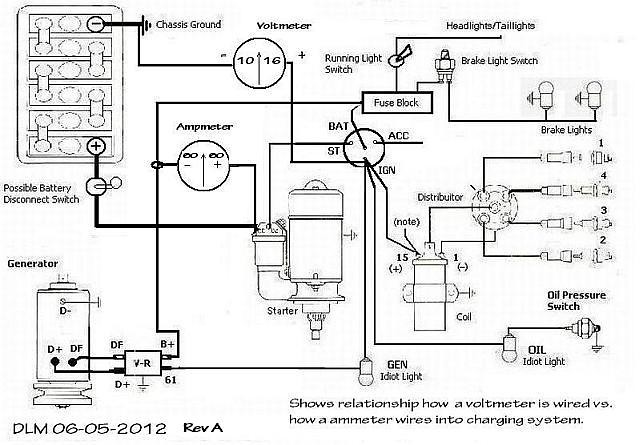
This is "concept" on how a voltmeter and/or ammeter should be wired....

9274209575_8f01390ea2_z.jpg


Does not matter if car or truck or tractor or bus or gas engine or diesel... Electrical are electricals...

Dale

OP, Richard: With reference to the Schematic attached by DL Meisen, I think your ammeter is connected in the lower portion of the vertical line shown rising from the Voltage regulator - instead of in the horizontal line, above there, that branches from it over to the starter.

This would explain the symptoms you are describing. -- Your ammeter is measuring the full current from the ammeter instead of the net current (as it should) to the battery.​
 
   / Ammeter question.... #72  
This is "concept" on how a voltmeter and/or ammeter should be wired....

9274209575_8f01390ea2_z.jpg


Does not matter if car or truck or tractor or bus or gas engine or diesel... Electrical are electricals...

Dale


The battery disconnect switch in this schematic is wired in the plus wire and should't be.
For optimum safety the battery disconnect should be wired into the ground wire, same cost more safe.
 
   / Ammeter question.... #73  
The battery disconnect switch in this schematic is wired in the plus wire and should't be.
For optimum safety the battery disconnect should be wired into the ground wire, same cost more safe.

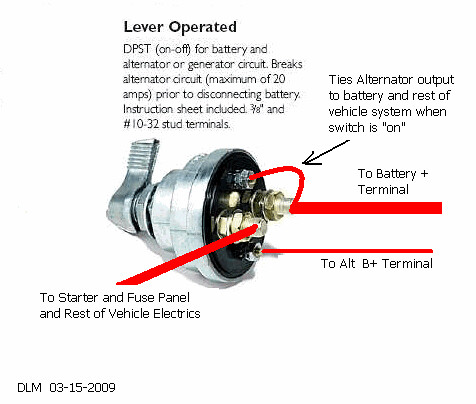
Not relevant to discussion about ammeter.... ls relevant to application.... So what happens on a lot of VW engines (and not just VW engines) with alternators there is a condition called run on, where there is enough voltage leak through ALT LAMP that will keep coil energised and engine will not shut down allowing alternator to power system minus battery... It require actually disconnecting B+ output of alternator to battery to kill engine.... This is basically why most people upt disconnect switches in Positiv eebattery cable....

3949687656_8117bd5c99.jpg


And the is this....

443 Master Battery Cut-Off Switch Wiring Instructions | Pegasus Auto Racing Supplies

Or this...

Longacre 4-Terminal Kill Switch Instructions | Pegasus Auto Racing Supplies

IN the end all that is really relevant is you open the power loop from negative battery terminal through electrical system back to positive terminal if battery.. It prevents a internal leak that can drain battery and can act as a theft deterrent if dumb thief can not fine disconnect switch and turn it on....

Dale
 
Last edited:
   / Ammeter question.... #74  
Not relevant to discussion about ammeter.... ls relevant to application.... So what happens on a lot of VW engines (and not just VW engines) with alternators there is a condition called run on, where there is enough voltage leak through ALT LAMP that will keep coil energised and engine will not shut down allowing alternator to power system minus battery... It require actually disconnecting B+ output of alternator to battery to kill engine.... This is basically why most people upt disconnect switches in Positiv eebattery cable....

3949687656_8117bd5c99.jpg


And the is this....

443 Master Battery Cut-Off Switch Wiring Instructions | Pegasus Auto Racing Supplies

Or this...

Longacre 4-Terminal Kill Switch Instructions | Pegasus Auto Racing Supplies

IN the end all that is really relevant is you open the power loop from negative battery terminal through electrical system back to positive terminal if battery.. It prevents a internal leak that can drain battery and can act as a theft deterrent if dumb thief can not fine disconnect switch and turn it on....

Dale

Most technicians do it wrong and put the battery disconnect in the PLUS. ( on a vehicle with minus = ground)

Think of this; a person is diving a race car. The battery disconnect is on the mudguard were it can be reached from the seat and from the outside.
The car is in an accident and the driver is stuck, the battery ignites the car. The first responders turn of the battery disconnect and try to extinguish the fire but the battery keeps igniting the vehicle. The driver dies.
Why ? Because the battery cut of switch was not in the ground wire.

Dale; I know this is a tractor forum, not a racing forum. But don't say that in the plus or in the ground is the same. It is not! I hope my example explained.
 
   / Ammeter question.... #75  
Most technicians do it wrong and put the battery disconnect in the PLUS. ( on a vehicle with minus = ground)

Think of this; a person is diving a race car. The battery disconnect is on the mudguard were it can be reached from the seat and from the outside.
The car is in an accident and the driver is stuck, the battery ignites the car. The first responders turn of the battery disconnect and try to extinguish the fire but the battery keeps igniting the vehicle. The driver dies.
Why ? Because the battery cut of switch was not in the ground wire.

Wish you can supply supporting documentation to your argument... You seem to be ignoring mine....

Dale; I know this is a tractor forum, not a racing forum. But don't say that in the plus or in the ground is the same. It is not! I hope my example explained.

Wish you could supply supporting documentation for your statements... You seem to want to ignore my documentation...

Polarity has nothing to do as if switch goes open circuit or not....... We discovered we needed to put switch in positive side after incident at auto X track after a car actually had cause use disconnect and engine did not kill... It was discovered that there was a run-on situation because of alternator output.... You can put switch in negative all you want but if alternator continues to put out voltage and since alternator frame is grounded it is perfect power supply to run engine (battery excluded) ... One has to wire cutoff switch so It functions as intended not by archaic rule that may make non operational...

Don't care if its a tractor or race car or street drive performance car it has to function as intended, poliarity does not matter....

I worked tech inspection at auto X track off and on for over 10 years.... You would be surprised how many times I picked a car at random and said "start it up" and they did, I went to cutoff switch and flipped it, many times car did not shut off..... It's not polarity dependent its application dependent...

Its just like people don't understand you need some sort of safety switch on electric fuel pumps so in situation where engine dies (car stall because of crash) you need to have cutoff for fuel pump... IF driver is unconscious, and can not turn off ignition and fuel pump continues to run it can spew fuel out till tank empty, do you want big puddle of fuel around car crash scene... That is why almost all electric fuel pump need a safety switch of some sort so if engine dies it shuts down fuel pump... Some cars use impact sensor as disconnect, some use pulses from electronic or mechanical ignitions.... When people convert from mechanical fuel pumps to electrical (non ECM cars) our group always recommends something like this...

Fuel Pump Safety Switch


Dale
 
   / Ammeter question.... #76  
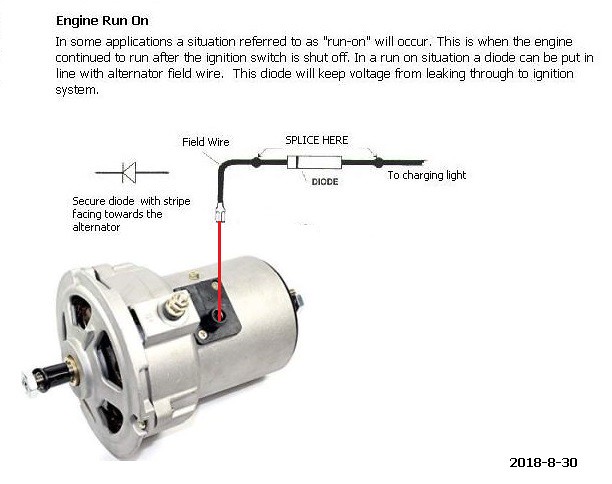
In the world of tractors (not race cars) run on can be a problem when alternator conversions are done. A simple charge indicator lamp in the excitation circuit typically provides sufficient resistance to alleviate the problem. A diode in the circuit accomplishes the same thing. Both are passive cures that require no though or action.
 
   / Ammeter question.... #77  
In the world of tractors (not race cars) run on can be a problem when alternator conversions are done. A simple charge indicator lamp in the excitation circuit typically provides sufficient resistance to alleviate the problem. A diode in the circuit accomplishes the same thing. Both are passive cures that require no though or action.

Most definitely....This is solution popular in VW world...

42567742460_f57bbe9acc_z.jpg


Dale
 
   / Ammeter question.... #78  
I have started a new post in Safety. "Battery disconnect switch" it explains why the switch is best put in the ground wire.
 

Tractor & Equipment Auctions

GRID SHAPED BUCKET FOR MINI EXCAVATOR (A58214)
GRID SHAPED BUCKET...
25 DUAL AXLE GOOSENECK TRAILER (A55745)
25 DUAL AXLE...
2025 MMS MS36C (A53317)
2025 MMS MS36C...
2006 CATERPILLAR 304C (A58214)
2006 CATERPILLAR...
2021 Unverferth 432 Rigid 4 Row 36-inch 3PT Ripper Bedder (A56438)
2021 Unverferth...
2013 Frieghtliner with Altec Bucket Model LR760 (A56438)
2013 Frieghtliner...
 
Top