Any one use these quick links

/ Any one use these quick links #1  

Eric_Phillips

Platinum Member
Joined
May 16, 2005
Messages
714
Location
Rochester, NY
Tractor
FarmTrac 270DTC
I am looking for some quiklinks to help in connecting my safety chains to the hitch. Still not sure why no one has figured out how to make a hook that easily connects to a class III hitch. Below is the link to the quicklinks I am considering. My concern is these seem to have a higher WLL than any other I have found.

Amazon.com: Stainless Steel 316 Quick Link 9/16" (14mm) Marine Grade: Industrial & Scientific

This is to connect a new camper to my minivan. The camper is rated at just under 3100lbs. The van has a towing capacity of 3500lbs. The tags on the safety chains said WLL 7700lbs. These chains seem to be extreme overkill. From what I have read is the total chain break strength for the 2 safety chains added together must be equal or greater than the weight of the trailer. I am thinking a 3/8" or 1/2" quicklink might be easier to work with the hooks on my safety chains than the 9/16". That would bring the WLL to 3950lbs or 5500lbs. That is still more than required. I know it would make the quiklink the weakest link but do I need to keep over engineering something just because the person before me did?
 
/ Any one use these quick links #2  
Will a screw pin anchor shackle work? I would try to match the rating of the chain. While it may not be necessary legally it would be nice to have a single chain be able hold in case of an accident.
 
/ Any one use these quick links #3  
I use them on a regular bases and love them but not on safety chains. Seems they may work to attach the hooks just fine.
 
/ Any one use these quick links #4  
Will a screw pin anchor shackle work? I would try to match the rating of the chain. While it may not be necessary legally it would be nice to have a single chain be able hold in case of an accident.

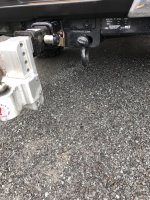
This is what I did because the shape of the safety chain holes on a 2017 F250 are not conducive to any kind of a proper sized hook.

IMG_9274.JPG
 
/ Any one use these quick links
  • Thread Starter
#5  
I was also considering screw pin shackles. My concern with them is the possibility of them coming unscrewed while bouncing down the highway. I have found a bolt type with a nut and cotter pin which would fix that problem. The quick links could be situated such that gravity would keep the nut closed. I am wanting these to be relatively easy to remove since the hitch is only 7" above the ground. When I am not towing I want to be able to remove them so they don't hit the ground over bumps and such.
 
/ Any one use these quick links #7  
I was also considering screw pin shackles. My concern with them is the possibility of them coming unscrewed while bouncing down the highway.

That's what the hole in the pin is for. :D

shackle-safetywire.jpg


Bruce
 
/ Any one use these quick links
  • Thread Starter
#8  
/ Any one use these quick links #9  
This is what I did because the shape of the safety chain holes on a 2017 F250 are not conducive to any kind of a proper sized hook.

View attachment 555276

A good way to use that shape hole is to pass the hook through the hole and hook it back into the chain, assuming your hook will hook into a link. This is also the best way to adjust the length of the chain so it's not too tight, not dragging.
 
/ Any one use these quick links #10  
A good way to use that shape hole is to pass the hook through the hole and hook it back into the chain...
Hey, I'm no expert, but you should never hook to the hitch. As BeeferMan says, pass the chain through the hole in the hitch and attach the hook over a link (not THROUGH a link!). Then use the quick link, in a totally non-load bearing way, to hold the hook to the chain. The quick link is not intended to be a chain extension.
 
/ Any one use these quick links #11  
A good way to use that shape hole is to pass the hook through the hole and hook it back into the chain, assuming your hook will hook into a link. This is also the best way to adjust the length of the chain so it's not too tight, not dragging.

Not happening. Didn't like the flimsy factory chain and S hook. Replaced with a larger, stronger hook & chain. No way it's going through that hole.
 
/ Any one use these quick links #12  
Keep in mind that in case of something going wrong there is a good chance that only ONE safety chain will take the impact at a time. The chances of both chains taking a impact at exactly the same time is slim. So ONE chain and its fasteners needs to be able to take some force.
Once the trailor is loose then its likely going to zig zag back and forth sideways for a bit, once again with one chain taking the impacts at a time.
For the times speed bumps and such might cause the chain to drag you can use put a bungee cord or such on the chains and strap them up to the trailor frame or hitch as needed. Keeps them from dragging and if something goes wrong the chains will still do their job.
 
/ Any one use these quick links #13  
If your chains ever drag they are way too loose. They only need 3-4 inches less than tight, so you can turn. I don't like seeing tongues with a semicircle of chain hanging down to a few inches above the road, but it is common.

Bruce
 
/ Any one use these quick links
  • Thread Starter
#15  
I didn't think my chain and hook would fit through the hole but they actually do. The hooks are S-hooks with keepers so I can't use this method to adjust the chain length since the chain will slide through the hook. I will have to see what the chain length is going to be like. I am planning on installing an Anderson W/D hitch so that will change the length needed. I still can't figure out what you are supposed to do with the quick links if they are not weight bearing.
 
/ Any one use these quick links #16  
Many quick links are unmarked. Others have a WLL stamped on them. I use the stamped ones on my safety chains.

Bruce
 
/ Any one use these quick links #17  
Keep in mind that in case of something going wrong there is a good chance that only ONE safety chain will take the impact at a time. The chances of both chains taking a impact at exactly the same time is slim. So ONE chain and its fasteners needs to be able to take some force.
Once the trailor is loose then its likely going to zig zag back and forth sideways for a bit, once again with one chain taking the impacts at a time.
For the times speed bumps and such might cause the chain to drag you can use put a bungee cord or such on the chains and strap them up to the trailor frame or hitch as needed. Keeps them from dragging and if something goes wrong the chains will still do their job.

I'm not sure this is entirely correct (though I agree the chains should be sized to handle max load individually). If the chains are crossed under the trailer tongue and the trailer comes unhitched, won't it be cradled on the crossed chains, thereby spreading the load across both chains?
 
/ Any one use these quick links #18  
I'm not sure this is entirely correct (though I agree the chains should be sized to handle max load individually). If the chains are crossed under the trailer tongue and the trailer comes unhitched, won't it be cradled on the crossed chains, thereby spreading the load across both chains?

I often see crossed chains that are so slack they are a couple of inches above the road. No way they will cradle the tongue.

Bruce
 
/ Any one use these quick links
  • Thread Starter
#19  
In a perfect world both chains would support the trailer should it come unhitched. In reality both chains are rarely equally tensioned. Even in a straight line if one chain is a little looser than the other the tighter chain will take either all or most of the force.
 
 
Top