Anyone have experiences with Timber Block homes?

   / Anyone have experiences with Timber Block homes? #1  

MGH PA

Gold Member
Joined
Oct 25, 2010
Messages
280
Location
Northcentral, PA
Tractor
2005 Gravely 148Z 48" ZTR
My wife an I are in the very early stages of planning our future home build and are just exploring some options. I've been saving plans, images, etc., for a few years to help better plan. Now that we're about 1-2 years out from building, we're starting to examine builders in our area. We're setting up appointments in the coming weeks to begin interviewing.

This leads me to my question. A local builder here deals with Timber Block homes (Timber Block | Engineered Log Homes). At first, I was really against such a system, but I'm starting to look into this a little more after reading about it online in a few other publications.

Do any of you have experiences with this system? Would love to hear everyone's thoughts (both good and bad).
 
   / Anyone have experiences with Timber Block homes? #2  
Your gut is right- I’d stay away IMHO. A fake log look on a SIPS doesn’t sound good at all. SIPS are a PTIA Plus, the log home is a never ending maintenance hassle- beyond about any other construction method. SIPS and log homes have been around for years- if they worked everyone would be doing it. This timber block is just the latest rebranding of a failed residential construction method.

Btw- SIPS does have its place in a commercial environment.
 
   / Anyone have experiences with Timber Block homes? #3  
Standard stick frame built homes are the most common type of home construction for a very good reason. It's the most economical. It's also the most flexible. You can make it as fancy as you want, or as simple as you want.

Any time you go with a different method, you have to deal with issues that nobody else has to deal with. Usually more maintenance once it's done and more expense to build it.
 
   / Anyone have experiences with Timber Block homes? #4  
I agree with both above. If you want a well insulated home (sips primary advantage) spend your money on spray foam & high performance windows & doors in/on a conventionally framed house. That will keep you with all locally based subs throughout the whole process. Sip's require a well trained (expensive & specialized) crew for panel erection. There are some EXTREMELY important construction details necessary to protect the panels, I won't go into that but it's moisture related (de-lamination & rotting of the panels) . Then there is all your trade's, the plumber, electrician & hvac are the highly effected but it go's all the way down the line with maybe the foundation, flooring & painting guy's (price) being unaffected.
 
   / Anyone have experiences with Timber Block homes? #5  
I don't know this particular system, but i did SIPs for my walls. They are great, IMO. Was it probably a bit more expensive than stick framing? Not sure as i never quoted stick. Any SIPs company will know firms that do erection, so that is not a big deal. They go up super fast. The only real downside is wiring is more of a PITA, but there are strategies to minimize the pain. It doesn't really affect any other trades, so not sure where you get that from. Nobody puts plumbing in an exterior wall in any northern climate, except perhaps an occasional vent line, but there are typically ways around that easily enough. Same with HVAC. Most all utilities other than electric are run in interior walls and floors only. The added bonus is easy to hang whatever you want anywhere as the continuous OSB is behind all the drywall. Drive a screw anywhere you want. Very airtight and well insulated in one step. Now i did not do SIPs roof as that became significantly too complicated with my roof design, so it was just trusses with raised energy heels. Then a thin coat of foam to seal everything, and blown-in on top. No comments on the log aspect of it as i have no experience with it.
 
   / Anyone have experiences with Timber Block homes? #6  
My current home is a log home, and my wife and I will probably never live in a stick built home again. I have no experience with Timber Block other than seeing their ads in Log Home Living, but R30 walls and R40 roof is nothing to complain at. I do like the look of their hand peeled log exterior. Most of your neighbors in PA in stick built probably have R19-21 2x6 wall construction. I would not dismiss them because they don't use common construction, but I would visit their models, and if you can, talk with other owners.
 
   / Anyone have experiences with Timber Block homes?
  • Thread Starter
#7  
My current home is a log home, and my wife and I will probably never live in a stick built home again. I have no experience with Timber Block other than seeing their ads in Log Home Living, but R30 walls and R40 roof is nothing to complain at. I do like the look of their hand peeled log exterior. Most of your neighbors in PA in stick built probably have R19-21 2x6 wall construction. I would not dismiss them because they don't use common construction, but I would visit their models, and if you can, talk with other owners.

Sort of my thoughts. Everyone here does run of the mill block wall basements (with no exterior insulation), 2x6 walls/r21 fiberglass, OSB everything (more builders are using the ZIP variety at least now), and cheap vinyl siding. I don稚 want run of the mill, and I want energy efficiency.

We were considering a timber frame (still haven稚 written it off) and Woodhouse is only an hour from here and they own Murus panels (they make SIPS). Was very impressed with the technology, but you would definitely need a crew who knows what theyæ±*e doing.

Thanks for the insight, though, everyone. I will be interviewing quite a few builders in the future to see what experience they have with energy efficiency construction. This was just one option and I saw that a local builder was a rep/installer for them as well.
 
   / Anyone have experiences with Timber Block homes? #8  
Sort of my thoughts. Everyone here does run of the mill block wall basements (with no exterior insulation), 2x6 walls/r21 fiberglass, OSB everything (more builders are using the ZIP variety at least now), and cheap vinyl siding. I don稚 want run of the mill, and I want energy efficiency.

We were considering a timber frame (still haven稚 written it off) and Woodhouse is only an hour from here and they own Murus panels (they make SIPS). Was very impressed with the technology, but you would definitely need a crew who knows what they?*e doing.

Thanks for the insight, though, everyone. I will be interviewing quite a few builders in the future to see what experience they have with energy efficiency construction. This was just one option and I saw that a local builder was a rep/installer for them as well.

We built a timberframe home 4 years ago but didn't use sips. I wanted piece of mind that if the roof ever leaked or if we had siding issues it could be easily fixed.
We closed in the home with traditional framing using 2x4 walls, 2x6 roof, and insulated the cavities completely with closed cell spray foam. 2x4 walls because anything more than 3-1/2" of closed cell foam seemed to be a waist in the walls. There just wasn't an added benefit vs cost to increase the wall and foam thickness.
For the basement no exterior insulation, just sprayed 2" of closed cell on the interior walls.

I'm not sure we saved a ton of money this way due to the cost of closed cell insulation however we ended up with a home that is extremely energy efficient for its size and complexity and don't have to worry about the long term reliability of sips. Total of 3600 sq/ft+- on the first two floors plus finished basement. Our ACH50 when blower door tested was 1.9. The house is very open with 26' living room ceiling and our fireplace in the living room will heat all but the furthest bedroom down to about 20 degrees outside. We have been extremely pleased with the envelope performance. In fact the only issue we had was our HVAC guy really missed the mark and way oversized our HVAC needs.

Jeremy
 
   / Anyone have experiences with Timber Block homes? #9  
When talking energy efficiancy, you have to be careful of what you are hearing. It is very common to twist ratings around to make something seem better then something else. In a house, there are two different things happening when talking insulation and energy efficiency. The first, and easiest is that heat rises, so insulating the attic is the easiest to understand. Foam is the best because it also seals off air. If you can afford it, and if you will be in the house long enough to see the return on your investment, it's a great product. It's also very good if you have vaulted ceilings or a thin distance between your exterior roof and interior ceiling. For a lot less money, I like blown in insulation in an attic. The latest standard is R60, which is about 2 feet thick. It should look like fresh snow when done, and it should never be disturbed. This is also why I never like putting the AC system in the attic, and never store anything up there. Attic space should only be used for insulation in my opinion.

I'm also very much against skylights. While there may have been an argument at one time that it's cheaper to have a skylight to light up a room during the day then to turn on a light bulb, that argument doesn't work anymore with LED lights. There is never a good reason to have a skylight. It's just a massive hole in your ceiling that has almost no R value. And while people selling skylights like to tell you they have solved all the leaking problems, or it leaked because it was installed wrong, I believe that they will all leak sooner or later. Just say no to skylights.

Wall insulation is where things get really confusing. It's actually very simple, but people selling products have muddied it up so much that it's easy to over think and confuse what's happening with the exterior walls. First, the force that you are fighting with the walls is wind. Wind gets through your walls and defeats the insulation that you have there. The number one goal of an exterior wall is to keep the wind out. Bricks allow a massive amount of wind through them. House wrap is pretty good at stopping the wind, but it needs to be taped and sealed up everywhere. Zip siding is better then house wrap, but it's quite a bit more expensive then standard OSB and house wrap. My house has Zip siding and when I build my addition, it will have Zip siding. I feel that expense is worth it.

From what I'm reading in the trade magazines that I get, rubberized paint type products are probably going to be the future in home building. They are using it more and more around windows instead of tape. I'm also reading that they are rolling it on the entire exterior of the the OSB or plywood, covering every inch to achieve the highest level of efficiency. There have been all sorts of studies done on double framed walls with foam between the studs to stop therm jumping, and then building with SIPS to get an even higher R value, but none of those very expensive methods actually achieve anything above a certain point that you already get when super sealing the exterior walls with something like Zip system or rubberized paints. Another huge consideration is that every double pained window has an R value of 3 or less. What good is making your wall R30 when you have a big opening that is only R2.5? You can get three pane, and I know one guy who lived close to a major airport that got 4 pane glass. The price is crazy, but you do notice a difference in sound. He didn't see any change in his energy bill after those windows where installed, but the rest of the house was well insulated, and he really didn't have any issues with his 2 pane windows before going to 4 pane. It was all for sound.

In all reality, you will never notice any difference in your wall insulation going above R19 if your walls are air tight and able to keep out the wind. If the wind can get through your walls, it wont matter what you use on your walls, they will not insulate.

Solid logs are not great at insulating for walls. But that's not that big of a deal if they are able to keep the wind out. Your chinking, or sealing off the air is all that matters. Log companies claim that the thickness of their logs is what does the job, but that's just a sales gimmick. Keeping the wind out is all that matters.

Going with alternative building methods is for those who want something special and unique. Not for somebody wanting to build an energy efficient home with limited funds.

I had a friend back in CA who was into riding mountain bikes. He was fifty pounds overweight and not what anybody would consider an athlete. But he really liked riding and he didn't think he was overweight at all. So to make up for not being able to keep up with his friends, he spent a fortune on things to make his big better and lighter. His seat cost him $600 and it was several ounces lighter then anybody else's. He spent more, felt better about it, but that didn't make him any better and keeping up with is friends. Houses are the same way. You can spend a lot more on products that sound good, may be the latest "thing" and you see on TV, but they don't actually make any real world improvement to your home.

When planning your home, focus on the floor plan, storage, usable square footage, curb appeal and resale value. Read up on what's available to make it something you will enjoy living in, and last the longest with the least amount of work. You mentioned vinyl siding, what about going with Hardie siding instead? Rock is becoming more and more affordable. Exposed beams, cedar posts, and trim add a lot to the look of a home without adding a lot of expense. Forget the alternative building methods, they will just lead you down a hole that is impossible to get out of.
 
   / Anyone have experiences with Timber Block homes? #10  
Sort of my thoughts. Everyone here does run of the mill block wall basements (with no exterior insulation), 2x6 walls/r21 fiberglass, OSB everything (more builders are using the ZIP variety at least now), and cheap vinyl siding. I don稚 want run of the mill, and I want energy efficiency.

We were considering a timber frame (still haven稚 written it off) and Woodhouse is only an hour from here and they own Murus panels (they make SIPS). Was very impressed with the technology, but you would definitely need a crew who knows what theyæ±*e doing.

Thanks for the insight, though, everyone. I will be interviewing quite a few builders in the future to see what experience they have with energy efficiency construction. This was just one option and I saw that a local builder was a rep/installer for them as well.

If the energy efficiency is what you are after I’d check out the building science website. They are an Independant outfit so you won’t get the salesman spin.
With some exterior rigid foam and blown cellulose your new home will be right up there with the best of the best.
Read up on SIPS. It’s not all good- rot etc are issues. My wife specs SIPS all the time- just not in the residential setting. I’ve built a SIPS house and wouldn’t do it again. When you are the one cutting channels, dropping hot steel balls etc you realize the theory and reality are very different. Plus walls (including the windows) only account for about 30% of your heat loss/gain.
Anyway- you can get lost researching- check out the articles at the building science website. Soon you will more concerned with the permeability of the building paper and the roof/attic venting.
 
   / Anyone have experiences with Timber Block homes? #11  
I did not see any wall details on the link the OP provided. What I did see, seemed to be wood applied to the SIP. If that is true, don't run away from those homes, get in fast car and drive away as fast as you can go.

Where to go you ask? Go to Building Science Corporation | Consulting & Architecture and start reading. Buy Joe Lstiburek's building guide that is specific for your climate, Builder's Guides | Building Science Corporation. Looks like they are mostly on PDF now. The books have very specific building details for foundation, roof, walls, etc for specific climates.

Look at the wall details for a drain plane or rain screen. The OP's link does not seem to have a drain plane between the SIP and wood. That is just asking for trouble.

I used Lstiburek's guide for our climate when I designed and specified details for your house.

I spent years looking at different building materials and details from log homes, log kit timber homes, modular, ICF, stick built, rock, rammed earth, multisided homes, steel, etc. What made the most building and money sense was to just stick build with the correct details. We have 2x6 walls for extra insulation, with 1-2" rigid insulation, simple batt insulation in the walls, with blown insulation in the attic. I think the attic is R40. Our house is brick and we have no problem what so ever with air leaks from the wall. None. Lstibureks wall design that we used, from the inside out, is as follows:
  • Drywall
  • 2x6 wood studs with batt insulation
  • OSB wood sheathing
  • 20/4# building paper. Forgot which but it is in the plans.
  • 1 or 2 inch rigid insulation with the seems taped. Forgot if thickness and would have to check the plans.
  • Air gap
  • Brick.

One of the key deails is the air gap. Bricks can, and almost certainly will, leak water from the outside to the inside brick face. The air gap prevents any water from touching the structure of the house and the water will drain down the interior of the brick wall. There should be weep holes in the brick to allow any water to get out. In our case, we have large roof overhangs to allow sunlight to enter the house for passive solar heat gain in the winter but the overhang shades the windows in the summer preventing heat gain. The other added benefit for the large overhangs is rain water can't get to the wall.

In the OP's link, where does the rain go when it gets behind the pretty wood exterior? That is the key question. An answer of the house wrap will protect the SIP would make me get a speeding ticket as I drove away.

When we were working on the details of the house back in 2005, I read the manufacturer installation requirements and warranty information for some of the house wrap brands. I was NOT impressed. What I was reading stated that the material was a vapor barrier and was not going protect against water getting into the structure. Furthermore, the warranty was all about how the material had to be installed and it was obvious the warranty was worth less than the PDF file containing the warranty. The installations I had seen as I passed by houses on construction would not have met the warranty requirements, and frankly, some of the installations defied what should be common sense. More than a decade has passed since I read up on house wraps so maybe things have improved.

Since I am yacking about walls, I remember the plastic like "stucco" that was applied to houses a few decades back. That crap really mess up some homes and led to some very expensive repairs. I know of two homes in expensive neighbor hoods that had to redo the exterior walls because of that cra...p. The "stucco" actually kept water out but it also would not let water out. Water would get behind the "stucco" because it was not applied correctly, it would crack, etc. Once the water was behind the "stucco" it had not way out. Twas a rain/water screen design/build issue.

Flip side, I saw houses in Florida around 1990 with 4x8 wall sheathing. There was no siding per say. The houses were simply painted or maybe using this "stucco". Whatever was used, water was getting into the exterior and the edges of the sheathing were expanding and very noticeable. :shocked: SCARY it was. I did not have a fast car back then, but I got in what we had, and drove away as fast as the car would go. :shocked::D

Later,
Dan
 
   / Anyone have experiences with Timber Block homes? #12  
... Our house is brick and we have no problem what so ever with air leaks from the wall. None. Lstibureks wall design that we used, from the inside out, is as follows:
  • Drywall
  • 2x6 wood studs with batt insulation
  • OSB wood sheathing
  • 20/4# building paper. Forgot which but it is in the plans.
  • 1 or 2 inch rigid insulation with the seems taped. Forgot if thickness and would have to check the plans.
  • Air gap
  • Brick.

I think your foam is keeping the air out from your insulation. Foam is really good at stopping air!!!

What I've discovered when working on homes for clients is when I remove the sheetrock, there are patterns of dirt on the inside of the sheetrock. Just about every house I work on is brick. They are anywhere from 100 years old, to almost brand new. Worse areas are around the windows, then water spickets and exterior outlets. But in other areas, there is nothing to explain how all the dirt gets onto the sheetrock other then that it just goes right through the bricks.
 
   / Anyone have experiences with Timber Block homes? #13  
.......Going with alternative building methods is for those who want something special and unique. Not for somebody wanting to build an energy efficient home with limited funds.

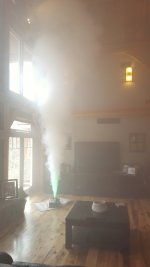
One of the most cost effective investments someone wanting energy efficiency on a limited budget should consider is a blower door test. I think it should be done on all new builds. It will typically only cost a few hundred dollars and is key to finding the air leaks in a building envelope. It's best done on a cool day if possible so that you can see the cold spots using thermal imaging. If you want to make it really interesting use a theatrical fog machine inside the house and reverse the blower door to create pressure inside the home. Do this on a day with no wind and you can walk around the outside of the home and see exactly where your leakage is. We did this both before sheetrock and used the fogger again after the house was finished. One of the biggest leaks we found was around our electrical service penetration. Just don't forget about the need to ventilate with and ERV or HRV with a tight home.

Fogger1.jpg
 
   / Anyone have experiences with Timber Block homes?
  • Thread Starter
#14  
One of the most cost effective investments someone wanting energy efficiency on a limited budget should consider is a blower door test. I think it should be done on all new builds. It will typically only cost a few hundred dollars and is key to finding the air leaks in a building envelope. It's best done on a cool day if possible so that you can see the cold spots using thermal imaging. If you want to make it really interesting use a theatrical fog machine inside the house and reverse the blower door to create pressure inside the home. Do this on a day with no wind and you can walk around the outside of the home and see exactly where your leakage is. We did this both before sheetrock and used the fogger again after the house was finished. One of the biggest leaks we found was around our electrical service penetration. Just don't forget about the need to ventilate with and ERV or HRV with a tight home.

View attachment 529503

Yeah, that's something I considered doing.

I do remember following your build thread and was impressed.

I realize there becomes a point where you're seeing seeing diminishing returns. Air infiltration is a big part of my problem in my existing house (but so is lack of insulation and proper installation of that insulation). I will explore some options (mineral wool, flash and batt, fiberglass interior/foam exterior).

I suppose this is simply me going off on a tangent away from my intent of the OP. I'll stick with my gut and explore other options. I'll be sure to post a build thread when the process begins.
 
   / Anyone have experiences with Timber Block homes? #15  
I like the concept of SIPS, but have no direct experience. My brother in law is an architect and he likes it but I don't think he has more than about 15 years experience with it.

For our home, we did 2x6 walls with about 2" of spray foam and then blown in cellulose (which gets leveled off with the studs prior to drywall install). That is about R27 or so. The spray foam seals things up very tight and gives the all important moisture/dewpoint control when warm moist interior air meets exterior walls -- with the spray foam, that interior air should never ever get cool enough to condense.

The house is certainly tighter and warmer than others I have lived in, but some things to keep in mind. First, wherever a 2x6 stud bridges the wall, it's more like R7 (or R5 for a 2x4 wall). There are a lot of studs! In places like corners, dormers, windows, etc, there is more wood than insulation by a long shot, so those areas are naturally going to be very inefficient. And windows -- no matter how much you spend they have horrible R values. We have about 60 windows in this home (combination of craftsman styling and desire to enjoy the view), and I am sure that takes a toll.

One area I am sure we could do better is the attic -- there is about 16" of blown in cellulose up there. Someday, when my list of projects gets shorter, I want to rent a machine and blow another 12-24" of fiberglass on top. I may go as far as building a raised walkway so that I can access the attic for maintenance in the future without trampling over the insulation. I have a couple duct dampers in the attic, exhaust fans, spare electrical/network wiring, etc.
 

Tractor & Equipment Auctions

208320 (A58375)
208320 (A58375)
Massey Ferguson 1745 Hesston series (A53317)
Massey Ferguson...
2014 F-150 STX (A56438)
2014 F-150 STX...
iDrive TDS-2010H ProJack M2 Electric Trailer Dolly (A59228)
iDrive TDS-2010H...
Toyota SR1-BET35 3,500 LB Stand-On Electric Forklift (A59228)
Toyota SR1-BET35...
INGERSOLL RAND  G25 GENERATOR (A58216)
INGERSOLL RAND...
 
Top