buickanddeere
Super Member
Has anybody hit this engine with ether ?


Yup ... that's exactly what R & R Engine and Machine did when I had them do the cylinder head off my OM647 engine ... and it is overhead cam (dual) ...
BTW ... I reused the head bolts ... they were all well within spec (within the tolerance range for stretching) ... that was about 60K miles ago (at least 1000 hours ago, roughly) ... no problems yet
From your description of having this same breakdown happen on multiple motors, do you ever drain and change the coolant, flush the cooling system on any of these engines?
A compression test can tell a lot about what is happening, blown gasket, bad valve(s), low compression per/cylinder, broken ring(s), etc. It's a good baseline to use before tear-down. Thermostat, general condition of radiator inside and out are crucial too. Just doing a head job without knowing cause of failure of whatever components can result in having to do it all over again and/or more later down the road.
Example: if marginal cooling system caused whatever the current problem is and you don't fix it too, then you will likely have to fix it sooner than later, and may have to then also replace the head.
There is only so much info one can get with a compression gauge. Don't get me wrong, it is valuable information, but limited. What makes compression more valuable is putting it together with pressurizing the cyl.'s. and leak down tests. Put them all together with some experience and one can come very close to knowing exactly what is going on where.
The compression test is the first thing to acquire because it gives the means to run compressed air to the cyl's.

Were you, the OP doing something wrong is difficult to say, but if I had to guess I'd say not too likely. I would ask what you are using any of the machines to do that is creating high load conditions for long periods; and suggest that you might consider hogging more frequently, when the grass is less tall and/or cutting when it's cooler out, late afternoon/evening or earlier morning- if possible, and take some breaks to let the equipment cool down...
An overflow tank might actually help because it could allow pressure and very hot coolant to be able to be released to the tank rather than the current situation where you experience overheating. You could also add, if there is room, a thermostatically controlled auxiliary fan to cool the radiator.
Make sure your coolant mix is correct viscosity, and don't run just water; coolant includes chemicals to prevent water pump destruction from minerals in the water. Try not to overfill the radiator either, especially since you don't currently have a overflow tank.
You might have a failing water pump on any of the motors you describe, considering the age of each, # of hours used in high heat conditions, and the tendency of water pumps impellers, (fins)to be destroyed be harsh hard water minerals, assuming you have hard water.... Something to consider since the most frequent thing I hear about your equipment is overheat conditions and radiator bubbles....
BTW, where are you located that you are experiencing so many heat related issues? And have these issues started happening on your machines just recently?
What has you looking for bubbles in your radiators- are your temp gauge needles redlining?
One possible cause of overheating is a blown head gasket. No, we don't run them until the temp gauge goes into the red. We stop and let them cool off if it looks like they might go into the red if we keep on going. Coolant is sometimes boiling by that time though.
Usually, the tractor is used in small spurts, but when it overheated last I was mowing very thick grass and dead crimson clover I planted last fall -- bout an acre. Could only take about a 2' bite at a time. Pretty dense.
You're definitely taxing your cooling system under those circumstances.
I've been thinking along those lines too. I wedged an aluminum can in the frame and ran the tube in there, but it doesn't seem to help much. Not much room for an aux electric fan on mower and not sure that the tiny little alternator/dynamo could run it and still charge the battery. Many of those take 6 amps or more.
We use distilled water and antifreeze in both machines. Probably runs kinda weak in the summer though.
Might be weaker than specked but distilled is good use.
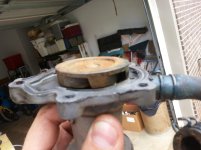
Yeah. I want to inspect the water pump impellers.
Definitely do so...
I live in North Alabama. Hot days do seem to exacerbate the problems. Mower has been happening for a while. Tractor usually doesn't overheat except when run under heavy load for extended periods.
Last sentence tells the story as to why; maybe consider lesser times and lower 'loads'.
I looked for bubbles because I'm trying to troubleshoot overheating problems!
At the time I pulled the cylinder head (aluminum) to replace the head gasket, the engine had about 380,000 miles on it (probably on the order of 7500 hours, if not closer to 10K)What's exactly what they/you did? Sink the valves or grind the stems down? :confused2:
I get that you're looking for causes of your overheating. So your method is to remove the pressurized radiator cap when the radiator is hot enough to boil the coolant? That's a good way to get badly scalded/burned.
I suggest you test your thermostats in boiling water to see at what temp they open/close.

Actually, I was thinking water pump.Nope. Don't have a compressions tester but HF has one with a glow plug adapter for Kubota. Been thinking about it. You thinking about rings?
Actually, I was thinking water pump.
Much ea$ier repair if that's what's ailing you.