Backhoe blowing hoses

   / Backhoe blowing hoses
  • Thread Starter
#21  
Thanks for the info Wrenchturner...would this be the relief cartridges the manual refers to? I'll try to scan a illustration tomorrow and post it.

It is some tough digging but it has seen this type of digging without any problems before. Its the rough, red, and rocky Ozarks!
 
   / Backhoe blowing hoses #22  
Even if the BH relief was sticking closed, the tractor PRV would relieve the pressure. for the supply hose. If the cyl hoses are blowing, there are extra forces at work here.

If the relief was stuck open, you would not have any or very little pressure.

Disregard the first part of this post.
 
Last edited:
   / Backhoe blowing hoses #23  
Even if the BH relief was sticking closed, the tractor PRV would relieve the pressure. for the supply hose. If the cyl hoses are blowing, there are extra forces at work here.

If the relief was stuck open, you would not have any or very little pressure.

The backhoe has an external pto pump/reservoir.

So, the tractor PRV is not in the picture.
 
   / Backhoe blowing hoses #24  
I have to retract my last post as the BH uses an independent hyd system. It is not part of the tractor hydraulics. The BH has it's own relief valve.
 
   / Backhoe blowing hoses #25  
Are you using single braid hose rather than double braid? Is it blowing off the fittings, or out the side wall? Do the hoses have the correct fittings for that type of hose. Are you using reusable fittings? etc. A awful lot of questions should have been asked before most of the responses were given!
 
   / Backhoe blowing hoses #26  
I'm curious if your ambient temperature was below normal when these hoses were blowing? Do you recall what weight the motor oil was? What viscosity hydraulic fluid did you put in? Others have asked, this is important troubleshooting information.
 
   / Backhoe blowing hoses #27  
I have to agree with mace canute, find it hard to believe the viscosity being that much difference especially after all ready being out digging.
I also question if you have QD (like I believe some one else said) hooked to tank return. If so, just waiting for problems there.
 
   / Backhoe blowing hoses #28  
My best guess is the OP had some old hoses, got into some tough digging and worked them past their useful life for that application. What taxes hoses more than anything is pressure changes and spikes. This causes hoses to flex violently. I'm also going to guess that most of these hoses blew close to the crimp fitting. If the change in fluid viscosity caused this then every cold piece of equipment on the planet would blow hoses when they are cold.
 
   / Backhoe blowing hoses #29  
Guys, I really appreciate the feedback and points made. I should have provided some specs first. Here are some of the details in the manual:

Operating Pressure: 2150 psi
Bucket Digging Force: 2875 lbs.
Dipperstick Digging Force: 1744 lbs.
Oil: 10W40 engine oil with API "SD" classification in Northern climates, SAE 40W in Southern Climates. (I'm in southern Missouri)

I stopped at a local logging equipment shop today to have a new supply hose made. They seemed to think it was a stuck pressure valve...not sure if that is stuck shut or stuck open. Looking at the illustrations in my manual it shows what they call relief cartridges which are non-repairable except for seals...is this what they are speaking of.

Don't mind switching the fluid and filter back as discussed. At least I understand how to do this!

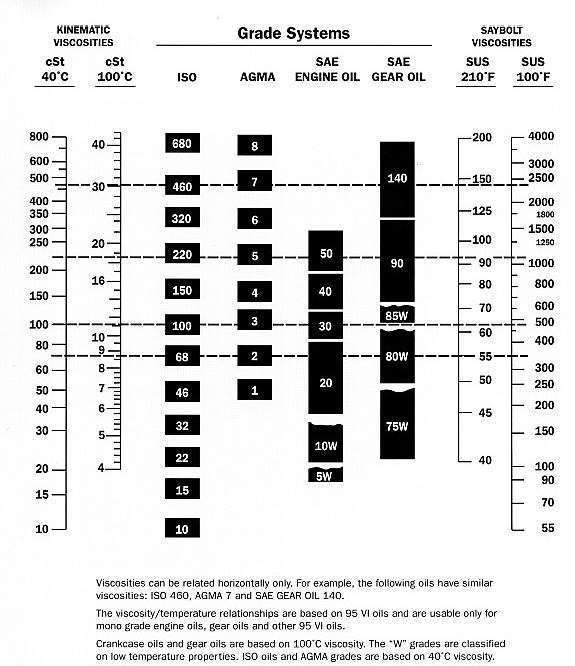
SAE 40 motor oil is the roughly the equivalent of an ISO 150 hydraulic oil.

visc.jpg


Since Missouri's spring and fall average temps are about 55 F and summer averages around 75 F (winter average about 32F), a high viscosity oil like ISO 150 is probably not called for. From the chart below which shows the operating temperatures of the oil itself, not ambient temperatures, an ISO 46 or 68 hydraulic oil should work well.
articles_200701_LubSelect_PMFigure2.gif

As others have pointed out, the causes for the blown hoses are very likely to be either a faulty pressure relief valve or the hoses themselves not being up to withstanding the stress. Wayne County Hose makes a compelling case for failed hoses. I'm 60/40 either way on which one it could be. You might be able to take the PR valve apart, at least partially, and have a look-see at it for obvious damage or anything that looks hinky. Maybe some foreign material in the fluid got into it and is jamming it? Hopefully you get it sorted out without a lot of $$$.
 
   / Backhoe blowing hoses #30  
Bad batch of hose? Badly made hoses?

I agree.....shy of hooking up pressure guages to check status of PRV, I'd suspect the hoses also.......maybe the hoses were yanked under pressure (routing..??).....best to check crimp specs and inspect to make sure these hoses were pushed in all the way before crimp....(seen that too)
 
   / Backhoe blowing hoses
  • Thread Starter
#31  
Hoses are all factory from 2003. I think with a 2,000 psi rating.

The bursts were all just out the sidewall, well away from fittings, but probably 1/2 were in natural wear points like where the hoses bend back up the arm of the backhoe. The supply line burst out the side two different times, once where the hose made a bend but the second was just a pure burst out the side on a straight run of the hose.

Air temps were ~40-60 degrees during this.
 
   / Backhoe blowing hoses #32  
I don't think hyd hose rated at 2000 psi is good enough. If that is a Prince PTO hyd pump, it has a max pressure of 2200 psi, but would depend on the relief setting.

If the relief setting is not set correctly for the lowest component pressure rating, then this will continue to happen.

When you had new hoses made, did they not suggest 3000 psi or better.
 
   / Backhoe blowing hoses
  • Thread Starter
#33  
Sorry for the confusion. I checked the smaller lines a while ago and they are 3,000 psi and dated 2002. These lines look very good other than an occasional nick or bend. I had the burst lines repaired by cutting out the burst hole and coupled back together.

The supply line after the second burst, I had replaced with a new line. I believe the guy said my original was 2000 psi on this supply line and he replaced it with a 3,000. The supply line is of course bigger than the smaller individual lines to the cylinders.

The hydraulic fluid I used in the system is a AW 46 just fyi.
 
   / Backhoe blowing hoses #34  
If that hose burst once, then it is a good chance it will pop again. I have had that happen on hyd hose and pressure washer hose, just a slight nick, and water gets in and rust, and then one day, Pop. I don't think the type of fluid make much difference on the pressure when warm.

The fluid type, do you use it year round. What part of the country do you live? You mentioned frozen, so you can't be in Florida.

I think I would install a hyd gage at the controls so you can monitor the pressure. Could also help solve and troubleshoot the hyd system.
 
   / Backhoe blowing hoses #35  
1 wire hose on a backhoe? There is the problem. To the OP, next time please give all this info from the start and pics would be better.
 
   / Backhoe blowing hoses
  • Thread Starter
#36  
Its the factory setup..I didn't build it.

I just put the fluid in last fall but have hardly used the hoe since then. Southern Missouri is where I'm located.

I'll start by trying to setup a gauge and operating it from there.

Would you hook this gauge up to the supply line coming out of the pto pump for starters? Can something malfunction in the pto pump to cause excess pressures?
 
Last edited:
   / Backhoe blowing hoses #37  
If that hose burst once, then it is a good chance it will pop again. I have had that happen on hyd hose and pressure washer hose, just a slight nick, and water gets in and rust, and then one day, Pop. I don't think the type of fluid make much difference on the pressure when warm.

Yeah, false economy to repair a burst hose. At least that's my opinion, a hose pops and it's replaced.


Would you hook this gauge up to the supply line coming out of the pto pump for starters? Can something malfunction in the pto pump to cause excess pressures?

You want to put the gauge on a hose where it would connect to a cylinder. Or on a output from the BH valve,which ever is more convenient. You don't want to dead head the pump,it will harm the pump.
 
   / Backhoe blowing hoses #38  
I would tee the gage at the input to the BH valve. That way, anything you do will be reflected on the gage. I would also check out the QD's and maybe replace.
 
   / Backhoe blowing hoses
  • Thread Starter
#39  
Guys, I finally got to test some of it this morning with a pressure gauge. On all the fittings after the BH valve, pressures are reading at 2500 psi max. I did not have the fittings to hook to the supply line between the pump and BH Valves.

I'm beginning to wonder if its not just a case of worn hoses but possibly am I getting higher pressures with the AW 46 Hydraulic Fluid vs. the 10w40 motor oil that was in it?

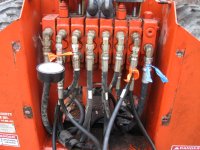
The picture here shows the hoses that have blown. The orange flagging shows which hoses have blown. The two on the right (one is behind the other) is backhoe arm lift cylinder. The two on the left are curl for the backhoe arm. The supply line is marked with blue line.

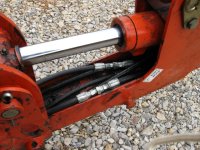
The second photo shows where most of the "blows" have taken place. With the cluster of fittings here now, I'm sure I just need to replace the hoses. Otherwise all these fittings will rub holes in each other.
 

Attachments

  • IMG_0409.JPG
    IMG_0409.JPG
    211.7 KB · Views: 206
  • IMG_0410.JPG
    IMG_0410.JPG
    235.3 KB · Views: 205
   / Backhoe blowing hoses #40  
No Hydraulic expert for sure , but as mentioned above , If a hose bursts on my BH , I replace entire hose . I only repair hose if I happen to damage a connector , ( which i have done on my stabilizers when retracting ) .

My BH is about the same age and over the last 1+ years have had to replace 3 hoses . Both for Bucket curl and 1 of the swing lines . The Bucket curl lines both burst were they run on top of the boom . Different locations , so no rubbing involved , Nor any bends in line . Most likely just the constant exposure to sun and elements .

I figured if I had to snake that bucket curl line out of there , I was NOT going to just repair it and have it happen again .


Fred H.
 

Tractor & Equipment Auctions

PumpJack Brand Pump Jack (A56438)
PumpJack Brand...
FENCE PANELS (A58214)
2024 DEVELON DL250-7 WHEEL LOADER (A59823)
2024 DEVELON...
Poly Fuel Tank with Electric Pump (A55851)
Poly Fuel Tank...
2014 JOHN DEERE  544K WHEEL LOADER (A58214)
2014 JOHN DEERE...
International S1900 (A56438)
International...
 
Top