Barnplans.com

   / Barnplans.com #1  

DaNag

Silver Member
Joined
Nov 7, 2004
Messages
157
Location
PNW
Tractor
Kubota 3130HST w/LA723, HD bucket
I was searching the forums for "barnplans", hoping to find somebody who had purchased and/or built a barn from barnplans.com. Looks like a few of you are familiar with them, but I didn't see anyone mention they had actually purchased the plans and completed a barn. Anyone out there with some first-hand experience?

We're in the beginning stages of planning a Gambrel barn/garage/workshop with living quarters in the loft area. It will be a minimum of 32x48, but if funds allow, we'd like to go with the 36x60. Other than moving around a few doors and windows, I don't think we'll need to deviate from the stock plans by much, although I may have the trusses manufactured instead of having them built on site. We'll probably opt for the dormer window and shed roof plans for a porch as well.

Any feedback on these plans or dealings with the company would be appreciated.
 
   / Barnplans.com #2  
I bought the 32 x 40 plans, side shed roof plans (lean-to) and cupola plans from barnsplus.com, after long searching. Their claim to fame is having the "right" proportions for a "proper" gambrel roof. I agree with them. Their product looks terrific.

However, their home-made truss design is only rated for 89 MPH wind loads, and I need 120 MPH here in Florida. So, I took the plans to a couple of different local truss companies. One of them stayed very faithful to the original proportions and slopes, but stayed with the same design as barnsplus -- requiring a center beam and posts to support the second floor. The other truss company came up with a very innovative design in which the bottom chords of the truss took on characteristics of an engineered floor truss, combined with the roof truss. This gives me a clear span on the first floor without support posts, which I really like. However, in order to make the engineering work, the proportions of the roof were changed slightly.

When I discussed (via email) the changes with the barnsplus designer, he was very upset that I would consider changing his "perfect" proportions. Unfortunately, my thinking has progressed even further. His design for the walls uses many more studs than traditional stick design. HIs studs are placed 12" o.c., and where there is second floor (it has to be at least 50% second floor to hold it together; I planned a full second floor), he doubles the studs with a "cripple" to hold the floor joists. I think I would much rather build traditional stick-built walls 16" o.c., double top plates, and then set the floor joists on top (in my case, the special trusses with the floor trusses engineered in).

In other words, by the time I was done substitutng my preferences and designs, there isn't much left of the barnsplus design. Of course, you may not need the wind load specs that I have to have; you may not care about a clear span in the first floor; you may not be planning to go with over 12' of first floor ceiling height as I am; and you may love his stud layout. In other words, the plans may be perfect -- certainly, a lot of relatively unskilled people have built the barns exactly as the plans specify.

For a lot of reasons, I haven't built the barn, yet. I was hoping to build it before the house, but my local codes prohibit that. Now, the whole issue has been confused with a different building system that was discussed a few months ago in another thread about a hardware socket system ( http://socketsystems.com/ ) that looked pretty promising to me. It's sort of a pole barn without having the poles go in the ground, which is great for me, as I don't want wood posts in the tropical Florida ground, no matter how much pressure treatment they have. However, there are some height limitations I'll have to get around, probably by constructing a low block wall to built the wood barn on top.

Bottom line is, I think barnsplus.com has a decent product, and I don't regret the money I paid for the plans (which wasn't all that much, anyway), but I don't think I'm going to end up using very much of the plans.
 
   / Barnplans.com #3  
hey DaNag:

I did not use any plans (for the most part) to build my barn, it is nearly exactly what you described (38x50 gambrel with 10' x 50 poarch open 2nd floor (almost 10'6" to the bottom of the gambrel roof cross brace) lower floor has 6x6 PTL (pressure treated lumber) on 8' ctrs down both sides and on the porch outside and 6x6 PTL down the center of the lower level on 10 foot ctrs. 2nd floor finished height will be about 10' except for the 2x12 doubbled up beams running the lenght in the center supporting the 2nd floor joists. there are 2x12 2nd floor joists on 16" ctrs and 2x6 fab on site roof joists on 16" ctrs. I have 2 man doors one under the lean too and one in the end with a 9'x9' roll up door.

I have not finished much more as I ran out of $ as I was laid off about 3 days after construction started.. /forums/images/graemlins/frown.gif good news is I'm back to work but I built up so many bills that it will take a full yar more before I can think of getting in there...

anyhow some photos are here http://www.bright.net/~ispike/home2

Markm
 
   / Barnplans.com #4  
Have you thought of buying a home design software? That's what me & my wife did - we bought some plans but we thought we could do a better job. I did ask for help when I had to get a support beam in our living room. but that was free because I went to the company that I was buying it from. I might have paid a few more dollars for it but I do feel better having done that.
The software is real easy & they even have "take offs" so you sould have an idea on what material you will need.
 
   / Barnplans.com #5  
Don, How do the plans look for the "side shed roof plans (lean-to) "? Been thinking about this and wondered if plans were available. I realize you have not built it yet, but still curious on your thoughts.
thanks
Russ
 
   / Barnplans.com #6  
Don,
I have often wondered why you folks in FL don't use concrete more? I lived in Germany for 12 years. They build just about everything out of concrete. Their homes are fire proof, wind proof, insect proof. well you get the idea. since concrete always continues to harden, they just get stronger with time.
I helped a number of friends build their homes, while it was very labor intensive, it was a easy DIY project. One project was a large barn two story barn, only the roof rafters were wood, with a tile roof. Just a thought, but I notice that after you guys have a storm it's the old concrete buildings that are left standing?
JD
 
   / Barnplans.com #7  
The lean-to plans are nothing special, just about what you'd expect if you have any construction experience. They do show alternate footings and have some detail regarding whether you will leave the lean-to open, partially closed or closed as rooms. The real benefit is that the plans and detail are good enough that many building departments will accept them; save some extra work.
 
   / Barnplans.com #8  
Well, a lot of things ARE built with concrete. The vast majority of the houses being built today are concrete block and stucco construction on a monolithic slab. There is some poured concrete being done, but primaily in developments where the same forms can be used over and over; not so much in custom work.

I have some problems with concrete for my personal use. First is aesthetics -- there's not much you can do with it, and it gets darned boring after a while. Poured concrete in custom forms is an exception, of course, very versatile, but concrete blocks are concrete blocks, and stucco is stucco, and it all looks pretty much cookie cutter. Second, it just looks kind of cold and hard.

Third, it isn't something a do-it-yourself guy will tackle. It's heavy, hard work, and it's messy. Just not my style. I like the warm, comfortable, old-shoe look of a country-style house, and a CBS (concrete block - stucco) barn would just be ugly, in my opinion,

But, more to the point, what you believe about storm-related construction is pretty much a myth. The buildings that have lasted the longest through hurricanes are the old, southern yellow pine buildings from the 19th century. A concrete house will resist a storm until the storm is strong enough to break it. A well-built wood, stick-built house will bend with the wind and survive a stronger storm. Both will lose their roof before the walls go down. I prefer wood construction, especially because CBS doesn't insulate well (big difference being that we try to keep the heat OUT /forums/images/graemlins/cool.gif ).

What you see being blown apart in the storms is mobile homes, for the most part. And, frankly, the whole idea of regular residential construction being blown down is pretty much a myth for most storms. My area endured the center of two hurricanes this year, with the worst damage to most residences being roof shingles. If the shingles were blown off enough, some folks had leaks and interior drywall damage. But, there weren't even very many broken windows. Hurricane Andrew in the early 90's did knock down a lot of houses, but most folks agree that it had tornadoes in the hurricane, and both wood and cement houses were knocked down.

The real reason why folks use as much cement as they do has nothing to do with storms, which don't happen all that often, anyway (the ones that hit us were the first ones since 1949), but everything to do with rot and termites.

My son-in-law's 3-car garage is an interesting combination of techniques. It was there when he bought the property. They poured a monolithic slab, then constructed 10 pillars, 16" x 16", with concrete blocks, on 12' centers. There are 4 pillars for the front wall and 4 for the rear; the end walls each have a pillar in the center. The outer dimensions thus are 36' wide x 24' deep. They constructed beams across the tops of the pillars, then set 24' trusses on the beams, on 24" centers. Finally, they stuck garage doors across the openings between the front pillars, and constructed simple curtain walls of studs and T1-11 between the pillars on all the other walls. They topped it with purlins and tin roof. The T1-11 has suffered over the years, but it will be a simple matter to rip it out and replace it -- the curtain walls don't do anything except keep the outside from getting inside and vice versa. The concrete pillars are 90% of the structure -- sort of like a concrete pole barn.

Regardless of whuch method I use for my barn -- the hardware sockets or stick built -- I'll start with a monolithic slab and at least a couple of courses of concrete block. The idea is to keep the wood away from contact with the ground.
 
   / Barnplans.com #10  
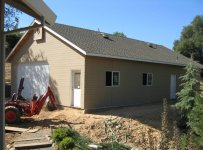
I bought a set of modified (actually custom) plans from BGS Plan Co. and built the attached (pix) shop from the plans.

They put the plans for "my" shop on their web site here for all to see.

I recall, that you are somewhere here on the West Coast. I got my plans approved in El Dorado county, California. Not that that it makes any difference, BGS has a Engineer that is registered in all 50 states.

The plans look rather cold in comparison to the finished product.
 

Attachments

  • 571585-Done front 3-4-sm.jpg
    571585-Done front 3-4-sm.jpg
    92.6 KB · Views: 593
   / Barnplans.com #11  
Here is one of the few pictures I have from the inside of the property showing the shop. This is earlier in the construction and shows the side door and bathroom window. I was digging some trenches for drainage earlier and parked the tractor over the area after I finished.

I forgot to say in the earlier post this is 30'x50' shop with 10' walls.
 

Attachments

  • 571592-Inside view-sm.jpg
    571592-Inside view-sm.jpg
    96.8 KB · Views: 360
   / Barnplans.com
  • Thread Starter
#12  
Whew...thanks for all the replies.

Don - I found the truss design you posted a while back. Looks interesting, and keeping the first floor open is something I'd like to do. However, I'd prefer to keep the high pitched ceiling upstairs, and I don't like the idea of losing the small amount of space at the wall edges. Also, I'm thinking of adding a couple 8' dormers on each side - I'm assuming barnplans.com includes details for accomodating the trusses around the dormers, not sure if your design could be tweaked to allow for them or not.

One thought I had...I wonder if the 2nd floor support posts could be eliminated by using those engineered i-beam flooring systems, i.e. Silent Floor, TrueJoist, etc. I'm guessing these might be pricey for 32-36 footers, and don't know how they would affect the barnplans.com engineering - they state on their web site that the second floor is not optional, for structural reasons. If they could be used, I could keep the 2nd story features I like, as well as having an open first floor.

RE the suggestions of using design software or just building as I go...thanks guys, but if I include living quarters, I have to submit detailed plans to the county, stamped by a WA state structural engineer - the barnplans.com folks have such an engineer on staff. It would cost me more to get my own plans drawn up and stamped than buying the barnplans.com plans.
 
   / Barnplans.com #13  
I mentioned that I had two estimates for making the trusses. The first company was going to build them to the same size specifications as barnplans.com, but modify them enough to get me my required 120 MPH wind load. While I was there, I also asked them for an estimate for an engineered floor truss. The first thing was that they were not able to get me a clear span at 32' without making the floor trusses extraordinarily deep -- over 24" as I recall. And, as you guessed, they were VERY pricey. However, what they were specifying was not an engineered I-beam, but a floor truss with a top and bottom chord and triangulation in between. The other company gave me something similar, but integrated the floor truss into the roof truss, each gaining strength from the other, with the result that the floor was only 18" thick.

As far as the design software and engineering is concerned, you're absolutely correct, as long as the barnplans.com plans work for you unmodified. In my case, I have to have an engineer stamp them anyway, because of the wind load. So, I have drawn my own plans in TurboCad, using standard stick-built walls and the clear-span trusses. I haven't had an engineer stamp them, yet, but here in Florida, everything has to be stamped by a local engineer. Last Fall's hurricanes and some health problems have thrown me some curves and delayed my construction.
 

Tractor & Equipment Auctions

Redirective Crash Cushion Guardrail (A59230)
Redirective Crash...
2018 CATERPILLAR 12M3 MOTORGRADER (A52709)
2018 CATERPILLAR...
2006 Heil Tanker Trailer Heavy Duty 65K GVWR Tank Trailer (A56438)
2006 Heil Tanker...
2009 Mariah SC23 23ft. Cabin Cruiser with T/A Boat Trailer (A59231)
2009 Mariah SC23...
KAWASAKI 42ZV WHEEL LOADER (A60429)
KAWASAKI 42ZV...
2021 Harley-Davidson FLHP Road King Motorcycle (A59231)
2021...
 
Top