Battery disconnect switch

   / Battery disconnect switch #1  

BertZegers

Gold Member
Joined
Jan 2, 2012
Messages
259
Location
South-West Ontario
Tractor
Kubota L2900, Zetor 8011, Kubota KX41Excavator, John Deere 4400 Combine, Case 1816C skidsteer
There have been a debate about if the battery disconnect switch should be in the plus or in the ground. On tractors and heavy equipment the SINGLE POLE shut off switch is mostly used, and is often put in the positive battery wire. In my opinion it is safer to put the switch in the ground wire.
The costs are the same and the work is the same.
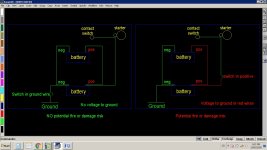
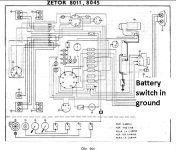
I have an example of an electric diagram with the battery shut off switch in the plus wire, and a diagram from a tractor company with the battery shut of switch in the ground wire. It is not complicated, and we do not have to make it more complicated than need be.
Because some people have claimed that it makes no difference if the switch is in the plus or in the ground wire, I have tried to make the difference understandable in a drawing.

One note: if the battery ground wire shorts to ground before the switch, no dangerous current path is created. If a plus battery wire shorts to ground before the switch, it might start a bad fire.

Let me know what you think.
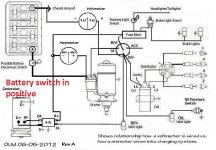
BatterySwichPos.jpg ZetorBatSwitchGround.jpg

BatterySwitch.jpg
 
   / Battery disconnect switch #2  
Fair enough. No worry about exposed terminals on the switch is good for me.
 
   / Battery disconnect switch #3  
Fair enough. No worry about exposed terminals on the switch is good for me.

If a switch is needed,I agree with the logic about exposed terminals. Why would a switch be installed? It add's at least 4 connections to the original 2 that develop resistance and cause poor/no start situations.
 
   / Battery disconnect switch #4  
If a switch is needed,I agree with the logic about exposed terminals. Why would a switch be installed? It add's at least 4 connections to the original 2 that develop resistance and cause poor/no start situations.

My first guess would be an anti-theft switch/device.
 
   / Battery disconnect switch #5  
There's also an issue of battery drain if left connected full time. Some prefer to disconnect if the machine won't be used for long periods. I get concerned about some of the electronics that have any sort of programming that might be lost if left unpowered over time.

On topic of positive or negative, when I disconnect a battery in any vehicle for any reason, I pull the negative terminal/cable first. My reasoning is my clumsiness with tools and the possibility of shorting the wrench or driver to ground if I pull the positive first. In a passenger vehicle, I've heard of cases where that can cause the airbag to trigger.

I'd be less concerned about that with a fixed/mounted switch.
 
   / Battery disconnect switch #6  
Most battery disconnect switch instructions call for them to be installed in the ground cable.
Many are not rated to be installed on the battery hot lead.
 
   / Battery disconnect switch #7  
Does not matter if you install it on the ground or positive cable. Negative cable would be my choice. Most positive cables are factory configured with extra leads/possible fuseable links/etc... and usually the ground cable is just the one cable going to the frame. I put one on my Cat excavator on the ground, whilst the ground also had an OEM contactor in that lead to shut power off to the starter. There is absolutely no difference in the amps carried between the ground and positive cables. With DC current, operating the disconnect switch with little or no load is no problem. Operating the switch near rated load will quickly destroy the contacts. DC is nasty stuff. Working with batteries, it is always better to connect the negative last, disconnect it first unless you want to take the chance of shorting the positive to ground with your wrench.
 
Last edited:
   / Battery disconnect switch #8  
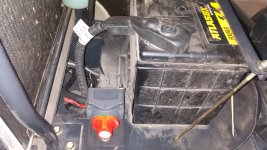
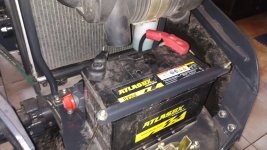
Installing the switch on the positive does have the disadvantage of exposing the terminals, on the other hand, it's easier if you want to run a separate wire for a radio, GPS trackers or something along those lines.

That being said, I still installed mine on the Positive side. It worked better that way for me.

IMG_20191214_111126.jpgIMG_20191214_111146.jpg
 
   / Battery disconnect switch #9  
My skidsteer came with a quick disconnect on the negative post installed by my dealer. He advised to keep it disconnected when not running because it would otherwise drain when off. He was right.

About five years later I out a new alternator in and that eliminated the drain; still have the disconnect on the battery, but I leave it connected and have never had the battery drain issue anymore.

The point made above about many other things being connected to the positive post is a good point.
 
   / Battery disconnect switch #10  
My volvo excavator has factory disconnect and right sure it is on the ground. It is a little extra anti theft benefit and to me helps limit drain and I prefer power disconnected if given reasonable option.
 
   / Battery disconnect switch #11  
My backhoe (JCB) would drain the battery. I finally bought a disconnect. I HAVE to think there are different grades of them. I bought it at an auto store and it was primarily (cheap) plastic with the guillitine (if I recall) type connector.

Frankly, it was a bit more cumbersome to use as it would come lose and I finally ditched it and attached my Negative without cinching it down so I could simply wiggle the cable off the terminal.

During weak battery season, the battery isn't strong enough to spin the engine NOR, is it strong enough to release the starter so the starter "binds" in start mode which causes some heating on the wires.

I've learned that even prior to starting machine, I open hood and stand there, prepared to yank the cable. If I get the slow grind and stuck starter, I yank cable, drag charger out and several minutes later, all is fine.

I've had the starter out to the shop THREE times over the years, just KNOWING that it was getting old & tired.....and every time it comes back with a clean bill of health.

I have since learned that I had a weak (shorted?) wire inside the wiring harness. Got that fixed last fall so hopefully I'll be back to charging the battery when it's running!
 
   / Battery disconnect switch #12  
I can see the argument for switching the negative cable, but if you want to kill all power with the engine running, you MUST disconnect the alternator/generator output lead or the alternator/generator will keep supplying power to keep everything running (as the alternator is grounded through its case).
From the other thread:
Polarity has nothing to do as if switch goes open circuit or not....... We discovered we needed to put switch in positive side after incident at auto X track after a car actually had cause use disconnect and engine did not kill... It was discovered that there was a run-on situation because of alternator output.... You can put switch in negative all you want but if alternator continues to put out voltage and since alternator frame is grounded it is perfect power supply to run engine (battery excluded) ... One has to wire cutoff switch so It functions as intended not by archaic rule that may make non operational...

Don't care if its a tractor or race car or street drive performance car it has to function as intended, poliarity does not matter....

I worked tech inspection at auto X track off and on for over 10 years.... You would be surprised how many times I picked a car at random and said "start it up" and they did, I went to cutoff switch and flipped it, many times car did not shut off..... It's not polarity dependent its application dependent...

Aaron Z
 
   / Battery disconnect switch #13  
There have been a debate about if the battery disconnect switch should be in the plus or in the ground. On tractors and heavy equipment the SINGLE POLE shut off switch is mostly used, and is often put in the positive battery wire. In my opinion it is safer to put the switch in the ground wire.
The costs are the same and the work is the same.
I have an example of an electric diagram with the battery shut off switch in the plus wire, and a diagram from a tractor company with the battery shut of switch in the ground wire. It is not complicated, and we do not have to make it more complicated than need be.
Because some people have claimed that it makes no difference if the switch is in the plus or in the ground wire, I have tried to make the difference understandable in a drawing.

One note: if the battery ground wire shorts to ground before the switch, no dangerous current path is created. If a plus battery wire shorts to ground before the switch, it might start a bad fire.

Let me know what you think.
View attachment 638408 View attachment 638409

View attachment 638411

I've a knife edge one on the Isuzu's battery. It's on the negative ground side. Too much risk in its hitting the enclosure if on the positive side. Could cause a fire if that happened.

Ralph
 
   / Battery disconnect switch
  • Thread Starter
#14  
If a switch is needed,I agree with the logic about exposed terminals. Why would a switch be installed? It add's at least 4 connections to the original 2 that develop resistance and cause poor/no start situations.

It ads only 2 connections on the switch.
 
   / Battery disconnect switch #16  
Not sure what the wrench size has to do with disconnect switches, but in my case, I use either 5/16" or 10MM most of the time.
 
   / Battery disconnect switch #17  
Having several tractors in an outbuilding, I just take each battery inside to the garage and hook up to a maintainer. It keeps the batteries at full charge and is an anti-theft practice.....kinda a PITA though.
 
   / Battery disconnect switch #18  
I can see the argument for switching the negative cable, but if you want to kill all power with the engine running, you MUST disconnect the alternator/generator output lead or the alternator/generator will keep supplying power to keep everything running (as the alternator is grounded through its case).
From the other thread:


Aaron Z

This makes sense to me. I also noticed in the wiring diagrams that most implements/vehicles have the main power coming off of the starter. If that's the case then installing a shutoff on the positive cable is as effective as installing it on the ground cable.
 
   / Battery disconnect switch #19  
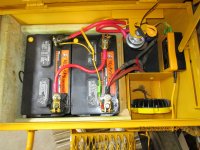
Here is the battery disconnect I put in my excavator last summer. Right below it is the OEM Caterpillar contactor also on the negative cable. To the right of that is an onboard 24v battery maintainer. Sorry about the Kabota batteries in it, but they came with the unit. I repainted the battery box and insulated the batteries from the metal with treated wood. The battery box is also locked with a padlock when not in use.
 

Attachments

  • IMG_0541 (Large).jpeg
    IMG_0541 (Large).jpeg
    392 KB · Views: 524
   / Battery disconnect switch #20  
Most battery disconnect switch instructions call for them to be installed in the ground cable.
Many are not rated to be installed on the battery hot lead.

Current flow is same in hot lead and ground.... Amperage flow (current) is a loop originating and terminating at battery... This is why ground and positive battery main leads are same gauge wire...

Your comment is not valid...

Dale
 

Tractor & Equipment Auctions

2016 AutoHauler CX11HCSD T/A Car Hauler Trailer (A56858)
2016 AutoHauler...
2018 Nissan Versa Sedan (A59231)
2018 Nissan Versa...
2018 John Deere 245G LC Excavator - Hydraulic Thumb, Tooth Bucket, 56K LB Class (A56438)
2018 John Deere...
72" ROCK BUCKET (A52706)
72" ROCK BUCKET...
2020 KOMATSU HM400-5 OFF ROAD DUMP TRUCK (A60429)
2020 KOMATSU...
PumpJack Brand Pump Jack (A56438)
PumpJack Brand...
 
Top