Beaver 370d clutch problem

   / Beaver 370d clutch problem #1  

z28clone

Member
Joined
Aug 4, 2009
Messages
35
Location
Ashville Ohio
Tractor
370D
Groaning noise when I push in the clutch. It grinds when I put into gear. It isnt stuck to the flywheel, because I tried to start the tractor in gear with clutch pushed in and it doesn't move. Is there an adjustment, or do I have to split it? With this clutch issue and possible hydraulic issue, I'm beginning to see why I got a good deal on it.
 
   / Beaver 370d clutch problem #2  
It's not the end of the world, probably the release bearing. You'll have to split it to be sure. Lots of thread here on how to do it. Just use the search.
 
   / Beaver 370d clutch problem #3  
Don't get too discouraged. I consider these tractors pretty well made and relatively easy to maintain. For something 30+ years old it's not going to be problem-free, especially if previous owners neglected it which tends to be the case after that many years. Heck, even the new stuff I buy seems to break just as often (or even more often) than the old stuff. Usually the older stuff is simpler to fix though. If you choose to correct the problems yourself, you can have some fun in doing so and you'll learn a lot and gain a better appreciation and understanding of things. It depends on if the tractor is more of a hobby or a tool to get necessary work done. If you need high reliability out of your machine, it will take some work to help get it there, or you'll have to break down and buy something newer and let the dealers fix the problems as they arise - hopefully under warranty.

I've said this before and I'll state it again here. Either I'm really unlucky with used tractors or they are all that way because I've acquired five of these type of tractors for varying prices, mainly Isekis and none of them came w/o issues. The worst were the broken gears, cracked rims, engines poorly rebuilt, over-loaded/broken loaders, and many other odd things. Leaking seals and gaskets are almost a given on every one along with missing parts. Electrical issues are prominent mainly due to age and disrepair. A lot of the problems I can attribute to neglect/lack of knowledge by owners. I think, in general, most owners expected more from these small machines than what they were orginally designed to do and it tends to show in what remains out there.

All is not lost though. Most of the problems can be fixed, maybe not always as cheap as one would hope, but there can still be a lot of servicability left in these machines. I find these tractors are a good value for what a person gets compared to other things like four-wheelers or snowmobiles, for example. Nothing against those things and I've had both and liked them, it's just that for me a tractor is more justifiable to help get things done around the property vs. something that is geared towards sports/entertainment. It all goes back to a person's interests and I respect what others' do and hope they would say the same for me.
 
Last edited:
   / Beaver 370d clutch problem #4  
Splitting that tractor is pretty straight forward. I posted a fair amount of pictures when I did mine. Good luck.
 
   / Beaver 370d clutch problem #5  
You state, it grinds when I put it in gear.

That took me a minute to figure out on my new little Beaver. I'm used to having a couple of older manual transmission engine cars and motorcycles and at first thought I needed to start out in first and build some speed, then shift. Nope. These non synchro transmissions don't care for that. Plus you just put it in 3rd and drive away anyways. So are you attempting to shift on the move or stationary? Also I found that mine will make all kinds of angry noises if I have the RPM's up when fiddling around. Now I keep it at idle, shift into gear (silently and effortlessly, then open up the governor, and release the clutch.
 
   / Beaver 370d clutch problem #6  
A friend of mine "test drove" my Satoh and attempted to "shift-on-the-fly" between 1st and 2nd and had some grindage issues. I was surprised he never drove a gear-drive tractor before since he's around 60 years old. He couldn't believe that you can start and are supposed to start out in the higher gears from a stopped position. If you're good on the throttle and can keep the machine moving forward, you can shift-on-the-fly between gears, but that's a talent I don't wish to seek. I believe some Yanmar tractors (and surely others) have a "power shift" feature that allows you to shift to any gear at any time. I'd love to try one out.
 
   / Beaver 370d clutch problem #7  
Sometimes I downshift when I need a slower ground speed. I go from second to first only using the clutch to go from second to neutral. As the tractor slows, I can slip it into first with no grinding and no clutch.
 
   / Beaver 370d clutch problem #8  
Oliver - what engine does your 1450D have in it? Is it the K3D? Just curious, thanks.
 
   / Beaver 370d clutch problem #9  
Whatever is in a 373, can't remember.
 
   / Beaver 370d clutch problem #10  
K3A which makes sense since that is about 14 PS (about the same as 14 horsepower) and matches the "14"50D. Somebody was discussing a "Suzue" on here that had a K3D in it and it was about the same size as a Beaver. I was surprised it had the K3D engine. I believe it is rated around 18 PS. I think a version of the Bolens HT23 had the K3D in it also. Kind of neat tractor-trivia I guess.
 
   / Beaver 370d clutch problem #11  
My Buck has the K3B. I think it is about 18 at the flywheel.
 
   / Beaver 370d clutch problem #12  
K3B engine is rated at 15.5 PS at the flywheel according to the performance curves I have. Bolens hyped it up to 17 hp. I think they arrive at 17 since it probably takes around 2 PS to turn the engine over. Just a way to play with the numbers.
 
Last edited:
   / Beaver 370d clutch problem #13  
Evidently there are different flavors of the same displacement engine out there.

Attached are examples of hp claims for the K series engines. In the Bolens manuals, they publish the power ratings as 14 and 15.5 PS for the K3A and K3B engines respectively in the G15x/G17x tractors.

The KE70 and 75 are rated at 13 and 14.8 PS which were also in the G15x/G17x tractors (early years).

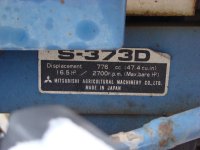
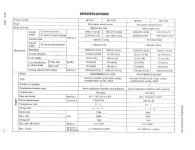
The sticker on my Satoh claims 16.5 hp for a K3A-11BE and that matches up with the specs in the Mitsubishi manual. The term "bare hp" needs definition for me. This also shows the K3B engine with 18.5 hp.

So, in the end I'm not sure what to believe. I lean towards the curves as they appear a little more scientific than just claims on a sticker or manual. A little more information on the engine versions, which I'm assuming has to do with the suffixes would be helpful. I just checked my G174 (Iseki TX2160) and it has a "K3B-11GT" sticker on the valve cover. Hard telling what the differences are with that and the "11BE" version.

Note also that 1 PS = 735 watts. 1 hp = 746 watts. So a PS is slightly less than a hp.
 

Attachments

  • S-373D nameplate.jpg
    S-373D nameplate.jpg
    389.5 KB · Views: 221
  • K3A-K3B engine performance curves.jpg
    K3A-K3B engine performance curves.jpg
    52.4 KB · Views: 302
  • 373-470 specs.jpg
    373-470 specs.jpg
    172.5 KB · Views: 344
   / Beaver 370d clutch problem #14  
My understanding is that the agricultural industry are sticklers for accurate horsepower ratings. A survey of tests of similar type and vintage tractors indicates the manufacturers knew what they were saying when independent testers inspected their products. A few examples: Sato S650 claimed PTO horsepower is 22, tested PTO horsepower is 22.03. Engine hp is 25. Yanmar YM240: claimed PTO hp is 19.756, tested horsepower is 19.76. Engine hp is 24. Kubota L245 claimed PTO hp is 22, tested is 22.35. Engine hp is 25.

The Japanese market rates their tractors in terms of PTO horsepower, so corresponding products between markets are rated rather differently. For instance, the engine in my Japanese market YM2000 is identical to my US-market YM240. Apart from insignificant differences in throttle linkages and PTO gears, they are absolutely identical. But the YM2000 engine plate rates things at 20 hp, and the YM240 plate says 24 hp. The tractor model numbers correspond to their respective ratings, even though they are mechanically identical.

Similarly, Kubota's L245 was originally the L2201. 22 PTO horsepower in Japan, but 25 horsepower in the states. Smaller tractors carry the tradition through. An 18 horsepower YM186 is identical to a 15 hp YM1510. I think the Beavers are around 14 PTO horsepower in Japan, and 17 or so engine horsepower in the US. The fraction of PTO to engine horsepower is pretty close across the board with this size tractor, too, with models that have been independently tested. There is about 15% less PTO horsepower than engine horsepower. The "bare" horsepower rating then should be the engine horsepower, while the power curve numbers or Japanese market specs are actual output at the PTO.
 
   / Beaver 370d clutch problem #15  
I agree with everything you said and there is a lot of evidence out there to support it. The only problem I have with the curves I posted is that they state "K3A" and "K3B" Engine performance curves. If the curves represented PTO horsepower, I would think they would label them as the respective tractor designations such as TX2160 or TX2140 PTO output, but understand if that's the convention over there then everybody "knows" they mean PTO output.

One other thing that makes me question if it's PTO output is on my KE70 engine, it has "13 PS" cast right into the engine block. If that engine was used in other equipment, say a generator or forklift or whatever, then that would seem odd they would cast a PTO power rating for a tractor into it. Then again, maybe Mitsubishi only sold the KE70s for tractors, but it just seems odd to me they would limit their market in case another manufacturer came along and wanted to use it for something else.

I would also suspect that with the multitude of PTO speeds the Japenese tractors came with that the efficiencies across the speeds are different, resulting in slightly different PTO outputs. That would seem to complicate the ratings even more.

Great discussion. Can we have a Mitsubishi tractor designer jump in and solidify some of this information? :p
 
   / Beaver 370d clutch problem
  • Thread Starter
#16  
I never shift when moving. My issue is shifting while stationary. Cluctch groans all the time. It grinds when putting in gear when tractor is cold. As tractor gets warmer, the shifting gets easier and shifts without grinding.
 
   / Beaver 370d clutch problem #17  
Where did you find the dyno sheet? I have that one, too, but don't remember where I found it.

I know more about the Yanmar products. Many of their tractor engines are also used in marine applications, generators, and refrigeration units, as well as industrial applications. While many/most parts interchange, the engine model numbers and their power ratings do vary markedly. For instance, the version in my Yanmar tractor of a small 3 cylinder diesel is 18 engine, 15 PTO hp at 2600 RPM in the tractor, but nearly 24 horsepower in industrial applications, at 3600 RPM. In marine applications output varies according to the rated RPM but is generally higher, presumably because of the unlimited cooling capacity. Different casting numbers exist for all these applications even though parts are interchangeable.

It seems like the power curve listed is from a tractor manual, and thus is "as-installed." I would predict Mitsubishi would be similar to Yanmar and have different numbers and outputs if engines in the same family, depending on application.

I'm not sure about the different PTO speeds vs efficiency. I don't think there would be meaningful differences, but I don't have any evidence for that. Gear efficiencies shouldn't change unless there are additional gears within the drive train in different speeds. Otherwise, the power should be the same.
 
   / Beaver 370d clutch problem #18  
The curves were in one of the manuals I've acquired over the years (specifically for the TX2140/TX2160 Iseki/Bolens G15x/17x tractors). I've only have one manual that had curves and it was only for those engines. I wish more were available.

I ran some efficiency numbers from the graphs, and if you use the lowest specificy fuel number (210 g/PS/hr) the efficiency is around 27% (using the BTU content of one gallon of diesel @ 139,500 BTU). If you factor in an 85% gearbox/PTO efficiency, then the numbers go to around 32% for the engine. According to some sources on the net, "average" diesels should be between 31 and 44% efficient at their peak efficiency. So that would tend to support the graphs being PTO power outputs.
 

Marketplace Items

500 BBL FRAC TANK (A58214)
500 BBL FRAC TANK...
2005 CATERPILLAR 345CL EXCAVATOR (A60429)
2005 CATERPILLAR...
2011 Ford Expedition 4x4 SUV (A59231)
2011 Ford...
2014 FORREST RIVER SALEM TRAVEL TRAILER (A55745)
2014 FORREST RIVER...
500 BBL FRAC TANK (A58214)
500 BBL FRAC TANK...
(INOP) 2007 VOLVO A35D OFF ROAD DUMP TRUCK (A60429)
(INOP) 2007 VOLVO...
 
Top