Bore Water Pump query.

/ Bore Water Pump query. #1  

alchemysa

Veteran Member
Joined
Oct 6, 2006
Messages
1,401
Location
South Australia
Tractor
Kubota B1550HSD
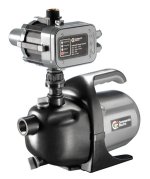
I recently bought this 'Constant pressure' pump for my bore. ($139 at Bunnings). Its just used to water the garden at the shack. It will be replacing an old pump that had a large pressure tank. I understand how the old pump worked: when the air pressure in the tank dropped, it triggered the cut-in switch. But how do these pumps with no pressure tank work? I understand that if it detects a flow rate of 2 litres a minute then it kicks in. But how can there even be a flow to detect if the theres no pressure tank? Just wondering.
 

Attachments

  • CE WATER PUMP .jpg
    CE WATER PUMP .jpg
    23.1 KB · Views: 121
/ Bore Water Pump query. #3  
I recently bought this 'Constant pressure' pump for my bore. ($139 at Bunnings). Its just used to water the garden at the shack. It will be replacing an old pump that had a large pressure tank. I understand how the old pump worked: when the air pressure in the tank dropped, it triggered the cut-in switch. But how do these pumps with no pressure tank work? I understand that if it detects a flow rate of 2 litres a minute then it kicks in. But how can there even be a flow to detect if the theres no pressure tank? Just wondering.

A flapper valve switch mounted in the output line. With no water flow, the flapper is straight and when it senses water flow, by bending, it activates the pump.

In order to have a pressure switch, the pump has to have a compressible vessel of some kind, be it a bladder or pipe with air trapped inside, a spring loaded cylinder, much like an accumulator, and there may be others.
 
/ Bore Water Pump query. #4  
A flapper valve switch mounted in the output line. With no water flow, the flapper is straight and when it senses water flow, by bending, it activates the pump.

How might the initial fluid flow be initiated?:confused:
 
/ Bore Water Pump query.
  • Thread Starter
#5  
How might the initial fluid flow be initiated?:confused:

I guess JJ meant theres something like a spring loaded pressure tank inside the electronic head that initiates the water flow.
 
/ Bore Water Pump query. #6  
How might the initial fluid flow be initiated?:confused:

I am looking at it this way, if there is no water flow, there is equal pressure/static pressure/ 0 psi on both sides of the flapper valve. Once the output spigot or outlet valve is opened, there will be water movement, and less pressure on one side, and the flapper will bend in the direction of water flow, activating the pump. As soon as you shut off the water, the pressure goes back to the static state.
Maybe some water hydraulic engineer will jump in here and correct us if we are wrong.

An analogy might be a sail switch used in A/C systems, which is a vane activated switch in the path of air flow, which will occur when the A/C cuts on. At rest, the electronic filter is not activated, so when the A/C cuts on, the vane switch is activated and turns on the electronic air filter. When there is no air flow, the vane goes to a static position, and the electronic filter is shut off.
 
/ Bore Water Pump query. #7  
Once the output spigot or outlet valve is opened, there will be water movement, and less pressure on one side,

For water movement there will have to be pressure differential across the out spigot will there not.:D
 
/ Bore Water Pump query. #8  
For water movement there will have to be pressure differential across the out spigot will there not.:D

I am thinking that gravity will try and let the water out and air in, and doing so will cause a differential. That is assuming that the outlet is pointed down You could set up an experiment and try it.

Try this, close off one end of a 6 ft pvc pipe, and 3/4 in ID , and fill with water. Now turn it so the open end is down and see if you get water flow. If there was a flapper valve in that line, I think it would activate.
 
/ Bore Water Pump query. #9  
I guess JJ meant theres something like a spring loaded pressure tank inside the electronic head that initiates the water flow.

A device to hold pressure doesn't have to be very big. Look at CO2 cartridges.

Can you visualize a small nitrogen filled cylinder with a switch on the end added to a water line, and set to turn on a pump at 22 psi and shut off at 40 psi.

Air against water will be absorbed in time, so a bladder is used to separate the pressure container from the running water. Some of the old water tank system had to be recharged often to keep things in order.
 
/ Bore Water Pump query. #10  
I am thinking that gravity will try and let the water out and air in, and doing so will cause a differential. That is assuming that the outlet is pointed down You could set up an experiment and try it.

This is kinda an iffy thing if you want to rely on it to start a pump is it not.:D
 
/ Bore Water Pump query. #11  
In order to have a pressure switch, the pump has to have a compressible vessel of some kind, be it a bladder or pipe with air trapped inside, a spring loaded cylinder, much like an accumulator, and there may be others.

There can be static pressure in a pipe or line filled with fluid. In some systems a vessel that is in line is just considered as a larger chunk of line. Air does not have to be present for pressure to exist. :D

One of these might be used to measure pressure in a line.


Pressure Transducers

There are many different flow meters. This is a site with some of them.

Flow Transmitters Information on GlobalSpec
 
/ Bore Water Pump query. #12  
Pumps like this have a built in pressure tank. Also there is a pressure sensor (transducer) located somwhere in the line. This senor read pressure and tells the pump when to turn on, speed up, or slow down. This pump is similar to the Grundfos MQ style booster pump.


Cyrus Herrera
Submersible pumps

submersible_pumps.gif
 
/ Bore Water Pump query.
  • Thread Starter
#13  
With a name like that (submersiblepumps) its sounds like you might know something about this. So welcome!

Heres my situation. The pump I bought (shown in the first post) says it will suck from 8 metres down, and pump up to 40 metres. The water table is only about 2 meters down, and I'll be mainly using it to feed 4 garden taps at ground level. But I also want to connect it to a tap thats on our first floor deck thats about 4 meters above ground level. My question is, will the controller be confused by this? The old pump (with a large pressure tank) that I'm replacing never seemed to come to grips with this problem. If I adjusted it to turn on and off at ground level, it then wouldn't power the deck tap. (That could have been my fault of course, and the pump was stuffed anyway). And my other question is.. .Is there any benefit in plumbing the old pressure tank from the old pump into the new system?
 
/ Bore Water Pump query. #14  
Pumps like this have a built in pressure tank

Where might this pressure tank be located on the pump??:D

Id suggest that if this pump is to be used for watering a lawn etc. it be running constantly. This will be best for power consumption and electrical component life. The operation can be set up to operate on the line pressure.:D And yup, it don't need a pressure tank to work!:p


question is, will the controller be confused by this

Nope, when the pressure falls the pump starts and viola; Flowing water at the spigot :D

The on demand pump in my camper has no pressure tank but will start up when I open a spigot and deliver water.:D

For years I watered an acreage lawn using a centrifugal pump with no pressure tank. Worked well! When I closed the spigots the pump shut off. On opening the spigots the pump started.:D

Now, can someone tell me how a hydro test is conducted on piping or pressure vessels and how the results are recorded for posterity for the official agencies involved:D?:D This may help explain line pressure without the use of a pressure tank or air!
 
Last edited:
/ Bore Water Pump query. #15  
Where might this pressure tank be located on the pump??:D

Id suggest that if this pump is to be used for watering a lawn etc. it be running constantly. This will be best for power consumption and electrical component life. The operation can be set up to operate on the line pressure.:D And yup, it don't need a pressure tank to work!:p


Nope, when the pressure falls the pump starts and viola; Flowing water at the spigot :D

The on demand pump in my camper has no pressure tank but will start up when I open a spigot and deliver water.:D

For years I watered an acreage lawn using a centrifugal pump with no pressure tank. Worked well! When I closed the spigots the pump shut off. On opening the spigots the pump started.:D

Now, can someone tell me how a hydro test is conducted on piping or pressure vessels and how the results are recorded for posterity for the official agencies involved:D?:D This may help explain line pressure without the use of a pressure tank or air!

It is not recommended to test water pipe with air. Read the following page.

Safely Testing PVC and CPVC Pipe Systems
 
/ Bore Water Pump query. #16  
Oh yes I know that. No need to post the links! Hydro testing pipe with air in the line can be hazardous and is not done!:D Thats why the lines/vessels are hydro tested.:D

But now tell me how you pressure test the line using only water and be able to show chartable results to the required authorities? :D And yes it can be done.:D

By the way air in a hydro test really makes a mess off the results! so that no certified inspector would pass the results.:D
 
/ Bore Water Pump query. #17  
How about this, you you fill the pipes with water as best you can, but as you know if you have vertical pips with caps on them, you will never get all the air out. Anyway, you take a bladder tank with shut off valve, and pressure gage, fill the tank with water to a pressure say about 30 lbs. hook the tank to the water lines with a coupling, and release the water in the tank. At some point, the pressure should stabilize, and the pressure reading should hold, and if it should hold that pressure for 24 hours, that should be a good test of the lines. You should talk to the tester, and find out what he does. If the pressure should drop, you have to inspect each joint, and if leaking, cut it out and repeat the test. I don't know if anybody does this, but a vacuum test will find a leak quicker.
 
/ Bore Water Pump query. #18  
JJ, why don't you just admit there can be fluid pressure in a line without the presence of air!:D

Hydro tests on pressure piping are usually conducted at pressures exceeding the the normal working pressure of the line. These pressure are usually set by governing agencies that are responsible for the piping and vessel inspection standards for the area in question. Their intent is to check material integrity of the lines and vessels. The results of the test are usually charted and then filled away for future reference if needed.:D

Air in the system when preforming the test just means you get to redo the test.:D
 
/ Bore Water Pump query. #19  
Off course water has pressure in a pressurized system. PVC pipe has a very high test pressure, around 320 lbs, so you can put a good bit of pressure in it. You will still have some air in all the risers unless you bleed every one of them. I believe that you know all this, so what is the point. No one is going to believe the test you make, the inspector will make their own test. We don't keep any logs on the test, and once done and passed, it is done.
 
/ Bore Water Pump query. #20  
JJ
The only reason stuff is hydro tested is the a fluid doesn't compress and and isn't as dangerous as compressed air if some thing breaks during the test a lot of time with air you have shrapnel with water it is less dangerous.

Now on to the constant pressure pump. They have a transmitter in the system some were and slow the pump down to keep the same pressure all the time. The transmitter will some logic in it or the pump as to when the pump shuts off when water isn't flowing.

Most standard well pumps can pump faster than the faucet discharge and the well tank (captive or old style galvanized) cushioned then to keep pump from starting and stopping on every faucet opening.

I remember many times hearing people complain the pump will run when the toilet was flushed or faucet was turned on usually the tank was water logged.

tom
 
 
Top