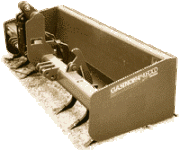
Box Blading in Reverse

   / Box Blading in Reverse #21  
</font><font color="blue" class="small">( Hiniker Box Blades use two grader blade edges- one facing forward and one rearward- to smooth and level the surface. )</font>

Norm, what part of this statement leads you to your conclusion? What I read is that they say "...two grader blade edges...." How do you grade with the rear blade if you aren't going in reverse? You and I interpret that statement very differently. /forums/images/graemlins/smirk.gif
 
   / Box Blading in Reverse #22  
Top N Tilt is irrelevant to this discussion. If you push with the box blade, it is the lower arms that doing the pushing. They aren't designed to push. They are designed to pull. You can push loose material with them but if you try to cut undisturbed soil and hit something solid, you are more likely to bend the lower control arms while pushing than if you hit the same solid object while pulling.
 
   / Box Blading in Reverse #23  
</font><font color="blue" class="small">( When you think about it, at the attach points, there is no difference whether you are moving forward or reverse because the pins are essentially perpendicular to the force. If anything, the pins would have more strength when being pushed on rather than pulled on. /forums/images/graemlins/cool.gif )</font>

There is a big difference. The lower arms are not perpendicular to the force. They are angled out from the tractor. When pulling they will tend to want to pull in toward the center. When pushing they will tend to want to spread apart. They are more likely to bend.
 
   / Box Blading in Reverse #24  
</font><font color="blue" class="small">( They aren't designed to push. They are designed to pull. )</font>

Ozarker, I don't think you can support the statement that the arms aren't designed to push with any engineering data. Certainly the traditional draft loads have been pulling, but I'll bet you that if we sat down with the engineer who designed lift arms on any modern tractor, he would tell you that pushing in reverse was indeed taken into consideration when sizing the rear lift arms.

Remember, you can always find an exception if you look far enough. If I were to ask you if it's okay to hook a trailer onto the swinging drawbar and back up with it, you'd probably say it was okay. I could then say that if you hit a tree with the trailer while backing you might bend your drawbar. /forums/images/graemlins/shocked.gif

What I'm saying is many older tractors had lift arms that could easily be bent. I think newer tractors are designed by engineers who have full knowledge of the wide range of attachments their tractors will be powering. The boxblade is an ideal example of just such an attachment. /forums/images/graemlins/cool.gif
 
   / Box Blading in Reverse #25  
</font><font color="blue" class="small">( .... If anything, the pins would have more strengh when being pushed on rather than pulled on. /forums/images/graemlins/cool.gif )</font>

Hmm, What I trying to say was that I would think the attach points would fail before the arms would, at least on my tractor.
 
   / Box Blading in Reverse #26  
"When pushing they will tend to want to spread apart."


So, they don't spread apart because they are restrained completely at each end. If the lower link material is put under a stress, inward or outward it would be my conclusion that at some point it would fail at the same load whether it is placed inward or outward and somewhere near the center. The question is at what level of load will that occur. For you it would apparently happen well before the tractor stopped bending your lower links, for me the box would eventually stop forward or rear movement either by spinning the tires or loading the engine. It's what has happened everytime.

The boxscraper is either having the load placed to the outside of the lower link pocket or the inside. The very structure of my 1000lb box completely eliminates the concern were that pressure is placed. Perhaps your tractor is not designed for rear work, thats to bad as it is very effective. Mine is. Why you would suggest that a lower link is more likely to bend outwards then inwards given the same span and potential stress if pressure is applied is beyond me, I can't follow your logic. After cutting several thousand yards of material (in reverse), my conclusion will differ from yours. I would worry far less about the lower arms bending on my tractor as I would where they attach to the tractor. My International could run into a concrete bunker going backwards and never know the difference. It's that beefy. My Kubota while less beefy may not be designed for concrete bunkers, it will handle dirt and the occasional rocks and stumps.
 
   / Box Blading in Reverse #27  
Not that it makes any difference what I think, but I do think Ozarker is right (more right, anyway) and the designed strength of the arms is more in favor of pulling, rather than pushing. There is more risk of bending the arms pushing with them, than there is pulling with them (and there is likely some engineering design built in to support pushing).
Beyond that, the original poster had it right too, that there is a need to be concerned when pushing backwards on a box blade or rear blade. Carefully working backwards shouldn't be a problem.

The 'rear' blade on the box is as much for smoothing going forward as it is for blading backwards, depending on the desires of the operator and the job at hand.
 
   / Box Blading in Reverse #28  
As I said before, I think it is impact that causes the most damage, and it would be unlikely to have much impact when pushing loose dirt. So in that sense it may be prudent to use the BB in reverse primarily for loose stuff. Since there are no scarifiers in reverse, unless the soil is pretty loose to begin with, then you're not get much of a bite into it anyway, but you would have a beter chance of hitting a rock.

How fast do you guys go with these things anyway? If I hit something imovable my wheels just spin, but the onset of the force is very slow. I don't feel much of a jolt, and I doubt the 3ph arms are stressed much at all. I think the thing to remember is that it you can feel it from the drivers seat, the 3ph arms felt it too.

The forces due to impact are much, much higher than you could achieve just by gently pushing or pulling until the wheels break traction. I would bet that if you go "slow" you cannot break any of the 3ph parts on any of these machines, unless it has a serious defect or design flaw - the traction limited forces won't be high enough to do damage. I would ultimately expect the arms to be weaker in reverse, as they are more in compression than in tension.
 
   / Box Blading in Reverse #29  
Maybe what we need are some pictures of our lower links. I'll snap a shot of both my L3830 and Internationqal. If you could get a picture of your Yanmar's lower links it may well squelch just what we are talking about. Mr NoJoyJoyStick, could you get a shot of your NH lower links?
 
   / Box Blading in Reverse #30  
You are right too, and I suspect most damage is when pushing in reverse at 'higher' speeds than at lower speeds. Also, working with the check chains (or supports) improperly adjusted, and even box blades that have the lower pins in non-standard locations.

Many things enter into the equation. Leaves lots of room to 'discuss' things and take stands that lead to heated discussions. Lets be cool. /forums/images/graemlins/cool.gif
 
   / Box Blading in Reverse #31  
Chris, you are correct. When cutting with the boxblade in reverse, it generally requires low gears or range as the load is high when cutting material. The impact is virtually eliminated becasue the speed is slow. I find my cutting speed is probably at or less then 2 mph. It takes everything my tractors have to push a blade in reverse depending on where I set my hydraulic top link. You make a good point that may have been missed.
 
   / Box Blading in Reverse #32  
[quoteSo, they don't spread apart because they are restrained completely at each end. )</font>

Restrained by what? Those cheap little snap pins? Please.......
 
   / Box Blading in Reverse #33  
Lower Links

Aww RaT, you know I have a "peek-ture" of everything, don't you? /forums/images/graemlins/laugh.gif

My lower links are made of steel almost 1" thick and where they attach to the tractor is a yoke rather than pins. Yes Ozarker... really. /forums/images/graemlins/wink.gif

I'd also like to make it clear that I think the geometry of the lower arms and the fact that they are solidly pinned to an implement does make the pressure essentially perpendicular to the pins. The rotating ball endlinks also help to assure this. Not all tractors have this yoke design, but I think my pins can take the same amount of force in either direction and that amount of force is not likely to be achieved while boxblading as I do, even if I hit a rock or a stump. /forums/images/graemlins/crazy.gif

Finally, I never said that the lift arms do not have more strength for pulling loads. I said that they were designed with reverse loads in mind and are stronger than ones on older tractors.
 
   / Box Blading in Reverse #34  
No, by the 1/2" or 5/8"steel pocket it sits in. My lower links are surrounded on both sides by these 1/2" to 5/8" plates of steel. I think your Yanmar/boxscraper setup is obviously designed much different with a simple pin sticking out securing the lower link with the snap pin. This may well account for the confusion and why you feel hesitant about blading in reverse. The cheap little snap pin you mention does little more then keep my removable 3/4" from falling out. A quick trip to most dealers should clarify how things have changed.
 
   / Box Blading in Reverse #35  
</font><font color="blue" class="small">( Ozarker, I don't think you can support the statement that the arms aren't designed to push with any engineering data. Certainly the traditional draft loads have been pulling, but I'll bet you that if we sat down with the engineer who designed lift arms on any modern tractor, he would tell you that pushing in reverse was indeed taken into consideration when sizing the rear lift arms. )</font>

No need for engineering data. This is fairly basic high school geometry. The 3-point system isn't designed to push. It is designed to pull......period. In fact, everything about a tractor is designed to work in one direction. That is why they have directional tread on the tires. Implements designed to be pushed are on the front and implements designed to be pulled are in the middle or on the back.

What it is designed to do what you get away with doing are two different things. A pickup truck isn't designed to have round bails of hay hanging off the back end but people mount spikes on the ends of their trucks and do it anyway. You can tell and old used truck that use to have a hay spike mounted on it by the way the frame is bent.

Box blades are not designed to be dozers when pulling or pushing. They can make shallow cuts but the reality of the design is that they have scarfer teeth to break up the ground in front of the blade if you need to cut rather than spread material. And it is certainly not designed to be a dozier in reverse.

Just imagine for a moment if someone designed a blade for the front of the tractor that was mounted with a system as loose as a 3-point on the rear. It had to have chains or bars to limit side to side sway. People would complain about fit and finish and walk away from such a silly design.

Nope, 3-point systems are designed for pulling implements and the implements for 3-point systems are designed to be pulled. Your tires are directional and your seat faces the front. No engineering data is required.
 
   / Box Blading in Reverse #36  
There is no confusion and I won't hesitate to blade in reverse if I need to push loose material the other direction.

But what you or I will or will not do has absolutely nothing at all to do with that the equipment is designed to do. My FEL isn't designed to be a grader blade but I backblade with it all the time.

Just because you CAN do something doesn't mean it was designed to be done that way.
 
   / Box Blading in Reverse #37  
I use the rear edge of the blade to smooth with going forward. Just tilt up the fromt of the box and go. The trailing edge leaves a nice smooth surface.
 
   / Box Blading in Reverse #38  
I reckon we do. I don't see where it says you grade with the rear blade. Also "Optional adjustable scarifiers loosen soil ahead of the blades." If you were in reverse, the scarifiers would not be ahead of the blades.
 
   / Box Blading in Reverse #39  
Jim, your hoses look a bit rotted. I think Ozarker has an entirely different setup. I'll snap a shot to help clarify where I believe he and we are comparing oranges to lemons.
 

Attachments

  • 458599-Gannon scrapper.gif
    458599-Gannon scrapper.gif
    7.4 KB · Views: 229
   / Box Blading in Reverse #40  
"Restrained by what? Those cheap little snap pins? Please....... "

Ozarker, I think this pretty much says it all. There indeed is confusion. The pins in my case restrain nothing except keeping the pin from falling out. In your case apparently they hold the lower links on. If I'm the only one confused, I apologize, take a look at the attachment. See those plates of steel, they trap the lower link from going in or out, pushing or pulling.
 

Tractor & Equipment Auctions

Commercial Lawn Mower 652R (A56859)
Commercial Lawn...
2024 MECO M-Y 4-Passenger Electric Car (A59231)
2024 MECO M-Y...
MINI KID DIRT BIKE (A56859)
MINI KID DIRT BIKE...
2015 TEXAS PRIDE TRAILER  30 FLATBED GOOSENECK TRAILER (A58214)
2015 TEXAS PRIDE...
Ford F450 Bucket Truck with Altec AT200A Boom (A56435)
Ford F450 Bucket...
2016 Caterpillar 349FL Hydraulic Excavator (A56857)
2016 Caterpillar...
 
Top