Broke Hydrostat twice? Why?

   / Broke Hydrostat twice? Why? #61  
Coyote machine,
That's a heckofa post. I'll try to answer your points in order.

1) oh yes I can blame myself. When I first got my tractor, I had to get rid of the slash from eleven semis of marketable timber - mostly 3 foot grand fir.
Unfortunately, about then I read about the German gardening concept called hugelkultur, and anyway my wife wanted a veggie garden.....
So I dug a hole 6 feet deep and 60 feet across and filled it with the slash ( there was a burn ban on at the time). When I hit the hard pan, i couldn't cut through it, try as I might even with a tooth bar. So I ripped into it with the box blade' rippers and this eventually worked. Then I put back some of the fill and all of the topsoil and now really have a spectacular garden.

Took over a month and I'm betting that that sort of thing caused my first hydro to go belly up.

I've been much more careful and gentile since then.

2) yes, I will install a temp guage.

3) yes. I have called Jordan and they are sending me the old hydro Monday.

4) I don't hose the radiators out. I've made a cleaner out of an 18 inch piece of brake line with a short right angle at the end. Connected to my air compresser. Does a heck of a job. I can't believe it leaves anything behind. I'm now cleaning it every 4 hours or so.

5) yes. I'm going to fix my grill.

6) yes. I have sent Dkrug a PM. Not sure I did it right though.

7) Bulldoze. Yes. See above.

I have a couple more comments and some questions regarding fluid flow and such, but my wife just climbed into the hot tub and I feel so dust incrusted from my home made radiator cleaner.that I'm going to
climb in.

I use my tractor every bit as hard if not harder than what you have described. I have put over 500 tough hours on her in the last 17 months. If you are blaming yourself for breaking your transmission based on the way you have used it, then mine should have broken several times over by now. It is possible, that the hydrostatic transmission itself has a design flaw if it can't handle the work that you are putting it through. It's not like a gear transmission where you can burn out the clutch. The system is designed to go into relief before it receives damage. I'm not going to claim that the hydrostat trans in my tractor is better than yours, because I simply don't know, however, again, mine should have broken numerous times by now if yours broke from the use you describe. Almost all of my dirt work is in medium range. I plow snow in high range. She works just as well as the day I brought her home. I'm wondering if something else in the system failed causing your unit to break.
 
   / Broke Hydrostat twice? Why?
  • Thread Starter
#62  
Coyote Machine,
That all sounda like good advice.

Not just for the tractor, but for me, too!

I can easily live within those guidelines.

By the way, how do you add on a thermostat, anyway? I assume (there' that word again) that I break iinto the line just before or after the oil cooler, run a length of hydraulic line to the new guage at the dash, then back to the main line.

If so, is the oil under pressure here, or are hose clamps OK?

Which side of the oil cooler?

Anybody?
 
   / Broke Hydrostat twice? Why?
  • Thread Starter
#63  
TSO,

Very interesting and helpful.

After breaking it the first time and having it replaced under warranty, the dealer mentioned more or less in passing that it was replaced with a new and improved hydro complete with a new and improved drive shaft that seemed to be part of the problem, if any. It was near the beginning of that model run and this sort of thing happened with several parts. In their favor, TYM was always good as gold on their warranty decisions.
 
   / Broke Hydrostat twice? Why? #65  
Any temp guage system I've seen uses a temperature sensor in the fluid path, which is wired to an electric guage. You will need to "T" the hydraulic line for a sensor (unless there is a threaded boss in the cooler or elsewhere in the system made for this purpose) and run wires to the sensor & the instrument panel for the guage. The power lead needs to have the right fuse in-line, to protect the circuit.
The only fluid line I know of that goes directly to a guage is for oil pressure & that's pretty old school. Oil pressure gauges are normally electric, these days.
 
   / Broke Hydrostat twice? Why? #66  
The temp sender unit must be in a place that has constant flow of oil to give correct readings.

There are lots of kits with sender and instrument on ebay or other part places, like this one

Hayden 275 - Oil Temp Gauge | O'Reilly Auto Parts

If there is no place to insert one, you need to get a T inline between two existing fittings and then find an adapter for the sender to fit, they are usually 1/8NPT.

BR /Marcus
 
   / Broke Hydrostat twice? Why? #68  
Hydraulic Oil in Hydrostatic Transmissions.jpgPICT6382.jpgPICT6384.jpg

Here are 3 files related to overheating. Thin oil is the most frequent cause of overheating failure. The chart gives you an idea what heat does. Green is the sweet spot, the oil viscosity at which the hydro thrives. Oil selection is to try and keep the oil temperature in the hydro in the green or yellow range under all operating conditions. Oils give viscosity at 100ーC and 40ーC. This chart was made from information collected from the 2 largest hydrostatic transmission builders in the world and may not correlate well with lower cost suppliers but it is a good indicator of what heat does - increased heat = lower operating viscosity = reduced life.

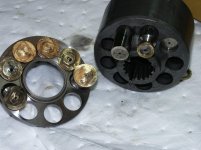
The pictures are of one of 3 hydros from a machine operating in the Persian Gulf in temperatures exceeding 50ーC (122ーF). I had this machine instrumented with 24 thermocouples monitoring oil and air temperatures everywhere. Highest temperature was, as expected, from the case drains. This is the hot oil after it has done all its work. Our system is set to bleed off 2.5 gpm of hot oil from each motor to allow cool oil to enter the main loop from the charge pump. At the temperatures I measured, oil at this point was 4 cSt because it was well beyond 100ーC (I have a chart that extends to the flash point of the oil).

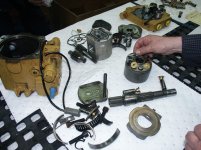
The pictures show what happens to a pump subjected to heat. Note the major problem is the rotating grop. The large picture shows all of the parts we disassembled including the steer pump. Everything was in perfect condition except the pistons, slippers and swash plate. The rotating group moved smoothly. All of the pistons could be easily removed from the cylinder housing. The bronze slippers melted from metal to metal contact. Then the round ends of the steel pistons started riding on the swash plate and dug the groove seen in the overall picture.

Except for me having removed components for further inspection, this pump could have been reassembled with new pistons and a new swash plate and it would have continued to run. Heat had no other detrimental effect.

Not saying heat isn't your problem, but illustrating the most common overheat problem in a hydro transmission.

We place our temperature sensor in the hydraulic reservoir. The reason is reservoir oil is the source for oil entering the hydrostatic system. If we keep that oil below 85ーC, its not going to exceed 100ーC in the system (based on collecting thousands of hours of data in conditions from -30ーC to +50ーC).

Operating your machine at a higher duty cycle than that for which it is intended should result first in weaker operation - excessive leakage so it won't go as fast, lower peak pressures so it won't pull as much, etc.

Testing pressure in neutral does not make sense. There must be something missing. On all the hydro machines for which I have been responsible the test procedure has been to shift into the highest range, then with the engine at full speed, slowly advance the propel lever to the stop (brakes set of course or other means to prevent the machine from moving).
 
   / Broke Hydrostat twice? Why? #69  
...this pump could have been reassembled
with new pistons and a new swash plate and it would have continued to run. Heat had no other detrimental effect.

Good photos of a failed GST unit, MHE.

Back when I repaired my Kubota B21, purchased with a bad transmission, I was able to get a quotation
for the HST pump or motor separately. But components of each were not sold separately; the pistons
were all "matched" to the cylinder blocks. I do think that any bad pistons with slippers should have
been replaceable separately, as long as the bores were in spec. Even in a case like yours, as you say.

I did end up buying the charge pump separately cuz the rotor and block showed some wear. In that
HST, the charge pump is on the front of the HST. Other HSTs have it separate.
 
   / Broke Hydrostat twice? Why? #70  
<img src="http://www.tractorbynet.com/forums/files/owning-operating/427212-broke-hydrostat-twice-why-hydraulic-oil-hydrostatic-transmissions-jpg"/><img src="http://www.tractorbynet.com/forums/files/owning-operating/427213-broke-hydrostat-twice-why-pict6382-jpg"/><img src="http://www.tractorbynet.com/forums/files/owning-operating/427214-broke-hydrostat-twice-why-pict6384-jpg"/>

Here are 3 files related to overheating. Thin oil is the most frequent cause of overheating failure. The chart gives you an idea what heat does. Green is the sweet spot, the oil viscosity at which the hydro thrives. Oil selection is to try and keep the oil temperature in the hydro in the green or yellow range under all operating conditions. Oils give viscosity at 100ーC and 40ーC. This chart was made from information collected from the 2 largest hydrostatic transmission builders in the world and may not correlate well with lower cost suppliers but it is a good indicator of what heat does - increased heat = lower operating viscosity = reduced life.

The pictures are of one of 3 hydros from a machine operating in the Persian Gulf in temperatures exceeding 50ーC (122ーF). I had this machine instrumented with 24 thermocouples monitoring oil and air temperatures everywhere. Highest temperature was, as expected, from the case drains. This is the hot oil after it has done all its work. Our system is set to bleed off 2.5 gpm of hot oil from each motor to allow cool oil to enter the main loop from the charge pump. At the temperatures I measured, oil at this point was 4 cSt because it was well beyond 100ーC (I have a chart that extends to the flash point of the oil).

The pictures show what happens to a pump subjected to heat. Note the major problem is the rotating grop. The large picture shows all of the parts we disassembled including the steer pump. Everything was in perfect condition except the pistons, slippers and swash plate. The rotating group moved smoothly. All of the pistons could be easily removed from the cylinder housing. The bronze slippers melted from metal to metal contact. Then the round ends of the steel pistons started riding on the swash plate and dug the groove seen in the overall picture.

Except for me having removed components for further inspection, this pump could have been reassembled with new pistons and a new swash plate and it would have continued to run. Heat had no other detrimental effect.

Not saying heat isn't your problem, but illustrating the most common overheat problem in a hydro transmission.

We place our temperature sensor in the hydraulic reservoir. The reason is reservoir oil is the source for oil entering the hydrostatic system. If we keep that oil below 85ーC, its not going to exceed 100ーC in the system (based on collecting thousands of hours of data in conditions from -30ーC to +50ーC).

Operating your machine at a higher duty cycle than that for which it is intended should result first in weaker operation - excessive leakage so it won't go as fast, lower peak pressures so it won't pull as much, etc.

Testing pressure in neutral does not make sense. There must be something missing. On all the hydro machines for which I have been responsible the test procedure has been to shift into the highest range, then with the engine at full speed, slowly advance the propel lever to the stop (brakes set of course or other means to prevent the machine from moving).

Great post.

Have you found a hydraulic oil that manages heat better than others?

Also, I've been curious... Do you know who builds the HST in my Massey 1648 (built by Iseki) ?
 
   / Broke Hydrostat twice? Why?
  • Thread Starter
#71  
While working today (with rest breaks for both me and the tractor) I noticed something disturbing.

I have a frame mounted backhoe. It is usually not attached. There is a lever that comes out from under the front of my seat that operates the rear remotes. The lever moves either way sideways and has a detent position at its full travel point. It is possible when entering or leaving the tractor to brush up against the lever and if you do it hard enough, it will stay at its full side detent position. I've noticed this before and I just re center the lever. There is no strange sound or any thing.

But now I'm more alert for any thing odd. How often have I NOT noticed this? There is no telling.

So I tried something. While traveling down the driveway at 2200 RPM, I moved the lever over to full detent. Tractor immediately bogged down by about 200 rpm. No hydro noise. No relief valve noise. No change at all except losing 200 RPM. Since the lever can only be accidentally moved while entering or exiting the tractor, I would never notice the missing RPMs. I would just start it and adjust the throttle.

More and more I'm thinking this is an overheat thing. Sometimes too low RPMs, sometimes the wrong gear, sometimes dirty oil cooler, no temp guage, and now this.

MHE's very helpful post - particularly those graphs - tell me that it is possible to ruin a hydro over a fairly long time without burning or even dis coloring the oil.

Well, tomorrow Jordan is going to mail me the old hydro and my wife and I are going to drive it down to DKrug as soon as we can schedule it, and then we'll all know.
 
   / Broke Hydrostat twice? Why? #72  
That lever is sending hydraulic flow to the rear ports the backhoe attaches to. With nothing on those ports it "dead-ends" and sends the system into hydraulic relief. While this shouldn't cause any damages short term, it could mess up the pump or the relief system over time. I don't think this is what caused your HST issues.
 
   / Broke Hydrostat twice? Why? #73  
Just curious, did your dealer put synthetic hydro oil in after changing the HST unit? If not I think it would be a good investment as it should handle the heat better. Another option might be to change the oil out more frequently. You could send a sample out to have it analyzed to see if it's time to change it or just do it at 200 or even 100 hours of use (if you don't want to use synthetic).
 
   / Broke Hydrostat twice? Why? #74  
That lever is sending hydraulic flow to the rear ports the backhoe attaches to. With nothing on those ports it "dead-ends" and sends the system into hydraulic relief. While this shouldn't cause any damages short term, it could mess up the pump or the relief system over time. I don't think this is what caused your HST issues.

Properly plumbed and valved the hydraulic system should not be dead-heading against the relief valve. Is there an open center and closed center mixup ?
 
   / Broke Hydrostat twice? Why?
  • Thread Starter
#75  
Just curious, did your dealer put synthetic hydro oil in after changing the HST unit? If not I think it would be a good investment as it should handle the heat better. Another option might be to change the oil out more frequently. You could send a sample out to have it analyzed to see if it's time to change it or just do it at 200 or even 100 hours of use (if you don't want to use synthetic).


I asked him that and the answer was 'no'.
I didn't discuss that cause I've noticed that disagreeing with somebody about that is akin to arguing with them about religion.

I am a believer in synthetic.

Every car, boat or anything else I've owned for the last 30 years or so gets syn.

Except the tractor. I've been using Kubota super whatever believing it was synthetic, but I find it's not.

I may switch to Amsoil.

In any event, I plan to change the oil after 50 hours like a new tractor.

Look here folks. I know I don' come across here as very smart, but I still drive the Honda civic we bought new 30 years ago. Changed the clutch last year - the first non maintenance dollar ever spent on it. Probably because I taught four consecutive nieces how to drive stick on it.

But I did'nt grow up around tractors. All my knowledge has come from you. That and trial and error of course.:)

Actually I' amazed how polite everyone's been to me here. This is the internet after all.
 
   / Broke Hydrostat twice? Why? #77  
I asked him that and the answer was 'no'.
I didn't discuss that cause I've noticed that disagreeing with somebody about that is akin to arguing with them about religion.

I am a believer in synthetic.

Every car, boat or anything else I've owned for the last 30 years or so gets syn.

Except the tractor. I've been using Kubota super whatever believing it was synthetic, but I find it's not.

I may switch to Amsoil.

In any event, I plan to change the oil after 50 hours like a new tractor.

Look here folks. I know I don' come across here as very smart, but I still drive the Honda civic we bought new 30 years ago. Changed the clutch last year - the first non maintenance dollar ever spent on it. Probably because I taught four consecutive nieces how to drive stick on it.

But I did'nt grow up around tractors. All my knowledge has come from you. That and trial and error of course.:)

Actually I' amazed how polite everyone's been to me here. This is the internet after all.

Apparently Washington State doesn't salt the roads in winter ?
 
   / Broke Hydrostat twice? Why? #78  
Bob, I call BS on the you're not very smart thing. Unless you stop self deprecating we'll have to send some old geezer TBNers, who are almost out to pasture anyway, out to Washington to set you straight!:laughing:

You're learning, as most of us do by talking about our machines.
Your backhoe lever/fluid flow might have been contributing to your trans failures; I can't say for certain because I'm not familiar with your hydraulics and I'm not an expert in this field.

Can you modify the lever so you can't accidentally drop into the detent unknowingly? Other idea would be to post a note near the key as a prestart checklist for the 'pilot', you. This would remind you every time you go to start what needs to be checked before takeoff.

Synthetic oils: I have used Amsoil for my Kioti engine, but not the HST. In fact, I've never changed any HST fluid in over 750 hours since new. It's sort of an experiment, because my dealer doesn't change trans fluid unless it shows signs of water or other contaminants.
I do plan to change it fairly soon, with Kioti's own branded HST fluid, so as to cover all the bases, might as well use the recommended fluids.

Running synthetic, or a blend, as an alternative to dino in your HST ought to give you some edge, but make sure it meets wet brake and any other required content specs that the current dino based oil does for your HST needs.


As far as synthetic for the engine, I've gone to Mobil diesel oil in 5-40 mix for the climate here in VT.

This thread is beneficial to all who want to know more about their HST transmissions, regardless of brand.:thumbsup:
 
   / Broke Hydrostat twice? Why?
  • Thread Starter
#79  
Bob, I call BS on the you're not very smart thing. Unless you stop self deprecating we'll have to send some old geezer TBNers, who are almost out to pasture anyway, out to Washington to set you straight!:laughing:

You're learning, as most of us do by talking about our machines.
Your backhoe lever/fluid flow might have been contributing to your trans failures; I can't say for certain because I'm not familiar with your hydraulics and I'm not an expert in this field.

Can you modify the lever so you can't accidentally drop into the detent unknowingly? Other idea would be to post a note near the key as a prestart checklist for the 'pilot', you. This would remind you every time you go to start what needs to be checked before takeoff.

Synthetic oils: I have used Amsoil for my Kioti engine, but not the HST. In fact, I've never changed any HST fluid in over 750 hours since new. It's sort of an experiment, because my dealer doesn't change trans fluid unless it shows signs of water or other contaminants.
I do plan to change it fairly soon, with Kioti's own branded HST fluid, so as to cover all the bases, might as well use the recommended fluids.

Running synthetic, or a blend, as an alternative to dino in your HST ought to give you some edge, but make sure it meets wet brake and any other required content specs that the current dino based oil does for your HST needs.


As far as synthetic for the engine, I've gone to Mobil diesel oil in 5-40 mix for the climate here in VT.

This thread is beneficial to all who want to know more about their HST transmissions, regardless of brand.:thumbsup:


Well, thanks for your kind words. Any TBNers are more than welcome here. I never have had any friends who had a tractor and I never even sat in one before I bought this one. So I guess it could have been worse.

Yes, I have thought of a way to keep the lever in place.
I think that if I ever did let the tractor run for long with the lever on, it must have at least contributed to heat because those 200 RPMs went somewhere and it seems to me they must have been converted into heat in the hst.

I believe synthetic oil resists molecular breakdown better than Dino oil and I think that it thins out less with heat, but not by much.

I do hope that others do get some benefit from the sage comments here.
 
   / Broke Hydrostat twice? Why?
  • Thread Starter
#80  
Bob, I call BS on the you're not very smart thing. Unless you stop self deprecating we'll have to send some old geezer TBNers, who are almost out to pasture anyway, out to Washington to set you straight!:laughing:

You're learning, as most of us do by talking about our machines.
Your backhoe lever/fluid flow might have been contributing to your trans failures; I can't say for certain because I'm not familiar with your hydraulics and I'm not an expert in this field.

Can you modify the lever so you can't accidentally drop into the detent unknowingly? Other idea would be to post a note near the key as a prestart checklist for the 'pilot', you. This would remind you every time you go to start what needs to be checked before takeoff.

Synthetic oils: I have used Amsoil for my Kioti engine, but not the HST. In fact, I've never changed any HST fluid in over 750 hours since new. It's sort of an experiment, because my dealer doesn't change trans fluid unless it shows signs of water or other contaminants.
I do plan to change it fairly soon, with Kioti's own branded HST fluid, so as to cover all the bases, might as well use the recommended fluids.

Running synthetic, or a blend, as an alternative to dino in your HST ought to give you some edge, but make sure it meets wet brake and any other required content specs that the current dino based oil does for your HST needs.


As far as synthetic for the engine, I've gone to Mobil diesel oil in 5-40 mix for the climate here in VT.

This thread is beneficial to all who want to know more about their HST transmissions, regardless of brand.:thumbsup:


Well, thanks for your kind words. Any TBNers are more than welcome here. I never have had any friends who had a tractor and I never even sat in one before I bought this one. So I guess it could have been worse.

Yes, I have thought of a way to keep the lever in place.
I think that if I ever did let the tractor run for long with the lever on, it must have at least contributed to heat because those 200 RPMs went somewhere and it seems to me they must have been converted into heat in the hst.

I believe synthetic oil resists molecular breakdown better than Dino oil and I think that it thins out less with heat, but not by much.

I do hope that others do get some benefit from the sage comments here.
 

Tractor & Equipment Auctions

2016 Caterpillar 349FL Hydraulic Excavator (A56857)
2016 Caterpillar...
2013 PETERBILT 389 (INOPERABLE) (A55745)
2013 PETERBILT 389...
2019 WABASH DVLSHPC 53FT DRY VAN TRAILER (A59905)
2019 WABASH...
2020 SAVANA 3500 16FT BOX TRUCK (A59905)
2020 SAVANA 3500...
2014 PETERBILT 384 TANDEM AXLE CDL REQUIRED WRECKER (A59575)
2014 PETERBILT 384...
2014 INTERNATIONAL PROSTAR+ (A58214)
2014 INTERNATIONAL...
 
Top