BROKEN WIRE INSIDE WELDER

   / BROKEN WIRE INSIDE WELDER #1  

Aussiebushman

Gold Member
Joined
Jul 31, 2008
Messages
252
Location
Jerrong, south of Oberon in NSW, Australia
Tractor
Ford 6000
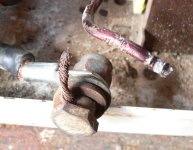
My old stick welder has performed faultlessly for many years but now has a broken connection between the connection screw and the wire from the transformer. I assumed there was wire inside the metal shielding but all it seems to be is solid aluminium or lead - no obvious wire inside.

Can anyone advise how I reconnect the two parts please
 

Attachments

  • welder_stinger_connection.jpg
    welder_stinger_connection.jpg
    224.8 KB · Views: 557
   / BROKEN WIRE INSIDE WELDER #2  
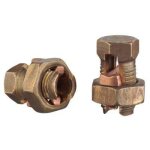
Something similar to this might be the easiest solution.
b53e318c-1dc0-4d1d-b534-d24547f80bda_400_compressed.jpg
 
   / BROKEN WIRE INSIDE WELDER
  • Thread Starter
#3  
Thanks for replying - but the screw connector is not the problem - the one on there is OK. It is the "wire" from the transformer that has broken and it appears to be solid metal - I can't find any wire inside it so I can't see how this connects to the bolt.
 
   / BROKEN WIRE INSIDE WELDER #4  
Can you punch out the hole that the copper wire is in large enough to go over the aluminum wire off the coil? Looks like there was a fair bit of corrosion going on; if that's doable cut the bad part off and sand off the lacquer, and put it back together. If drilling it out would exceed the bolt's integrity, maybe put on an eye terminal and bolt them together.
 
   / BROKEN WIRE INSIDE WELDER #5  
Aussie
As Mendonsy said a "splitnut "as he put up would be the easiest repair..Simply cut the wire from the transformer, cut the screw/bolt lug off of what appears to be your ground leg, insert them both into the splitnut tighten, tape off and you are done...:thumbsup: If not you could silver solder the connection back to the connection that it broke off from..
Regard's
Sean
 
   / BROKEN WIRE INSIDE WELDER
  • Thread Starter
#6  
Correct! Mystery solved!

There was NO wire inside the one exiting the transformer - it is solid metal with a minimal insulating coating

The manufacturers had crimped a separate piece of twisted wire to it and the twisted wire was inserted into the split bolt. It was the twisted wire that had broken.

The coating just has to be scraped off and wire filed down to fit the hole in the split bolt and all will be well.

Thanks again
 
   / BROKEN WIRE INSIDE WELDER #7  
Don't you love it when a plan comes together?:thumbsup: Tear it up "down under" Aussie..:cool2:


Regard's
Sean
 
   / BROKEN WIRE INSIDE WELDER #8  
That may work for a while.. but the solid wire is the winding of the transformer, and as such it is liable to vibrate at your line frequency.. The reason for the stranded piece of wire is to have a little "give" so that vibration won't bust the solid wire over time.
I would crimp another piece of heavy gauge but small strands in the stranded wire onto the solid wire. Then connect this stranded wire to the "binding post" . I am pretty sure this is why the manufacture did what they did. It eventually vibrated and broke anyway, but I think your solid winding out of that transformer is going to have some movement during high currents.
 
   / BROKEN WIRE INSIDE WELDER
  • Thread Starter
#9  
You are right James - The stranded wire was crimped by the manufacturer to the aluminium transformer wire for that very reason. However, before I saw your message, I has already filed the aluminium down to a snug fit into the split bolt and put it all back together with new insulation. It now works perfectly.

The cover is easy to get off with a few screws, so if it plays up after another 25 years and if I'm still around to experience it, I'll know exactly how to fix it. Currently aged 74. I rather doubt this will be my problem!

Thanks again guys

Alan
 
   / BROKEN WIRE INSIDE WELDER #10  
The cover is easy to get off with a few screws, so if it plays up after another 25 years and if I'm still around to experience it, I'll know exactly how to fix it. Currently aged 74. I rather doubt this will be my problem!
Alan

It must have been nearly fifty years ago when my grandfather and I were in the hot attic fixing a beam that had given out. He said he hoped he'd be dead before the repair had to be repeated. I'm afraid the beam on the other side of the attic is about to go and grandad got his wish. He died in '87.
 
   / BROKEN WIRE INSIDE WELDER
  • Thread Starter
#11  
Your grandfather was right - its the pragmatic approach to repair work that counts. As a bush mechanic, I work on the same principle - it only needs to outlast me, then it is someone else's problem
 
   / BROKEN WIRE INSIDE WELDER #12  
LOL... I frequently work on 90+ year old cars. Asked why I put so much effort into a restoration, my reply is always; "So it'll last another 90+ years".

Today is my 66th birthday. I hope all my restorations out-live me.
 
   / BROKEN WIRE INSIDE WELDER #13  
   / BROKEN WIRE INSIDE WELDER
  • Thread Starter
#14  
Good idea Redneck. I do have an 8 ton hand operated hydraulic crimper with multiple dies that use for boat rigging. If the repair already made fails, I'll use that to crimp a new wire to the aluminium one
 
   / BROKEN WIRE INSIDE WELDER #15  
Good idea Redneck. I do have an 8 ton hand operated hydraulic crimper with multiple dies that use for boat rigging. If the repair already made fails, I'll use that to crimp a new wire to the aluminium one

Aluminum and copper don't play nice when in contact with each other. (google aluminum wire house fires - caused by aluminum to copper joints in wire splices and terminations on circuit breakers with copper lugs). The aluminum corrodes and makes a high impedance joint that can overheat and cause fires, or if you're lucky it just "rots off" like yours did.

There is special split nuts that keep the conductors from contacting each other, also solder and flux for joining aluminum to copper, but it's finicky - Tinning the aluminum can be challenging. There are also end-to-end screw-compression splices (think butt splice, but with setscrews) that are made specifically for joining aluminum to copper while not allowing them to contact each other like they do in a regular split nut. I think they're made out of tinned aluminum, commonly used for electrical service drops to a house. The tin doesn't react with the copper or the aluminum. You can get them at electrical supply stores.

A bit of good info here: Need to Connect 240 volt Alum to Copper Wiring - DoItYourself.com Community Forums

If you stick with the split nut splice in the picture, at least goober the wires with no-ox or similar oxide inhibiting compound.
 

Tractor & Equipment Auctions

2013 FREIGHTLINER CASCADIA (A55745)
2013 FREIGHTLINER...
2019 Ford F-150 4x4 Crew Cab Pickup Truck (A60460)
2019 Ford F-150...
SHOP MADE MANIFOLD TRAILER (A58214)
SHOP MADE MANIFOLD...
2017 TAKEUCHI TL10V2 SKID STEER (A60429)
2017 TAKEUCHI...
78" ROCK BUCKET (A52706)
78" ROCK BUCKET...
2023 CATERPILLAR D3 LGP CRAWLER DOZER (A60429)
2023 CATERPILLAR...
 
Top