Building 55' Bridge Across Creek - Utility Poles

   / Building 55' Bridge Across Creek - Utility Poles #101  
That is wonderful work. We have a similar size creek and I've been thinking about a walking bridge over it.
The permitting process can be a bit daunting in some areas.

If you were to do this job again, is there some tractor, attachment, or even a more specialized machine that would have made the job easier and more enjoyable?

BTW, on the use of linseed oil for protection, what you are describing with your the boiled linseed oil and turpentine mixture should work - although it may be slow to cure (self-polymerize). That mixture is not to far removed from a harder natural oil varnish - which I made up in bulk when we built our house & learned some tricks in the process.
rScotty
 
   / Building 55' Bridge Across Creek - Utility Poles #102  
BTW, on the use of linseed oil for protection, what you are describing with your the boiled linseed oil and turpentine mixture should work - although it may be slow to cure (self-polymerize). That mixture is not to far removed from a harder natural oil varnish - which I made up in bulk when we built our house & learned some tricks in the process.
rScotty
Re linseed oil:

I used that to treat the logs on a log cabin years ago.
As time went by the logs all turned black.
What I later learned was that I should have added a 'fungicide' to my oil mix.

OK, for a bridge black is OK, I guess!

Oh, and the difference between 'raw' and 'boiled' linseed oil is boiled is supposedly treated with driers or hardeners while the 'raw' is very slow dry.
"Raw' will penetrate better=better long life protection while 'boiled' will harden and skim like paint on the surface.
 
   / Building 55' Bridge Across Creek - Utility Poles
  • Thread Starter
#103  
For the treatment process - I have seen the application of a DIY mixture used on a trl deck, it is going on mine as well as all of my yard hand tools (wooden handles). The mixture is 1 part diesel and two part (used) oil (transmission, hyd etc). There will be some odour issues for a short spell however, I can sure attest to the use of diesel, it has been my go to for years for treating my leather boots.

Thank you. What is a sufficient amount of time to wait before treating? The oak was pretty green when I put it down.
That is wonderful work. We have a similar size creek and I've been thinking about a walking bridge over it.
The permitting process can be a bit daunting in some areas.

If you were to do this job again, is there some tractor, attachment, or even a more specialized machine that would have made the job easier and more enjoyable?

BTW, on the use of linseed oil for protection, what you are describing with your the boiled linseed oil and turpentine mixture should work - although it may be slow to cure (self-polymerize). That mixture is not to far removed from a harder natural oil varnish - which I made up in bulk when we built our house & learned some tricks in the process.
rScotty
Thank you. This project did not require a permit :).

The bridge is a little over a quarter mile from my house, so the only thing that would have made it easier would have been a road to the site wide enough to pull a trailer. This would have made getting the material there much easier. The only other thing I might have done would have been to build some rock retaining walls along the stream banks on either side of the creek BEFORE building the bridge. I am in the process of doing this now with sandstone, of which we have LOTs on the property. It wasn't required, but it will keep the stream banks from eroding over time and make for a clean area. Other than that, It was just a matter of taking it day by day and humping the material back there. It was strictly a weekend project, but if I didn't have a job, it may have gotten done much faster :).

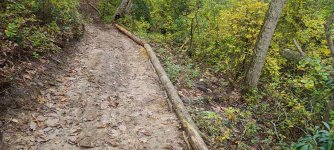
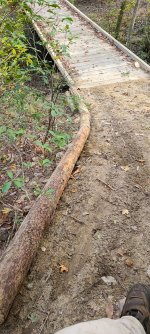
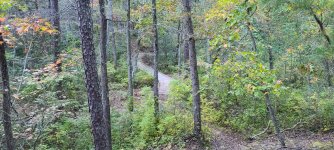
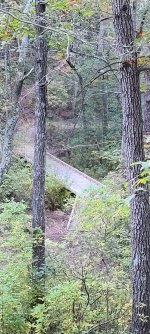
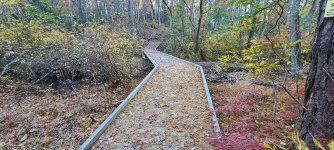
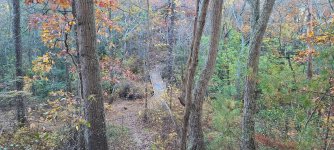
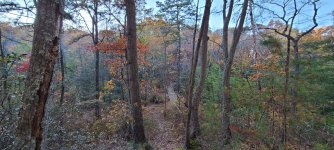
To give you an idea of the trail size leading up to the bridge, I will attach a few pics. The other two pics are a shot of the bridge from on top of the hill. Now that the leaves are beginning to fall, its a little easier to see from up on the trail.
 

Attachments

  • 20211031_151717.jpg
    20211031_151717.jpg
    4 MB · Views: 250
  • 20211031_151736.jpg
    20211031_151736.jpg
    3.4 MB · Views: 246
  • 20211028_173716.jpg
    20211028_173716.jpg
    3.4 MB · Views: 244
  • 20211028_173746.jpg
    20211028_173746.jpg
    2.5 MB · Views: 256
   / Building 55' Bridge Across Creek - Utility Poles #104  
Thank you. What is a sufficient amount of time to wait before treating? The oak was pretty green when I put it down.

Thank you. This project did not require a permit :).

The bridge is a little over a quarter mile from my house, so the only thing that would have made it easier would have been a road to the site wide enough to pull a trailer. This would have made getting the material there much easier. The only other thing I might have done would have been to build some rock retaining walls along the stream banks on either side of the creek BEFORE building the bridge. I am in the process of doing this now with sandstone, of which we have LOTs on the property. It wasn't required, but it will keep the stream banks from eroding over time and make for a clean area. Other than that, It was just a matter of taking it day by day and humping the material back there. It was strictly a weekend project, but if I didn't have a job, it may have gotten done much faster :).

To give you an idea of the trail size leading up to the bridge, I will attach a few pics. The other two pics are a shot of the bridge from on top of the hill. Now that the leaves are beginning to fall, its a little easier to see from up on the trail.
Being as how it green wood, it really ought to dry for a couple years for any level of curing - but that is done under a cover - and that is for when one is going to use the wood in a furniture type project. A good hardwood like white oak would be okay to leave for the first year at least - those are big diameter and without it being split, the drying process is actually quite slow - a cheat for telling if it is dried out, is to look for checks along the log, checks in the end can happen faster but those are usually only indictive of being dry in to about 6 inches from the end - with the bark removed, I would judge that your wood should start showing signs of being sufficiently dry by the end of the first year
 
   / Building 55' Bridge Across Creek - Utility Poles #105  
When I build with green lumber I want it to cure slowly.
That reduces the chance of warp, check, and splitting.

Best way I know of to do that is to paint the ends of the logs and boards with Anchorseal end sealer. It dries to a hard water resistant wax and really makes green wood cure better & last longer. You'll see it on high grade lumber ends too - especially hardwood. It goes on with a paintbrush.

Lots of articles about it if you google Anchorseal.
rScotty
 
   / Building 55' Bridge Across Creek - Utility Poles #106  
Looks awesome! Personally, I'd want higher bumpers or rails. I can see my wife watching wildlife and driving the sxs off the edge. 😀
 
   / Building 55' Bridge Across Creek - Utility Poles
  • Thread Starter
#107  
Thanks all, I will probably wait until fall to treat it. That seems like sufficient time to dry out.

We considered higher rails, but we like the open feel when walking/driving across. The bumpers are 4" tall and it would take a good deal of speed/power to jump it. My wife rarely drives the cart, so we should be good :D.

As a side note, I am surprised at how well the bridge is holding up to weight loads.

So far:

Golf Cart - 550lbs - no problem
JD z757 mower - 1050lbs - no problem
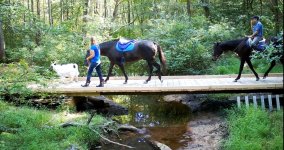
2 people, two horses, and a goat - 2200lbs - no problem

:D
 

Attachments

  • Screenshot_20211102-094923_Video Player.jpg
    Screenshot_20211102-094923_Video Player.jpg
    2.7 MB · Views: 227
Last edited:
   / Building 55' Bridge Across Creek - Utility Poles #110  
Looking good!

I was thinking about doing the same. I have a creek with about 20 ft crossing plus footings etc.

I was hoping to take my tractor across, MX series.

I have a duke power easement for transmission lines and they are going to take down 2 tall wooden poles soon? For duke soon might mean 5 years.

I guess they are maybe 50 ft tall?

They said i could have them but.....

I don't have the manpower to do it so....who knows,
 
   / Building 55' Bridge Across Creek - Utility Poles #111  
Fantastic pictures. With the Fall color, it has a sort of mystical quality to it!!!
 
   / Building 55' Bridge Across Creek - Utility Poles
  • Thread Starter
#112  
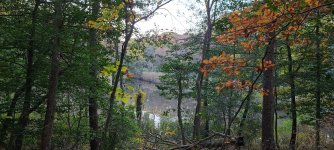
Thanks Everyone. It is certainly a spectacular time of year. A couple weeks and everything will be naked! Here is a cool shot just a little down stream from the bridge where it opens into the cove. Look close and you can see one of the Great Blue Herons doing some morning fishing. :) Now that I can easily access this side, I may do a little fishing myself. :)
 

Attachments

  • 20211108_164703.jpg
    20211108_164703.jpg
    3.3 MB · Views: 232
   / Building 55' Bridge Across Creek - Utility Poles
  • Thread Starter
#113  
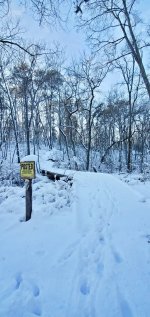
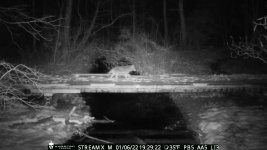
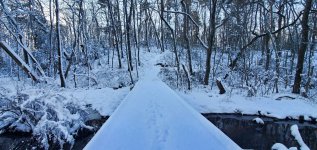
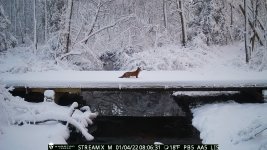
A few pics now that some snow has settled in.
 

Attachments

  • 20220104_160838.jpg
    20220104_160838.jpg
    2.9 MB · Views: 242
  • 20220104_160506.jpg
    20220104_160506.jpg
    2.8 MB · Views: 213
  • 1213322222.jpg
    1213322222.jpg
    411 KB · Views: 212
  • 20220104_160940.jpg
    20220104_160940.jpg
    3.4 MB · Views: 216
  • 1208829308.jpg
    1208829308.jpg
    916.6 KB · Views: 216
   / Building 55' Bridge Across Creek - Utility Poles #115  
Re linseed oil:

I used that to treat the logs on a log cabin years ago.
As time went by the logs all turned black.
What I later learned was that I should have added a 'fungicide' to my oil mix.

OK, for a bridge black is OK, I guess!

Oh, and the difference between 'raw' and 'boiled' linseed oil is boiled is supposedly treated with driers or hardeners while the 'raw' is very slow dry.
"Raw' will penetrate better=better long life protection while 'boiled' will harden and skim like paint on the surface.

The linseed oil isn't actually "drying"; nothing is evaporated or given off as linseed oil changes into a harder substance. The process is called polymerization. It helps to think of it as hardening instead of drying, althogh it does look a bit like drying when it happens. Linseed oil is one of the four naturally polymerizing oils. In those oils, the shorter chain hydrocarbon molecules of the oil can be made to join together in sunlight & oxygen (polymerize) to form a sort of natural plastic.
Boiling the raw oil and then adding a cobalt salt catalyst (Japan Dryer at HD) will kick off the polymerization in boiled linseed oil. It doesn't take much catalyst. .

I have no idea why yours turned black unless it was unboiled linseed oil and the fungus outran the polymerization. After it hardens, linseed oil is a durable coating.

You can add turps or mineral oil up to about 30% to change the viscosity to make the linseed oil penetrate the wood better. That will evaporate in a few days and then the polymerization can begin.
rScotty
 
   / Building 55' Bridge Across Creek - Utility Poles #116  
Yikes, more than I ever wanted to know about Linseed Oil. It is so hard to grow Lins to get it.
Thanks
 
   / Building 55' Bridge Across Creek - Utility Poles #117  
A few pics now that some snow has settled in.
Beautiful Bridge. I would put a Centre Support of Concrete Blocks or 6" capped steel pipe placed on heavy Patio stones or a big length of 8" Channel Iron. Old age sags!
 
   / Building 55' Bridge Across Creek - Utility Poles #118  
The linseed oil isn't actually "drying"; nothing is evaporated or given off as linseed oil changes into a harder substance. The process is called polymerization. It helps to think of it as hardening instead of drying, althogh it does look a bit like drying when it happens. Linseed oil is one of the four naturally polymerizing oils. In those oils, the shorter chain hydrocarbon molecules of the oil can be made to join together in sunlight & oxygen (polymerize) to form a sort of natural plastic.
Boiling the raw oil and then adding a cobalt salt catalyst (Japan Dryer at HD) will kick off the polymerization in boiled linseed oil. It doesn't take much catalyst. .

I have no idea why yours turned black unless it was unboiled linseed oil and the fungus outran the polymerization. After it hardens, linseed oil is a durable coating.

You can add turps or mineral oil up to about 30% to change the viscosity to make the linseed oil penetrate the wood better. That will evaporate in a few days and then the polymerization can begin.
rScotty
I did use RAW (unboiled) oil and thinned it somewhat for the 1st application followed by pure.
However I'll add that there was rarely any sun on the oiled surfaces due to trees and location.
Years later (30) I did clean up some of the logs and that wood was simply beautiful.

I used raw as I knew boiled actually used driers or hardeners and I wanted penetration over a dry harder skin.
 
   / Building 55' Bridge Across Creek - Utility Poles
  • Thread Starter
#119  
Beautiful Bridge. I would put a Centre Support of Concrete Blocks or 6" capped steel pipe placed on heavy Patio stones or a big length of 8" Channel Iron. Old age sags!

I will keep an eye on it, I am hoping the those large treated poles will hold shape for a while. It would detract from the aesthetic of the bridge to have to throw another support in there if I don't have too.

The linseed oil isn't actually "drying"; nothing is evaporated or given off as linseed oil changes into a harder substance. The process is called polymerization. It helps to think of it as hardening instead of drying, althogh it does look a bit like drying when it happens. Linseed oil is one of the four naturally polymerizing oils. In those oils, the shorter chain hydrocarbon molecules of the oil can be made to join together in sunlight & oxygen (polymerize) to form a sort of natural plastic.
Boiling the raw oil and then adding a cobalt salt catalyst (Japan Dryer at HD) will kick off the polymerization in boiled linseed oil. It doesn't take much catalyst. .

I have no idea why yours turned black unless it was unboiled linseed oil and the fungus outran the polymerization. After it hardens, linseed oil is a durable coating.

You can add turps or mineral oil up to about 30% to change the viscosity to make the linseed oil penetrate the wood better. That will evaporate in a few days and then the polymerization can begin.
rScotty
I think I asked this a few pages back, but with this bridge outside, in the elements year round, what is the best way to try and apply the oil, and how long will it take to dry/cure? I have animals on the thing daily and it rains at least once a week around here. Both of which would probably hinder the process. The boards have turned a nice grey color that oak normally does once its been exposed for a while, will applying the LSO bring back its original gold color or just protect it in its current state? I am fine either way, just curious. I planned to try and apply some sort of protectant this spring hoping that will have been enough time to let the wood "dry out."
 
   / Building 55' Bridge Across Creek - Utility Poles #120  
I will keep an eye on it, I am hoping the those large treated poles will hold shape for a while. It would detract from the aesthetic of the bridge to have to throw another support in there if I don't have too.


I think I asked this a few pages back, but with this bridge outside, in the elements year round, what is the best way to try and apply the oil, and how long will it take to dry/cure? I have animals on the thing daily and it rains at least once a week around here. Both of which would probably hinder the process. The boards have turned a nice grey color that oak normally does once its been exposed for a while, will applying the LSO bring back its original gold color or just protect it in its current state? I am fine either way, just curious. I planned to try and apply some sort of protectant this spring hoping that will have been enough time to let the wood "dry out."
Perhaps you might consider the wood end treating solutions like used an the treated woods most lumber yards sell for decks.
Usually in green and recently a light brown. Believe they also have clear.
Usually available in gallons.
Very liquid, fast penetrating and fast drying. Apply when wood is at its driest.
 

Tractor & Equipment Auctions

2019 ALLMAND MAXI-POWER 25 GENERATOR (A58214)
2019 ALLMAND...
Adams 5T Pull-Type Fertilizer Spreader (A56438)
Adams 5T Pull-Type...
2018 INTERNATIONAL 4300 NON CDL 26FT BOX TRUCK (A59904)
2018 INTERNATIONAL...
UNUSED 89" LAND PLANE (A52706)
UNUSED 89" LAND...
1629 (A57192)
1629 (A57192)
Utility Cart (A59231)
 
Top