Calculating lbs/sq ft.

   / Calculating lbs/sq ft. #21  
How big is the floor and how will it be supported? Once you have the joists sized (think span tables) will it be worth decking it with 1" x 6" t&g and covering that with 1/2" ply or osb.

Check your building code for calculations and include the tractor weight as point loads (under tires) and dead load (floor area).

I have a wooden floor that is 2x8 joists 12" oc with a span of 10' decked with 2x6 and I drive/park my L3400 with FEL and tiller attached (I can't recall the weight but it must be around 3000) with no issues whatsoever.

KB
 
   / Calculating lbs/sq ft. #22  
Good info - critical question, though - what's the unsupported span of the 2X6's?

Good question I should have been more specific. The floor is also constructed w/ 5 4x4 skids for extra support as well so the max unsupported span in my pole barn is probably around 30" all lumber is also pressure treated.
 
   / Calculating lbs/sq ft. #23  
Good question I should have been more specific. The floor is also constructed w/ 5 4x4 skids for extra support as well so the max unsupported span in my pole barn is probably around 30" all lumber is also pressure treated.

Wow. Unless I read this wrong, it sounds like you're parking on a lumber pile!
2x6 at 6" oc with 30" span decked with 1" screwed and glued. You could park a cement truck in there.:D
 
   / Calculating lbs/sq ft. #24  
Wow. Unless I read this wrong, it sounds like you're parking on a lumber pile!
2x6 at 6" oc with 30" span decked with 1" screwed and glued. You could park a cement truck in there.:D

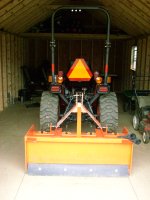
:D:D You are reading this correctly. I really wanted concrete originally but at the time we built this (last fall 07) concrete prices were outragous (even getting a discount from a buddy) and here in my area the concrete unions were also on strike at the time so I didnt want to wait. I spent a little extra for the floor material but IMHO well well worth it for my peace of mind. Still turned out way less than the price for concrete and as mentioned in my other post I could easily drive a truck on it w/ no problem, See Pic.
 

Attachments

  • DSCI0339.JPG
    DSCI0339.JPG
    841 KB · Views: 153
   / Calculating lbs/sq ft. #25  
If you have 30 PSI in a tire, it will exert 30 psi on the floor.

This is a common misconception about tires and how they work.

A tire works by the air pressure inside stiffening the sidewalls, which are the primary load-bearing mechanism.

If you increase the pressure in a 30 psi tire to 60 psi, the area in contact with the ground will not be cut in half.

My response was not intended to take into consideration the dynamics of a semi-solid structure such as a tire. It was purely a law of physics response.

If you add the tire dynamics, it will result in greater pressure at the edge of the tire due to sidewall stiffness, no pressure between the ribs not in contact with a flat surface and a whole range of spot pressures in between. Over the area of the contact patch with a flat surface, it will average 30 psi if the tire has 30 psi of pressure.

The bottom line is that every action has a opposite and equal reaction. It's a law of physics that not even NASA can deny.
 
   / Calculating lbs/sq ft. #26  
My response was not intended to take into consideration the dynamics of a semi-solid structure such as a tire. It was purely a law of physics response.
If you add the tire dynamics, it will result in greater pressure at the edge of the tire due to sidewall stiffness, no pressure between the ribs not in contact with a flat surface and a whole range of spot pressures in between. Over the area of the contact patch with a flat surface, it will average 30 psi if the tire has 30 psi of pressure.
The bottom line is that every action has a opposite and equal reaction. It's a law of physics that not even NASA can deny.

Even if your response made sense, and I'm not sure it does, the question is - How much does the floor have to push back up while remaining intact? Your hypothesis that the ground pressure equals tire pressure only works up to the point that the ground fails. Try it out on thin ice sometime!
BTW 30 psi = 4320 lb/ft2, lots of wood floors rated far less than that successfully hold up tractors every day. MikeD74T
 
Last edited:
   / Calculating lbs/sq ft. #27  
Raykos, If you're looking for an engineered answer you'll not likely get one for free - liability issues you know. If you want to figure it out for yourself support a 16" square of plywood on 2 sides with 2"x2''s, drive up onto it, & measure the deflection. Now try it again with the 2x's directly under the tire - no deflection !!! Place the stringers directly under the tires or at least narrow the spacing. That's 1/2 the equation.
Since you didn't indicate any building dimensions you next you need to determine the deflection of the supporting structure. If you are always going to park in the same place you need to think of your floor like a bridge -with extra stringers under the path of travel. Easier if they are also parallel. More details please! MikeD74T
 
   / Calculating lbs/sq ft. #28  
Do not use milled limber!! The strength is too variable. Look at engineered floor joists where you can get span/load tables. Also with 1" or better tongue and groove plywood screwed and glued to the joists, with glued joints. Vernon

OH Ye of little faith!! I know of not a single covered bridge in New England built of engineered lumber. Many built before Texas declared statehood & still see traffic daily.:D MikeD74T
 
   / Calculating lbs/sq ft. #29  
When I build my decks I normally use 2x6PT on 2x8 floor joists (16"center) which have a 6-7 span between main beams(doubled 2x8s). I have regularly driven 30hp Masseys and my 4300JD on them. The main beams are on 8-10"sono tubes, (depending on soil conditions) and have a 8-10' span, anywhere from 12" to 4' above ground
 
   / Calculating lbs/sq ft. #30  
Even if your response made sense, and I'm not sure it does, the question is MikeD74T


Blimey Mike - it's Newton's third law( Gospel since 1687) & you think it doesn't make sense!!!!!!!:eek:


Probably the greatest scientist ever :


"Isaac Newton
From Wikipedia, the free encyclopedia


Sir Isaac Newton, FRS (4 January 1643 31 March 1727 [OS: 25 December 1642 20 March 1727])[1] was an English physicist, mathematician, astronomer, natural philosopher, alchemist, and theologian and one of the most influential men in human history. His Philosophi Naturalis Principia Mathematica, published in 1687, is considered to be the most influential book in the history of science,"
 
   / Calculating lbs/sq ft. #31  
Blimey Mike - it's Newton's third law( Gospel since 1687) & you think it doesn't make sense!!!!!!!:eek: quote]

I'm not disputing Newton, I'm disputing whether orezok's response added any value to the question. Going to a ridiculous extreme even 1/4" luan plywood will hold up a tractor if the plywood is adequately supported. We're not discussing the compressive strength of a material but the tensile strength of a composite system.
If a 1" square post 4" tall were fastened to the floor & the tractor driven up onto it, provided it didn't puncture the tire, do you really believe it would only exert 30 lbs on the floor ???? Or that the tire pressure would suddenly spike to 2500 psi ???? :cool: MikeD74T
 
   / Calculating lbs/sq ft.
  • Thread Starter
#32  
Hi all,

I guess I should have provided more information when I ask my question!

Probably some of the parameters to the question would be location, cost & ease of construction.

A concrete floor is probably the best way to go when talking about supporting weight. However, working with concrete presents a whole lot of variables particular to concrete; site preperation, possible problems of delivery path(thus, influincing location), cost of material, dependence on concrete suppliers schedule, wheather, and hard work for just one person.

To me, wood is a heck of a lot easier to work with than concrete and it doesn't have some of the restrictions concrete does, BUT, can it work as well as concrete in similar applications; supporting a tractor? If, as one member put it, I'm going to be "parking on a lumber pile", wood wouldn't work; but if a 12" or 16" O.C. wood floor using 2 x ?? could support the weight, I'd rather go with wood.

Hence, my question about lbs/sq ft., and I thought that would give me an idea of whether or not a wood floor would work; I do appreciate the responses and information with regard to this question.

Ray
 
   / Calculating lbs/sq ft. #33  
If you already have a dirt floor and and want to put something non-muddy on it, I have had good results with using the 16"x16"x2" pavers from Home Depot or Lowes.

Just put down enough sand to level them out and lay them down. I have parked a 30 foot motor home on these without breaking them, and if one ever does break, they are easy to replace.
 
   / Calculating lbs/sq ft. #34  
great thread! I have a similar situation. I have nothing but hills. Found an area with only a 10-15 degree slope and picked this for shed/barn site. I had first thought to build a heavy duty wood deck on concrete piers. I'm no engineer, but I figured if I went with the "woodpile" approach I would be fine.

I still worried about the weight distribution and decided to go concrete slab and started bringing in fill dirt. After four truck loads and only being about a third of what I need (need even more than that to make it look good), I am reconsidering again.....
 
   / Calculating lbs/sq ft. #35  
I second the paver idea if it is applicable/acceptable....

I may have missed it if it's already been suggested...have you checked local saw mills to see if they could cut you some heavier timbers to build a substantial floor system...someone else has already mentioned bridges...a floor system to support a tractor would not need to be near as beefy as a bridge
 
   / Calculating lbs/sq ft. #36  
A fellow could also use some engineered precast concrete slabs!:D
 
   / Calculating lbs/sq ft. #37  
great thread! I have a similar situation. I have nothing but hills. Found an area with only a 10-15 degree slope and picked this for shed/barn site. I had first thought to build a heavy duty wood deck on concrete piers. I'm no engineer, but I figured if I went with the "woodpile" approach I would be fine.

I still worried about the weight distribution and decided to go concrete slab and started bringing in fill dirt. After four truck loads and only being about a third of what I need (need even more than that to make it look good), I am reconsidering again.....

I would be worried about pouring concrete on fill dirt, it would need to be compacted very well. #7 stone is the norm around here to use for fill. They claim 7's are self compacting, but if it's going to be very deep I'd compact it anyway. Also you need to have good water drainage
 
   / Calculating lbs/sq ft. #38  
I would be worried about pouring concrete on fill dirt, it would need to be compacted very well. #7 stone is the norm around here to use for fill. They claim 7's are self compacting, but if it's going to be very deep I'd compact it anyway. Also you need to have good water drainage

Your right - one of the reasons I'm waffling. If I stick with slab, then fill will go in - have to given the slope. Then I will proably do a pole barn with dirt floor and add the slab later - give dirt a couple of years to settle/compact. Have the drainage planned - no problem there.

Here is a quick sketch - not to scale - brown line is fill. I am layering, but know there will still be some settling. Going wood would be a much quicker solution in my case
 

Attachments

  • untitled.bmp
    765.1 KB · Views: 131
   / Calculating lbs/sq ft. #39  
raykos, Wood is a very viable solution within some size ranges. If you want better answers you need to provide some dimensions. How big do you want your shed to be? Flat ground or slope? If slope, how much drop in the distance covered by the shed? On perimeter walls or posts? What else will you park in the shed? Will you park in one section only or do you want to be able to park anywhere? MikeD74T
 
   / Calculating lbs/sq ft. #40  
Blimey Mike - it's Newton's third law( Gospel since 1687) & you think it doesn't make sense!!!!!!!:eek: quote]

I'm not disputing Newton, I'm disputing whether orezok's response added any value to the question. Going to a ridiculous extreme even 1/4" luan plywood will hold up a tractor if the plywood is adequately supported. We're not discussing the compressive strength of a material but the tensile strength of a composite system.
If a 1" square post 4" tall were fastened to the floor & the tractor driven up onto it, provided it didn't puncture the tire, do you really believe it would only exert 30 lbs on the floor ???? Or that the tire pressure would suddenly spike to 2500 psi ???? :cool: MikeD74T

Mike, perhaps you missed the part of my response that said "My response was not intended to take into consideration the dynamics of a semi-solid structure such as a tire. It was purely a law of physics response."
 

Marketplace Items

2025 Swict 72in Bucket Skid Steer Attachment (A59228)
2025 Swict 72in...
JLG E300AJ (A60462)
JLG E300AJ (A60462)
UNUSED X-STAR ACS LOADER BOOM LIFT (A52706)
UNUSED X-STAR ACS...
2001 CATERPILLAR D400E 6X6 OFF ROAD DUMP TRUCK (A60429)
2001 CATERPILLAR...
2013 International WorkStar 7400 4x4 Altec AM650 50ft Material Handling Insulated Bucket Truck (A59230)
2013 International...
1995 John Deere 7400 (A60462)
1995 John Deere...
 
Top