Wakey
Veteran Member
- Joined
- Jul 7, 2013
- Messages
- 1,253
- Location
- Madison Georgia
- Tractor
- John Deere Z915B Zero Turn 54 Deck
There is absolutely no info plaque or paperwork. The home was built in 1994. It has 220 volts / 20 amp circuit.
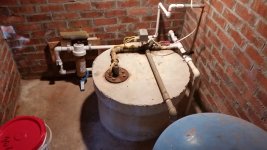
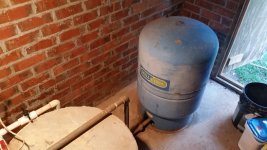

It may be a bored shallow well with a submersible pump. ??
But only a visual inspection will tell you.
If you pull the plug on the fitting comming out the casing and drop a line down the depth may be an indication.
There is absolutely no info plaque or paperwork. The home was built in 1994. It has 220 volts / 20 amp circuit.
View attachment 521236
View attachment 521237


THIS. Since boring and drilling have the same meaning, I'll assume OP meant dug or drilled.... It looks like a dug well, although a bit small on the diameter. Could have been drilled with a bucket auger to a shallow depth. The surface completion looks neat and tidy though.
As Egon said, remove the sounding plug on the seal cap and drop a weighted line down to check depth. If you're careful on the way down, you can hear the "plunk" when the weight hits the water. Mark that depth and then keep going till the line goes slack and that will be the total depth. The difference is the amount of water column you have to work with inside the well.
What exactly concerns you about the well? Does it make a difference to you if it was drilled or dug?
THIS. Since boring and drilling have the same meaning, I'll assume OP meant dug or drilled....

Just looking at your picture I would guess that you have a bored well;
View attachment 521292 I tried to attach a image of a bored well and it didn't work well Search for shallow bored water well.
A bored well is the modern equivalent of a dug well, normally done with an large auger, than lined with a casing of some type.
A "drilled" well can be done in a couple of different methods, the newest is a rotary drilling machine which can get lots of footage
in a day by using high horsepower applie to a drill bit with high pressure "mud" being injected down hole to lubricate the bit and flush the
drilled material to the surface. Some people are convinced that a rotary water well drill will seal and plug some of the smaller veins of water
between rock layers.
The other "older"method of drilled water wells is done by using a pounder, a heavy bit is raised on a cable an then dropped repeatedly to drive
a hole in the ground and also to drive the casing into the ground, a pounder, driver is believed to fracture the rock surrounding a well to
enable the small veins of water bearing material the well bore passes thru to enter the bore and the combination of lots of small veins can
create a good well as well as locating the larger veins of water. In some areas driven wells will produce good water flow rates at less depths
then rotary drilled wells, as much as 100 ft compared to two to five hundred feet.

I would have thought so, too, but this thread made me look into it.
Difference Between Drilling and Boring: Drilling vs Boring Compared


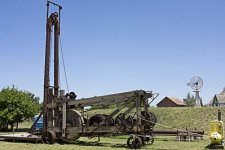
Our well goes down 223 feet and is capped with a concrete pad. My understanding is that the pad is to prevent
ground water from going down the well casing.
I would have thought so, too, but this thread made me look into it.
Difference Between Drilling and Boring: Drilling vs Boring Compared
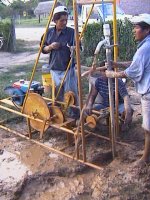
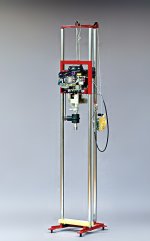
I didn't find much on the difference when used about wells, but perhaps comparing these two videos gives a clue:
3 inch bored water well being drilled (bored actually) Lostant, IL - YouTube
Watch a Water Well Being Drilled - YouTube