Carpenter bees!

   / Carpenter bees! #1  

Fuddy1952

Elite Member
Joined
Apr 17, 2018
Messages
4,332
Location
South Central Virginia
Tractor
1973 Economy and 2018 John Deere 3038E
I have carpenter bees, they look like bumble bees and they chew holes about 3/8" in wood. I spray what I can but it's a tough battle.
The main problem I need advice with is right now I'm having a large barn built and they're drilling as it's being built! Treated or untreated wood, doesn't matter. Is there a spray or something I can do? I could call an exterminator (expensive), I thought about old motor oil (messy).
Any ideas, thanks.
 
   / Carpenter bees! #2  
Let em bee, your flowers, trees, garden, etc. will appreciate it.
 
   / Carpenter bees! #3  
I have carpenter bees, they look like bumble bees and they chew holes about 3/8" in wood. I spray what I can but it's a tough battle.
The main problem I need advice with is right now I'm having a large barn built and they're drilling as it's being built! Treated or untreated wood, doesn't matter. Is there a spray or something I can do? I could call an exterminator (expensive), I thought about old motor oil (messy).
Any ideas, thanks.

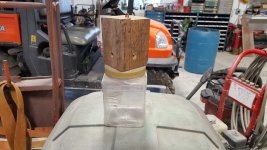
Google Carpenter bee traps. You can make one from a mason jar and scrap would in about 15 min - and they work.

My chickens love em.
 
   / Carpenter bees!
  • Thread Starter
#4  
The problem is I had an old shed I tore down a couple years ago. Lumber would have a hole drilled in middle, going up then over. A 2"x12" in places you could snap in two with your hands.
They're highly destructive and there would be piles of sawdust everywhere.
 
   / Carpenter bees! #6  
I'm the opposite. Battle them. Battle them hard!!!!! My neighbor has two buildings that have been destroyed by the bastards. Now I'm getting them...

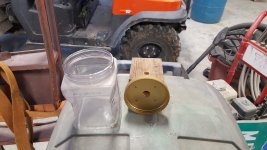
I built some traps that work. Rather than a lengthy verbal description, here's a couple pics. I caught a dozen last Spring in three traps. I have accepted that I'll need to continue this with diligence every year since a half mile away they have a metropolitan establishment...?. :(


20190508_092449.jpg


20190508_092505.jpg
 
   / Carpenter bees! #7  
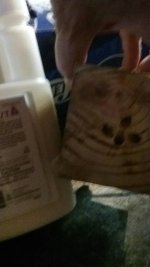
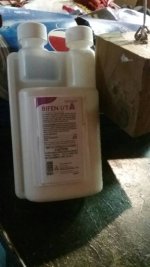
I had them pretty bad, and battled them with traps and some of the grease insecticide smeared on the holes. I changed to a 2 gallon pump sprayer adjusted to a jet stream, and use either Permethrin (last a couple weeks) or Bifen (lasts a couple months) squirted in and around the holes. You can buy either online and mix an ounce or 2 per gallon of water. The old holes attract new bees, and spraying them works really well keeping them under control and limits the damage they do.
 
   / Carpenter bees! #8  
I had them pretty bad, and battled them with traps and some of the grease insecticide smeared on the holes. I changed to a 2 gallon pump sprayer adjusted to a jet stream, and use either Permethrin (last a couple weeks) or Bifen (lasts a couple months) squirted in and around the holes. You can buy either online and mix an ounce or 2 per gallon of water. The old holes attract new bees, and spraying them works really well keeping them under control and limits the damage they do.

Good stuff. I may try spraying this year in addition to my traps.

The "old hole" theory you mentioned is why traps work. Once in the jar the bee isn"t smart enough to go back out the lid hole. It simply goes to the light.
 
   / Carpenter bees! #9  
I fully advocate the traps and spray (the individual holes when you find them) method of defense.!!!
 
   / Carpenter bees! #10  
I had some move in shortly after building an exposed rafter canopy. Not knowing what else to do, I went out in evening close to sundown and filled all existing holes with silicone caulk. 3 evenings of this and no more new holes.
Build/setup traps as explained above but fill existing holes with caulk.
 
   / Carpenter bees! #11  
I was thinking of starting a thread on this while I was watching three of them hover around my porch this morning. I've got 'em all over, new wood, old wood, doesn't matter. I spray some of them if I can get them in the holes. I don't want to kill pollinators, I just want them to nest in trees instead of my sheds.
 
   / Carpenter bees! #12  
I've been using this stuff. It foams up into the hole and kind of chases them, so they can't get away. Them it seems to treat the wood for a while so others see a no vacancy sign.

63bd3433-791c-43fa-b34a-01d6855e818d_400.jpg
.
 
   / Carpenter bees! #13  
Any brand of wasp or hornet spray will do the same thing. And you don't have to catch the borer bees in the holes. When they return or new bees arrive and start chewing on the woood, they soon drop to the ground and die.

Of course that spoils the fun the grandkids have swatting at them with old bad mitten rackets. :D
 
   / Carpenter bees! #14  
trouble around here with them is on top of the holes the woodpeckers peck the wood (2 x whatever) to pieces to get at them. Looks like a bomb went off. I do know they are territorial and the offspring's will be back at the same place next year. I sometimes catch them in the hole and then pack it with fine steel wool. Traps them in there and they die. Yea they might possibly do a little pollination to plants but not to the extent of regular bumble bees.
 
   / Carpenter bees! #17  
The holes contain the females and eggs. Most of the bees you see flying around and trapping are the males, but they do also go into the holes at night I think. Trapping or killing them doesn't stop the cycle since the hole is long and packed with a supply of new bees. Some of my boards have holes 'feet' long, branched into all sorts of tunnels, but with only one or 2 holes visible on the surface of the board. I learned the hard way, and they were doing a lot of damage before I realized how bad they were. Once I started using Permethrin and Bifen squirted into the holes, I see very few. As I stated above, both pesticides work well. I usually apply Permethrin first in the spring when I start to see the Carpenter bees. Permethrin knocks them down instantly and sometimes 5 to 10 bees fall out of each hole within seconds. It breaks down within a couple weeks but any bee entering or exiting the hole will be killed during that time. Then sometime after that I apply the Bifen to the holes in the same way. I usually coat some of the 'hole-prone' areas of the wood around the holes too, to prevent more holes. Bifen takes longer to kill them, so they come and go and usually die away from the area as long as they come in contact with it. Bifen lasts longer though so I rarely need to apply anything after that for the year.
 
Last edited:
   / Carpenter bees! #18  
My policy is anything that eats or drills holes in MY house has got to go...regardless of their alleged importance to the environment. Termites provide a valuable service to the ecosystem by aiding in the decomposition of wood, but I won't tolerate their activity in any of my structures. Carpenter bees are no different. Caulk the holes, paint the wood, and make some traps.
 
   / Carpenter bees!
  • Thread Starter
#19  
I'm working on em now! Plus I've been using the badminton rackets.
Dad (r.i.p.) wore holes in his rackets, so he used window screen on rackets.20190508_150907.jpg20190508_150900.jpg
 
   / Carpenter bees! #20  
I hate them. I seriously would have done far less ornamental woodwork on our house if I knew it would be such a battle.

I have had mixed results with the traps. Some years I will get 10-15 bees in a trap, but so far this year I only got 1-2 per trap (I probably have a dozen traps around our home, barn, and boat house). I have found that I need to periodically check the trap boxes since wasps love to nest in them, and then the bees won't go into the traps. Some of my traps are fixed in place with a screw, but others hang from a nail with a string so I can move them around if I think another area needs help.

My other strategy is to watch the bees and let them lead me to their holes, or just look for new holes. I treat the holes with Drione dust (silica-based desiccant dust with pyrethrum). The dust lasts for a few months, so once you treat a hole, you kill any bees that are active, any bees that go into a hole to check it out, and any bee larvae in the tunnel that mature and try to exit the hole. It's recommended to cork the holes after treatment so that the dust lasts longer (to kill maturing larvae longer) but I only do that for holes that are easy to get to (and I always wait at least 24 hours to allow active bees to come/go in the holes).

I have a small hand held duster and a "Dustick" which is a duster that can be assembled in 7, 14, or 21' lengths. That lets me treat holes around my home, barn, and boat house without a ladder. It was about $250 but totally worth it!!

The other day I was working down on my dock and noticed a half dozen bees buzzing around my boat house. I am particulary protective of the boat house because it was a challenging project to build (don't want to do it again), and I was real serious about wind loads and building it to survive hurricanes. I know having all those bee holes in the structure can only be a bad thing -- it has got to weaken structural lumber for sure. I treated about 10-12 holes and saw at least 4-5 bees die. I also watched one bee look for it's hole for a good 10 minutes and concluded they must be dumb as mud or blind as a bat, or both. That dummy female buzzed up and down the fascia board and was trying real hard to find her hole, which I could see plainly. She'd come within inches of it but not see it. I finally got bored and left. If she finds her hole, the dust will get her within seconds.
 

Tractor & Equipment Auctions

JEEP FOR DOUBLE TRAILER (A58214)
JEEP FOR DOUBLE...
2019 Allmand Night-Lite V-Series 7 kW S/A Towable Light Tower (A55973)
2019 Allmand...
2023 Fat Truck 2.8C Amphibious AWD Off-Road Utility Vehicle (A55852)
2023 Fat Truck...
4 Unused Montreal ST205/75R15 Trailer Tires (A55788)
4 Unused Montreal...
2025 CATERPILLAR 255 SKID STEER (A60429)
2025 CATERPILLAR...
2023 Caliber Trailers GH840MST 40ft T/A Gooseneck Flatbed Equipment Trailer (A55851)
2023 Caliber...
 
Top