You are using an out of date browser. It may not display this or other websites correctly.
You should upgrade or use an alternative browser.
You should upgrade or use an alternative browser.
Chimney Repair
- Thread starter citytransplant
- Start date
- Views: 2520
More options
Who Replied?
/ Chimney Repair
#1
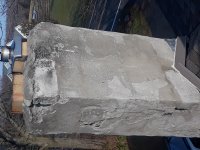
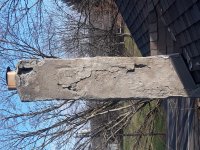

the old grind
Super Member
- Joined
- Jul 21, 2012
- Messages
- 5,308
- Location
- Mid-Michigan
- Tractor
- NH T-1520 HST, NH TC33DA HST, Case DX26 HST, .Terramite T5C, . NH L785
Call your insurance agent if you have one. If not, or also, call your local building inspector. It matters less what we think of what you have, and plenty to either or both of them. If the inside isn't a lot tidier than the outside, the nearest reliable liner installer guys are usually up on local requirements.
Also depends a bit on what vents through the chimney. Solid fuel heaters usually cause bigger temp fluctuations than similar gas or oil devices. Possibility of freezing between heating cycles wants something to minimize moisture absorption in veneers or facings.
A lot of small, post-war homes around here have metal weatherproof housings or shrouds with brick-looking paint jobs. Some were built with metal chimneys from day one, others a refit for sale or for insurance specs. I've seen both types go up in smoke after wood heaters were added to tiny homes built with wall heaters vs larger, more modern forced air units. Flue fires are no fun to stand and watch while fire vols are still on their way.
Also depends a bit on what vents through the chimney. Solid fuel heaters usually cause bigger temp fluctuations than similar gas or oil devices. Possibility of freezing between heating cycles wants something to minimize moisture absorption in veneers or facings.
A lot of small, post-war homes around here have metal weatherproof housings or shrouds with brick-looking paint jobs. Some were built with metal chimneys from day one, others a refit for sale or for insurance specs. I've seen both types go up in smoke after wood heaters were added to tiny homes built with wall heaters vs larger, more modern forced air units. Flue fires are no fun to stand and watch while fire vols are still on their way.

Deere Dude
Elite Member
- Joined
- Feb 10, 2011
- Messages
- 4,015
- Tractor
- John Deere 3720
Is the chimney actually used or does it have a stainless steel stovepipe going through the center of it?
OP
citytransplant
Silver Member
Is the chimney actually used or does it have a stainless steel stovepipe going through the center of it?
Thanks for the reply. There are 2 flues: 1 for oil furnace and 1 for wood stove. I believe the furnace flue is clay (it's the one on the left in the photo) and I'm sure that the wood stove vents through a metal chimney liner, possibly triple-wall (stainless inner wall, aluminized steel center wall, galvanized outer wall per some paperwork the previous homeowner left behind). I think the wood stove metal chimney liner runs through (is threaded inside) a clay flue pipe that is identical in size as its sister to the left.
Redlands Okie
Veteran Member
You could cover the whole thing with lath and stucco type products or with something like Hardiboard siding. With a carefully cut and fitted and sealed lid on top, metal likely to be the easiest for that part. Keep in mind feature maintence such as painting so you can keep that to a minimum. Hardiboard and good paint helps with that. Stucco or EFIS type products are perfect for it.
That thing has some major issues. Bottom line is you need to keep water away from the structure your picture shows. Careful attention should be applied to the top and where it meets the shingles. The pictures are hard to see details but does it have proper step flashing under the shingles? The flashing you see at the bottom that covers the step flashing is called counter flashing
You really need to find someone that knows what their doing or read up carefully on the manufactures recommended method of proper installation of the products installed. For that matter knowing the manufactures recommendation is a good idea no matter who does the work. Their are a lot of well intentioned and experienced contractors that do not really know the details of some things. This is one project that need those details done correctly.
Might be a good time to have the inside of the flues inspected by a certified chimney tech before you spend a bunch of money on the outside.
That thing has some major issues. Bottom line is you need to keep water away from the structure your picture shows. Careful attention should be applied to the top and where it meets the shingles. The pictures are hard to see details but does it have proper step flashing under the shingles? The flashing you see at the bottom that covers the step flashing is called counter flashing
You really need to find someone that knows what their doing or read up carefully on the manufactures recommended method of proper installation of the products installed. For that matter knowing the manufactures recommendation is a good idea no matter who does the work. Their are a lot of well intentioned and experienced contractors that do not really know the details of some things. This is one project that need those details done correctly.
Might be a good time to have the inside of the flues inspected by a certified chimney tech before you spend a bunch of money on the outside.

Egon
Epic Contributor
A replacement rather than repair would be a good way to go.
It looks like ordinary concrete blocks were initially used with some being cracked and parged over.
It looks like ordinary concrete blocks were initially used with some being cracked and parged over.

EddieWalker
Epic Contributor
It's beyond repair and it needs to be removed. You need to have something new built.
OP
citytransplant
Silver Member
Thanks for the recommendations, opinions, etc. so far. .
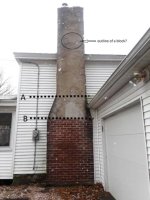
I failed to provide a shot of the entire chimney in my initial post. I've done so here, simply to give folks a clearer picture of what I'm dealing with. The brickwork appears to be in good shape. I think at some point the brick work ends and blocks were used, agree? If so, would you guess the brickwork ends at Point B (where the parging begins) or immediately at the top of the corbel, Point A?
I will post a photo of the results of my feeble effort to temporarily patch this mess later. All the masons that I contacted that came highly recommended have already packed it up for the season as far as outdoor work goes so I bit the bullet and did the best I could.
I failed to provide a shot of the entire chimney in my initial post. I've done so here, simply to give folks a clearer picture of what I'm dealing with. The brickwork appears to be in good shape. I think at some point the brick work ends and blocks were used, agree? If so, would you guess the brickwork ends at Point B (where the parging begins) or immediately at the top of the corbel, Point A?
I will post a photo of the results of my feeble effort to temporarily patch this mess later. All the masons that I contacted that came highly recommended have already packed it up for the season as far as outdoor work goes so I bit the bullet and did the best I could.
Attachments

rekees4300
Elite Member
What would be the best way to repair this chimney and does it pose any danger in its present condition outside of a piece of concrete falling atop someone's head?
It's beyond repair, best way to fix the problem is replacement or elimination. It does pose a danger of burning your house down via the cracked liner and/or crashing through your roof via collapse.
EddieWalker
Epic Contributor
Looking at your latest picture makes me think even more strongly that it needs to come down. It's like buying a car covered in bondo. You have no idea what they are hiding it how bad it is.
fishheadbob
Platinum Member
- Joined
- Aug 5, 2014
- Messages
- 662
- Location
- western ny
- Tractor
- New holland boomer 40 NH 3930 Deere 2320
I'm disagreeing with the previous posts to an extent. The concrete blocks underneath may be Ok, but the half arsed stucco job needs to come off for both aesthetic reasons, and so a competent person can tell just what you have there. While somewhat unlikely there's a chance that the chimney is salvageable. I'd get one of the quit for the season masons to give his 2 cents as to the overall condition of it and a guesstimate about repair versus replacement.

Mace Canute
Elite Member
Looking at your latest picture makes me think even more strongly that it needs to come down. It's like buying a car covered in bondo. You have no idea what they are hiding it how bad it is.
Agree 100%.
EddieWalker
Epic Contributor
I'm disagreeing with the previous posts to an extent. The concrete blocks underneath may be Ok, but the half arsed stucco job needs to come off for both aesthetic reasons, and so a competent person can tell just what you have there. While somewhat unlikely there's a chance that the chimney is salvageable. I'd get one of the quit for the season masons to give his 2 cents as to the overall condition of it and a guesstimate about repair versus replacement.
You might be right, but in my experience, the cost to repair something like this is usually close enough to the price to tear it down and start all over. And after the repair is done, you still have a very old chimney that will never be 100%.
forgeblast
Elite Member
I would have someone really look at it. My neighbors house went up due to a bad chimney. Not to scare but having it inspected for internal damage would be the way to go.
rekees4300
Elite Member
I would have someone really look at it. My neighbors house went up due to a bad chimney. Not to scare but having it inspected for internal damage would be the way to go.
Look at the first picture, the liner appears to be cracked. That's a good way to burn down a house.
Oaktree
Super Member
You might be right, but in my experience, the cost to repair something like this is usually close enough to the price to tear it down and start all over. And after the repair is done, you still have a very old chimney that will never be 100%.
The fact that it's an outside chimney makes it all that much easier to tear down and rebuild, it's not like you have to tear out walls or anything. Another vote for replace.

tcreeley
Elite Member
Outside chimney makes it good to work on. The brick may still be solid and provide a good base.
You have different options- cement with tile liner, stainless insulated metalbestos. If you are using a woodstove I would line it with stainless inside the tile liner or just use metalbestos.
The cold does a job on the creosote condensation. I've seen it soak into cement block, leak between the tiles- stain the chimney. You need to keep the woodstove flue hot the whole way- insulated metalbestose does this best. - A chimney going up through the house doesn't get chilled like one on the outside.
I took down my last chimney made with solid block and tile liner for my wood stove, After 8 years I simply lifted the blocks up and off. The mortar lifted up in one unbroken piece. The tile lifted out as well. Didn't break a single piece. The price of creosote condensation in a hot to cold chimney.
Get yourself a chimney mason or do it yourself. I am not sure there is time before the snow and cold weather is here. For this winter I'd fill the cracks with whatever will deal with the temps- looking to prevent water getting in, freezing and cracking. While you are doing it- check to see if it is firm- doesn't wobble.
Good springtime project.
Metalbestos can go up now if you need to.
You have different options- cement with tile liner, stainless insulated metalbestos. If you are using a woodstove I would line it with stainless inside the tile liner or just use metalbestos.
The cold does a job on the creosote condensation. I've seen it soak into cement block, leak between the tiles- stain the chimney. You need to keep the woodstove flue hot the whole way- insulated metalbestose does this best. - A chimney going up through the house doesn't get chilled like one on the outside.
I took down my last chimney made with solid block and tile liner for my wood stove, After 8 years I simply lifted the blocks up and off. The mortar lifted up in one unbroken piece. The tile lifted out as well. Didn't break a single piece. The price of creosote condensation in a hot to cold chimney.
Get yourself a chimney mason or do it yourself. I am not sure there is time before the snow and cold weather is here. For this winter I'd fill the cracks with whatever will deal with the temps- looking to prevent water getting in, freezing and cracking. While you are doing it- check to see if it is firm- doesn't wobble.
Good springtime project.
Metalbestos can go up now if you need to.
OP
citytransplant
Silver Member
Great responses, all of 'em. So there is no question that under the parging, the concrete block closest to the crown is in rough shape, due primarily to exposure to the elements as the crown itself is badly deteriorated and the parging is flaking off. The freeze and thaw cycles in my area, where avg. snowfall = 10 ft., begin this time of year and continue until spring. One of the most highly regarded masons in town, who is done working outdoors for the season, has agreed to swing by "real soon" to take a look and give me some recommendations.
To recap (pardon the pun), the chimney consists of 2 flues, running parallel. One vents an oil furnace, purchased only months ago and located in the cellar. In the cellar, the furnace vents horizontally (via metal duct with an draft inducer) for a 10' run prior to making the 90 degree turn up the chimney. The furnace guy told me that the furnace is so efficient that much what goes up the chimney is water vapor. Very little heat makes it up the chimney. If true, this works in my favor to reduce chance of fire in the event that the liner is cracked, agree? A clay liner exits the chimney cap at the terminal end of this flue and rekees4300 made a good observation noting cracks in this liner. Does the clay liner run the entire length of the chimney (rhetorical?). If yes, how far down do the cracks extend? I think it's safe to say that it is impossible to know without getting a camera in there. Upon closer inspection, the cracks (there are two) are hairline (no gaps exists). While they may be hairline at the terminal end, there is no guarantee that larger cracks don't exist at some point beneath. Finally as was mentioned earlier, the only way to correctly ascertain the condition of the concrete blocks, within which the clay pipe and the metal pipe (see below) both run, is by removing the amateurish, unsightly parge coat.
The other flue vents a wood stove located on the first floor of the two story home. The stove is vented directly into a triple wall metal pipe, constructed of a stainless steel inner wall, an aluminized steel center wall, and a galvanized steel outer wall (reading directly from the paperwork left me by the previous homeowner). The metal pipe runs inside a clay liner which, like the furnace clay liner running parallel to it, runs up through the concrete blocks stacked above the brickwork. There may or may not be insulation between the metal triple-wall pipe and the clay. The pipe is professionally cleaned annually. I burn about 5 face cord a season and the sweep always commends me on burning wood that is well seasoned. He can tell because his work yields a limited amount of dust only, not creosote wafers or chunks.
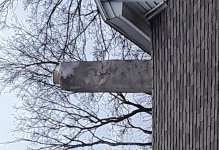
To summarize, I think it's impossible to tell with complete certainty, the condition of both the concrete block or clay liner running within, beyond what is exposed. The critical nature of the components require me to err on the side of caution, however, and assume the worst. I've already slapped some quick setting cement in the cracks as recommended by tcreeley and others (see photo, not suitable for those with weak stomachs) and will get up there and revisit closely over the winter when there are mild breaks in temperature, if any. I'm going to find someone with a chimney camera soon and get a look inside both the clay and metal liners. In the spring, the amateurish parging will come down and I will probably have it rebuilt. I'm looking forward to it. I will sleep better at night.
To recap (pardon the pun), the chimney consists of 2 flues, running parallel. One vents an oil furnace, purchased only months ago and located in the cellar. In the cellar, the furnace vents horizontally (via metal duct with an draft inducer) for a 10' run prior to making the 90 degree turn up the chimney. The furnace guy told me that the furnace is so efficient that much what goes up the chimney is water vapor. Very little heat makes it up the chimney. If true, this works in my favor to reduce chance of fire in the event that the liner is cracked, agree? A clay liner exits the chimney cap at the terminal end of this flue and rekees4300 made a good observation noting cracks in this liner. Does the clay liner run the entire length of the chimney (rhetorical?). If yes, how far down do the cracks extend? I think it's safe to say that it is impossible to know without getting a camera in there. Upon closer inspection, the cracks (there are two) are hairline (no gaps exists). While they may be hairline at the terminal end, there is no guarantee that larger cracks don't exist at some point beneath. Finally as was mentioned earlier, the only way to correctly ascertain the condition of the concrete blocks, within which the clay pipe and the metal pipe (see below) both run, is by removing the amateurish, unsightly parge coat.
The other flue vents a wood stove located on the first floor of the two story home. The stove is vented directly into a triple wall metal pipe, constructed of a stainless steel inner wall, an aluminized steel center wall, and a galvanized steel outer wall (reading directly from the paperwork left me by the previous homeowner). The metal pipe runs inside a clay liner which, like the furnace clay liner running parallel to it, runs up through the concrete blocks stacked above the brickwork. There may or may not be insulation between the metal triple-wall pipe and the clay. The pipe is professionally cleaned annually. I burn about 5 face cord a season and the sweep always commends me on burning wood that is well seasoned. He can tell because his work yields a limited amount of dust only, not creosote wafers or chunks.
To summarize, I think it's impossible to tell with complete certainty, the condition of both the concrete block or clay liner running within, beyond what is exposed. The critical nature of the components require me to err on the side of caution, however, and assume the worst. I've already slapped some quick setting cement in the cracks as recommended by tcreeley and others (see photo, not suitable for those with weak stomachs) and will get up there and revisit closely over the winter when there are mild breaks in temperature, if any. I'm going to find someone with a chimney camera soon and get a look inside both the clay and metal liners. In the spring, the amateurish parging will come down and I will probably have it rebuilt. I'm looking forward to it. I will sleep better at night.
Attachments
Last edited:
sailfast
Silver Member
DON'T PANIC
You should check on the oil furnace....
I'd be worried about CO gas not fire!
The exaust gases from that furnace may need to vent out the side of your house, not via the chimney! What material is the flu pipe for the furnace? Was the furnace installer a professional or a side job? Was the install inspected? What does the furnace manufacture require for a flu?
As for the stove, if it is lined with a Stainless liner you are good.
Depending on your answers everything I see so far is cosmetic other than water intrusion.... which should get squared away....
Call a chimney sweep to check the wood flu.
You should check on the oil furnace....
I'd be worried about CO gas not fire!
The exaust gases from that furnace may need to vent out the side of your house, not via the chimney! What material is the flu pipe for the furnace? Was the furnace installer a professional or a side job? Was the install inspected? What does the furnace manufacture require for a flu?
As for the stove, if it is lined with a Stainless liner you are good.
Depending on your answers everything I see so far is cosmetic other than water intrusion.... which should get squared away....
Call a chimney sweep to check the wood flu.


