Cold weather tractor problem

/ Cold weather tractor problem #1  

JesseWC

New member
Joined
Jan 15, 2018
Messages
10
Location
Des Moines, IA
Tractor
2010 Kubota Grand L5740
I知 new to the forum, and would like to post a question. I have a 2010 Kubota Grand L5740. It has just over 200 hours on it. I live in Iowa, and it has been very cold lately, sub 0 temps. Today, I pulled the tractor out to clear my driveway, and to move some wood. The tractor started and ran fine, I used it for maybe 20 min, and then parked it. I went back outside a couple hours later, started it, and put it back in the barn. I noticed when I got out, that it had a pretty good amount of oil leaking from underneath. When I got it inside, I crawled underneath, and saw that oil was leaking out of where the dipstick tube enters the case. I also noticed that the oil fill cap had blown off. I went inside to look some stuff up, and went I went back to check in it, it appears that oil is being blown out of my exhaust pipe. I did start it up again, and it started fine, and idled fine. Could it be a frozen pcv valve? Is there even one on this tractor. I知 clueless. Any thoughts or help is appreciated.

Jesse
 
/ Cold weather tractor problem #2  
I would say you definitely have a frozen crank case vent, normally it is on top of the valve cover with a tube back into the intake.
 
/ Cold weather tractor problem
  • Thread Starter
#3  
Thank you for the response. From everything I have read, that seems to be the case. I just can’t find the dang vent.
 
/ Cold weather tractor problem
  • Thread Starter
#4  
If it is a blocked or frozen crankcase vent, what would make oil come out of the exhaust?
 
/ Cold weather tractor problem #5  
I知 new to the forum, and would like to post a question. I have a 2010 Kubota Grand L5740. It has just over 200 hours on it. I live in Iowa, and it has been very cold lately, sub 0 temps. Today, I pulled the tractor out to clear my driveway, and to move some wood. The tractor started and ran fine, I used it for maybe 20 min, and then parked it. I went back outside a couple hours later, started it, and put it back in the barn. I noticed when I got out, that it had a pretty good amount of oil leaking from underneath. When I got it inside, I crawled underneath, and saw that oil was leaking out of where the dipstick tube enters the case. I also noticed that the oil fill cap had blown off. I went inside to look some stuff up, and went I went back to check in it, it appears that oil is being blown out of my exhaust pipe. I did start it up again, and it started fine, and idled fine. Could it be a frozen pcv valve? Is there even one on this tractor. I知 clueless. Any thoughts or help is appreciated.

Jesse

Welcome to TBN, Jesse.

Yep, those are classic signs of a frozen PCV valve. Your Grand L5740 and my M59 use the same engine - and same transmission, I believe. So they probably use a similar or same device for Positive Crankcase Ventilation.

That problem of PCV valves freezing in very cold weather has been around since PCV valves were invented. And it is a known problem with Kubotas which has been written about on TBN before now. It can happen to any engine in in real cold weather if the motor isn't working hard enough to get warm. You might want to tie a string to the oil dipstick so that if it blows out you can find it again.....no, I'm not kidding. It hasn't happened to me, but I recall someone posting about it.

The good news is that this pressure in the crankcase in cold weather is a known problem and probably not anything serious - but you should vent it to protect the engine seals.

Some history: Before PCV valves, crankcase ventilation was simply vented via a tube directly into the open air. You can still do that if you wish. Be aware that a direct vent pollutes the atmosphere with oil/water vapor and is a path for contaminents back into the engine. Both of those problems were mitigated 50 years ago by running the vent tube into a "breather cannister" instead of routing the vented fumes back into the intake manifod as is common today. The breather cannister was basically a tin can filled with a metal fiber filter material that became very oily. The water vapor evaporated away.

The PCV valve on your engine is hopefully like other Kubotas and consists of a gizmo mounted right in the middle of the valve cover. In fact, the valve body should be the next & only thing rearward of the oil fill cap right there on top of the valve cover. You should see a hose or tube connected to it. The problem is condensation freezing - just as you suspected. The engine doesn't get things hot enough. Removing 4 bolts on the top of the PCV body gives you access to a spring and diaphram that are the heart of the PCV itself. That's probably where it is frozen up, although there is some chance that some condensation at a low point in the breather hose has made an ice blockage in the hose.

If you change the existing system, take a moment to think about which way the pressures are going. At certain RPMs combined with certain coolant temperature the turbo pressurizes the intake manifold via the EGR valve - that needs to be considered.

I guess you could try to heat the PCV valve or tape some insulation over it so that the engine would heat it more.

Or you could just poke a hole in the oil filler cap and run a hose from that cap into a home-made breather cannister. Instant old style venting.

I haven't done anything to our M59 because we haven't had that freezing problem, probably because our winters here in the Rocky Mountains have been fairly mild since we got the M59. Some people say global warming....but I don't know if that's it. I do know that warmer winters with hardly any snow have become the norm here in the last decade.
Good Luck,
rScotty
 
Last edited:
/ Cold weather tractor problem #6  
High enough crankcase pressure can cause oil to be pushed past the rings/valve seals and come out the exhaust. Is it just a trace of oil or large quantity?

The short run time in the cold can be problematic, just enough temp to put moisture into the breather but not enough to burn it off and clear it out.
 
/ Cold weather tractor problem
  • Thread Starter
#7  
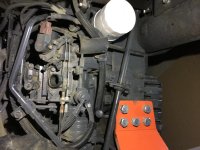
Thank you guys so much for the help, I should have joined this a long time ago. I’ll see if I can post a picture here of my oil fill hole, before I found the fill cap and put it back in. Is the PVC valve body in this pic?
DB01127B-8328-426B-BE35-50734DB98809.jpeg
 
/ Cold weather tractor problem
  • Thread Starter
#8  
As far as the amount of oil coming out of the exhaust, I think a small amount. When I noticed oil leaking under the tractor, there was no oil on the exhaust tip, or below it. It wasn’t until after I went back into the barn a while later, that I noticed maybe 10 to 15 trips worth had come out, while the engine was off.
 
/ Cold weather tractor problem #9  
Jesse
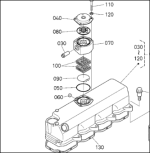
Engine crankcase breather is located on the top of valve cover.
 

Attachments

  • Capture.PNG
    Capture.PNG
    31.2 KB · Views: 963
/ Cold weather tractor problem #10  
Jesse
Engine crankcase breather is located on the top of valve cover.

Thanks for posting the picture, Jim. That should be it. Jesse, do you have part that on your motor?
BTW, in my parts manual the hose connection part 030 is listed as a "pipe, water return" which was either a case of amazing prescience on the part of the illustrator or more likely a (deliberate?) mistake.

The tube carries vapor, not water, and connects to the intake side of the turbo where it is designed to scavange oil and water vapor via the PCV valve (note to self: PCV; not PVC !!) and reburn those vapors in the engine. Thus complying with one part of the interim tier IV emissions requirements while either missing or ignoring the point of the regulations in the first place.

The PCV system is not mentioned by name in the parts manual; although you can find that picture that Jim posted on the page for the "head cover" i.e. the valve cover. Where the PCV valve assembly should be called out in the parts below the illustration is an oddity: an unusual blank entry. Nor is there any mention of the PCV breather assembly in the otherwise very complete engine section of the work shop manual.

So I think we are on our own here. Luckily the illustration does show a very nice exploded view of all the parts and that valve looks easy enough to take apart, clean, and/or modify.
There are enough of those interim Tier IV motors out there that we ought to just go ahead fix the problem. Any ideas? One way would be to get a slight amount of heat to the PCV valve. There's a handy hot exhaust pipe nearby.
rScotty
 
/ Cold weather tractor problem #11  
I gather there is a body of experience pointing to the PCV path as the culprit ... and it probably is. I hope it is that, but am also wondering , with abnormal things like oil coming out of the exhaust pipe, what about a blown head gasket ??
 
/ Cold weather tractor problem #12  
You would have to do a compression test on all the cylinders to see if there is a head gasket issue.
 
/ Cold weather tractor problem #13  
You might want to look at getting/making a winter front for the rad. That might help to keep the heat in and the pcv free to operate.
 
/ Cold weather tractor problem
  • Thread Starter
#14  
Jim, thanks for that diagram, and Scotty, also for your response. I talked to my local dealer today, and they kept telling me that there is no PCV valve on this tractor, but did supply me with that diagram as well. The diagram doesn稚 say 善VC so it must not have one...or, they are just using different terminology. They suggest bringing it in of course so more damage isn稚 done. Anyways, I知 at work now, but when I get home tomorrow morning, I will try to access this 礎reather and take it apart. Thanks for all the help.
 
/ Cold weather tractor problem
  • Thread Starter
#15  
JWR, I hope it is not a big problem or anything expensive also. Something I forgot to mention on my original post... After I let the tractor sit outside for a few hours, I started it back up and moved it out of the driveway so my wife could pull her car out. I left it running for maybe 45 minutes at idle, when I lost track of time playing with my kids. I was doing some reading, and came across ‘diesel slober.’ From what I understand, others have had some diesel slobber, that looks like oil, come out there exhaust when it idles for long periods of time, and not under any load. Could these be what happened in my case?
 
/ Cold weather tractor problem #16  
Operator Manual - translation from Japanese, possibly by a writer who has mastered English as a second language. Common automotive terms with which we are familiar don't translate well far a person not familiar with our terms so there is the need to complete the translation.

If I remember correctly, Kubota came out with a kit that included insulation for some top engine components. My M135GX was back at my dealer's during winter to replace the computer because the power shifts were too rough. They had me visit their shop before trucking it back to make sure I was satisfied. Like yours it had been moved from the warmer shop outside when I got there. The mechanic and I drove it around for a bit until it lost power, and ran extremely rough. The mechanic had me start it again after he raised the hood so he could watch. At that point crankcase pressure had built up to the point the turbo seals blew. Leaking oil fouled the DPF. So in that dealer visit my tractor got a new computer, turbo, and DPF filter. They showed me kits they had in stock for smaller tractors but my M135GX didn't have a kit because I had the only failure. I had no problems after the repair but your story resembles mine so much except for the final failure. I searched this computer for the pics I took but apparently I archived them when I traded the M135GX for a M7-171.
 
/ Cold weather tractor problem
  • Thread Starter
#17  
MHarryE, It's a good thing that happened at the dealer, because it sounds like that failure might have cost a pretty penny or two. What makes me thinking, at least hoping, that these guys are right about it being just a frozen breather/vent/valve, is that is still runs just as smooth as it did the day I bought it. Even after I found that the oil fill cap blew off, and some oil leaked out around the dipstick, it started right up, idled nice and smooth, and when I revved the engine up to PTO speed (the oil fill cap was still off at this time in case a valve/vent was frozen), it had no problems, sounded great, and no oil leaked anywhere as far as I could tell. Anyways, I hope all my worry was for nothing. Either way, I'm glad I joined this forum. I've gotten a lot of great replies, from some good experienced people...thank you all.
 
/ Cold weather tractor problem #18  
I gather there is a body of experience pointing to the PCV path as the culprit ... and it probably is. I hope it is that, but am also wondering , with abnormal things like oil coming out of the exhaust pipe, what about a blown head gasket ??

Could be, but I think it is more likely that the unusually high crankcase pressure is forcing oil into place where it wasn't designed to go. Like the valve/guides/seals for example. The crankcase is one large continuous volume that stretches from the sump to the valve cover that is supposed to be at a neutral or atmospheric pressure.

If you are really concerned about head gasket sealing - and I am not - then an easy way to do a non-invasive check is to submit an engine oil sample and ask that it be evuated for antifreeze byproducts. Blackstone Labs is a well known oil analysis site. Cost is about $30. Although I suggest you never rely on a single analysis report.
rScotty
 
/ Cold weather tractor problem #19  
JWR, I hope it is not a big problem or anything expensive also. Something I forgot to mention on my original post... After I let the tractor sit outside for a few hours, I started it back up and moved it out of the driveway so my wife could pull her car out. I left it running for maybe 45 minutes at idle, when I lost track of time playing with my kids. I was doing some reading, and came across ç§Ÿiesel slober. From what I understand, others have had some diesel slobber, that looks like oil, come out there exhaust when it idles for long periods of time, and not under any load. Could these be what happened in my case?

Yes, Jesse, you will see an unusual amount of "diesel slobber" with the Interim Tier IV engines such as you and I both have. Don't worry about it it - especially if it happens when you are running the engine at low RPM or leaving it to idle. In those conditions the amount of diesel slobber can be surprising. And even more so in yours with the frozen PCV valve. I suspect the excessive slobber is part of why that Kubota chose to have the exhaust on those engines exit toward the ground instead of up into the air where the slobber would be flung all over the machine.

There's an technical explanation for this slobber - You can to a TBN search for EGR valve or injector timing and make up your own mind. I don't think it is normally associated with the PCV valve - although of course if the PCV valve freezes up then all bets are off. I am beginning to think that the excessive slobber comes back to the Tier IV special Interim pollution regulations and the interaction of the EGR valve and the injection timing. Basically, it is increasingly looking to me as though during the Interim Tier IV era - roughly engines built from 2007 to 2014, NOx was reduced at the expense of excessive soot formation - especially at low RPM. If that is true, the slobber and some fuel-burning inefficiency at low RPMs that we have on our Interim Tier IV engines is simply part of the trade off to enable this engine to pass the interim regs.

Jesse, you and I have been lucky so far. Sounds like our engines were not damaged by crankcase pressure - and it sounds as though some were. Have you taken the PCV valve apart yet? I'm going to take a look to see if I even have one today.
rScotty
 
Last edited:
/ Cold weather tractor problem
  • Thread Starter
#20  
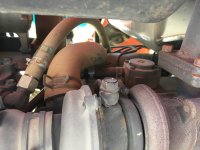
rScotty, I did have a chance to play around with my tractor. But I didn’t even go as far as removing the breather assembly and cleaning it out. Coming off of the breather, is about a three inch section of rubber hose. My hose was frozen solid. So instead of trying to gain access, I thought I might try and thaw it out first. I pulled the tractor outside, removed the oil fill cap to relieve any pressure (I did cover with a clean rag though) and started it up. I brought it up to about 3000 RPM, and let it sit outside for about 40 min. When I came back and checked on it, I had nothing sputtering out of the exhaust, and I even held a clean white rag up to it. I had no oil around the dipstick, and the rag that I covered the oil fill with was also pretty clean with just a few spatters. I checked the rubber hose coming off of the breather, and it was nice and pliable. I put the oil fill cap back in, and drove around for a bit, finally parking it over some white snow. I continued to let it run at an elevated RPM for another 10 min or so, and there was not one speck of oil on the snow. I will include a picture of that short rubber section of hose coming off of the breather. I will learn from this experience, and definitely run my engine at a high idle, if it has to sit for a bit in cold weather, and also, not run it for a short time in extreme cold weather, shut it off, and then try to run it again at idle. Maybe I will try a work around someday for freezing temps, that I can return to normal for above freezing temps the rest of the year.

E7226527-620D-4E66-A259-837640DD66B7.jpeg
 
 
Top