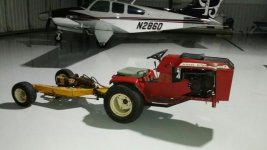
Compact Tractors are Designed All Wrong

   / Compact Tractors are Designed All Wrong #381  
:) I meant a deeper scarifying than that. There may be better soil not too far underneath.
Doubtful. We already have grass established, and it's slowly filling in. I think it just needs a few years of saying thatch and nitrogen. Once the grass gets thick enough to hold moisture, I'll lift the thatch and overseed with micro clover... should help a lot.
 
   / Compact Tractors are Designed All Wrong #382  
Doubtful. We already have grass established, and it's slowly filling in. I think it just needs a few years of saying thatch and nitrogen. Once the grass gets thick enough to hold moisture, I'll lift the thatch and overseed with micro clover... should help a lot.

Yah, I wouldn't scarify if you already have grass growing. I was talking about any bare or uncultivated areas. Just throw down organic fertilizer of some kind a couple of times; that will really help the grass fill in. Bare areas can be a problem on sloped areas. But you're already on your way to much better soil.

Do you really get "thatch"?
 
   / Compact Tractors are Designed All Wrong #383  
So I'm reading this thread:

https://www.tractorbynet.com/forums/attachments/403982-can-i.html#post5238845

I didn't want to comment in that thread, because the poster is looking for solutions and options using his equipment, and it's not the kind of thread asking what's the better tool. But it got me to thinking about this thread again, where we're comparing all sorts of different machines to a traditional tractor.

In that thread, the poster wants to clear a path to a spot on the property about 25-30' away. The path is full of scrub the thickness of his little finger and 3-4 feet tall. He's wondering if he could back his 3pt brush cutter in there with his tractor, which is this make and model.
TractorData.com Mahindra 1526 tractor information

People are concerned that he may pop a tire, or bend the sheet metal on the rear of the cutter on a hidden stump or rock, or poke things in his undercarriage, etc... They're suggesting he back in with his cutter raised as high as it will go and lower it down, raise, advance, lower, repeat.

This is one of those situations where a machine like the Power Trac VS a conventional tractor is a good head-to-head comparison.

I'd have no concerns about doing a heavily grown over path of 3'-4' high finger-sized saplings 25-30' long in one pass with my little machine in probably one or two minutes.

- The bottom of the PT is flat steel plate. Nothing sticks out. Nothing to poke or damage. The entire unit is basically a skid plate on wheels.

- With the brush cutter out front, you can see what's coming. The front of the deck is open. There's no sheet metal to be bent or pushed into the blades. If you push up against a stump, you'll see it and stop. Everything that the brush cutter can push over will be destroyed, chewed up and spit out before you drive over it.

- Finger sized saplings are of no concern. The little PT4255 will easily handle pushing over and destroying anything 1.5" in diameter or less. With care, I've pushed over 2" oaks and chewed them up.

- If needed, for, say, shrubs and bushes, I can lift the brush cutter 5' in the air to an almost vertical position and bring it down slowly, grinding the plant to shreds.

Having had a large 50hp tractor with a brush hog on the back for 10 years, and switching to this style machine for the last 17 years, I can say from experience, the brush cutter out front is way better for me. I'd venture to say it's probably better for most other folks, too.
 
   / Compact Tractors are Designed All Wrong #384  
Yah, I wouldn't scarify if you already have grass growing. I was talking about any bare or uncultivated areas. Just throw down organic fertilizer of some kind a couple of times; that will really help the grass fill in. Bare areas can be a problem on sloped areas. But you're already on your way to much better soil.

Do you really get "thatch"?
Sadly, I do. Things are so busy with a business, 4 kids, plus one on the way... I rarely get time to mow on schedule. It's not so bad when I mow with the Toro. The flail deck leaves the clippings small and lofted. My zero turn, on the other hand, is a different story.

Sadly enough, I had to quit mowing with my Toro, 'cause 5.5 acres of steep sloped lawn is just too much for the transmission.
 
   / Compact Tractors are Designed All Wrong #385  
Sadly, I do. Things are so busy with a business, 4 kids, plus one on the way... I rarely get time to mow on schedule. It's not so bad when I mow with the Toro. The flail deck leaves the clippings small and lofted. My zero turn, on the other hand, is a different story.

Sadly enough, I had to quit mowing with my Toro, 'cause 5.5 acres of steep sloped lawn is just too much for the transmission.

That wouldn't technically be "thatch" but def a problem, as excessive grass clippings kill or stunt your grass, allowing you-know-what to take over. So you're creating more work for yourself. Regular mowing is important if you care about your lawn. Maybe you don't and that's fine too! :)

You sound like a busy man. Truly the easiest way to improve your lawn is 1) scatter on any kind of organic fertilizer 1-2 times a year, and 2) mow regularly, fairly high.

As for the fertilizer, I only had to fertilize the first year and now the soil is good and getting better every year. As for mowing, might be worth your time to hire someone to do it during your busy times. Around here, a mowing company will mow my 3-4-ish acres of open land for around a hundred bucks. I'm busy too, so I prioritize it. The area immediately around the house I can mow in 15-20 minutes or so. That gets done no matter what, and I've done it in the dark at times. The rest gets mowed when I get to it. :)

Imma post before and after pics of my lawn, showing how awful it was and how gorgeous it is now, with just the two simple techniques above because no one believes it, until they try it.
 
   / Compact Tractors are Designed All Wrong #386  
So I'm reading this thread:

https://www.tractorbynet.com/forums/attachments/403982-can-i.html#post5238845

I didn't want to comment in that thread, because the poster is looking for solutions and options using his equipment, and it's not the kind of thread asking what's the better tool. But it got me to thinking about this thread again, where we're comparing all sorts of different machines to a traditional tractor.

In that thread, the poster wants to clear a path to a spot on the property about 25-30' away. The path is full of scrub the thickness of his little finger and 3-4 feet tall. He's wondering if he could back his 3pt brush cutter in there with his tractor, which is this make and model.
TractorData.com Mahindra 1526 tractor information

People are concerned that he may pop a tire, or bend the sheet metal on the rear of the cutter on a hidden stump or rock, or poke things in his undercarriage, etc... They're suggesting he back in with his cutter raised as high as it will go and lower it down, raise, advance, lower, repeat.

This is one of those situations where a machine like the Power Trac VS a conventional tractor is a good head-to-head comparison.

I'd have no concerns about doing a heavily grown over path of 3'-4' high finger-sized saplings 25-30' long in one pass with my little machine in probably one or two minutes.

- The bottom of the PT is flat steel plate. Nothing sticks out. Nothing to poke or damage. The entire unit is basically a skid plate on wheels.

- With the brush cutter out front, you can see what's coming. The front of the deck is open. There's no sheet metal to be bent or pushed into the blades. If you push up against a stump, you'll see it and stop. Everything that the brush cutter can push over will be destroyed, chewed up and spit out before you drive over it.

- Finger sized saplings are of no concern. The little PT4255 will easily handle pushing over and destroying anything 1.5" in diameter or less. With care, I've pushed over 2" oaks and chewed them up.

- If needed, for, say, shrubs and bushes, I can lift the brush cutter 5' in the air to an almost vertical position and bring it down slowly, grinding the plant to shreds.

Having had a large 50hp tractor with a brush hog on the back for 10 years, and switching to this style machine for the last 17 years, I can say from experience, the brush cutter out front is way better for me. I'd venture to say it's probably better for most other folks, too.

Sooooooo, I cut 8' tall brush up to 1" diameter
DSCN0802.jpg


With this 15hp grey market CUT
shibaura barn3.jpg


I think it is as cute as those Powertracs:)
 

Attachments

  • DSCN0795.jpg
    DSCN0795.jpg
    417.3 KB · Views: 154
Last edited:
   / Compact Tractors are Designed All Wrong #387  
Turn the seat around, rig up linkages for the pedals and steering, and you'll really have something.
 
   / Compact Tractors are Designed All Wrong #388  
Yep, another vote for an out front brush hog. This one is 7':

P5250022.JPG
P5280005.JPG


P5260004.JPG
P7250005.JPG
 
Last edited:
   / Compact Tractors are Designed All Wrong #389  
Turn the seat around, rig up linkages for the pedals and steering, and you'll really have something.

Like this? You sit on the hood to operate it with the steering wheel between your knees.

B47EF378-DDD2-48C5-8E16-AEFD14EDD0A8.jpeg
 
   / Compact Tractors are Designed All Wrong #390  
Like this? You sit on the hood to operate it with the steering wheel between your knees
Now that brings back memories from 1986 of the Wheelhorse C195 with a dirt scoop on three point. Had to ride backwards sitting on the hood to keep the front wheels on the ground.

Pictures from an image search. It had a 19.9 horsepower Kohler two cylinder, lever operated hydrostatic transmission and 16 inch rear wheels:

WH C195.jpeg


1984 C195.JPG
 
   / Compact Tractors are Designed All Wrong #391  
Yep. It was surprisingly natural to control direction and speed with your left hand, steer with your right hand and operate the brake pedal with your right heel while sitting on the hood. The brake and directional lever were somehow interconnected, as when you push on the brake pedal, it would center the directional control from either direction. I'm not sure if it even had brakes at all.
 
   / Compact Tractors are Designed All Wrong #392  
Nothing beat the ride of my old Gravely Pro 12, with a steering sulky and those handles whipping up and down with changes in terrain threatening to smash your knee caps or crown jewels. But the fun part was going around corners hanging on for dear life.
 
   / Compact Tractors are Designed All Wrong #393  
Having some experience under my belt, I am even more convinced now than I was when I began looking at tractors a year ago that the design of compact tractors, for us weekend diggers as opposed to real farmers, is all wrong. It is a design that has devolved, in an anti-Darwinian fashion, from a series of historical compromises and from blind mimicry of grandpa's agricultural tractor.

Here is a list of the design flaws and the obvious remedies:

1. The 3ph is an abomination. It is an historical industry compromise that, like all compromises, is a mediocrity at best. It is the interface that has launched a thousand hernias (and a googolplex cursewords). It needs to be replaced by the kind of simple, 30-second attachment interface that skidsteers have.

2. Mowers should be on the front of a tractor. This is so for both finish mowers and brush mowers. It is also so for snow blades and snowblowers. Having any of these in the middle or back of the tractor is inefficient, clumsy, and puts you in the hospital for with neck problems in addition to your hernia. The solution is having fully independent attachment interfaces on both ends of the tractor. Thus, for example, you could have the mower on the front and the FEL on the back as your "regular" set-up. This would also have the virtue of eliminating the need for clunky, useless counterweights for the rear of the tractor such as weight boxes, concrete-filled cans or trendy boxblades.

3. This naturally means you should be able to swivel the driver's seat around and drive in either direction. Thereby, your FEL or hoe would then be in front of you for proper operation, with the mower (or other useful implement) then becoming the "rear" counterweight.

4. The power connection to the attachment interfaces should be hydraulic, not mechanical. Just one-second quick-connect couplers. No more dangerous, twirling pto shafts to to catch your lovebead neckaces and choke you to death. No more clumsy, heavy implement shafts. No more lining up splines, or fiddling with collars and buttons.

5. All wheels should be the same size. Small front wheels are (for us weekend diggers) a largely useless artifact of agricultural crop row navigation. Might as well put sundials on tractors. Having equal wheel sizes would have many benefits. There would be a larger tractor footrprint and hence greater overall floatation. There would be less scuffing of lawns and imprinting in soils, and less sinking into wet soils and mud, because it is the small front tires that are the primary culprits in these matters. You could change tire sizes without worrying about differing 4wd circumference ratios between the front and rear wheels. You could fill all four tires for more traction and stability, and be driving an overall more weight-balanced vehicle. You would have better traction in 4wd, which should be significant in mud and snow applications.

6. Because mowing is a primary activity of compact users, these tractors should all articulate. This means they pivot in the middle to promote ease of turning and driving.

7. They should be significantly cheaper than they are. Why should a small compact tractor cost more than a compact car? Tractors are 1930 technology, for goodness sakes, and have relatively few parts. Something is wrong. They are way overpriced.

Having been on sabbatical from this forum for several months, I am pleased to observe that there is now an American-made product that cures most of these problems and meets most of these objectives: the Power-Trac, courageously purchased by Willingtonpizza. Having reviewed the Power-Trac on their website, it is obvious that there is no sane reason anymore to purchase the historically-flawed compact tractor.

You all may disgree with this, of course.

I have a PT 1425 and love it for all the reasons mentioned. When I brush hog I can see what im doing. Im about to buy a mahinra 1526 and think everything is backwards.
 
   / Compact Tractors are Designed All Wrong #394  
I have a PT 1425 and love it for all the reasons mentioned. When I brush hog I can see what im doing. Im about to buy a mahinra 1526 and think everything is backwards.
If the PT is so effective... why buy the Mahindra? Doesn't make sense.
 
   / Compact Tractors are Designed All Wrong #395  
Very interesting thread I don’t agree with everything the OP stated especially hydraulic drive inefficiencies but those articulated Italian tractors are **** nice. If service and dealer support was better I think I would buy one of those and a compact telehandler and call it a day.
 
   / Compact Tractors are Designed All Wrong #396  
And how much weight can you bring to bear on those teeth if the front wheels are off the ground? Tons! 👍

Decided to update this, since the thread became active again.

Used the crane scale to measure the weight on the bucket teeth:

PA170013.JPG
PA170014.JPG


2,383 pounds, not as much as I expected:

PA170004 2383.JPG
PA170015.JPG


The bucket weighs 818 pounds and the Toolcat weighs 5835 pounds:

P6060050.JPG
tcw.JPG
 
Last edited:
   / Compact Tractors are Designed All Wrong #397  
Small tractors are maybe not misdesigned but largly misused/abused. You hire a contractor to get rid of some trees or move some dirt and he won't show up with a little tractor.

I said it before. Tractors with FELs were meant to move manure and hay bales,not digging or removing trees. The very fact that you have to add extra ballast to the rear end is proof, that these things were never designed to carry and move weight up front.
 
Last edited:
   / Compact Tractors are Designed All Wrong #398  
   / Compact Tractors are Designed All Wrong #399  
Yep, 8 real sharp teeth:

P5250007.JPG
P5210003.JPG
 
Last edited:
   / Compact Tractors are Designed All Wrong #400  
GRRRRrrrr!!!


:laughing: :thumbsup:
 

Tractor & Equipment Auctions

2005 Sterling Acterra Tender Truck (A56438)
2005 Sterling...
30 INCH TOOTHLESS BUCKET FOR MINI EXCAVATOR (A58214)
30 INCH TOOTHLESS...
2017 Mercedes Benz GLA SUV (A56859)
2017 Mercedes Benz...
2015 Bobcat S650 Skidsteer - Enclosed Cab - 5462 Hours (A56438)
2015 Bobcat S650...
2012 Ford E-250 Cargo Van (A59230)
2012 Ford E-250...
2018 John Deere 1653 (A56438)
2018 John Deere...
 
Top