Comparing different approaches to emissions

   / Comparing different approaches to emissions #1  

4tillingdirt

Silver Member
Joined
Oct 18, 2013
Messages
241
Location
nc
Tractor
N/A
I believe the two main approaches are using a DPF, with some using a catalyst and a DPF, or using a catalyst with a cooled EGR and no DPF. I know Massey and Mahindra tout their approach with no DPF and no regen cycle, which on the surface appear to be superior. Does anyone have any good information on why the no DPF route would be more trouble than manufacturers claim they are?
 
   / Comparing different approaches to emissions #2  
I can foresee a problem with those systems. With an active regeneration system, when the system sees the catalyst plugging up, it will initiate a regen burn.
On the passive systems that are always supposed to be burning off the soot, if for some reason, say a dirty injector, causes the engine to produce soot, once the catalyst plugs up, there is no way for the user to clean it out.
 
   / Comparing different approaches to emissions #3  
I can foresee a problem with those systems. With an active regeneration system, when the system sees the catalyst plugging up, it will initiate a regen burn.

Beginning about thirty-three horsepower most tractors have Diesel Particulate Filters (DPF).
If not DPF, the less used alternative emission technology is Diesel Oxidation Catalyst (DOC).
Both the DPF and the DOC are honeycomb ceramic filters.
The DOC forces engine exhaust over a honeycomb ceramic structure coated with platinum, palladium, and rhodium catalysts. These catalysts oxidize carbon monoxide and hydrocarbons into carbon dioxide and water at hot exhaust temperature.


There is no catalyst associated with a Diesel Particulate Filter. A DPF is a ceramic matrix which accumulates particulates/soot at temperatures below soot ignition temperature. During regeneration, when DPF achieves and maintains at least 500 degrees Fahrenheit, the temperature of a hot kitchen oven, accumulated soot incinerates during a few minutes.


Operator Manuals for DPF equipped compact tractors do a poor job of explaining DPFs and a poor job of explaining regeneration cycles. For instance, two manuals i have viewed do not inform that soot accumulates faster during low weather temperatures, none inform time required for DPF to attain 500 degrees fahrenheit, the ignition temperature for diesel soot and none address faster soot accumulation at higher altitudes. It seems to me a DPF temperature readout on electronic instrument panels would address many DPF complaints, as would more descriptive technical writing.


As off-road diesel engines increase in displacement and horsepower emission treatment becomes increasingly complex. DPFs as a final particulate treatment are primarily associated with diesel engines <75-horespower.


Keep in mind emission standards for over-the-road diesel engined vehicles are much tighter than emission standards for off-road engines AT THIS TIME.
 
Last edited:
   / Comparing different approaches to emissions #4  
Emission Standards: USA: Nonroad Diesel Engines

There's three power categories for CUTS: under 25.47hp, under 75hp, over 75hp. The requirements get stricter with each category. Under 25hp can be met without EFI or DEF or DOC.

For 25-75hp there are three solutions currently in the market: EFI + DPF, EFI + DOC and EGR, and DOC + DPF. Branson does the last one. Mahindra and some Masseys do EFI + DOC. Everyone else does EFI + DPF. That solution requires active regen, the other two do not. Regen systems usually inject additional fuel to get the DPF up to temp. Branson's DOC + DPF doesn't do that. EFI + DOC probably doesn't either but I'm not sure.

Regens can be nearly un noticeable if the tractor's hot and working hard. When it's cold out, especially with smaller engines, it can be difficult to get the DPF up to temp. Kubota B3350s are notorious for that (the turbo does not help). Bransons have mechanical injection and do a low temp continual regen. If you don't run the tractor hard enough often enough the DPF can clog. For example if you're somewhere with cold winters, only do loader work all winter and don't run the engine in the recommended rpm range. There's a warning light that comes on before the DPF gets too clogged. Working the tractor hard will unclog the DPF. One way is to put it in high range and run it up and down the road for a while.

With a regen system you can run the tractor at low rpm all the time and it'll just do more regens. But you'll be having to put up with regens. If you're clogging the DPF quickly by not running it hard then you'll be doing parked regens where the ECU runs the rpms up for 20 minutes or so.

I'd say that if you're going to be doing loader work inside all cold winter, get a tractor that does regens. If you want to remove the DPF, that's easy on a Branson. However I suggest keeping it until it actually causes a problem. If you're going to run the tractor hard periodically and follow the manufacturer's recommendations, all the systems will work well.

With any of the systems, a clogged injector that's spewing fuel (don't they usually spray less when clogged?) would cause the DPF or DOC to clog quicker. In which case you'd be notified by the system monitoring it (by more frequent regens on a regen system) and could take action. On a non regen system you can get the filter hot by running the tractor hard and cook off the soot.
 
   / Comparing different approaches to emissions #5  
There is no catalyst associated with a Diesel Particulate Filter. A DPF is a ceramic matrix which accumulates particulates/soot at temperatures below soot ignition temperature. During regeneration, when DPF achieves and maintains at least 500 degrees Fahrenheit, the temperature of a hot kitchen oven, accumulated soot incinerates during a few minutes.

Great write-up. The only correction is the regen temp for DPF is 600 deg C or about 1100 deg F which is why some systems use a diesel injector in the DPF to help get the temperature up to burn off the carbon buildup.
 
   / Comparing different approaches to emissions #6  
I believe the two main approaches are using a DPF, with some using a catalyst and a DPF, or using a catalyst with a cooled EGR and no DPF. I know Massey and Mahindra tout their approach with no DPF and no regen cycle, which on the surface appear to be superior. Does anyone have any good information on why the no DPF route would be more trouble than manufacturers claim they are?

DOC functions in the same way as a catalytic converter for a gas engine, it's basically the same thing.
 
   / Comparing different approaches to emissions #7  
I had the Massey mechanic at my place the other day to pressure test my coolant system, found a loose hose. Anyway, I was talking to him about the different engines and emissions controls. He said the biggest pain and problem is the operator because they don't get the engine up to temperature or load the engine up enough. After a couple failed regens the only way to fix it is by hooking the computer up to it. In cold weather he has to tell his customers some of the tractors need cardboard placed in front of the radiator or else the temps won't get high enough. I purchased the 1735M with the Shibaura engine that uses the DOC and EGR. He likes them better ONLY because the operator really can't screw anything up :)
 
   / Comparing different approaches to emissions #8  
The op asked the same question over on the Kioti section, and I will give the short answer as I see it here.

Banking and Trading and Fleet Average emission implementation strategies impact what a manufacturer ultimately implements on a specific model.

If I sell a broad range of tractors and can bank emission credits on some models, or buy credits from someone like Tesla, I can sell some tractors that are above the standards.

It is a common strategy in the engine business.
 
   / Comparing different approaches to emissions #9  
Doc controls HC emissions, with only a minor effect on PM.
 
   / Comparing different approaches to emissions #10  
With a regen system you can run the tractor at low rpm all the time and it'll just do more regens. But you'll be having to put up with regens. If you're clogging the DPF quickly by not running it hard then you'll be doing parked regens where the ECU runs the rpms up for 20 minutes or so.

Quickly?? Bear in mind the average residential user clocks eighty (80) engine hours per year.

Regeneration is an infrequent event for my Kubota three cylinder engine.
Generally once every sixty engine hours. (Consistent in Florida due to warm weather.)

60 hours X 60 minutes = 3,600 minutes.

16 regeneration minutes /3,600 = .00444 = 4/10s of 1% of engine time is parked regeneration.

Fuel cost for sixteen minute parked regeneration @ 2,200 rpm ~~$1.00.


I clock 250 to 300 engine hours per year.
 
Last edited:
   / Comparing different approaches to emissions #11  
Great write-up. The only correction is the regen temp for DPF is 600 deg C or about 1100 deg F which is why some systems use a diesel injector in the DPF to help get the temperature up to burn off the carbon buildup.

I will further research compact tractor DPF temps in the next few days. I am nearly certain DPF in my Kubota L3560 reaches soot incineration temperature solely through throttle advance to 2,200 engine rpm. In abstract it would seem logical there would be one threshold temperature at which soot would incinerate cleanly and completely within DPF. Perhaps, perhaps not.
 
   / Comparing different approaches to emissions #12  
Beginning about thirty-three horsepower most tractors have Diesel Particulate Filters (DPF).
If not DPF, the less used alternative emission technology is Diesel Oxidation Catalyst (DOC).
Both the DPF and the DOC are honeycomb ceramic filters.
The DOC forces engine exhaust over a honeycomb ceramic structure coated with platinum, palladium, and rhodium catalysts. These catalysts oxidize carbon monoxide and hydrocarbons into carbon dioxide and water at hot exhaust temperature.


A DPF is a ceramic matrix which accumulates particulates/soot at temperatures below soot ignition temperature. During regeneration, when DPF achieves and maintains at least 500 degrees Fahrenheit, the temperature of a hot kitchen oven, accumulated soot incinerates during a few minutes.

It occurs to me that enclosed volume of DPF may influence temperature required to accomplish thorough incineration, with greater volume DPF requiring higher temperatures to incinerate soot for greater volume matrix with temperature varying throughout, especially end-to-end.
 
   / Comparing different approaches to emissions #13  
I will further research compact tractor DPF temps in the next few days. I am nearly certain DPF in my Kubota L3560 reaches soot incineration temperature solely through throttle advance to 2,200 engine rpm. In abstract it would seem logical there would be one threshold temperature at which soot would incinerate cleanly and completely within DPF. Perhaps, perhaps not.

Guys, any diesel engine equipped with a DPF uses supplemental fuel during an active regen to burn off the accumulated particulate matter. I don't know why that is even in question. If EGTs are high enough to cook off accumulated PM in the DPF on their own, you'd never see the regen light. This does occur to an extent if you are working the trade hard enough. It is called a passive regen and is 100% natural and requires zero electronic intervention.

Most dealers know very little about the emissions systems on the tractors they sell. Even the service dept often knows very little.

Most tractors (and I believe Kubota is like this) that run common rail injection use a fuel injection event during the exhaust stroke. This sends fuel into the cylinder but without the compression stroke the fuel does not combust. It simply is pushed into the exhaust stream and down towards the DPF. Some DPFs use a separate injector to accomplish this but I do not believe that's the case with Kubota. I have yet to spot a 5th injector in the exhaust system of my 4 cylinder Kubota. It would be more costly. Besides, Kubota themselves mentions the possibility of fuel diluting crankcase oil in the owner's manual. The only way that can occur on an engine that isn't worn out is because of this additional fuel event where unburned fuel enters the combustion chamber but isn't burned.

Furthermore, I think you'll find that even a DPF equipped tractor will also have a DOC. The reason being that a DOC is designed to generate heat. If fuel doesn't combust when it is injected into a hot cylinder on the exhaust stroke, how would it combust in the DPF, which has lower temps than the engine cylinder? It won't, unless that fuel is oxidized in the DOC, which is what it is designed to do.

Some Kubota engines may utilize a DOC, DPF, and an EGR system, which is likely cooled. I believe my MX series tractor has a cooled EGR - I could be wrong, but upon visual inspection that's what it appears to have. There are more emissions targets than "just" particulate matter. A big one is NOx...that's what got VW into so much trouble with their TDI engines. Cooled exhaust end gases recycled into the intake causes fewer NOx emissions to form. None of these lower HP tractors utilize SCR with DEF, so NOx needs to be controlled through EGR.

Less than 26HP is able to meet TierIV Final with no changes...that's why a B2601 or an L2501 are still mechanically injected, indirectly, with zero emissions controls on them whatsoever.
 
   / Comparing different approaches to emissions #14  
The US emission standards were established in 2004. Emissions are per kW-hr. The 25 HP and under could be pretty dirty but due to low power and usual low usage rates the standard for Tier 4 was 2008. It’s not that they have no control but are relatively easy to meet. My RTV900XT and GR2120 meet Tier 4 and are sooty and smelly.

My L6060 falls in another class and has EGR and DPF. The DPF plugged percentage can actually drop under high power like full speed roading. To regen it needs to be above 1200 rpm but the harder you work the tractor the better it is - according to the book. No problem here - I traded up from a L5740 for cleaner exhaust, better power with the direct injection, and improved economy also due to direct injection. After 2 years my wife and I agree one of my better purchase decisions.

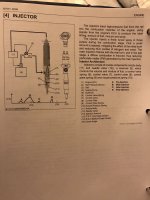
My M7-171 is in the next class, has EGR, SCF, and DPF. The DOC is at the inlet of the DPF and the SCR is after the DPF. Fuel to the DOC is the little burp shown at the end of the attached injection diagram - the post injection. Note post injection is before BDC so is still in the power stroke. There are temperature sensors at the inlet to the DOC, DPF, and outlet of the DPF. I don’t know which sensor provides the DPF temp on my panel but it runs between 1100 and 1200 in regen, about 1000 under a good load. Actually it has 2 EGR valves, one for high power high flow rate and one for low power, low flow rate.

Overall I love driving the M7 and also servicing it except it does have about 5 gearboxes. Other than changing fluids and filters, if anything major goes wrong it’s dealer time but the emissions warranty covers all the complex stuff. The worst thing so far is I have no use for it in below zero temps so it sits snug in the shed. The RTV and L6060 get the winter work and sit in the heated garage.

IMG_0061.JPG
 
   / Comparing different approaches to emissions #15  
...Fuel to the DOC is the little burp shown at the end of the attached injection diagram - the post injection. Note post injection is before BDC so is still in the power stroke...

That last injection event (D) occurs right at the end of the power stroke because it needs to happen just as the exhaust valves are opening so that the end-gases will be effectively pushed out. If the post-injection happened after the exhaust valves opened, the fuel would not effectively move nor would it be as hot.

The first injection event your manual describes is called pilot injection. The primary purpose is noise control, although it also prevents as rapid a rise in cylinder temps which helps reduce NOx.

To put into perspective, a modern diesel pickup has 7 or 8 injection events. The timing of injection pulses has become critical to fuel consumption, soot production, NOx production, power, and noise.

As far as regens are concerned, I prefer having a separate injector external to the engine which eliminates the possibility of oil-fuel dilution.
 

Tractor & Equipment Auctions

2008 JCB 190 ROBOT SKID STEER (A60429)
2008 JCB 190 ROBOT...
UNUSED RAYTREE RMBD72ST-72" HYD DRUM MULCHER (A60432)
UNUSED RAYTREE...
10 Lug Wheels Full Set (A57453)
10 Lug Wheels Full...
MULCHER (A58214)
MULCHER (A58214)
2008 MACK CHU613 TRI AXLE 16FT DUMP TRUCK (A58018)
2008 MACK CHU613...
2014 Chevrolet Express Van (A55973)
2014 Chevrolet...
 
Top