Compressor issue

   / Compressor issue #41  
Think I would plug it in without the long cord and see if it works. if it does like in my case I put the compressor by the plug and ran a long airline to get around voltage drop.
The thing about voltage drop is that even though a motor may start at the reduced voltage it will draw more current because of the drop. This excessive current causes excessive heat in the motor windings. Even though the motor starts if it takes even a few seconds longer than it should the insulation in the windings will start to break down. This leads to early motor failure, especially in single phase motors. This is because the start windings in single phase motors already run hot, especially in motors that are starting heavy loads, like compressors. It is best to keep the voltage drop to a minimum when starting induction motors. This low voltage causing higher current, hence higher heat, is why brownouts are so deadly for appliances like refrigerators.
Eric
 
  • Good Post
Reactions: bgr
   / Compressor issue #42  
Electric Motors need 3x the Current to Start. If voltage is reduced due to outside actions they will buzzz and blow a safety device like a Breaker.
 
   / Compressor issue #43  
you answered your problem in the last sentence of your opening statement
 
   / Compressor issue #45  
Im guessing mine are too old for a destruction date...?
Right. My air 'Pig' has destruction date (20 years after mfg.) stamped on one leg.
 
   / Compressor issue #46  
I picked up a couple of compressors, one is electric the other gas. The electric starts up fine from my temporary power source a hundred feet away with a 100 ft 15 amp extension cord but as soon as it needs to automatically re start itself cause the air pressure drops it will not start, it just sits there making an unhappy noise until it blows a fuse or damages the outlet it’s plugged into.
What might be the problem?
It operates fine when plugged directly into the same outlet.

Hi,

There are a couple of problems with your set up. Here are some numbers to help illustrait why.

The compressor motor is rated 1.5 HP. In electrical terms this is 1.5 hp x 746W/hp or 1119W (notice how the "HP"s cancel).

To accomidate the starting torque and initial head pressure you have to triple this, 3 x 1119W = 3357W. ( Its a long story where the 3 comes from but it is a minimum value )

I assume the outlet is 120V but if not just adjust this equation. Cord Current = 3357W/120V = 29.97A
This is why it pops the breaker which is likely 15-20A rated.

It takes approximately 29.57A to start the motor/compressor every time it kicks on so technically the cord should be #1/0 AWG otherwise there will be losses. I won't get into the details about what makes up the losses but it is effectively the resistance in the wire x2 (out and back) plus the connections on both ends.

Where your cord is undersized the losses are greater so the voltage droop at the compresssor is much lower than 120V. This is why it won't restart but worse as it tries to restart the currect goes ever higher than the ~29.57A because the voltage is low. Because the cord and connectors are now operating above their rating so, both are getting hot and this is why the connectors are melting and possibly the wire probably inside the casing. It gets worse. The more you run or try to run the compressor the hoter the cables get only compounds the situation. As the losses increase it becomes even more difficult to retart. Overall the situation can become hazarduous because it can start fires or potentially shock someone if it a wire melts through to the surface.

Going back to the beginning and the name plate rating on the compressor motor. We calculated that the compressor needs 1119W of power to operate so, when normally running the motor consumes 1119W/120V = 9.325A. The cable size to support 9.325A at 100 ft is #4 AWG. If the losses are low enough and the compressor can start quickly the period over which it draws 29.57A is significantly reduced. In other words the period when the voltage droops is shorter and not so deep giving the compressor a better chance to start. I didn't mention it earlier this when things heat up they include the motor which takes time to cool back down. With the cord you have now the motor will fail in a short time. The wires just fry.

So, @ 100' #4 cord will get you by but the motor's life may be shortend to some extent, its hard to say how much because there are other factors involved as well.

I get it though, 100' #1/0 cords are astronomically expensive, #4s not much better, even #10s but physics dictates the reality of it and its up to us to make reasonable tradeoffs that won't kill us or the equipment. Compressors are somewhat unique because they are cyclic and one of the most difficult to start repetedily.

Maybe you could move the work a lot closer to the outlet with no cord. As you mentioned it works great there. The manufacturer selected the attached cord length to match the motor's rating and they are not meant to be extended unless you select the extension well. Generally speaking. A good general rule of thumb is to x1.5 the initial cord size AWG for each cord length you add to account length and losses some of which I haven't mentioned. In any case this estimate shows that the cord gets big fast with quick math.

So, I hope this helps.

1700488414246.jpeg


To just simply recap all of my ramblings. Small cords are always fed by big cords and how big is determined by the length of the run at a given current.

I hope the simplified math helps everyone understand what is going on and why. This is a huge problem in more ways than you can imagine and in places you might not expect. It's not always understood well by some professionals so don't feel bad for not getting it.
 
Last edited:
   / Compressor issue #47  
You need a dedicated 20 amp circuit which is 110 volt and a 12 gauge extension cord because of the distance and the voltage drop. 15 amps will not cut it.
 
   / Compressor issue #48  
SORRY GORD BAKER, I WAS TALKING TO 1930 NOT YOU
 
   / Compressor issue #49  
When it shuts down it blows air back out the intake tube. Hard to even cover it shut with my thumb.
Soon as air stops leaking out intake tube I can plug it back in and it starts fine
That little line connected to the pressure switch should vent off the air between the compressor and the check valve when it turns off, so the compressor starts unloaded next cycle.

If you manually turn the compressor off before the pressure switch turns off, it won't get vented and the compressor will try to start loaded next time. (voice of experience)

I think you need a larger gauge extension cord. That's a long run.
 
   / Compressor issue #50  
You need a big extension cord to go out 100ft. It’s loosing too much voltage over that distance. The easy solution is to use the gas compressor you have sitting there. Or leave the compressor at the power source and run more air hose.
More air hose is definitely cheaper than a long heavy gauge extension cord.
 
   / Compressor issue #51  
Before taking the compressor apart, to find a problem that may or may not be there, go to the larger extention cord , or, run the longer air hose. Remember that beyond 100 ft you will also have air pressure drop because of the length of the run. Continuing to run on an extension cord that cannot carry what the compressor needs will only damage the compressor motor
 
   / Compressor issue #52  
I have used good quality 5/8" garden hoses with adaptors at the end to extend my distance from a compressor to a work site when using a nailer. Ran 200' to a job years ago.

Do you own a volt meter? If you do not, it should be your next purchase for situations as you describe.
 
   / Compressor issue #53  
Most air compressor tanks that fail just start leaking nothing "explosive" or dramatic.
I was in a small shop (24' x 24') when a 20 gallon 125 PSI tank let go. No shrapnel, but the dust and debris filled the shop. Turns out the tank rusted thru on the bottom and a small hole quickly became bigger and released all the compressed air in just 2 or 3 seconds, so it was dramatic, and not sure about the "explosive" part but it sure seemed like it.
 
   / Compressor issue #54  
There is one in your picture of the motor. The FLA is Full Load Amps. Sometimes you'll see a LRA (locked rotor amps) which is how much it will draw if the motor is not turning. Keep in mind that the starting of the motor will draw more than the running current.

View attachment 831780
Usually starting infeed amps are 3 times running amperage Starting amps always refer to locked rotor amps at least in my experience and running amps can be impacted by capacitance star-run as well. Lets just say it takes a gob to start my 7.5 horse on my Quincy, unloader or not.
 
   / Compressor issue #55  
Most air compressor tanks that fail just start leaking nothing "explosive" or dramatic.
And usually at the bottom of the receiver where undrained condensate lingers from not draining it in a timely manner and why I use an electrically powered timed drain valve on both of my principal compressors. They ain't cheap but neither is a new receiver, especially the big ones I have. My smallest one is 175 gallon and the other one is 200.
 
   / Compressor issue #56  
10 ga 100' cord is the standard for 15a power tools & the like.
 
   / Compressor issue #57  
If the OP has to run power that far for his compressor it is much better to switch it over to 230volt using a 3 conductor plus ground cords set. Running electric motors of 3/4Hp and above on both legs helps keep your power feed balanced and the electric motors will start much easier on 220 as long as they are configurable 115/230 as most are, including the OP's per the motor data on the first post.
Otherwise use hoses as has been suggested.
 
  • Good Post
Reactions: bgr
   / Compressor issue #58  
And usually at the bottom of the receiver where undrained condensate lingers from not draining it in a timely manner and why I use an electrically powered timed drain valve on both of my principal compressors. They ain't cheap but neither is a new receiver, especially the big ones I have. My smallest one is 175 gallon and the other one is 200.
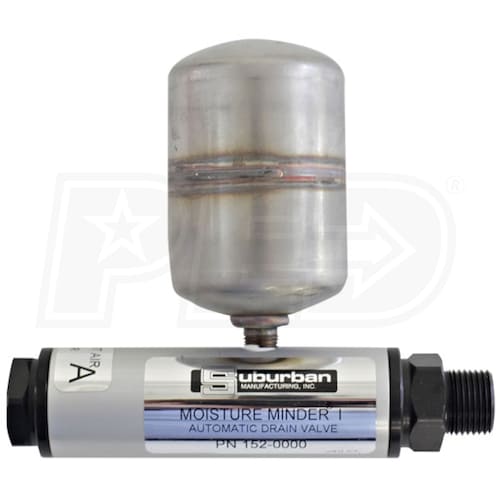
I really like the "Moisture Minders" that trigger from the unloader every time the pump shuts off. Purely mechanical/pneumatic with no wires or timers. I've got them on my larger compressors including an IR T30 from the 80s with the original 80gal receiver.


Tractor & Equipment Auctions

Kubota M4700 4WD 51HP Utility Loader Tractor (A56857)
Kubota M4700 4WD...
(INOP) JOHN DEERE 544 AA WHEEL LOADER (A60430)
(INOP) JOHN DEERE...
KAWASAKI 42ZV WHEEL LOADER (A60429)
KAWASAKI 42ZV...
(INOP) 2016 CATERPILLAR 259D SKID STEER (A52709)
(INOP) 2016...
2019 FORD F-150 XL CREW CAB TRUCK (A59823)
2019 FORD F-150 XL...
2025 MMS MS36C (A53317)
2025 MMS MS36C...
 
Top