Concrete block construction basics?

   / Concrete block construction basics? #1  

zmoz

Silver Member
Joined
Feb 12, 2004
Messages
244
Location
Outside of Raleigh, NC
Tractor
-
I'm planning on building a new shop and my head is spinning trying to figure out what kind of building I want. I would like to sheild the noise from the inside of my shop somewhat for the neighbors, and that means a cheap metal building with 26ga walls won't cut it.

I'm considering building the shop out of standard 8x8x16 concrete blocks due to the fact that I can work slowly, putting up one peice at a time, by myself without much major equipment. I also found somebody selling a large quantity of them for only $0.65/each.

I'm just trying to get an idea of how much this is going to cost me. What kind of footing do I need to pour for a concrete block wall, and how deep? Below the frost line, obviously, any further than that? (not very deep here) I would like to lay the blocks first and then pour the slab inside. The blocks would also be filled with grout and rebar. How tall of a wall can I build using reinforced 8x8x16 blocks, before I need to step up to a wider block? I'm looking at building up to a 40x60 building, not sure how tall yet.

Would you think this is too large of a project for someone who has never actually laid concrete blocks before? I have done some work with bricks and mortar, but nothing of this size. I have a lot more time to invest than money...
 
   / Concrete block construction basics? #2  
Two thoughts:
1. It would be easier to pour the slab before walls go up so you can work from the perimeter
2. A pro could lay the block in a fraction of the time AND it would be done correctly.
Mike
 
   / Concrete block construction basics? #3  
Laying that many blocks by yourself is a lot of heavy work. You have to mix the mortar, carry the block, etc. There must be sound insulating materials you could add to the inside of your interior walls that would be as quiet or quieter than concrete block. Also, the appearance of a huge block wall is not all that attractive either.

From the bit of block laying I have done, the challenge for a beginner is to keep your mortar mixture stiffness consistent. Otherwise you tend to have trouble keeping a level course of block.
Dave.
 
   / Concrete block construction basics? #4  
I would advise aginst trying to do it yourself. If you really want block, hire it done. BUT block does have drawbacks if this is going to be more of a garage. It will still need insulated if you plan on heating it, and it is much more difficult to hang stuff and finish the inside.

But on to your questions. As to the maximum height, the rule used to be h/t must not exceed 20. That is the ratio of height in inches and thickness in inches. So we can solve for the max height of 8" block like this....h/8"=20. OR 160" max wall height for un-engineered and unreinforced walls. That is 20 courses high or 13'4". Some of the codes have changed and that is no longer used. There is actually no limit to the height for a properly engineered and properly reinforced wall. But for a DIY'er, I would go over 20 block high.

As to the footer, old rule of thumb was twice as thick as the wall and at least as deep as the wall thickness. In your case of 8" block, that would be a footer of 8" thick and 16" wide.

If you conemplating doing block to save money, even at the price of .65, it will still probabally be cheaper to build conventionally, and a lot easier.

Just a rough figure of your walls, you are looking at 150 block around the peremiter times 20 high. That is 3000block. Which is $1950. The footer will run you about 6 yards of concrete which would be about anoher $700. I cant remember on the mortar figures but all I could find with a quick google search turned up 2.5 bags of mortar AND 600lb of sand for ever 100 block. with 3000 block, that is 12,000lb of sand and 75 bags of mortar. Total that is about another $1000. An we havent even got int figuring lintels and such for doorways. Not to mention, how were you planning on hauling 3000 block, 75 bags of mortat, and 12,000lb of sand to the site??? If you have to hire that, well. $$$$$ If you do it yourself, that will be a LOT of trips.

But if you decide to try it yourself, LAYOUT it the big key. Making sure EVERYTHING starting at the footer is measured accuratly and square. Then once you start laying the block, making sure the doorways and window openings are measured ACCURATLY. You will also need a variety of tools that you probabally dont have if you've never done block before. Like the trowel, string level, joint striker, at a minimum. A transit/sight level is almost a must. As is a mortar mixer with that much block. Scafolding is probabally another you will need.

Sorry for being long winded, but there is a lot more than meets the eye that goes into block laying. I know it may seem like a simple job and cheaper, but in the long run, I think it will cost you more, and take forever.
 
   / Concrete block construction basics? #5  
Do you have proper plans for the building? Lateral support may be an issue.

The footings and grade beam should also be designed.

Building codes??:)
 
   / Concrete block construction basics? #6  
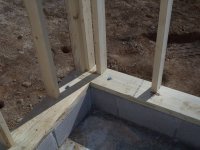
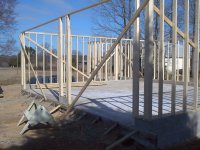
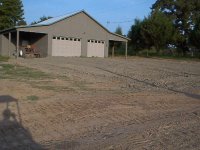
Wall height is not an issue, go high as you like with standard CMU block. I have seen them more than 25 feet tall on many electrical control rooms. Just have to install rebar in the blocks and grout it in. If you dont go more than about 12 feet high, you would probably be ok with #4rebar in ever 4th cavity. I put a 18 x 18 footer under my barn but I dont have more than a few inches of frost line. My builder used CMU for making the forms for the slab as seen in the photos. He left the front side open to allow the concrete truck to back into the area and work out to the front where he quickly installed the outside wall form and poured it on out. I then had him install one course of blocks on top of the slab so I could water wash my floor and not wet the walls and also raise my ceiling height. On hind site, I should have put 2 courses up to raise it even further. I used standard 2x4x 9' lumber for the walls and when mounted on the 8" block and the 2x8 wall plate give me almost a 10 foot ceiling. I insulated all the walls and ceiling with fiberglass bat insulation and sealed all interior walls with 3/8 plywood. It is fairly sound proof and sunlight coming thru the garage door windows warms it up pretty good in the winter. I would think that wood construction would be lots cheaper than CMU even at .65 per block. You still have all the mortar to purchase and as someone said handling a 16" block and mixing the mortar and laying the blocks is not for a single person to handle. Mine is 30 x 52 fully insulated and wire for lighting, 110 and 220V power and cost me $25,500. All I did was pretty much level the slab area. I left it sloping to one side to give me a higher shed height on the left side which came in handy when I got my LS P7010 with Cab as if pretty much takes the full height to get it in under the shed where my Yanmar is parked in the photo.
I put in one 16 foot door and one 10 foot. I keep my boat on the 10 foot side and my workshop is on the other.
 

Attachments

  • Shop wall plate detail.jpg
    Shop wall plate detail.jpg
    454.8 KB · Views: 7,439
  • shop 4.jpg
    shop 4.jpg
    472.8 KB · Views: 1,884
  • Gary House Apr 069.JPG
    Gary House Apr 069.JPG
    57.3 KB · Views: 2,056
   / Concrete block construction basics? #7  
I'm planning on building a new shop and my head is spinning trying to figure out what kind of building I want.

Would you think this is too large of a project for someone who has never actually laid concrete blocks before? I have done some work with bricks and mortar, but nothing of this size. I have a lot more time to invest than money...

It's not a bit too big of a project at all. But I'd go with something simpler than a total block building. Why not just use a simple poured continuous concrete footer under wood framed walls? Just do the perimeter, you can add a floor later inside or just leave it as dirt. Wood framed walls will go up quick, insulate better, and cost way less. Lots easier for one person to work with. Believe me on this. And you can get second hand wood lots of places like old buildings or recycle places. Don't overlook packing crates for lumber. big beams can be glued and screwed together out of smaller pieces. Your local creek has a sandbar; you'll have to buy a few bags of cement and a wheelbarrow.

I built my workshop just like I've described and have used it 40 years. The cost was mostly in scrounging. It took about three months with friends helping some weekends. Most of the expense was in fixing up a table saw and an old pickup truck for scrounging around.

Doing projects that way used to be common; it's still a good way to go, just out of popularity right now.

For the technical end of homebuilt architecture, good books are the old ones by Harry Parker. Like "Simplified Engineering for Architects & Builders" His books may be close to 100 years out of date - but are simple and accurate. Best of all, they are available on Abebooks.com for a buck or two. Get the old ones by Parker.

good luck, rScotty
 
   / Concrete block construction basics? #8  
I'm planning on building a new shop and my head is spinning trying to figure out what kind of building I want. I would like to sheild the noise from the inside of my shop somewhat for the neighbors, and that means a cheap metal building with 26ga walls won't cut it.

I'm considering building the shop out of standard 8x8x16 concrete blocks due to the fact that I can work slowly, putting up one peice at a time, by myself without much major equipment. I also found somebody selling a large quantity of them for only $0.65/each.

I'm just trying to get an idea of how much this is going to cost me. What kind of footing do I need to pour for a concrete block wall, and how deep? Below the frost line, obviously, any further than that? (not very deep here) I would like to lay the blocks first and then pour the slab inside. The blocks would also be filled with grout and rebar. How tall of a wall can I build using reinforced 8x8x16 blocks, before I need to step up to a wider block? I'm looking at building up to a 40x60 building, not sure how tall yet.

Would you think this is too large of a project for someone who has never actually laid concrete blocks before? I have done some work with bricks and mortar, but nothing of this size. I have a lot more time to invest than money...

You're going through a lot of effort and expense with concrete blocks in a DIY project just for sound suppression. A metal building with interior insulation is what you want.

If you're really worried about the neighbors, buy them Mickey Mouse ear protection:).
 
   / Concrete block construction basics? #9  
2 years ago when I built my shop I priced metal building and for the size I built they wanted $42K for the material and I had to supply the slab and labor to erect it. Almost double my cost to have it built wood frame and insulated and wired and lighted. All of that would have added up more than double my final cost. I think prices of steel may have came down a bit since then, but maybe so has wood. I havent priced either lately. I likely got a pretty good deal on my shop, because the contractor just finished building my brother in laws shop which is almost identical and also his house and I had contracted him to build my new house also. Therefore your cost may be much higher especially in New York. By the way my shop has a 30x30 work area with a 8 x 12 bathroom on one side that also doubles as some storage area, so total enclosed area is almost 1000 sq feet. The wings are 12 x 30 on one side and 12 x 22 on the other. I already need to add some more shed area for my equipment so it seems that the old addage that you can never build large enough is surely true.
 
   / Concrete block construction basics? #10  
another option we use here, Insulated Concrete Forms, (IFC). This is the styrofoam walls that they pour with concrete, You can erect the forms your self, and just have a crew come pour them on the day the trucks arrive.

The sound insulation is impressive, and the insulating quality is better.

Just a thought
 
   / Concrete block construction basics? #11  
I just built a 30X32 block garage, here; TractorByNet.com > General Forums > Projects > Breaking into the bank

Sorry, have to figure out how to insert a thread?

Anyways, I thought for a brief second about trying to lay block myself, but I definitely didn't have the time to do it, especially having never done it. Found a great block sub, and the rest is history.
I would agree with the other great opinions, conventional construction would be cheaper and just as soundproof. I used block to also act as a retaining wall against a bank.

ICF's are great, but that's even more money with the forms and poured walls....

I personally think you would get overwhelmed by that size of a building laying block, having never done it. Wood would definitely be an easier route.....

Good luck!!
 
   / Concrete block construction basics? #12  
Google "celular concrete block". My brother build his house from those. The blocks are much ligter than wood so even 6'X8"X12 block can be handled by single person. You can cut them with regular hand saw. Since they are precise made you need only very small amount of mortar. More like glue. They also have quite good R value.
 
   / Concrete block construction basics? #13  
Sounds to me like a pole barn frame with siding that is cheapest would be better. Might take two put siding up with any speed, but a lot easier. At some point noise is noise. You would also have to insulate your ceiling in any case.

Not cheap, but good insulation value, fast assembly: SIP construction.
 
   / Concrete block construction basics? #14  
The OP did mention he could get a good price on block; $.065 each, IIRC. That's less than half the usual price. ICF and SIP's are great, but will run about $5-6 per square foot of wall space.

One thing you could look into is surface bonding the block. The block are dry laid (no mortar), then skim coated with a fiber reinforced mortar. I believe you have to put in rebar and fill the cavities, too. It's claimed to be stronger than conventionally laid block. Personally, I can't begin to imagine laying that much block!

I would do a monolithic slab, footer and all, then build my walls on top of that. They have ways of insulating footers these days to keep the slab warmer. Concrete would be best for controlling noise, if it really is that much of a problem. Another way to control noise would be to be to build the walls 8" thick with staggered 2X4's, half of them flush with the inside; half of them flush with the outside. You would have to put up interior sheathing as well as exterior. The staggered studs prevent the internal vibrations from reaching the outside, and provides a lot of room for insulation. Still a lot of trouble to go to for a shop, though.
 
   / Concrete block construction basics?
  • Thread Starter
#15  
Thanks for the information everyone. One of the reasons I'm thinking about concrete blocks is because the 24x30 shop I have now is made out of them. I like it. Fireproof, waterproof, floodproof, bugproof and vandalproof. Isulation isn't too much of a concern here, right now my shop is only insulated in the ceiling, and just barely. It rarely gets below 45-50 degrees in there. As for looks, there would be some split face blocks mixed in in certain areas. I can still nail things to the wall...I just need stronger nails. :)

I still don't know what I'm going to do, but at a minimum I think I'll be building a block foundation for my building. One thing I have thought of is maybe block walls up to about 6' high and then a metal or wood structure on top of that. I have heard about dry stacking them before filling the voids with concrete...but that sounds a little "iffy" to me...
 
   / Concrete block construction basics? #16  
zmoz, Are you planning on a chimney?? Keep in mind that if you build to code, that's the minimum standard...

What part of the world is this building being built???
 
   / Concrete block construction basics? #17  
can you lay the block yourself? Sure you can. Will it look like a pro did it? Probably not. WIll it take you forever and a day to get done with it? Most likely.

My buddy is a mason, laid the block for my house. Did a great job and I paid him well. I wanted a pad in my basement for my pellet stove. Found some cheap brick from an old school house they tore down. Got the brick for .15 each. I read everything I could, ask a lot of questions, cleaned the brick, and built my own pad. It took me a long time to do it, but I had roughly 15-20 dollars in brick and a couple of bags of mortar. Does it look like a pro did it? Heck no. Does it hold the pellet stove? You bet it does, and it will likely outlast me and the next person who owns my home. Was I fast? No. My buddy told me that he could have laid the whole thing in four hours or less - it took me a significantly longer time. Using a trowel and laying the block is not as easy as it looks.

Rod and coring block is required in my area and the concrete adds cost.

You could always volunteer to be a mason's tender to learn a few tricks. You could also go to your local vocational/technical school and take a 3 month night course if your not in a hurry.
 
   / Concrete block construction basics?
  • Thread Starter
#18  
zmoz, Are you planning on a chimney?? Keep in mind that if you build to code, that's the minimum standard...

What part of the world is this building being built???

No, I'll probably have a wood stove inside though. This is in NW Oregon. Just trying to figure out what I want to do before I approach the code nazis. I was thinking about using a metal shipping container as part of one side of the building, that would eliminate a lot of block work. Probably hard to get through code though...

The entire thing is going to have to be as DIY as possible...I've never been accused of being in a hurry. ;) I am trying to scrounge as much materials as I can from craigslist and a local building recycling place...
 
   / Concrete block construction basics? #19  
Have you thought of going with a pole barn, having someone come in and spray foam insulation and then putting up plywood (or something) on the inside?
That should take care of your sound issues and should be easier than laying block.

Aaron Z
 
   / Concrete block construction basics? #20  
I'm looking at building up to a 40x60 building, not sure how tall yet.
Sounds like you will need expanion joints in your walls to prevent cracking, from expanion.. The heigth of the wall may change the width of the footer.... Keep in mind that an extra 2' of block adds a lot of weight on the footer...

IMHO, When you start the laying the Block, start by laying the first one in the N E Corner.... (grin)
 

Tractor & Equipment Auctions

2020 CATERPILLAR 306 CR EXCAVATOR (A60429)
2020 CATERPILLAR...
2015 Bobcat S650 Skidsteer - Enclosed Cab - 5462 Hours (A56438)
2015 Bobcat S650...
2022 FREIGHTLINER CASCADIA SLEEPER (A56129)
2022 FREIGHTLINER...
2024 Bobcat T770 (A53317)
2024 Bobcat T770...
2014 GMC Sierra SLT Crew Cab Pickup Truck (A59230)
2014 GMC Sierra...
2018 International WorkStar 7500 Aquatech B-15 Combination Sewer Jetter Vacuum Truck (A59230)
2018 International...
 
Top