Concrete Chairs

/ Concrete Chairs #21  
Pretty sure it was one of Eddie's posts a while ago that made me over rule my builder and concrete guy and put my rebar up on small blocks of broken brick. They played the whole " we will pick it as we go " thing, yea, no ! Slab on the garage addition has been perfect, nary a crack !
 
/ Concrete Chairs #22  
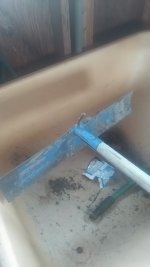
Used chairs once before had to put them in place during pours between laser screed and the screed board it was pulling they were made of plastic specifically for there intended use, I believe they were used with #8 bar. Those are heavy. Normally used this hook in picture to pull rerod or mesh on "come along" when puddling, that hook is not for hanging it up but prob is used to lol. Usually tied all rerod to hold it in place during pours overlapped mesh and tied it also. Used fiber a few times almost 20 years ago steel trowel finished but was a struggle and those darn fibers would would usually stick out. Last flatwork I did was my own, poured a 5" thick (in case i ever got a bulldozer lol) 24x36' slab for my pole barn up north. Used wire mesh pulled it as I placed the concrete also spent the few extra dollars per yard more and paid for fiber. Very limited fibers exposed with a smooth steel trowel finish probably over jitterbugged it idk? Going on ten years no cracks anywhere in that slab, and I didn't cut in control joints.
 

Attachments

  • KIMG2388.JPG
    KIMG2388.JPG
    829.2 KB · Views: 130
Last edited:
/ Concrete Chairs #23  
Anybody ever bring up stress risers in slabs? Seems like those chairs will leave some significant ones in the tension side of the (brittle) slab. Maybe positioning rebar at the right height makes up for them...
 
/ Concrete Chairs #24  
I’ve watched a lot of concrete poured and tested quite a bit of it. In the engineering world there is often a trend of not using rebar for flat work. Parking lots and highways are often that way and if done properly will last. Often on highways the pavement will not have continuous reinforcement but have joints that are reinforced. The concrete is also very thick.

For residential I agree, mesh almost always ends up at the bottom and rebar needs to be on chairs.
 
/ Concrete Chairs #25  
One of the things I look for in pictures and videos of people pouring concrete, is if they use concrete chairs to hold the rebar off of the ground. If they are not using them, that's a huge red flag to me. The same thing if they are using wire instead of rebar, that's a red flag.

While watching some YouTube videos last night, it hit me that 100% of every commercial concrete job that I saw, they use Concrete Chairs.

The only people that do not use them are residential jobs, or home owners doing their own pours. To me, biggest lie told in concrete work is that they will pull it up while spreading it, and it will remain in the middle of the slab after being walked on.
What's your opinion on post tension slabs?
I did not even know it was a thing until a few years ago.
My initial thought was it seems like a good technique with the only downside being the equipment required for the tensioning.
 
/ Concrete Chairs #26  
One of the things I look for in pictures and videos of people pouring concrete, is if they use concrete chairs to hold the rebar off of the ground. If they are not using them, that's a huge red flag to me. The same thing if they are using wire instead of rebar, that's a red flag.

While watching some YouTube videos last night, it hit me that 100% of every commercial concrete job that I saw, they use Concrete Chairs.

The only people that do not use them are residential jobs, or home owners doing their own pours. To me, biggest lie told in concrete work is that they will pull it up while spreading it, and it will remain in the middle of the slab after being walked on.
I know this is a sore point for you, as you've mentioned it several times over the years.

So when we did our garage addition a few years ago...

I USED CHAIRS FOR THE REBAR!


Thanks! :)
 
/ Concrete Chairs #28  
What are the pros thoughts on using "cattle panels" for walks etc?
/edit - suspended on chairs or small pieces of concrete for blocks
 
Last edited:
/ Concrete Chairs #29  
Anybody ever bring up stress risers in slabs? Seems like those chairs will leave some significant ones in the tension side of the (brittle) slab. Maybe positioning rebar at the right height makes up for them...
Having rebar 1/3 up in the slab maximizes its ability to provide tension strength (bending strength) to the concrete to keep it from fracturing. Since it is cast into the concrete, stress riser effects are minimal, if and only if, there is enough concrete below it. That's why "lifting rebar" is so detrimental to the strength of the slab. From a practical perspective, nobody is going to get the rebar at the right height consistently by lifting it, resulting in a weaker slab. My motto is use enough chairs that walking around on the rebar doesn't bend the rebar, or shift it.
I’ve watched a lot of concrete poured and tested quite a bit of it. In the engineering world there is often a trend of not using rebar for flat work. Parking lots and highways are often that way and if done properly will last. Often on highways the pavement will not have continuous reinforcement but have joints that are reinforced. The concrete is also very thick.

For residential I agree, mesh almost always ends up at the bottom and rebar needs to be on chairs.
I agree. I would point out that the compaction and subsurface grading for roads and highways often are several feet thick, and commonly below the frost level to enable straight pours. However, as far as I am aware adding rebar to the concrete on that prepared subsurface will yield a stronger concrete road. I think for many places it is a cost / benefit call; they could spend 10x more on the road and it would last 20x longer, or they could do it cheaply and come back in two/five/ten years and redo it, depending on actual usage, and degradation.

I've watched many folks on the county and state highway commissions wrestle with that one over the years...

All the best,

Peter
 
/ Concrete Chairs #30  
With our MRI center all the rebar is fiberglass rods and plastic chairs... Nothing ferris/magnetic allowed anywhere near MRI

We had an electrician and repeatedly caution him and he said got it...

The ladder he carried was flung out of his grip sticking to the MRI...

One other contractor also didn't comprehend... I heard shouting and his steel tool boots pulled his feet right it from under...

I believe the fiber regards are stronger with better longevity than ferris bars...
 
/ Concrete Chairs #31  
Having rebar 1/3 up in the slab maximizes its ability to provide tension strength (bending strength) to the concrete to keep it from fracturing. Since it is cast into the concrete, stress riser effects are minimal, if and only if, there is enough concrete below it. That's why "lifting rebar" is so detrimental to the strength of the slab. From a practical perspective, nobody is going to get the rebar at the right height consistently by lifting it, resulting in a weaker slab. My motto is use enough chairs that walking around on the rebar doesn't bend the rebar, or shift it.

I get it that rebar, below the neutral plane, adds more tensile strength- my point was that the chairs themselves leave defects (stress risers) in the tension side of the neutral plane.
 
/ Concrete Chairs #32  
Just saw this thread, and didn't read everything yet; but I will comment; per FDOT standard plans; sidewalks, curbs, and driveways get no rebar or wire. Now, of coarse inlet tops, structures, gravity walls, get an incredible amount of rebar. Try smashing up RCP pipe, and the amount of heavy gauge wire (#2) is incredible.

For residential, and some commercial, I've seen Adobe (I think it's called), or a solid concrete brick, with tie wire embedded in it, and tie the rebar to that to keep it spaced off the ground.

IMO, property installed wire beats fiber hands down; BUT fiber beats wire in the dirt...
 
/ Concrete Chairs #33  
With concrete, as all things, Subgrade is where it starts. I see people pour driveways on sloppy mud, no compaction over pipes, and then adding 30 gals of water; and then wondering why it cracks.
 
/ Concrete Chairs #34  
What's your opinion on post tension slabs?
I did not even know it was a thing until a few years ago.
My initial thought was it seems like a good technique with the only downside being the equipment required for the tensioning.
I've been on many large post tension slabs when doing apartments. Very little rebar needed, other than for the thickened edge; no wire. It works great, but requires engineering.

When I was maybe 20, I was an assistant superintendent (think salary laborer, and doing the crap the superintendent didn't want to); and standing on the slab, watching them tension. Super came up, and said, "do you like your nuts; if so, don't stand over the cable when the tension it". I never had one break, but its bad when they do...
 
/ Concrete Chairs #35  
I’ve watched a lot of concrete poured and tested quite a bit of it. In the engineering world there is often a trend of not using rebar for flat work. Parking lots and highways are often that way and if done properly will last. Often on highways the pavement will not have continuous reinforcement but have joints that are reinforced. The concrete is also very thick.

For residential I agree, mesh almost always ends up at the bottom and rebar needs to be on chairs.
Rebar cost money. unless slab is heavily loaded, it is cheaper to gain strength with increase thickness of concrete.

fyi concrete will slowly gain strength for years if kept moist
 
/ Concrete Chairs #36  
I get it that rebar, below the neutral plane, adds more tensile strength- my point was that the chairs themselves leave defects (stress risers) in the tension side of the neutral plane.
I see your point; do you have any data/personal experience for chairs causing a stress riser issue? I don't do lots of concrete work, so I'm no expert, but I haven't happen to me or on a job that I was working on. (So, that doesn't mean much, but I haven't ever read that it is an issue, either.) If it is an issue, I wonder whether concrete chairs or plastic ones are better? IIRC: the concrete institute recommends both, but doesn't call out a stress riser issue, but my memory isn't that great...

All the best,

Peter
 
/ Concrete Chairs #37  
One thing, and don't take this as disrespect, but Many concrete guys either don't understand or don't care how concrete actually works; beyond "turns gray, gets hard, and cracks". Water cement ratio is a real thing. I'm not a concrete guy, and have Personally only poured and finished a 120 yards or so; a lot of guys seem to think you can't work with a 5" slump; that's BS, you don't need to pour an 8" slump on flat work, and dumping the water to it is bad. Now drilled shafts, ect, yes, you need a 8-9" slump, but that mud is designed to reach strength at those slumps.

As an interesting note; we had a mast arm drilled shaft get hit in a wreck, and the 7/8" bolts got damaged. Anyways, the engineered repair design involved chipping it down 60", adding a 9000 psi epox, and recasting the top 60" with new bars and bolts. Got some of that epoxy on a boot, and it pulled the boot apart trying to pick it off...
 
/ Concrete Chairs #38  
So, on chairs or rebar tied to Solid brick, 100% should be used. On WWF on chairs; my only concern has always been how much of a void is left in a 4" house slab at that chair? Never seen any evidence of it; But maybe a nagging doubt.
 
/ Concrete Chairs #39  
Ultra runner fiberglass is significantly more expensive than steel. Only used in highly corrosive environments or where magnetic properties are issue
 
/ Concrete Chairs #40  
One thing, and don't take this as disrespect, but Many concrete guys either don't understand or don't care how concrete actually works; beyond "turns gray, gets hard, and cracks". Water cement ratio is a real thing. I'm not a concrete guy, and have Personally only poured and finished a 120 yards or so; a lot of guys seem to think you can't work with a 5" slump; that's BS, you don't need to pour an 8" slump on flat work, and dumping the water to it is bad. Now drilled shafts, ect, yes, you need a 8-9" slump, but that mud is designed to reach strength at those slumps.

As an interesting note; we had a mast arm drilled shaft get hit in a wreck, and the 7/8" bolts got damaged. Anyways, the engineered repair design involved chipping it down 60", adding a 9000 psi epox, and recasting the top 60" with new bars and bolts. Got some of that epoxy on a boot, and it pulled the boot apart trying to pick it off...
For structural concrete high slump is obtained by use of plasticizers.water cement ratio is kept low. Structurally all concrete below pour of rebar is ignored except to provide protection to rebar.
 

Marketplace Items

2005 John Deere 7320 (A60462)
2005 John Deere...
excavator trenching bucket- one bucket per lot (A61306)
excavator...
FUTURE 60" PALLET FORK (A60432)
FUTURE 60" PALLET...
Hyster H155 XL Forklift (A59213)
Hyster H155 XL...
2018 VOLVO VNL TANDEM AXLE DAY CAB (A59905)
2018 VOLVO VNL...
ANTHONY CARTS 94LFW-24 OXY/ACCELYNE TANK CART (A60432)
ANTHONY CARTS...
 
Top