Concrete control joint question

   / Concrete control joint question #1  

Macinnis

Gold Member
Joined
Jan 9, 2018
Messages
257
Location
St. Louis/Old Mines MIssouri
Tractor
LS MT3 57 Cab
I have a 60x60 pole barn. All posts are 10,000 psi concrete posts set in ground with concrete and dirt material filling the 4 foot hole they are set in. At 6 inches out of ground they are 3 2x6s screwed together up to the truss.

20x45 of this space will be used as an apartment with the remaining 15 foot as a covered patio. The remaining 40x60 will be used as a barn/shop.

I had the concrete guy out today to do a final inspection of the grade (now that I finished my plumbing) and control joints came up.

Concrete guy said: the living quarters does not need to do any control joints, we will just do one on your long wall (separating the shop from the apartment).

They will be doing cut in control joints in the 40x60 shop side. He was trying to be nice I believe and not show any control joints in the living quarters side.

My question is...should I have him put in some control joints in the living quarters side, regardless of what they look like?

The barn sits on level ground with 4-6 inches of compacted gravel with fines and then 4-6 inches of clean gravel on top of that.

Edit: the slab will be 4-5 inches thick, over 4000 psi, with rebar on chairs and fibers.

All opinions appreciated.

Thanks,
Bill
 
   / Concrete control joint question #2  
Control joints are meant to put cracks where you want them. All concrete cracks, especially in large monolithic slabs.

I can't picture your setup, but if you get a good concrete job done on a well compacted base it probably doesn't matter if you put control joints in or not if you plan on a floating floor material like engineered wood or carpet. Terrazzo might be different. I have no control joints in my house and ceramic tile and haven't had any problems in 23 years.

I've seen new builds where lazy contractors don't compact properly, then the concrete guys pour wet runny cement because its less work for them, and a year later your beautiful concrete floor with control joints has cracks in it and is heaving in unexpected places.

On an aside I strongly recommend putting insulation under your concrete floors. Recently I've seen contractors using closed cell spray foam on the floors upto and onto the walls. Makes a great vapour barrier and thermal break.
 
   / Concrete control joint question #3  
Control joints are meant to put cracks where you want them. All concrete cracks, especially in large monolithic slabs.

I can't picture your setup, but if you get a good concrete job done on a well compacted base it probably doesn't matter if you put control joints in or not if you plan on a floating floor material like engineered wood or carpet. Terrazzo might be different. I have no control joints in my house and ceramic tile and haven't had any problems in 23 years.

I've seen new builds where lazy contractors don't compact properly, then the concrete guys pour wet runny cement because its less work for them, and a year later your beautiful concrete floor with control joints has cracks in it and is heaving in unexpected places.

On an aside I strongly recommend putting insulation under your concrete floors. Recently I've seen contractors using closed cell spray foam on the floors upto and onto the walls. Makes a great vapour barrier and thermal break.

A major reason for concrete floor cracking, is the amount of water added to the concrete mix.
The stiffer the mix (less water) generally the less cracking (shrinkage).
Concrete contractors do not like using a stiff mix, because it is more difficult for them to work with.
Tough chit!
I would put lots of control joints in the entire floor.
The joints are best being cut in, and done so within 18 hours of the pour.
 
Last edited:
   / Concrete control joint question #4  
When my garage floor was poured they used a different technique for the control joints. I didn't see them do it, the contractor pointed it out and explained it to me afterwards. They poured the floor. Then at some point before the concrete completely set they used a trowel? to slice a control joint in the floor. The they lightly troweled over that joint to hide it. As it dried I had very fine cracks at those points. It served me well.

Doug in SW IA
 
   / Concrete control joint question #5  
Remember that saying, there are two types of concrete: concrete that has already cracked, and concrete that will crack. I'd put standard control joints the same everywhere. There are methods that might look a little neater in the living area if appearance matters.
 
   / Concrete control joint question
  • Thread Starter
#6  
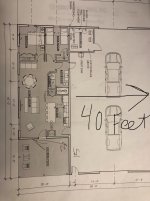
Here is the layout...he was going to do one control joint along the wall separating the apt from the shop, then all throughout the shop.

8BEF3196-AA52-4A7A-8A5A-35040E81AFB3.jpeg
 
   / Concrete control joint question #7  
Isn't there a reccomend s/f for control joints in a large (60x60) slab? I know there is, just don't want to mis state it.
The last slab I had done I had them use a vinyl "T" shaped strip that got pushed- tapped into the concrete after the first trowling. Then the too of the "T" got pulled off leaving a very minor visual, and it worked as a control joint and is near invisible.
 
   / Concrete control joint question #8  
Here is the layout...he was going to do one control joint along the wall separating the apt from the shop, then all throughout the shop.

View attachment 686325

I would also cut a cross joint every 20ft.
I guarantee you will have cracks with the layout you show.
 
   / Concrete control joint question
  • Thread Starter
#9  
Thanks. I will look into the vinyl thing or have him just cut them into the living space side as well. Thanks all!
 
   / Concrete control joint question #10  
That's what I would do. Saw cut the expansion joints on your living area. You can always put down tile, vinyl or wood flooring to hide the expansion joints.
 
   / Concrete control joint question #11  
A major reason for concrete floor cracking, is the amount of water added to the concrete mix.
The stiffer the mix (less water) generally the less cracking (shrinkage).
Concrete contractors do not like using a stiff mix, because it is more difficult for them to work with.
Tough chit!
I would put lots of control joints in the entire floor.
The joints are best being cut in, and done so within 18 hours of the pour.

My neighbor got a great deal on a concrete driveway UNTIL, the contractor kept putting off sawing in the joints. Before they were in, one section of the beautiful driveway had cracked.
 
   / Concrete control joint question #12  
My neighbor got a great deal on a concrete driveway UNTIL, the contractor kept putting off sawing in the joints. Before they were in, one section of the beautiful driveway had cracked.

In my opinion, you cannot have too many control cuts.
The alternative is many ugly random cracks, and unfortunately, that is frequently the norm!
Control cuts must be done within 18 hours of the pour, and much sooner than 18 is desirable!
 
Last edited:
   / Concrete control joint question #13  
My neighbor got a great deal on a concrete driveway UNTIL, the contractor kept putting off sawing in the joints. Before they were in, one section of the beautiful driveway had cracked.

In my opinion, you cannot have too many control cuts.
The alternative is many ugly random cracks, and unfortunately, that is frequently the norm!
Control cuts must be done within 18 hours of the pour, and much sooner than 18 is desirable!

That contractor was frequently talking about the great work he did. Not by me.
 
   / Concrete control joint question #14  
Im finishing a large finished basement with poured concrete floor.
Its “ L “ shaped. Has one diagonal saw joint in it and perimeter 1” foam.
Not one crack anywhere in the basement. Poured 18 years ago.
 
   / Concrete control joint question #15  
Im finishing a large finished basement with poured concrete floor.
Its “ L “ shaped. Has one diagonal saw joint in it and perimeter 1” foam.
Not one crack anywhere in the basement. Poured 18 years ago.

The perimeter foam is the salvation, but I have rarely seen that method used.
 
   / Concrete control joint question #16  
The joints are best being cut in, and done so within 18 hours of the pour.

Why is it better to cut them in and not just use a Control Joint Groover? Seems like that would be less time, labor and cost.
 
   / Concrete control joint question #17  
As mentioned above, the more water added to the concrete when it's poured, the bigger the cracks are going to be. The reason some people like to cut the concrete after it has set up is to make the cracks look nicer, or be less noticeable. The concrete will crack where it's weakest, so the cut line becomes the place that it cracks first.

All concrete cracks is a true statement. But not all cracks are very big, or problematic. The bad cracks will happen in the first week. Rebar has to be in the middle area of the concrete so it will hold all the cracks together and keep them tight. Rebar on the ground does not accomplish this, or anything else. Welded wire is actually better then rebar at holding concrete together when it cracks, but it's 100% impossible to keep it off of the ground when pouring concrete. The exception is if it's tied on top of the rebar and it's held up in the air so well that guys can walk on it while spreading the concrete.

Concrete expands and contracts from warming up and cooling off. Concrete that is exposed to these temperature changes needs an expansion joint. This is not the same as cutting concrete. An expansion joint is most commonly done with a 1/4 board. Most driveways will have this. Each section is separate from the other, but usually connected with rebar. The wood creates a gap between the concrete and it absorbs the movement of the concrete. Sidewalks do this too, but usually it's over longer distances. Bridges and Highways also have expansion joints, which is why they make so much noise driving over them.

When a house is built, the slab for the heated and cooled areas are poured at one time. It is very rare for this area to have anything cut into it unless a person just wants to create a design in the concrete that looks similar to tile grout lines. I think it's a dust collector, but to each their own. After the living area is poured, the porches are poured. This could happen the next day, or a month later, or longer. The reason it's done separately is that the indoors area will not expand and contract. It generally remains at a constant temperature, which means it stays the same size. The outside areas will expand and contract. Garages are done both ways, with varying results. Some never have issues, others do. I believe it really depends on how hot or cold it gets inside the garage. If insulated, they are usually fine when poured at the same time as the house.

For your situation, the living area will be kept at a constant temperature and there is no need to cut anything into it. It might be worthwhile to cut the line where the shop and the live area wall will be, especially if you are installing tile. If you are installing carpet, then it really wont matter since you'll never know if it cracks or not. Same thing with any floating flooring. My workshop is 24x30 without any cuts to it, and you have to get on your hands and knees to find a crack in it. I haven't seen one since it was poured 15 years ago, but I'm sure that they are there.
 
   / Concrete control joint question #18  
With the above mention of foam...

I can easily understand the benefits of a thermo break below the concrete...

But logically, a layer of foam added above the gravel seems to be less solid than the typical gravel foundation used directly under the concrete?

Is there risk of foam not being as stable as gravel and potential for less support under the slab?
 
   / Concrete control joint question #19  
With the above mention of foam...

I can easily understand the benefits of a thermo break below the concrete...

But logically, a layer of foam added above the gravel seems to be less solid than the typical gravel foundation used directly under the concrete?

Is there risk of foam not being as stable as gravel and potential for less support under the slab?

I've seen this discussed before and the outcome was basically no. There are higher density foams available, iirc like 25psi, that would be the blue or pink exp (?). The end rationale was that the psi of the compacted dirt that's under the stone is less or equal to the foams capacity. Notice my "iirc & (?)..... but the discussion included engineers and concrete experts and I wish I could provide a link or reference, but this was the outcome. :thumbsup:
 
   / Concrete control joint question #20  
Screenshot_20210214-115808_DuckDuckGo.jpg
This is that vinyl tap in control joint I described above. Tap it in flush after the first trowling, then pull off the black top
just before your subsequent trowelings.
 

Tractor & Equipment Auctions

iDrive TDS-2010H ProJack M2 Electric Trailer Dolly (A59228)
iDrive TDS-2010H...
2023 CAN-AM DEFENDER RTV (A59823)
2023 CAN-AM...
John Deere 6300 (A60462)
John Deere 6300...
2016 Dodge Grand Caravan SE Plus (A59231)
2016 Dodge Grand...
New Holland WorkMaster 37 (A53317)
New Holland...
DEUTZ MARATHON 60KW GENERATOR (A55745)
DEUTZ MARATHON...
 
Top