Concrete footing question

/ Concrete footing question #1  

joeu235

Platinum Member
Joined
Mar 27, 2014
Messages
724
Location
Little River, TX
Tractor
John Deere 4020 / 6403 / 317 Ford 5600
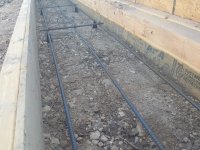
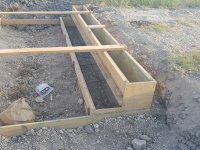
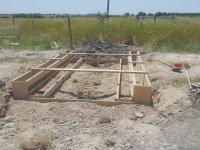
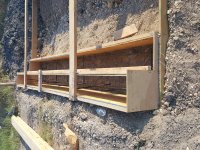
Hello people more knowledge about concrete than me. Is this steel enough for my cattle guard footings? Do i need something going vertical on the outer section?
20180728_192816.jpg 20180728_192825.jpg
 
/ Concrete footing question #2  
looks like you have 3 - #4 or 5 bars which for a footing should be fine.......rebars require min of 3" of concrete cover to prevent corrosion and should be placed in the bottom third of the depth of the footing....purpose is so footing can span any voids or soft spots in ground as steel adds tensile strength to the concrete.....concrete is great in compression but lousy in tension......not sure exactly what your final project is but some vertical bars in the cheek wall section will only help.....again 3" min concrete cover......in this case they would be placed in the center of the width of the wall.......if you are adding any masonry on top of the concrete wall then extend them past the finished surface so they can be used to tie in the block if not then stop them 3" below the finished surface....don't forget to send pics of the finished product.....:)....Jack
 
/ Concrete footing question
  • Thread Starter
#3  
Thank you for the feedback! For the vertical pieces in the cheek, i understand they need to be in the middle. Can i tie them off to each side of the forms with wire so the stay put? Or can i just push them in right after the pour?
 
/ Concrete footing question
  • Thread Starter
#4  
The footings are to support a cattle guard
20180728_131005.jpg 20180624_170439.jpg
 
/ Concrete footing question #5  
After seeing the cattle guard, which looks nice, I would put longitudinal rebar in 6 inch on center. Transverse rebar 12 in on center. Semi trucks will be a heavy load
 
/ Concrete footing question #6  
How thick is your foundation
Can you get stirrups or loop rebar.
Rebar shown in plans helps with bending loads but not shear. Stirrups work for shear
 
/ Concrete footing question #7  
I would put vertical bars in the "cheek" section on 12" centers then also tie in horizontal bars to the verticals with at least 2 horizontal runs, one along the bottom about 3" from the bottom and one at the top also 3'' from the top of concrete.. It would have been much better to have bent L shapes on the lower section to extend upward in the cheek section so all would have been one piece. Since this didn't happen, You could now bend the vertical bars into an L shape and overlap the lower rebar by at least 20 diameters of the bar used (I.E. 1" bar would overlap 20"), tie all the rebar sections together securely with tie wire. It is common practice to keep the rebar spacing at least 2" from the surface by using concrete blocks of similar strength to the concrete being poured that are tied to the rebar and rest against the form. By using concrete blocks, there is no exposed wire to rust and cause issues with the concrete spalling years later.

You can make these yourself with Portland cement/sand mix by pouring it into a 2" deep form, then scarring the pour into a 2" checkerboard with a trowel after the concrete has set but not hardened. You can also insert a tie wire loop into each block if you want so it can be tied securely to the rebar. Also I think many concrete suppliers sell these blocks.
 
/ Concrete footing question #8  
Looks good so far. I would pound some rebar into the ground in the middle of the form to give something to attach the horizontal rebar to. Make it look kind of like a pipe fence.

The most important part of this is that when you mix your concrete, that it doesn't have too much water in it. Excess water is the number one reason for cracking. Rebar is to hold the concrete together after it cracks, and add strength to the concrete by giving it something to grab to. Water increases volume that leaves a void when it evaporates. That void causes cracking. Do a slump test to see if you are too wet. It doesn't have to be accurate, but your concrete should retain some shape from the test and not just spread out without retaining any of the shape of the bucket or cup or whatever you decide to use for the test.
 
/ Concrete footing question #9  
Hard to determine adequacy w/o knowing the traffic loading. If you need HS 20 load capacity (highway standard for semi trucks, concrete trucks, etc) highly recommend you get a civil or structural engineer to take a look at your design. Traffic like crossing that also creates some dynamic loads. Tearing it out and replacing it will be exponential $s of an engineer fee if it fails in use. 5000 PSI concrete with air entrainment and water reducing additive would be indicated at 3" slump.

Ron
 
/ Concrete footing question
  • Thread Starter
#10  
Thanks for the input Ron and everyone else. The cattle guard is on a private gravel road that will see concrete trucks maybe three times in my lifetime. Otherwise its daily vehicles and me pulling a 20K trailer once a month.

I found design criteria for cattle guard footings on the National Forestry Service website. They have a worksheet that takes into account soil type and expected loads and a formula that spits out the required square footage of the footing.

Hopefully 5 years from now my wife isn't hauling ***** to the nail salon too often and breaks the footing. :) But I'm willing to take risk that I will have to tear it out and replace.
 
/ Concrete footing question #13  
Looks good so far. I would pound some rebar into the ground in the middle of the form to give something to attach the horizontal rebar to. Make it look kind of like a pipe fence.

I don’t think you want to do this. Rebar is supposed to be totally encased in concrete and never touch the soil. From what I understand is if it does touch soil it starts to rust and that rust travels along the rebar into the slab and will ultimately cause it to crack apart. Granted this isn’t going to happen overnight but OP did a heck of a nice job on the cattle guard I would hate to see the footing fail years down the road.

I am no concrete expert but I have poured a lot both doing it myself and hiring it done. When it comes to rebar on small projects I go overboard because it costs so little. Putting excess rebar in a 100’x100’ shop floor would get costly quick not to mention the time to do it but on something like this the cost and time of adding more rebar is insignificant in the grand scheme of things. You never know what the future holds. Is this cattle guard the only way in or is there an alternate route if need be? If you would have asked me ten years ago if I would own a semi, dump truck, bull dozer, etc I would have thought you were crazy but I do now. The guard itself is built to withstand anything might as will go super stout on footings too.
 
/ Concrete footing question #14  
Rebar is pounded into the ground all the time and nothing happens. I've done it in California for footings, where the inspectors are known for being really brutal, and it's always passed. While I understand what you are saying in theory, has anybody ever found rebar in the ground that has rusted out? Corner posts for a survey are all half in rebar in my area, and from what I understand, they never rust away. Only time I see rust on rebar is when it's sitting out in the rain.
 
/ Concrete footing question
  • Thread Starter
#15  
It would have to rain again for the rebar to rust. I'm more worried about the whole thing falling into a crack in the ground.
 
Last edited:
/ Concrete footing question #16  
I've had rebar rust...when it sits a puddle of salt that melts off the cars.
 
/ Concrete footing question
  • Thread Starter
#17  
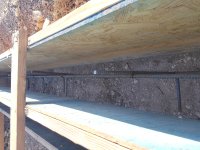
I put in 5 verticals with a bent end and pounded two more in the ground to support the structure. I'll dig it all up in 40 years to see if the two rusted out. :)

Also swapped the plastic rebar holders with dobies. So much better.
20180803_182923.jpg 20180803_182938.jpg

I'll be pouring Tuesday. Thanks for all the help everyone
 
/ Concrete footing question #18  
If it was mine, I would have put another piece of rebar towards the top and I would trim off the ends that are closer then two inches from the sides of the forms. I also think that you will be fine just like it is if you get your mix right and go light on the water.
 
/ Concrete footing question
  • Thread Starter
#19  
I can add another horizontal rebar easily.

Do i need to rent vibrator?
 

Marketplace Items

2014 GMC Sierra SLT 4x4 Crew Cab Pickup Truck (A59230)
2014 GMC Sierra...
2019 MERTZ MANUFACTURING MANIFOLD TRAILER (A58216)
2019 MERTZ...
2022 Ram 2500 4x4 Crew Cab Service Truck (A55852)
2022 Ram 2500 4x4...
2024 CATERPILLAR D5 LGP HIGH TRACK CRAWLER DOZER (A60429)
2024 CATERPILLAR...
2009 Hyundai Sonata Sedan (A59231)
2009 Hyundai...
2017 John Deere 6120E (A53317)
2017 John Deere...
 
Top