You are using an out of date browser. It may not display this or other websites correctly.
You should upgrade or use an alternative browser.
You should upgrade or use an alternative browser.
Concrete prices per yard
- Thread starter gregfender
- Start date
- Views: 56998
More options
Who Replied?
/ Concrete prices per yard
#21

RxRatedZ71
Gold Member
We "placed" 3 trucks worth of concrete 3500PSI and #2 rebar on 2' center in my 1200sqft polebarn in October. For the labor and 'crete my contractor on charged $3250. I bought the rebar and sand and he provided the labor.
My neighbor two tracts over who is building a 3500 sqft concrete house (you know with the styro-foam forms that fit like puzzle-pieces) said he's used all 4 concrete companies around here. The best price was $92/yard and the highest was $130/yard. This guy is always great for "free information, no extra charge", but I learned that you have to take what he says with a grain of salt. Because it was after the lesson on concrete that he told me he was building a "concrete safe-room" inside a concrete house. WTF????
My neighbor two tracts over who is building a 3500 sqft concrete house (you know with the styro-foam forms that fit like puzzle-pieces) said he's used all 4 concrete companies around here. The best price was $92/yard and the highest was $130/yard. This guy is always great for "free information, no extra charge", but I learned that you have to take what he says with a grain of salt. Because it was after the lesson on concrete that he told me he was building a "concrete safe-room" inside a concrete house. WTF????

terry.dinerman
Gold Member
- Joined
- Oct 11, 2009
- Messages
- 431
- Tractor
- 1990 - JD 870
..... a "concrete safe-room" inside a concrete house......
This fellow sounds like he and I may have worked some of the same neighborhoods...
Nothing like a few feet of concrete between you and "rainy" weather...
T

Attachments


Dargo
Super Member
- Joined
- Mar 6, 2004
- Messages
- 6,011
- Location
- S. IN
- Tractor
- Jinma, Foton, TYM, Belarus, Yanmar, Branson, Montana, Mahindra and maybe some green and orange too.
We "placed" 3 trucks worth of concrete 3500PSI and #2 rebar on 2' center in my 1200sqft polebarn in October. For the labor and 'crete my contractor on charged $3250. I bought the rebar and sand and he provided the labor.
My neighbor two tracts over who is building a 3500 sqft concrete house (you know with the styro-foam forms that fit like puzzle-pieces) said he's used all 4 concrete companies around here. The best price was $92/yard and the highest was $130/yard. This guy is always great for "free information, no extra charge", but I learned that you have to take what he says with a grain of salt. Because it was after the lesson on concrete that he told me he was building a "concrete safe-room" inside a concrete house. WTF????
That's surprising. After buying over 2500 yards of concrete at my place, the only problem I had was with the floor in my first barn where I only used the 'standard' 3500 psi concrete. Having that much concrete work done has taught me two things; 3500 psi concrete is a joke as is the laughable 'kitty hair' fiberglass crap they try to talk you into using. I've seen absolutely zero difference in the "fiberglass reinforced" concrete and standard concrete except what it cost me.
The only concrete I have that is 4" is sidewalks. I used that crappy rolled wire in it. Everything else is at least 6" or more and had 1/4" wire mesh in it along with rebar and is 4500 psi. Over the years I can tell a big difference. If a concrete contractor told me that I only need 4" of 3500 psi with fiberglass in any area where I'd park anything heavier than a lawn mower, I'd fire him on the spot. It's not fun doing concrete work the 2nd time! Doing it right with a good mix and at least 1/4" wire matting costs just over $100 per sq. yd. when buying over 500 yards at a time.

jonyyuma
Elite Member
- Joined
- Sep 14, 2010
- Messages
- 2,922
- Location
- 35 miles North of Memphis,TN
- Tractor
- kubota L3000dt, ford 8n1952
Is it just me, Do you like to see a vibrator thrown in to set the mix and remove bubbles from said product.? They always did it on columns and big forms?I now almost consider it necessary...

Diamondpilot
Super Star Member
- Joined
- Jan 18, 2007
- Messages
- 16,331
- Location
- Daleville, IN
- Tractor
- Jinma 254/284 Ford 861 Powermaster at work
I had 4000 psi with mesh in it poured last spring and it was about $115 per yard.
Chris
Chris
Dargo
Super Member
- Joined
- Mar 6, 2004
- Messages
- 6,011
- Location
- S. IN
- Tractor
- Jinma, Foton, TYM, Belarus, Yanmar, Branson, Montana, Mahindra and maybe some green and orange too.
Is it just me, Do you like to see a vibrator thrown in to set the mix and remove bubbles from said product.? They always did it on columns and big forms?I now almost consider it necessary...
I bought my own from Horrible Freight and vibrated away on all pours along with the crew. I can't tell you for sure if it helped, but it sure makes your hands numb for a day or so.
greasemonkeyok
Veteran Member
Not an expert, but a novice using a vibrator is not a good idea. Vibrate it too much and it will not set up properly. I know enough to say wear good rubber gloves and boots. Cement eats leather.
tulenutn2o
Platinum Member
I was told awhile back...the proper terminology is "lay" concrete...not pour. When, talking to pro's..they seem to have more respect..or look at you like you know what your doing if you use the proper terminology:confused3:
I ain't out to impress nobody. Pour(gary says place) is something you do to concrete, lay is...........well you get the picture. Seriously, I find that if you don't act like you know it all, you gets more help. Just my observation. I poured pad for my boiler last october and paid $100 yard, but they gave me little over 1 1/4. And truck driver helped me screed it. Side note: We lay pipe around here, I guess place would work-pour definitely not, bury pipe would work........ argument goes on and on.. I guess I'll stick with sayin and doin as I please.....LOL!!!
Dargo
Super Member
- Joined
- Mar 6, 2004
- Messages
- 6,011
- Location
- S. IN
- Tractor
- Jinma, Foton, TYM, Belarus, Yanmar, Branson, Montana, Mahindra and maybe some green and orange too.
Vibrate it too much and it will not set up properly.
Sorry, please explain with references. I'm no "professional", but I've been involved with over 2500 yards at my home as I mentioned as well as 10,000 yards or so working other jobs. In 20 years I've never heard anyone say what you said. I'd like to see clear and quantitative information to back up what you claim.
terry.dinerman
Gold Member
- Joined
- Oct 11, 2009
- Messages
- 431
- Tractor
- 1990 - JD 870
Sorry, please explain with references. I'm no "professional", but I've been involved with over 2500 yards at my home as I mentioned as well as 10,000 yards or so working other jobs. In 20 years I've never heard anyone say what you said. I'd like to see clear and quantitative information to back up what you claim.
To achieve its design strength, a concrete mix must be uniform throughout.
Excessive vibration will cause the mix to segregate, with the large aggregate sinking to the bottom of the pour...
In a slab, this leads to starving the bottom zone of Portland cement, weakening the area of the slab that is placed under tension when the slab is loaded, as well as creating an aggregate starved and thereby em-brittled zone at the top, which is placed in compression under load...
The use of the correct amount of water to Portland cement normally results in a stiff mix that helps prevent the segregation from taking place but necessitates the use of a vibrator to get it to flow around the reinforcing and into all corners of the form.
Most folks add way too much water to their concrete to get it to flow down the chute for the mix to get even close to the design specs....it is just too danged much work...
The wetter mix is even more susceptible to aggregate segregation during vibration due to this issue and it can even segregate from the force of GRAVITY if dropped from too high above the form...
With all the thousands of yard I've poured, even if a test cylinder was not scheduled to be drawn on any particular job, I was never allowed to accept a truckload that would not pass a slump test.
I turned away a lot of concrete....and the only person I ever saw madder than a concrete truck driver with a refused load was my wife when she found out I broke the tip off her K-Bar opening a paint can...
Anyway - Like all crafts, skills and trades....concrete work ain't just hard labor....there is a lot of "art" in a good end product...
T
OP

gregfender
Gold Member
Dang, I'm beginning to think I should keep the dirt floor. :confused2:
terry.dinerman
Gold Member
- Joined
- Oct 11, 2009
- Messages
- 431
- Tractor
- 1990 - JD 870
Dang, I'm beginning to think I should keep the dirt floor. :confused2:
It isn't that hard....do all the prep work yourself and hire out the placing and finishing...you will be working with materials in small easy to handle bites....let the contractor do the labor-intensive part.
You will save a lot of money and get the product you deserve.
T
Dargo
Super Member
- Joined
- Mar 6, 2004
- Messages
- 6,011
- Location
- S. IN
- Tractor
- Jinma, Foton, TYM, Belarus, Yanmar, Branson, Montana, Mahindra and maybe some green and orange too.
To achieve its design strength, a concrete mix must be uniform throughout.
Excessive vibration will cause the mix to segregate, with the large aggregate sinking to the bottom of the pour...
Only if the mix is improper in the beginning. With some of the pole barn companies who 'also' do concrete floors that they call "self leveling", your aggregate will be on the bottom and you'll have spalling sooner than later. A proper mix, with even calcium added if necessary, will begin to cure fast enough to prevent all the aggregate from dropping to the bottom with a simple buzz rod being run through the mix. Even though two concrete beams were ordered early to be used in my bridge, we still allowed no more than .10 percent chloride in the mix for the entire pour. The entire bridge was poured to AASHTO T 22 specs. Needless to say, it would be unnecessary and cost prohibitive to pour the entire drive and barn floor to those specs.
The company who did my pours do interstate highway bridges and radio tower bases. They are pretty well up on their profession; I'm not, but I did learn a lot from them. My "big" job (for me) was just something to keep them busy during a down time.
With all the chatter on "pouring" "placing" concrete. I have this to say about that! 1st you can't pour "concrete" -- "concrete" indicates the cement has set up. You can place concrete but a forklift is recommended. I don't think we have a communication problem, I believe we have a problem processing the communication. Oh, by the way the last concrete I purchase was $110 a yard.
greasemonkeyok
Veteran Member
Cement is the dry powder that is mixed with sand, gravel, water, and other stuff to make concrete mix, which then sets up to become concrete. Just like model airplanes, cement is what holds the parts together.
To achieve maximum strength, as is required for things like pre-stressed wall panels or bridge girders, all of the variables, including vibration and temperature, have to be monitored. In the pre-stress plant where I worked 40 years ago, they did not let the rookies run the vibrators for that very reason and they tested every girder. That is the only "clear and quantitative" data that I can give you.
Next time you drive under the 635 interchange in Dallas, or similar structures, consider the expertise involved in constructing the bridge pillars and girders. For a barn slab or other non-critical structure, vibrating till the water comes to the top may not pose much of a risk of physical harm. Then again, it may be prone to premature cracking and sloughing.
To achieve maximum strength, as is required for things like pre-stressed wall panels or bridge girders, all of the variables, including vibration and temperature, have to be monitored. In the pre-stress plant where I worked 40 years ago, they did not let the rookies run the vibrators for that very reason and they tested every girder. That is the only "clear and quantitative" data that I can give you.
Next time you drive under the 635 interchange in Dallas, or similar structures, consider the expertise involved in constructing the bridge pillars and girders. For a barn slab or other non-critical structure, vibrating till the water comes to the top may not pose much of a risk of physical harm. Then again, it may be prone to premature cracking and sloughing.
terry.dinerman
Gold Member
- Joined
- Oct 11, 2009
- Messages
- 431
- Tractor
- 1990 - JD 870
Only if the mix is improper in the beginning. With some of the pole barn companies who 'also' do concrete floors that they call "self leveling", your aggregate will be on the bottom and you'll have spalling sooner than later. A proper mix, with even calcium added if necessary, will begin to cure fast enough to prevent all the aggregate from dropping to the bottom with a simple buzz rod being run through the mix. Even though two concrete beams were ordered early to be used in my bridge, we still allowed no more than .10 percent chloride in the mix for the entire pour. The entire bridge was poured to AASHTO T 22 specs. Needless to say, it would be unnecessary and cost prohibitive to pour the entire drive and barn floor to those specs.
The company who did my pours do interstate highway bridges and radio tower bases. They are pretty well up on their profession; I'm not, but I did learn a lot from them. My "big" job (for me) was just something to keep them busy during a down time.
I am in total agreement with you!
The right mix for the job at hand, used by experienced craftsmen will nearly always give the long lasting product the owner hoped for by specifying concrete in the first place.
I noticed you understand the codes, found a highly experienced company to pour and finish your job....got them to work your "big job" into their schedule....and got a top notch result.
Did you do your own formwork? I am still pretty confident that Bro Gregfender can save some money by doing some of the work himself...
T
Dargo
Super Member
- Joined
- Mar 6, 2004
- Messages
- 6,011
- Location
- S. IN
- Tractor
- Jinma, Foton, TYM, Belarus, Yanmar, Branson, Montana, Mahindra and maybe some green and orange too.
Did you do your own formwork? I am still pretty confident that Bro Gregfender can save some money by doing some of the work himself...
T
Nope, I didn't do the form work. There are many compound curves and I didn't have the forms; especially for a 6" (not 5 1/2" most get when they say 6") driveway. I did clear all the sod and use my laser level to level and compress the #11's used for a base though.
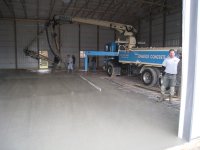
I even cheated and used them to get to the far reaches inside my barn to save my back since it was a 10" pour. The wire matting was sat on little plastic "top hats". The picture was just before the pumper backed out of the barn and the 1/4" mesh was put on the top hats and the rebar added.They came back and cut the joints in rather than form them in during the pour. I honestly have no idea which is better. After a couple of years of running heavy equipment in and out I do have a few 'cracks' in the floor, but they have not moved apart nor vertically; just small cracks you can see when the floor is wet. My other barn was done the same way about 15 years ago and once the few 'cracks' appeared, nothing more happened, so I'm happy.
Attachments
terry.dinerman
Gold Member
- Joined
- Oct 11, 2009
- Messages
- 431
- Tractor
- 1990 - JD 870
Nope, I didn't do the form work. There are many compound curves and I didn't have the forms; especially for a 6" (not 5 1/2" most get when they say 6") driveway. I did clear all the sod and use my laser level to level and compress the #11's used for a base though.
They came back and cut the joints in rather than form them in during the pour. I honestly have no idea which is better. After a couple of years of running heavy equipment in and out I do have a few 'cracks' in the floor, but they have not moved apart nor vertically; just small cracks you can see when the floor is wet. My other barn was done the same way about 15 years ago and once the few 'cracks' appeared, nothing more happened, so I'm happy.
WOW - I am having a bad case of Barn Envy! What a super space....
Cracks - If you are parking heavy equipment on this slab and all you have are a few hairline cracks, you have done well. The fiber additives are supposed to control that issue, but I am not convinced that they do very much good.
Cutting control joints - Cutting them after the pour or using pour-in-place joints are two ways of getting to the same end...creating a stress riser to allow expansion forces to crack the slab in a place of your choosing, or building in enough movement room to prevent cracks from forming....in either case there is an "interruption" in the surface of the slab.
I have used the pour-in-place control joints as surfaces to screed...one advantage of that technique...
T

Degolyerent
Gold Member
- Joined
- Nov 21, 2010
- Messages
- 439
Y'all are a bored bunch to sit and argue over terms used to do concrete work, the only "greenhorn" term I really pick up on is "frame" but then maybe that's how y'all say it up north!!!
But down here we say form it up rather than frame. Like someone else said form it up if you want but leave it to experienced people to pour/place/finish!!!!the only thing to do is make sure you have a caring and competent contractor that will do a good job all the way through the entire scope of the work.
There is plenty of sources that you can find on the Internet to educate yourself about the process.
I have worked with concrete for 40 + years and it varies in different regions of the country due to mostly weather related issues
Proper techniques in every stage is important even down to spacing on control joints and sealing!
I believe the thread was about price------ which is about $75 contractors price and $100 private individual price in my area of Florida
John
But down here we say form it up rather than frame. Like someone else said form it up if you want but leave it to experienced people to pour/place/finish!!!!the only thing to do is make sure you have a caring and competent contractor that will do a good job all the way through the entire scope of the work.
There is plenty of sources that you can find on the Internet to educate yourself about the process.
I have worked with concrete for 40 + years and it varies in different regions of the country due to mostly weather related issues
Proper techniques in every stage is important even down to spacing on control joints and sealing!
I believe the thread was about price------ which is about $75 contractors price and $100 private individual price in my area of Florida
John



