Condensation

/ Condensation #1  

Barnbuilder

Gold Member
Joined
Apr 21, 2009
Messages
397
Location
Waxhaw, NC
Tractor
Bobcat A300, Kubota F3680, JCB 212S sold
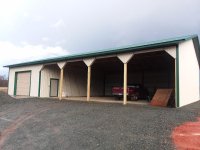
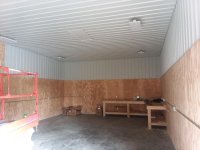
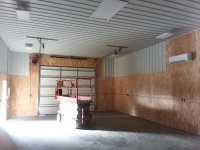
I know there have been several threads on condensation with metal skinned buildings. I just framed a 42x72. Should start roof end of week. The first 24' is an insulated shop. R19 walls and R30 in ceiling. Metal ceiling, bottom 8' of walls will be 3/4" plywood and upper 5' metal. Exterior of walls I'm going to use Tyvek under the metal. What should I do about the roof? Use Tyvek or roll insulation to prevent water dripping on the ceiling insulation? Should I use a plastic vapor barrier on the interior? The shop will have a mini split.

I have 2 more lines up after this one. I want to provide a good building for my customers so they don't have future issues.
 
/ Condensation #2  
Metal building is no different than any other building except for thin skin rather than several layers. If you have r30 in ceiling, you should be fine. It wont rain nor drip. Zero or very thin -sub par insulation is the issue. I had building in MS, high humidity all the time. R5 or 6 on walls and ceiling. Never dripped. But inversions would condense on my tools... but not from ceiling
 
/ Condensation #3  
The condensation occurs at the dew point and that occurs when their is a temp difference between the inside and outside. Ventilation is the key to control it. You will want ventilation between the insulation and the metal. For sure in the roof and preferably in the walls too.
Shingles “require” felt or better to be warranted- so yes add something below the shingles.

Adding Tyvek isn’t a cure. It does have some permeability but simply adding it without an overall plan to vent wont solve everything.

Your roof will need something below the shingles. Felt or a different roofing paper is best- unless you need ice and water.

Check out a website called buildingscience.com They have a lot of good info.
 
/ Condensation
  • Thread Starter
#4  
I'll have perforated soffit in the eaves so it will have airflow to the ridge.
 
/ Condensation #5  
I'm finishing a metal skinned building now. Ridge and soffit vents. Roof metal screwed to purlins with no barrier added. R45 blown ceiling insulation. Builder says it'll work great. Results dependent on geographic area.
 
/ Condensation #6  
The condensation occurs at the dew point and that occurs when their is a temp difference between the inside and outside. Ventilation is the key to control it. You will want ventilation between the insulation and the metal. For sure in the roof and preferably in the walls too.
Shingles 途equire felt or better to be warranted- so yes add something below the shingles.

Adding Tyvek isn稚 a cure. It does have some permeability but simply adding it without an overall plan to vent wont solve everything.

Your roof will need something below the shingles. Felt or a different roofing paper is best- unless you need ice and water.

Check out a website called buildingscience.com They have a lot of good info.

I accept that your statements are rooted in a science that I don't understand, and I'm not being contrary; I'm being inquisitive. I want to understand why my experiences do not match what you've described.

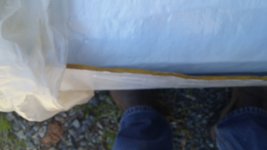
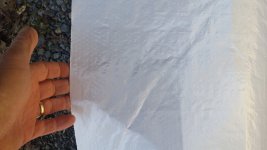
I had my shop built by a contractor and I just told him generally how big I wanted it and what I planned to do with it (build insulated interior walls and air condition the whole thing) I let him specify the particulars of the building. I did not do much research about condensation or anything. He asked if I wanted him to put the typical insulation that metal buildings have, and I said yes. I figured double insulation down the road couldn't hurt (see attachments). What he built is a 30x30 metal building with 11ft eaves and 14ft peak. It has roll insulation between the purlins and the exterior metal R-panel. There are no ridge vents or soffitts. The R-panels are sealed with foam strips at the ends.

It has zero ventilation that I know of and it does not condense. I live south of Houston TX, about 15mi from the ocean, and it stays ultra humid here year round; usually hot, sticky, and gross. I have never once seen a single droplet of condensation inside. My tools and metal stuff have been sitting inside for 3 years with no climate control (have not yet gotten around to installing A/C) and I have no surface rust. How is it that in the absence of ventilation I have no condensation problem?

Is the answer maybe that the condensation is occurring between the R-panel and the roll insulation? If so, is that bad? Does that water have anywhere to go? Or does it just sit there slowly rusting my panels away from the inside where I can't see it? Also, will building my insulated interior walls mitigate or exaggerate any unseen condensation problems?

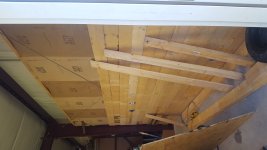
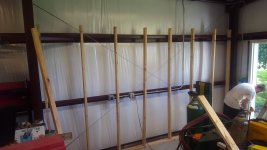
P.s. the attached pictures show the first interior wall which I built last week. For 3 years it has been insulated solely by the roll insulation between purlin and R-panel.
 

Attachments

  • 20181004_144635.jpg
    20181004_144635.jpg
    1 MB · Views: 335
  • 20181003_155129.jpg
    20181003_155129.jpg
    1.2 MB · Views: 333
/ Condensation #7  
I accept that your statements are rooted in a science that I don't understand, and I'm not being contrary; I'm being inquisitive. I want to understand why my experiences do not match what you've described.

I had my shop built by a contractor and I just told him generally how big I wanted it and what I planned to do with it (build insulated interior walls and air condition the whole thing) I let him specify the particulars of the building. I did not do much research about condensation or anything. He asked if I wanted him to put the typical insulation that metal buildings have, and I said yes. I figured double insulation down the road couldn't hurt (see attachments). What he built is a 30x30 metal building with 11ft eaves and 14ft peak. It has roll insulation between the purlins and the exterior metal R-panel. There are no ridge vents or soffitts. The R-panels are sealed with foam strips at the ends.

It has zero ventilation that I know of and it does not condense. I live south of Houston TX, about 15mi from the ocean, and it stays ultra humid here year round; usually hot, sticky, and gross. I have never once seen a single droplet of condensation inside. My tools and metal stuff have been sitting inside for 3 years with no climate control (have not yet gotten around to installing A/C) and I have no surface rust. How is it that in the absence of ventilation I have no condensation problem?

Is the answer maybe that the condensation is occurring between the R-panel and the roll insulation? If so, is that bad? Does that water have anywhere to go? Or does it just sit there slowly rusting my panels away from the inside where I can't see it? Also, will building my insulated interior walls mitigate or exaggerate any unseen condensation problems?

P.s. the attached pictures show the first interior wall which I built last week. For 3 years it has been insulated solely by the roll insulation between purlin and R-panel.
You have a situation where the inside of your shop never falls below the dewpoint. Probably stays warm in there all night with extremely small air exchange. Surfaces stay warmer than the air than night air. You are lucky in this. Hard to know the safety margin you have, but Id guess youd go beyond it if you had a cold day - cooling everything in the shop - followed by a warm rainy night.
 
/ Condensation #8  
The “flaw” in your comments is to say “it does not condense”. The science still occurs at your building but your hunch is correct. It’s occurring “inside” the wall. When air with two different temperatures meet you have a good chance of condensation. Your location- darn near a desert - is about as close to perfect as you can get to avoid the condensation. Btw- this is happening in your house too......also inside the wall.

Tyvek and other house wraps are designed to breathe. They aren’t simply plastic. The difficulty with metal siding is it doesn’t breathe like wood or something else with a lot of seams etc that can breathe.

The folks with good venting and climate are in the best shape. Their are some other tricks but those are the big ones.

I’m writing from a phone so I will stop.....but I think you get the idea.
 
/ Condensation #9  
...and R30 in ceiling. Metal ceiling, bottom 8' of walls will be 3/4" plywood and upper 5' metal. Exterior of walls I'm going to use Tyvek under the metal. What should I do about the roof? Use Tyvek or roll insulation to prevent water dripping on the ceiling insulation? Should I use a plastic vapor barrier on the interior? The shop will have a mini split.

Keep it simple. Condensation will form under the metal if there is air touching it. The only way to stop this is to have 100% closed cell foam sprayed under the metal.

In every other method, you have to deal with the moisture that forms under the metal. Air flow is the most common, simplest and proven method to get rid of the moisture. Heat rises, so air coming in from the eaves, rises along the metal to the peak, and then hopeful exits the building. Ridge vents are the best at air flow, and removing moisture. In extreme cases, the amount of moisture can be more then the air can deal with, which results in the rain effect inside of a building. To deal with this, some buildings have "insulation" under the metal in the form of bubble wrap, or some other type of plastic. This works fine as long as the plastic remains in tact. The moisture that falls off of the metal, lands on the plastic, and then flows down the plastic to the outside at the eaves. If there are gutters in place, you never see it. If there are no gutters, you will see it.

In your case, with the R30 attic insulation, you have to deal with the air between the insulation and the metal roof. Most of the time, what small amount of water that drops from the ceiling, will land on the insulation, and then evaporate when the attic gets hot during the day, and nobody will ever know about it. This requires good air flow in the attic, from eaves and ridge vents. For barns and even my house, this is how I've done it.

On porches, where I don't have really good air flow under the metal because of how the roof ties into the house, I put down OSB decking and 30 pound felt paper. The moisture that forms in the ribs of the R panels goes onto the felt paper and then later evaporates as the metal heats up during the course of the day. In worse case scenarios, the moisture runs down the tar paper and out through the eaves. This adds to the cost of the structure because you have to have something to attach the OSB decking to every 24 inches. So more purlins, or more rafters or trusses.

With insulation on the ceiling, if you add something under the metal roof, you have to be able to vent the air trapped between those two barriers. You need to be sure to leave the ridge open for the air to flow up and out of the roof.
 
/ Condensation
  • Thread Starter
#10  
Only issue I have with spray foam, if you have to remove the building material or have a leak you're screwed. It will have a ridge vent. I think I might add the roll insulation in shop roof area to be safe. I stopped using the bubble wrap because it deteriorates over time. I was at a customers last weekend where I used the both sides foil bubble wrap and it was still good after 14 years. The other barns where I used the plastic/bubble/foil has all deteriorated.

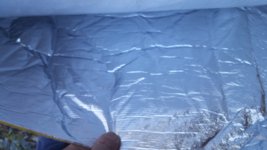
Picture of the current insulation I'm using. Its 6'x125' and its $350/roll.

20160130_121538.jpg

20160130_121445.jpg

20160130_121513.jpg


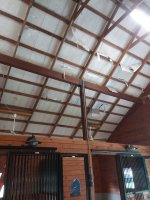
This is one where we just put in a ceiling to cover the old.

oldinsulation.jpg

newinsulation.jpg

ceiling2.jpg
 
/ Condensation #11  
My current shop is all metal, vaulted ceiling, wrapped with 6" insulation. It's nine years old and has never "sweat" inside. Temp has never been below 60F degrees inside. I can't attest to what's happening between the R panels and the insulation.
 
/ Condensation #12  
My current shop is all metal, vaulted ceiling, wrapped with 6" insulation. It's nine years old and has never "sweat" inside. Temp has never been below 60F degrees inside. I can't attest to what's happening between the R panels and the insulation.

Do you add supplemental heat or is that by natural convection? I just had my building insulated and am curious what the temp and humidity might do this winter.
 
/ Condensation #13  
Do you add supplemental heat or is that by natural convection? I just had my building insulated and am curious what the temp and humidity might do this winter.

Definitely supplemental heat. I use a wood stove when I'm around to stock it. Have a Propane forced air furnace set on 65F.

Side track. If your concrete is insulated you might get by with minimal supplement. If not, plan on adding heat source. Another thing is the desired temp. I hear of guys talking about working in their shop when it's 50F or less. Not me. I'm spoiled. I expect to work in my shop in a T-shirt. Gotta be above 60F.
 
/ Condensation #14  
Definitely supplemental heat. I use a wood stove when I'm around to stock it. Have a Propane forced air furnace set on 65F.

Side track. If your concrete is insulated you might get by with minimal supplement. If not, plan on adding heat source. Another thing is the desired temp. I hear of guys talking about working in their shop when it's 50F or less. Not me. I'm spoiled. I expect to work in my shop in a T-shirt. Gotta be above 60F.

Maybe that's why my building doesn't sweat. It sits atop a hellacious slab. I imagine that slab is still holding onto heat that it picked up in 2016.
 
/ Condensation #15  
Maybe that's why my building doesn't sweat. It sits atop a hellacious slab. I imagine that slab is still holding onto heat that it picked up in 2016.

Elaborate.
 
/ Condensation #17  
Hey Barnbuilder,

I'm in Davidson County just south of Winston-Salem. I just had a 24x60 metal building raised on a concrete slab and am turning it into a home for me and the wife. To deal with condensation, I had 1in closed cell spray foam applied to the entire interior. Cost was a little over $6K. Four reasons for the closed cell. 1. Water tight. 2. Air tight. Most contractors today will tell you that air leakage is actually more of a problem with heating costs than lack of insulation. 3. Absolutely no condensation issues. 4. My attic space will have R-7 above my ceiling plane.

Also, wooden studs should not make direct contact with the metal building structure studs. It's called Thermal Bridging and is a significant gateway for heat loss. We inset our walls an inch to put styrofoam between the wood and metal.

Another point. Our building has a blue skirt above the white side walls. When the sun shines on it, the white is about 100degreesF while the blue was about 130degreesF. With the spray foam on it, you can't tell the temperature different from the inside anymore.

Now, the biggest problem with closed cell is the house doesn't breath at all and I'll have to install an Energy Recovery Ventilator (ERV) for fresh air exchange. Panasonic and Venmar (Broan) appealed to me most. Plus, with an ERV, you don't have to install fart fans in the bathrooms as you'll use the ERV for that purpose.

So, with the complication of the ERV, is it worth it? I think so. I'll still do all the full pink batt in the walls and blown cellulose for the ceiling plane to code. There are other considerations in this design and you're welcome to contact me or come see the building for more details. Sheetrock and insulation are not up yet so the walls are still exposed.

Hope that helps,
JFoy
 
/ Condensation #19  
For those interested in RNeumann's great link, check out the referenced material at the end of the article and find those books written by the great building science minds of all time. Also and perhaps more important for a great reference that is easily understandable by the interested layperson, get "Buildings Don't Lie" by Henry Gifford and available on Amazon.

These reference materials offer a clear understanding of the topic of this thread. The misunderstandings expressed here and elsewhere are unfortunate and depending on climate and conditions can lead to problems of durability and indoor air quality. Build wisely by friends.
 
/ Condensation
  • Thread Starter
#20  
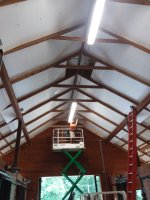
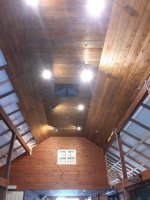
Well Finally finished this except for electrical. Now they want to add on 16'.

Kelchnerfinished.jpg

Kelchnerin1.jpg

Kelchnerin2.jpg
 
 
Top