Construction Fasteners

/ Construction Fasteners #1  

jlgurr

Veteran Member
Joined
Oct 21, 2013
Messages
1,187
Location
Bostic, NC
Tractor
Massey Ferguson GC1705, John Deere STX46
Being an amateur but continually seeking professional quality, wondering if there is anyone who can share advice on construction nails, screws, etc.? Brands, coatings, value, etc.

Several brands are available at our local big box store but are they really what I should be buying? The project I am working on now is a double carport with a 4/12 pitch shingled roof setting on 6 x 6 treated posts. Trusses are due end of next week so it's time to start buying the fasteners I'll need.

Thanks,
Jeff
 
/ Construction Fasteners #2  
Check your local codes.

If thinking about screws there will only be a few that qualify for load bearing construction. You may have to ask for them at your local store.
 
/ Construction Fasteners #3  
Nails and screws are designed to hold lumber in place, not support it or any load of any kind. If you need to support a load, you need to use either brackets with appropriate fasteners, bolts or lag screws. In some areas, bolts and lag screws are no longer code and not allowed to support a load.

For any outdoor structure that does not have protective walls, I don't use nails. With movement and exposure to the elements, wood moves, shrinks and swells. Nails fail quickly under those conditions. Star drive 3 inch exterior deck screws are what I use most of the time.
 
/ Construction Fasteners #4  
Ditto on star drives (trying to rid my shop of anything other than)...Mike Holmes did a show years ago on nails vs. screws and commented that codes were not up do date (might have been the only show where he admitted to "violating"...he used screws). Not cheap but the coated deck screws with the star drive heads should handle anything you can throw at them I think. For most stuff that will not be exposed to the elements I find the "interior use only" star-drive screws to work just fine.
 
/ Construction Fasteners #5  
Ilike the stainless torx screws. I know they cost more but they are strong, look amazing, won't rust and you can tell people it's all stainless.

The big box stores do have contractor grade stuff. That's why they are so big. Most contractors used them.

I probably shop at lowes/Hd 2015 times a month. And I still use ace/true value/do it best when I can.
 
/ Construction Fasteners #6  
Good advice from those folks....:thumbsup:
 
/ Construction Fasteners #7  
Being an amateur but continually seeking professional quality, wondering if there is anyone who can share advice on construction nails, screws, etc.? Brands, coatings, value, etc.

Several brands are available at our local big box store but are they really what I should be buying? The project I am working on now is a double carport with a 4/12 pitch shingled roof setting on 6 x 6 treated posts. Trusses are due end of next week so it's time to start buying the fasteners I'll need.

Thanks,
Jeff

What method are you going to use to put it together?
Is it going to be a crew of 10 guys or are you by yourself? Only 1 or 2 people it seems like an air nailer would help, but a good one can cost over $200 and you need a compressor. If you have a crew of 10 friends all with their own $200 battery powered impact driver screws may be the way to go.

Also is it going to be inspected and if so what does the inspector want? If code calls for nils you could be screwed if you use nails :)

I tend to do everything by myself so I rely on power tools to assist my construction. I've bought a pneumatic framing nailer for building a shed and plan on using ring shanked nails for most of it. The when I put my deck together it was up for about 23 years with ring shank nails and only about 4 nails had come loose over the entire time.

To me ring shank nails offer the holding power of a screw (or better) with the ease of a nailer driving them. So with the nailer I can rapidly put in a bunch of nails without my wrist giving out.
 
/ Construction Fasteners #8  
Coated framing grade nails are more than adequate for fasteners, maybe the best option. Nails hold in shear and fasteners like joist hangers need that shear resistance.

I've always used coated 8 and 16 penny nails for all my framing. Everything is still standing.
 
/ Construction Fasteners #9  
A "carport" is a very basic structure. The area of concerns would be the post's to beam connection along with the post to ground connection or situation, esp. if there will not be any walls to "rack" the structure. The trusses & sheathing/roofing "fastening" is basic (local codes) usually "toenail" trusses to the beam or header and possibly metal "hurricane" clips or ties. Sheathing will allways benefit from using "ring shank" nails (usually 8d). If you get into diagonal bracing the posts, GRK makes some really nice screw fasteners with big heads and are available in long legnths.
 
/ Construction Fasteners #10  
The job to be done drives the choice of Fastners.
Over the years, my favorite vendors are GEK for star head screws, Simpson Strong Tie for ledger lock screws (replaces common lag screws), and Maise 'storm guard' double galvanized nails.
In the pneumatic arena, Paslode framing and trim gun nails along with Senco flooring and underlayment staples. Of course, no work truck is complete with out buckets full of #8 and #16 sinkers.
B John
 
/ Construction Fasteners #11  
Checkout the Simpson Strong Tie web site. They have many specialty brackets and connectors with specific applications and nails or screws and associated engineering and installation data. They are carried by many hardware and lumber suppliers. They will have what you need for your roof structure attachment.
 
/ Construction Fasteners #12  
I've never found galvanized ring shank nails 3 inches long or longer. When I use nails to frame, I use nails that are 3 1/4 inch long. In every case that I've come across ring shank nails used on decks, they either use a dozen nails where I would have used 2 screws, or they where too short to get a secure hold on what they where nailed to. The only thing I think ring shank nails are really good for is attaching sheething to the side of the framing of a house, or the decking to the roof of a house.
 
/ Construction Fasteners #13  
Do you have plans for the carport, or are you making it up as you go along?

If you have plans, either purchased as a package, or individually drawn, read them carefully. If you read every word on every page, and look at the definition of the symbols that are used to describe various walls, you will usually find that professionally drawn plans specify the type of fasteners to be used.

When I built a house several years ago, I was rather forcefully educated in this area.

I used to think ring-shank nails were good. My architect told me that for fastening any type of sheet material (plywood, OSB, T-111 siding, etc.) to framing or any dimensional lumber they are rarely approved. Sure, they resist pull out, but they leave a hole in the sheeting that is larger than the nail shank, and over time the forces on the sheeting "work" this hole and enlarge it, which is the failure mechanism seen. But, they sure are popular because they are hard to pull out. He specified "screw nails" which have spiral flutes on them, sort of like polygonal rifling in a gun, which have much better test results. Couldn't find them at any of the big box stores, but a professional construction supply house had them and knew exactly why they were preferred.

Another place to be very careful is the size of nails. For example, many people think all 16d nails are about equal. This is just plain wrong. A 16d common nail is 3-1/2" long and 0.162" in diameter. A 16d sinker is only 3-1/4" long and 0.148" in diameter. A 16d short is 3-1/4" long, but only 0.131 in diameter. The big box stores sell the 16d shorts for nail guns, where they are sometimes called 16d cooler nails. The 16d short nails have less than 70% of the shear strength of the 16 d common nails, but are by far the most popular for nail guns. It is very difficult to find 16d common nails collated for a nail gun, and most nail guns do not like to shoot them.

As stated above, the Simpson catalog is a wealth of information. But, you have to read it. All the fine print. If you put a 16d short into a connector when the catalog calls for a 16d common, Simpson is not going to stand behind it when that fails. You also have to read the part where it says you need to drill pilot holes so you don't split the lumber. I don't think I have ever seen a carpenter do that, and I have had guys walk off my jobs when I told them they had to drill pilot holes. I even show them the catalog where it says they are required, and they just say they have never done it and aren't going to do it now. Then I tell them about my policy which is that they either follow instructions or don't get paid.

Screws are convenient and fast, but frequently do not have a lot of shear strength. Look up the specs and see for yourself. The way to overcome this is to use more of them, but few contractors like this approach since they are expensive and more screws=more time.

The big box stores are very convenient, but you need to read the plans very carefully and be certain you buy the right materials, or get the right materials from a better supply house. And, the clerk in the aisle is not an engineer, and doesn't really know what he is talking about. If he was he would have a much better job.
 
/ Construction Fasteners #14  
I've never found galvanized ring shank nails 3 inches long or longer. When I use nails to frame, I use nails that are 3 1/4 inch long. In every case that I've come across ring shank nails used on decks, they either use a dozen nails where I would have used 2 screws, or they where too short to get a secure hold on what they where nailed to. The only thing I think ring shank nails are really good for is attaching sheething to the side of the framing of a house, or the decking to the roof of a house.
The "pole barn" guys seem to find those long ring-shank nails (guessing 4-5" and probably 20p...requires a BFH...that's how they attach the purlins).
 
/ Construction Fasteners
  • Thread Starter
#15  
Do you have plans for the carport, or are you making it up as you go along?

If you have plans, either purchased as a package, or individually drawn, read them carefully. If you read every word on every page, and look at the definition of the symbols that are used to describe various walls, you will usually find that professionally drawn plans specify the type of fasteners to be used.

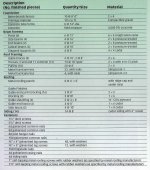
I have plans but have modified them slightly to accommodate the size we are building. The biggest change was the trusses being on 24" centers rather than 16" but the trusses we ordered are designed to be at 24" too. The material list states which type of fasteners to purchase but obviously don't suggest or promote any type of brand. The list also does not give me as much knowledge as all you folks have. The other significant change to the plans is we are using a shingled roof rather than the metal roof.

01 Material List.jpg

Appreciate your suggestion to read and read again. I love to read and yep, I read the entire plans multiple times before even considering building this project.

Helped Dad build a small barn many moons ago and lots of "light" remodeling projects over the years but this is for sure the largest project I've done on my own. So far it's going very well, maybe a bit slower than I'd like but there are many other things in this household to juggle, including four year old twins and a more than full time job five days a week. Once the trusses arrive I may opt for some vacation time to get a good long run of work done on it rather than piece meal week after week.

The greatest part of the project so far is how much I have learned by reading what you all are sharing from your knowledge and experiences. If I wasn't able to do the work or wasn't enjoying it I definitely know who could be hired to do it. And in the future when I need contractors I can watch what they do and make sure it's right.

The plans also include photos of construction steps for less than professionals, like me.
 
/ Construction Fasteners #16  
/ Construction Fasteners #17  
I like the fastenmaster products. timberlok, headlok, ledgerlok, etc.

Just bought 250 4-1/2" of them doing a new deck out front AND out back. They are quite pricey though, but alot faster than the alternative.

Menards stocks alot of the fastenmaster stuff.
 
/ Construction Fasteners #18  
For treated lumber you need stainless or coated fasteners, typically gold.

I don't know code, but I use gold coated self tapping lags for most things.

I have lived in homes 100 years old, built by nails.
 
/ Construction Fasteners #19  
The choice between screws and nails has to do with design method.

Screws are superior to nails in resisting pull-out. Nails are superior in shear strength. You need to determine what is critical in the joint you are using.

A post, with a beam notched into the side.....screws are fine. There is no shear load, only need to hold the post to the beam...pull-out resistance.

If no notch and beam is just attached to the side....nails would be a better choice. Depending on nail size....they can each hold a given weight in shear. Use enough to exceed expected loads. Lags or thru-bolts for something heavily loaded would be even better.

Its all in how you design. You can design something can can use all nails and have no issues. Likewise you can design something that uses all screws if you want. Or use a combination.
 
/ Construction Fasteners #20  
I would suggest that any joint that will have a bending moment will see shear in some of the fasteners.
 
 
Top