Crimp tool

/ Crimp tool #4  
Use the crimp area of the standard crimp tool. They are usually located between the pivot point and the stripping area on standard wire stripper/crimping tools.
 
/ Crimp tool #5  
The garbage stamped metal junk that comes with a lot of kits are probably the 2nd biggest reason that crimp connections have the completely undeserved bad reputation that they do.

This is what the junk looks like, do NOT get these!

View attachment 502232


That Klein tool above is an excellent choice.

This ratcheting kind is also excellent.

View attachment 502234
 
/ Crimp tool #6  
For the splice terminals you want a wide flat pliers. The Klein pliers are a must- but not for those connectors. I have good luck with channel locks, lineman or slip jaw/combination. You insert the wires, squeeze the metal splicing bar into both wires and then close the cover.

Edit- OP- which connectors are you referencing? Half of the connectors would use the Klein crimp style pliers and the other half need a flat and wide jaw.
 
/ Crimp tool #7  
/ Crimp tool #10  
Hmmmm... I hate crimping because I never have confidence in them. I typically crimp the crap out of them and then cover it all up with heatshrink tubing.

I might have to invest in one of these 'Crimp specific pliers' and see whether my confidence improves.
 
/ Crimp tool #11  
That is what I use exclusively now. It creates a double crimp that is necessary for boats up here.


That is one I use for the last 10 years or so, the simple Kline is what I used for the 30 years before that. I still use the heat-shrink with adhesive in it for every crimp I make, both to water proof the connection and to hide them.
 
/ Crimp tool #12  
Hmmmm... I hate crimping because I never have confidence in them. I typically crimp the crap out of them and then cover it all up with heatshrink tubing.

I might have to invest in one of these 'Crimp specific pliers' and see whether my confidence improves.

My thoughts exactly.
 
/ Crimp tool #13  
I use the non-insulated terminal crimps even on the insulated type terminals. The post drives in on the split side and holds the wire tight. The cup on the opposite side leaves a nice production looking crimp. I've also used a lot of non-insulated terminals and covered with heat shrink. Also a nice production look.
 
/ Crimp tool #14  
For smaller wires, I just use vice grips, solder it, then cover it with heat shrink
 
/ Crimp tool #15  
This thread has opened up a whole new world for me... and my electrical connections.

I... had... no... idea.

Funny how little things can brighten your day.
 
/ Crimp tool #16  
I use the non-insulated terminal crimps even on the insulated type terminals. The post drives in on the split side and holds the wire tight. The cup on the opposite side leaves a nice production looking crimp. I've also used a lot of non-insulated terminals and covered with heat shrink. Also a nice production look.

And I've seen exactly the opposite orientation recommended. :(

????

Bruce
 
/ Crimp tool
  • Thread Starter
#17  
For the splice terminals you want a wide flat pliers. The Klein pliers are a must- but not for those connectors. I have good luck with channel locks, lineman or slip jaw/combination. You insert the wires, squeeze the metal splicing bar into both wires and then close the cover.

Edit- OP- which connectors are you referencing? Half of the connectors would use the Klein crimp style pliers and the other half need a flat and wide jaw.

The male spade joints.
The reason I brought this up in the first place is because from the nylon translucent insulator terminals as opposed to the standard opaque plastic crimp terminals, I've seen pictures of WITH the wires in them, the nylon ones look like they have no crimp (not talking about translucent heat shrink). Was wondering if I'm missing something with these or if they're supposed to be crimped at all or have a special tool just for plastic terminals.
 
/ Crimp tool #20  
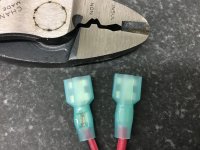
I just crimped some with the same Channellock crimper I linked above and took a picture for you.

On the left using the non-insulated part, you can see the crimp well but as often happens when doing this the plastic is pierced.
On the right I used the insulated part, and yes the crimp is hard to see but it's solid and cannot be pulled off with reasonable force.

IMG_5261.JPG
 
 
Top