Culvert Question

/ Culvert Question
  • Thread Starter
#21  
haha - this plan needs to be blessed off by the wife. Not sure that she would want to cross the creek in a Prius - ;)
 
/ Culvert Question #22  
If the fill material is placed properly, by that I mean, loose, no large chunks of dirt, packed as it's put around the culvert, nothing is needed over the top for strength. I've saw culverts that the top was exposed. It can't crush it if the sides can't bulge out. So, with concrete, I'd not put more than a foot of fill over it. Also keep in mind, your elevated roadbed is going to settle. But the top of the culvert is not going to settle. So even under the best conditions you are going to end up with a bump over the culvert for awhile until everything else gets settled in. Using a 3' culvert with 1' fill over top you have 4' of fill. It'll settle 20% or more over the next few years. So if you want to end up with a 1' over the culvert you are going to need to start with 18" or so, and then work your way back down to your goal.

Haul dirt in until it looks stupid high. Then come back the next day and haul dirt again until it looks insane. Then come back the 3rd day an add dirt as you think it needs. Overkill is your friend. Then when everything "settles" in you'll have the driveway you dream of. If you don't do that, you'll have the driveway your wife will haunt you with. ;)
 
/ Culvert Question #23  
I generally prefer plastic myself, due to the ease of handling and installing. However, you do need proper cover over the top, which is generally 12" minimum. The only guys I still see using concrete around here are old-fashioned and afraid of plastic, or they know that it's for a construction entrance and there won't be any fill over the top, so concrete will do a better job supporting a load (and note I am referring to 12-16" pipes; once the concrete gets larger diameter, it also needs good fill to carry a load because of the thickness to diameter ratio).

If you can get another section of concrete to make the pipe wider, it's viable, though then you need machinery to handle and install it, so there is some tradeoff. I wouldn't even bother if you can only get that 16'. That is not nearly enough to work with.
 
/ Culvert Question #24  
By the way, your state or county probably has a regulation as to what size pipe is needed there. It would have to accommodate the standard stream flow and a "historical" storm event (usually in the 10- or 100-year range, but everyone has different specs). Be sure to check and see what they require before making any decisions!
 
/ Culvert Question
  • Thread Starter
#25  
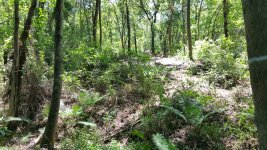
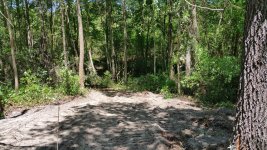
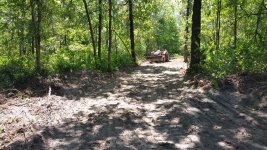
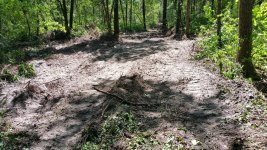
Well - they started to clear the road today. They made it down to the creek crossing. The road clearing is approx 12' wide, which actually seems a little narrow when driving my truck through. It looks like I was able to secure a third concrete culvert - so we will start with 24' width at the creek ]before fill. The angle of the road is a little steeper than I had originally thought it would be. I downloaded an app in my phone that is supposed to tell you the slope of a road. Mine varies from 12 - 20%, but increases to about 30% when you get to the creek crossing. My guess is that this will be slightly decreased once we bring some fill in for the culvert. The soil is pretty loose sand, which makes me think I'm going to get stuck pretty easily in the truck.

Once the area is reasonably level can I just start putting down crusher run? Would you recommend that we start with geo-tex fabric first?

Here are some pictures - please provide any feedback that might help us out....

Justin

Road 4.jpegRoad 3.jpegRoad 2.jpegRoad 1.jpeg
 

Attachments

  • Road 1.jpeg
    Road 1.jpeg
    597.1 KB · Views: 185
/ Culvert Question #26  
Wow, that does look sandy! One section of my property is like that (great for the septic field) and is basically held together with pine straw and a thin layer of topsoil. Have to be very careful disturbing it, otherwise it will wash out easily.

If the area is all sandy like that, you will need something between the crusher run and the sand. If money was not an object, I'd want geotextile fabric, then a layer of #3 gravel, then crusher run. If budget is constrained, I'd have a hard time deciding whether the fabric or the layer of #3 was more important. I am thinking the #3, since it will give a base that bears weight, whereas the fabric will not. Really, if you can do fabric, #3, and then crusher run, that would be the best.

Good luck!
 
/ Culvert Question #27  
I don't think anyone on this website is equipped with enough information to give you solid advice. I think you need to be consulting with the guy making the roadway. If you don't think he is competent enough to guide you correctly, you've hired the wrong guy. The Prius is not going to like what I see so far, and neither is your wife. :(
 
/ Culvert Question
  • Thread Starter
#28  
Ovrszd,

Fair enough - I was just hoping for some thoughts from people who have "been there - done that". If the area is leveled, compacted, and stone/crush and run is added - will that not leave me with a viable access road? I understand that these things can be complex - but I imagine that if you follow the proper steps it should work....

It's not that I dont "trust" the guy building the road - but I don't want to have blind trust.
 
/ Culvert Question #29  
I don't care how much stone/crush run/fabric you pour on that roadway, it's still a trench. You need drainage. That is going to require more width to crown it or material hauled in.

Now you see what I mean?? I'm talking "Missouri" conditions. You aren't in Missouri. So unless you can find a member on here that lives down the road from you, our advice is worthless.

Again, if you don't trust the guy, you hired the wrong person. :)
 
/ Culvert Question #30  
Crusher run, 304's, 411's, 3/4 minus etc is all top coat stuff. (or middle coat). But it dont make a very good base unless you have some real solid and dry clay that stays that way. Around here, we us #2's for base, then the 304's for a top coat to lock it all in. And if you dont like the dust content of the top layer, add to that a thin layer of 8's or 57's, whatever your preference
 
/ Culvert Question
  • Thread Starter
#31  
Crusher run, 304's, 411's, 3/4 minus etc is all top coat stuff. (or middle coat). But it dont make a very good base unless you have some real solid and dry clay that stays that way. Around here, we us #2's for base, then the 304's for a top coat to lock it all in. And if you dont like the dust content of the top layer, add to that a thin layer of 8's or 57's, whatever your preference

So here is the plan....

1. Let the area settle for about a week
2. Bring in dozer w/six way blade to shape road and cut ditches for water runoff
3. Lay geotextile fabric.
4. Lay base layer of larger stone.
5. Finish off top with crush and run.
 
/ Culvert Question #32  
So here is the plan....

1. Let the area settle for about a week
2. Bring in dozer w/six way blade to shape road and cut ditches for water runoff
3. Lay geotextile fabric.
4. Lay base layer of larger stone.
5. Finish off top with crush and run.

That sounds ideal to me.
 
/ Culvert Question #33  
Sounds good to me too, but waiting the week aint gonna gain much at all unless you get a few rains in there
 
/ Culvert Question
  • Thread Starter
#34  
Sounds good to me too, but waiting the week aint gonna gain much at all unless you get a few rains in there

LD1,

That's a good point. I can wait until we have a few good rains.

What do y'all think about bringing in dirt to help out with the really sandy areas? I think that compacting and shaping sand like that won't really be possible.
 
/ Culvert Question #35  
Harf to judge just how sandy it is without seeing in person. Adding dirt or clay to sand may help, or it may make a big mess.
 
/ Culvert Question #36  
Again, it's hard for us to advise you. You are talking to a guy from Virginia, a guy from Ohio and a guy from Missouri. You are in North Carolina. I see no similarities in any of those places that might be beneficial to you. For example, LD1's descriptions of stone material are foreign to me. I have no idea what 57s are?? :)

But I think we all agree, you gotta have drainage. That's going to require widening your pathway and elevating, either by dragging outer edge material to the middle or hauling in material.
 
/ Culvert Question #37  
What we have around here. Theres more, but these are the common ones
#2.........base material...............................2-1/2 to 4-1/2"......baseball to softball sized stuff
#4.........Base material...............................1-1/2 to 2"............golfball sized stuff
#57's.....Top coat, also used in concrete..........3/4"...................Grapes or a tad bigger
#8's......Top coat.........................................3/8"...................Common called pea gravel. Except if limestone, limestone aint gravel
#304's...Top coat or base over hard soil.........dust to 1-1/2.......Contains #4 sized stuff, dust, and everything in between in a pretty good mix
#411's...Top coat........................................Dust to 3/4".........#57 sized stuff to dust

#304's and 411's are commonly both called crusher run, bank run, etc. 3/4 minus is another word to 411's also.
 
/ Culvert Question #38  
What we have around here. Theres more, but these are the common ones
#2.........base material...............................2-1/2 to 4-1/2"......baseball to softball sized stuff
#4.........Base material...............................1-1/2 to 2"............golfball sized stuff
#57's.....Top coat, also used in concrete..........3/4"...................Grapes or a tad bigger
#8's......Top coat.........................................3/8"...................Common called pea gravel. Except if limestone, limestone aint gravel
#304's...Top coat or base over hard soil.........dust to 1-1/2.......Contains #4 sized stuff, dust, and everything in between in a pretty good mix
#411's...Top coat........................................Dust to 3/4".........#57 sized stuff to dust

#304's and 411's are commonly both called crusher run, bank run, etc. 3/4 minus is another word to 411's also.

Sorry to the OP for the hijack here. But this is amusing and educational to me.

Here, pea gravel is natural stone sieved to a maximum size in inch measurements, usually 1" and down.

Here, limestone is always called gravel and is what's most commonly used to gravel roads, parking lots, etc.

Here, size is almost always in inch measurements. Then there are some additions to the name to described other materials involved. For example I have my township roads "graveled" with 1-1/4" gravel (crushed limestone). It is maximum 1-1/4" size down to course lime which is pea size.

The State uses 3/4" modified. It is 3/4" maximum, 1/2" minimum. Everything below screened out. It's also used in the making of concrete.

The quarries normally stock 2" (2" and down), 3" (3" and down) and sometimes 4" (4" and down) for base material. Next thing up from that is rip-rap, which is dynamited and loaded out of the hole before it goes to the crusher. The buyer can be selective about maximum size but generally takes what they get. Usually 2' diameter and down. It's normally used to fill large holes or very soft mud crossings. I use it around the ends of road culverts to control erosion. State uses it around bridges for the same purpose.

Very interesting how different regions name it differently. In your references, I see no correlation between the names and the size of the material. :)
 
/ Culvert Question #39  
Is this covert going to be on a primary driveway to your house? What do you plan on driving over it? Tractor and pickup or cement mixing trucks?
 
/ Culvert Question
  • Thread Starter
#40  
Is this covert going to be on a primary driveway to your house? What do you plan on driving over it? Tractor and pickup or cement mixing trucks?

No, it's not a road to a house. It's an access road so that we can get to the rear of our property. That being said, heavy equipment, trucks, trailers, etc will need to be able to cross it.
 
 
Top