Oil & Fuel Diesel torque difference mostly myth?

   / Diesel torque difference mostly myth? #61  
What I was told is as follows. I believe it is correct and seems to be an easier way to understand all that has been said.

Take a diesel engine and a gas engine that produce the same amount of torque at rated speed. (Let's say 2200 RPM for the deisel and 5600 RPM for the gas).

IF you had the gas and the deisel at rated speed, then yes, the torque would be the same. A few points to ponder here as to why deisel is superior for work:

1. You have to get to rated speed before this works. Therefore, when you put the plow in the ground and start to move forward, the gas engine will have much less torque at the wheels since it is starting below rated speed and it has such a sharp torque curve. However, with the flatter curve of the deisel, you may not be getting max torque, but you are getting much more than the gas engine.

2. Once you achieve optimum engine speed, it's very hard to maintain it (especially when driving a truck). Look at a high HP gas engine. The torque curve drops off sharply on either side of the peak. Therefore, you usually have around a 500 RPM window when the gas engine is going to pull well. With a deisel, you may have closer to a 700 RPM window. When you factor in gears for a truck, that 700 RPM window is a much greater percentage of the max RPM and therefore, a much greater speed range. Hence why deisels don't have to downshift as much.

Just a couple of points to ponder. I tried to keep this as simple as possible for easy explanation to one who isn't an engineer... /forums/images/graemlins/tongue.gif
 
   / Diesel torque difference mostly myth? #62  
</font><font color="blue" class="small">( This is also why the Cummins motor is a better design for working than the V-8 diesels in pickups. Go ahead and flame me now, sorry. /forums/images/graemlins/grin.gif )</font>

I am not a "Dodge" guy at all. However, after doing honest research, it is unavoidable to discover that the Cummins in line 6 is far superior to the other diesel pickup offerings. That is difficult for me to say since I really prefer the Ford pickups! If you want a quick confirmation of this, do some research on what is the longest lasting pickup diesel; Cummins. What pickup diesel engine holds the world record in each of the diesel pickup drag race categories; Cummins. What diesel engine holds the top spot in the diesel pickup truck pull categories; Cummins.

There must be something about the inline 6 stuff for diesels. As a matter of fact, the only semi engines I have personally seen have been huge inline 6 engines. Hmm, must be something with this inline 6 stuff. /forums/images/graemlins/wink.gif And, I've never seen a gas powered semi either. /forums/images/graemlins/tongue.gif
 
   / Diesel torque difference mostly myth? #63  
(quietly) I would rather have the Ford "truck" too. /forums/images/graemlins/blush.gif

Perfect world: Ford Truck, Cummins motor, Allison Tranny. When I bought mine, I bought a Cummins motor that just happened to be wrapped in a Dodge truck. /forums/images/graemlins/smirk.gif
 
   / Diesel torque difference mostly myth? #64  
Have followed this thread, thought would add a couple comments.

Henro had the right idea. Compare the torque curves of both motors. While the gas Kohler engine might make the same torque as the Kioti, it only makes the torque in a very small region of the operating range. The diesel engine will still have a peak torque, but it will also operate close to that torque rating over a large rpm range while the gas engine will only make useable torque at a specific, and often hig rpm.

For you instance, the little lawn tractor can make big numbers in hp and torque. But, you could outpull it even at lower rpm, because there is torque spread across the rpm range on the diesel.

the diesel also does more work per unit volume than a gas engine. My Farmall-A makes great torques for a gas engine. So, why the change to diesels if a gas engine will make a wide torque band? Economy when you're out in the field plowing and mowin and baling all day, all year long.

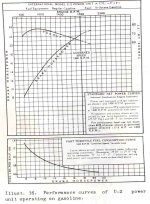
Iterestingly, my Farmall rev limits at 1400rpm, has a 3" bore, 4" stroke(113ci).It is hand crank startable(all mine has), with about 6:1 compression. It makes about 20hp(22hp/1800rpm in the U2 power unit configuration). For something close to a diesel torque curve, check out the attachment...

My Kubota B8200, about a '86 year model, is 19hp. It is 3" bore, 2.8" stroke(56.6ci). There is no torque info in either the owners manual or service manual. They do list gross power in kW too, 14.2kW.
 

Attachments

  • 619597-farmall A torque.jpg
    619597-farmall A torque.jpg
    81.7 KB · Views: 319
   / Diesel torque difference mostly myth? #65  
</font><font color="blue" class="small">(
There must be something about the inline 6 stuff for diesels. As a matter of fact, the only semi engines I have personally seen have been huge inline 6 engines. Hmm, must be something with this inline 6 stuff. /forums/images/graemlins/wink.gif And, I've never seen a gas powered semi either. /forums/images/graemlins/tongue.gif )</font>

The first semi that I drove was a GMC V12 gas, early '60's, the next was V8 2 stroke diesel, but the ones that just keep on going is the ones with 6cyl all in a row.
 
   / Diesel torque difference mostly myth? #66  
Quote "For reasons we don't need to get into, with the motor running happily with maximum voltage applied to the armature terminals, its speed can be increased by reducing the magnetic field within the motor frame. This is done by reducing the electrical current flowing through the motor field windings.

When the motor field current is weakened, the motor will speed up."

Got this one figured and can't get the blue quote on???Thanks for clearing all this up. I was guessing /forums/images/graemlins/confused.gif that varying the field current changed the speed.

Then I made the mistake of thinking about something I was taught back in High School and had forgotten along the way. I was focused on DC motor or starter operation and couldn't remember how the polarity reversed to get it past my conceptual "it's locked up" stage. This link refreshed me rather quick. http://zone.ni.com/devzone/conceptd.nsf/webmain/85399932CDCC7DCB0625683F007290A7 I couldn't remember if it was a geometric or electronic solution that reversed the polarity in a simple motor operation. The dumber I get the older I am. /forums/images/graemlins/grin.gif

Appreciate the help. You explained it just well enough that I'm not tripping all over this..... again. /forums/images/graemlins/cool.gif /forums/images/graemlins/grin.gif

Thanks,
 
   / Diesel torque difference mostly myth?
  • Thread Starter
#67  
Wow that is some big torque.. and you're graph shows that big torque numbers are not nearly as tightly tied to the fuel used, diesel or gas, as it is to the way the engine is designed. Todays diesels seem to be sacrificing the traditional high torque engine designs.

Take a look at todays small diesels... Daedong, Yanmar... anyone in about the 20-25HP range. The peak torque is MUCH LESS than that 20HP Farmall gas engine. Most of todays small high revving diesels in that horsepower range are peaking around 40-45 lb-ft of torque. That 20HP farmall is making nearly 80 lb-ft.

Oh.. no one has any comments about my post dealing with lugging yet? /forums/images/graemlins/grin.gif
 
   / Diesel torque difference mostly myth? #68  
The only diesel that I have any experience with that had specific mention of lugging is my TDI VW. Their reason is the motor will over boost if the RPM's aren't high enough.

My Cummins pulls like a mule from idle up to 2300 RPM where the governor starts to de-fuel it. (for now /forums/images/graemlins/grin.gif )

Truck driver friends have told me that lugging is, as was stated, applying full throttle and getting no increase in RPM. Some add a modifier of LOW RPMs to where the full throttle is added. I don't know what "low RPM" means though. VW specifies the low RPM as 1500.
 
   / Diesel torque difference mostly myth? #69  
An electric motor draws the most amps at zero RPM. When its running theres something about Back EMF produced by the motor.

On a steam engine the maximum pressure exerted on the piston is at zero rpm. As soon as the piston moves this pressure will be reduced.

For torque on gasoline and diesel engines one has to take into consideration the design of the motors. The diesel is usually designed to run very efficiently in a narrower RPM range than a gasoline engine. To properly compare the two they both have to have a specific design for a specific job. When this is done there should be little or no difference.

Egon /forums/images/graemlins/confused.gif /forums/images/graemlins/confused.gif as always
 
   / Diesel torque difference mostly myth? #70  
I looked at Kubota, Deer/Yanmar, and Kioti site. Kioti showed torqu curve, and although Jehn Deere did not, it was an easy lookup at the Yanmar site, for the motor used in the JD4110.
Yanmar torque curve, jd4110 tractor Kioti used the 3C093 motor; you have to look it up in the drop down menu.

I was looking at 20hp models. Kubota did not show any info on thier 20hp offerings.

Of note, the Kioti and Yanmar engines data starts at 1600rpm. The curves are pretty flat...

Kohler offered a performance curve, on the 20hp "Command" model. Kohler page

The Kioti and Yanmar had really flat torque curve. The Kohler was kinda peaky. Only Yanmar and Kohler had torque in Newton/metres. The Kohler had a peak of about 44Nm or 32ft/lb, while the Yanmar had a peak of over 65Nm or about 48ft/lbs. The Yanmar had a flatter torque curve, and about 1.5x more torque than the Kohler. The Farmall did peak higher, at about 80ft/lbs.

Interesting to note, is the Farmall is the biggest, the Yanmar medium, and the Kohler relatively small. The Farmall is is 113ci, the Yanmar about 60ci, and the Kohler 38ci.

the 48ft/lb at 1600rpm still aint bad though(for the Yanmar). That's not revving that high to hit peak torque... It has more than 1/2 the torque of the '41 Farmall gas engine, at approximately 1/2 the displacement.
 
   / Diesel torque difference mostly myth? #71  
I think torque is completely irrelevant, but everyone else will disagree with me. Power is the only thing we really care about. You can hang a 1000 lb weight on the end of a fixed beam that's 10 feet long, and you get 10000 ft-lbs of torque. But guess what, it's not moving, so there's zero power. Zero power means zero work is done, and if zero work is done, well, then nothing gets acomplished. Both power and force (torque is rotational force) are required to do work and create an energy differential.

Here's a simple example. Say you have two engines, one is gas, and one is diesel. Both engines are the same displacement, although the bores and strokes can be different. The diesel engine has a specifc torque curve which can be measured on a dyno. The gas engine is designed so that the gas engine's valve timing and ignition timing and fuel maps generate a torque curve which is *EXACTLY* the same as the diesel engine at any given shaft speed. Both engines now produce the same torque curve and the same power curve, so what's the difference? Well, the diesel engine uses alot less fuel than the gas engine, and that's the only real advantage. Maybe it can be argued that the diesel is heavier duty and will therefore last longer, but that's debatable I guess. Now, my example is never going to happen in real life, so please don't misundrestand me, it's only an example.

The reason diesels tow mow with less downshifting is because they have more low speed power and low speed torque than the typical gas engine.

To defend my statement that torque is irrelevant, I pose this argument. Drag force on airplanes, drag force on boats, drag on cars/trucks, etc, are all rated in power consumed. Some will say drag is based on a known force at a given speed, but when you have both speed and force, that's power. Look at a hydraulic system. A hydraulic pump at any given input speed produces a certain flow rate at a certain pressure. Flow is speed and pressure is force, and that's power. An electric motor requires a current and a voltage to operate. Current is the speed component, and voltage is the force component, and the two make power. Also look at a turbine engine. Say the typical fixed speed industrial turbine engine may produce 2,000 hp at 35,000 RPM. Using our forumla (available all over the internet) T=P*5252/RPM we get that the torque produced by the 2000 hp engine is only 300 ft-lbs. Doesn't sound like it will do much work, but in fact, these types of engines propel tanks and ships and trains and lots of other vehicles with ease, all that's required is gear reduction. I guess I'm getting off on a tangent so I'll stop now.
 
   / Diesel torque difference mostly myth? #72  
Torque means less to me also. One thing about a diesel that's just wonderful is that you never have to worry about the associated problems of leaving diesel fuel in your system for long periods of times without running the engine. It's going to start up.
Often, you leave gas in the system and you're going to get enough varnishing that you'll have to clean everything before it's going to start again.
I've used both gas and diesel tractors, and would NEVER consider owning a gas model again. Torque or not torque. I CURVE to the diesel. John
 
   / Diesel torque difference mostly myth? #73  
300 ft/lbs at 35,000 rpm is an insane amount of torque. As youstated it requires a gear reduction, and subsiquent torque multiplication. Simply stated:

35k rpm = 300 ft/lbs
17500 rpm = 600 ft/bls
8750 rpm = 1200 ft/lbs
4375 rpm = 2400 ft/lbs
2188 rpm = 4800 ft/lbs

Of course there is some loss in the gearing, but you get my point.
 
   / Diesel torque difference mostly myth? #74  
Interesting thread! I think you & AARDVARK & others are getting to the heart of it. HP is a measure of work, torque is (almost) meaningless. A 20hp gas engine will do the same work as a 20hp diesel, or a 20hp engine that runs on bananas - in a steady-state sense. It's the transient response that's a problem. If you load it suddenly, the RPMs will drop a bit, and then the engine with a flatter torque curve (which will also have a flatter hp curve) will be superior. BUT - the difference between diesel and gas may not be anywhere as big as people assume, because we get fooled by the other differences in engine design. Sure, a really big engine that only puts out 20hp is going to have a fat torqure curve compared to a little one that puts out 20hp, but that's true no matter what you run it on. You'd have to look at engines with as much of those things removed from the picture (like similar displacements, bore/stroke ratio, cam timing, etc.) to be able to compare the two fuels. I think you'd get down to the fact that diesel has more energy, and will always be a bit more effecient, and I think it does lend itself to better low end torque, but as you say, it's not as extreme as it seems.

A couple of other things:

1. Long stroke has nothing to do with compression ratio.

2. A big bore/short stroke engine develops higher PEAK torque throughout the crankshaft rotation than a long stroker (for the same diplacement). Remember it's a pneumatic cylinder, and big bore = more force. But it falls off faster as the piston moves away from TDC.

3. If you run an engine that's half the size at twice the RPM, you have the same swept volume per second, and you're using the same amount of fuel. You can't carry that to extremes though, as volumetric efficiency will get in the way, but with tractor engines....

4. Don't assume that high RPMs = shorter life & more wear. If the engine is designed for it, it's not a problem. Usually, a high RPM engine will have a shorter stroke, so piston speeds don't have to be higher. If you shorten the stroke, you usually don't have to shorten the con rod proportionately, so the rod length to stroke ratio is better. This means the max angle of the rod towards the cylinder wall is lower, which causes less wear. If you design the bearing diameters, oil & water pumps, etc. for higher RPMS, it won't be stressed any more than a low RPM design.

Lastly, smaller engines = lower weight = lower shipping costs = lower cost to us. And pretty soon, big fuel costs are gonna make those shipping costs even higher!
 
   / Diesel torque difference mostly myth? #75  
I agree, 300 ft-lbs at 35000 RPM is a huge number, but comparing it to the 540 (or whatever number was put out) that the Cummins diesel makes, it looks less capable /forums/images/graemlins/smile.gif
 
   / Diesel torque difference mostly myth? #76  
I'm not disagreeing with you, but the other thing that I want to point out is the whole "shorter stoke means lower piston speeds and higher RPM" ideal. Piston speed is determined by the head, intake, and valve timing. The piston can only move away from the combistion chamber at a rate which would allow the induction path to fill the cylinder without causing a large pressure decrease inside the cylindre during the intake cycle. As the piston moves away from the head, it sucks air through the intake. The faster the piston moves the more vacuum it will create and the faster the air flows through the intake. This vacuum is really just low pressure. The pressure in the cylinder as the piston moves is determined by the intake characteristics. The free-er flowing the intake system, the faster the piston can move before it hits the wall of low cylinder pressure which keeps the piston from moving any faster. Or course valve timing has alot to do with this. Piston speed is completely independant of crank speed, however crank speed is completely dependant on piston speed, which depends on induction characteristics.

Say we have a constant piston speed, and two different engines. The engine with a 4" stroke would require twice the time to go from top dead center to bottom dead center as an engine with a 2" stroke. This time from TDC to BDC is based soley on piston speed and distance, and that distance is determined by the crank's stroke length. The part where people get confused, is they begin to think that the crank pulls the piston along, and the crank determines the piston speed. In actuality it's the opposite. The piston speed pushes the crank along and controls the shaft speed. The shaft speed is ultimately controlled by the induction cycle.

Maybe I'm getting off ona tangent here again though.
 
   / Diesel torque difference mostly myth? #77  
You're right, the low pressure does hold back the piston. But for the same displacement, the longer stroke engine has a smaller bore, so while the 4" stroker might be going a longer distance, it is uncovering less volume for each bit of movement it makes. The situation on the suction side is the same as on the pressure side, I suspect, in that the peak "vacuum" may be a little different, but for the most part the bigger piston is offset by the longer lever arm.

Actually, I was more interested in the wear aspects of piston speed.
 
   / Diesel torque difference mostly myth? #78  
<font color="blue"> I think torque is completely irrelevant, but everyone else will disagree with me...

...The reason diesels tow mow with less downshifting is because they have more low speed power and low speed torque than the typical gas engine.
</font>

AArdvark,

Sounds like even you disagrees with you! /forums/images/graemlins/shocked.gif /forums/images/graemlins/smile.gif /forums/images/graemlins/grin.gif /forums/images/graemlins/grin.gif
 
   / Diesel torque difference mostly myth? #79  
<font color="blue"> An electric motor draws the most amps at zero RPM. </font>

Egon,

This is true if a motor is stalled and there are no external controls to control/limit armature current. A stalled motor armature then acts like a short circuit.

However, when one refers to full torque at zero RPM it implies there is some control in place to limit armature current to motor design limits, otherwise the motor would burn up, or the power source feeding it would experience difficulty... /forums/images/graemlins/smile.gif

What you said is perfectly correct for a motor applied across a fixed voltage source, which is what most of us would encounter around the house/farm/workshop... /forums/images/graemlins/smile.gif
 
   / Diesel torque difference mostly myth? #80  
I happened to find some torque curves for Ford gas and diesel truck engines. These fortunatly are for engines that are about the same size and running over the same RPM range.

Blue is <font color="blue">torque </font> and red is <font color="red"> HP.</font>

The blue line tells the story. Peak torques (388 vs 410) are about the same on these engines as well...

f68sm.gif

Ford 6.8L V-10 GAS

f73ism.gif

Ford 7.3L V-8 IDI Navistar Diesel

These images and more are located here...

THe key is the way the torque on the diesel rises as the engine RPM drops. Read: Give more effort when effort is needed. /forums/images/graemlins/cool.gif

With the gas, torque drops off with engine RPM drops. Read: Fall over backwards...I can't pull any harder... /forums/images/graemlins/grin.gif

Which would you rather have pulling with you on your end of the rope during a tug of war?

I know my answer... /forums/images/graemlins/grin.gif
 

Tractor & Equipment Auctions

2354 (A60432)
2354 (A60432)
2020 DRAGON 150BBL ALUMINUM (A58214)
2020 DRAGON 150BBL...
(32) 8" FLOOR TRUSSES (A60432)
(32) 8" FLOOR...
FUTURE 60" PALLET FORK (A60432)
FUTURE 60" PALLET...
1990 Bayliner 19ft Trophy Center Console Boat w/ S/A 20ft Boat Trailer (A59231)
1990 Bayliner 19ft...
TANK MANIFOLD (A55745)
 
Top