RedDirt
Gold Member
- Joined
- Dec 4, 2007
- Messages
- 469
- Location
- Northern Idaho
- Tractor
- Kubota BX23, Wards 16HP HST Garden Tractor, (previous) D2 Logging Cat
Volp's thread, Device for emptying backhoe bucket
http://www.tractorbynet.com/forums/build-yourself/148164-device-emptying-backhoe-bucket.html
is getting side tracked as we begin to talk about how to maintain an even slope for a drainage trench. This topic really deserves a thread of its own. I've copied a bit of that thread here. Please add your methods and comments.
Thanks, Ray
Volp 9-20-09
RedDirt your digging is impressing!
Any tips on how to get the right leveling of the trench bottom so that the water will flow easily?
--------------
RedDirt 9-22-09
I shoot for 1/4" per foot slope for my minimum slopes. I use a tilting transit. I set it up at the far end of the trench and measure the length from hoe to transit. With transit set level I measure the depth of my trench at the hoe then calculate the drop for the hoe to transit distance. Then I tilt the transit down (or up) that distance and clip a target on my height pole at that spot. The transit is now set to the slope I want to dig. Before I move the tractor down the trench to the next grab length I'll get off, set the pole w/target in the trench, check my progress, and fine tune the slope concentrating on flattening the trench bottom before moving down the trench.
At first you'll get on and off a lot but this decreases as your skill increases and you are more able to judge your progress and trench depth. A helper is very handy especially if your dig is in soft ground and progress along the trench is fairly quick. The helper can set the pole in the trench, walk back to the transit, shoot the target and give you a progress report. You just stay on the tractor and dig .
Ebay is a great place to shop for a cheep transit and tripod. You don't need anything fancy. I bought mine, a Craftsman, many, many years ago but I recently picked up a $700 Leica auto level for $60 on ebay. An older, four leveling screw, tilting transit should be in the $20-$50 range, a tripod $15-$30. My leveling rod is a broken tape measure taped to a stick and I use two more sticks pinch clamped to the rod to hold it upright. You can see the rod in the first picture of my trenching photos above.
----------------
J_J 9-22-09
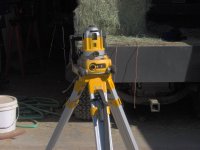
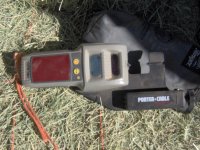
Just thinking out loud here. I have one of Dewalts rotating laser level, and I believe some of the laser receivers beep when level. If that receiver were on the BH dipper, you would know if you were above level or below level, and flatten the bottom of the trench based on an audible, or visual indication. If one knew how to set up the level for a gradient, you could dig the trench keeping the receiver on the beam. Pretty much the same way they level a field with a set grade. They do some amazing work with those laser graders/box-blades.
-----------------
RedDirt 9-22-09
Your idea would work regarding knowing if you were above or below level but working a grade would require more sophisticated equipment. Most laser levels I am familiar with will not function out-of-level. I do know they make laser levels that you can program a gradient into at set up but they are special units. In any case, if you had the receiver/target attached to the dipper it seems you'd need to "probe" the trench with the bucket and dipper in the identical position for each reading. Like bucket fully curled and dipper as vertical as possible.
I think gradient laser levels are fairly spendy units although I've never researched them specifically. The excavators on our job sites have some of that stuff and they spend thousands, even tens of thousands on them. Over the years I have bought six digital theodolites for our company and trained field crews to run highly accurate site and building layout. I can set or read a gradient with them but they are optical instruments. At 17K a piece they are certainly out of my range; I paid less for my tractor! A professional gradient laser may be near the same price or at least 6k-8K. But maybe there are affordable homeowner models that will read grade and someone can tell us about them. I'd like to know. In the meantime my reasonable (cheep) optical tilting transit with or without a helper works fine.
--------------------
Brad_Blazer 9-24-09
Here's an EL Cheapo laser with with manual leveling that would presumably be able to function while adjusted to follow a slope.
- Harbor Freight Tools - Quality Tools at the Lowest Prices
Otherwise some reflective tape with graduations might be a simple alternative to the receiver and sloped laser.
------------------
RedDirt 9-24-09
I don't mean to hijack this thread off original topic yet OP asked and this is where it is leading. This should be a thread of its own since there is probably some interest with varying opinions and methods for digging a sloped trench. Anyway...
I went and looked at the HF instruction manual. Now they don't specifically say that you can set the level "out-of-level" but their precautions warn you to "level carefully because just having the bubble off the thickness of the scribed vial line can give a variance of 3" in 100ft". And it does not mention an auto off feature if out-of-level.
So maybe you could set this unit out-of level. If you could you could proceed as I describe above with an optical transit with a couple of twists.
This appears to be a visible laser without a receiver/beeper. Therefore you'd need to see the laser and if the target was attached to the dipper you'd need to place the laser behind you, ie the FEL end of the tractor. You'd still need another rod and tape to calculate the slope and set the laser out-of level but that's easy.
Say you want to dig a 2% trench. That's 1/4" per foot drop. Set the tractor on the trench and dig to the desired depth. Set the level at the FEL end but a bit off to the side so the laser strikes the dipper. Level the laser. Now measure out say 20 feet on the ground from the instrument along your trench line and set up your height rod. 20ft x 1/4" = 5" vertical drop so wherever the laser, (when level) is hitting the rod, adjust the leveling screws until the laser hits the rod 5" down (or up) from the original level reading. The laser should now be set to the 2% slope. Now set the dipper plumb in the trench, bucket hitting the bottom of the trench. For a standard reading I'd have the bucket either fully curled or fully open so you are always measuring the same depth. Place a target (a card with a horizontal line on it) on the dipper where the laser strikes the dipper. Now as you move down the trench, when you want to check your slope, put the dipper in the "measure depth mode" and read on the card to see if you are high or low.
What remains to be seen is if the laser beam is strong enough to read outside. Some cheap (and even some expensive) lasers lack the brightness to be effective in the sunshine. Maybe one could devise a target shade to help out in this regard.
I don't have any drainage projects on my to-do list but the next one that comes up I might just buy one of these cheepo lasers and give it a try. The $50 is certainly reasonable and it would save an awful lot on and off the tractor that's needed with an optical instrument.
Your reflective tape idea would also work if you owned a rotating visible laser that would not tilt out-of-level. You'd need to lay out distances along the trench and relate the required depth at those distances to the target/card on the dipper. EG. the laser is shooting level so the target would have one inch divisions for every four feet traveled along the trench for a 2% slope.
http://www.tractorbynet.com/forums/build-yourself/148164-device-emptying-backhoe-bucket.html
is getting side tracked as we begin to talk about how to maintain an even slope for a drainage trench. This topic really deserves a thread of its own. I've copied a bit of that thread here. Please add your methods and comments.
Thanks, Ray
Volp 9-20-09
RedDirt your digging is impressing!
Any tips on how to get the right leveling of the trench bottom so that the water will flow easily?
--------------
RedDirt 9-22-09
I shoot for 1/4" per foot slope for my minimum slopes. I use a tilting transit. I set it up at the far end of the trench and measure the length from hoe to transit. With transit set level I measure the depth of my trench at the hoe then calculate the drop for the hoe to transit distance. Then I tilt the transit down (or up) that distance and clip a target on my height pole at that spot. The transit is now set to the slope I want to dig. Before I move the tractor down the trench to the next grab length I'll get off, set the pole w/target in the trench, check my progress, and fine tune the slope concentrating on flattening the trench bottom before moving down the trench.
At first you'll get on and off a lot but this decreases as your skill increases and you are more able to judge your progress and trench depth. A helper is very handy especially if your dig is in soft ground and progress along the trench is fairly quick. The helper can set the pole in the trench, walk back to the transit, shoot the target and give you a progress report. You just stay on the tractor and dig .
Ebay is a great place to shop for a cheep transit and tripod. You don't need anything fancy. I bought mine, a Craftsman, many, many years ago but I recently picked up a $700 Leica auto level for $60 on ebay. An older, four leveling screw, tilting transit should be in the $20-$50 range, a tripod $15-$30. My leveling rod is a broken tape measure taped to a stick and I use two more sticks pinch clamped to the rod to hold it upright. You can see the rod in the first picture of my trenching photos above.
----------------
J_J 9-22-09
Just thinking out loud here. I have one of Dewalts rotating laser level, and I believe some of the laser receivers beep when level. If that receiver were on the BH dipper, you would know if you were above level or below level, and flatten the bottom of the trench based on an audible, or visual indication. If one knew how to set up the level for a gradient, you could dig the trench keeping the receiver on the beam. Pretty much the same way they level a field with a set grade. They do some amazing work with those laser graders/box-blades.
-----------------
RedDirt 9-22-09
Your idea would work regarding knowing if you were above or below level but working a grade would require more sophisticated equipment. Most laser levels I am familiar with will not function out-of-level. I do know they make laser levels that you can program a gradient into at set up but they are special units. In any case, if you had the receiver/target attached to the dipper it seems you'd need to "probe" the trench with the bucket and dipper in the identical position for each reading. Like bucket fully curled and dipper as vertical as possible.
I think gradient laser levels are fairly spendy units although I've never researched them specifically. The excavators on our job sites have some of that stuff and they spend thousands, even tens of thousands on them. Over the years I have bought six digital theodolites for our company and trained field crews to run highly accurate site and building layout. I can set or read a gradient with them but they are optical instruments. At 17K a piece they are certainly out of my range; I paid less for my tractor! A professional gradient laser may be near the same price or at least 6k-8K. But maybe there are affordable homeowner models that will read grade and someone can tell us about them. I'd like to know. In the meantime my reasonable (cheep) optical tilting transit with or without a helper works fine.
--------------------
Brad_Blazer 9-24-09
Here's an EL Cheapo laser with with manual leveling that would presumably be able to function while adjusted to follow a slope.
- Harbor Freight Tools - Quality Tools at the Lowest Prices
Otherwise some reflective tape with graduations might be a simple alternative to the receiver and sloped laser.
------------------
RedDirt 9-24-09
I don't mean to hijack this thread off original topic yet OP asked and this is where it is leading. This should be a thread of its own since there is probably some interest with varying opinions and methods for digging a sloped trench. Anyway...
I went and looked at the HF instruction manual. Now they don't specifically say that you can set the level "out-of-level" but their precautions warn you to "level carefully because just having the bubble off the thickness of the scribed vial line can give a variance of 3" in 100ft". And it does not mention an auto off feature if out-of-level.
So maybe you could set this unit out-of level. If you could you could proceed as I describe above with an optical transit with a couple of twists.
This appears to be a visible laser without a receiver/beeper. Therefore you'd need to see the laser and if the target was attached to the dipper you'd need to place the laser behind you, ie the FEL end of the tractor. You'd still need another rod and tape to calculate the slope and set the laser out-of level but that's easy.
Say you want to dig a 2% trench. That's 1/4" per foot drop. Set the tractor on the trench and dig to the desired depth. Set the level at the FEL end but a bit off to the side so the laser strikes the dipper. Level the laser. Now measure out say 20 feet on the ground from the instrument along your trench line and set up your height rod. 20ft x 1/4" = 5" vertical drop so wherever the laser, (when level) is hitting the rod, adjust the leveling screws until the laser hits the rod 5" down (or up) from the original level reading. The laser should now be set to the 2% slope. Now set the dipper plumb in the trench, bucket hitting the bottom of the trench. For a standard reading I'd have the bucket either fully curled or fully open so you are always measuring the same depth. Place a target (a card with a horizontal line on it) on the dipper where the laser strikes the dipper. Now as you move down the trench, when you want to check your slope, put the dipper in the "measure depth mode" and read on the card to see if you are high or low.
What remains to be seen is if the laser beam is strong enough to read outside. Some cheap (and even some expensive) lasers lack the brightness to be effective in the sunshine. Maybe one could devise a target shade to help out in this regard.
I don't have any drainage projects on my to-do list but the next one that comes up I might just buy one of these cheepo lasers and give it a try. The $50 is certainly reasonable and it would save an awful lot on and off the tractor that's needed with an optical instrument.
Your reflective tape idea would also work if you owned a rotating visible laser that would not tilt out-of-level. You'd need to lay out distances along the trench and relate the required depth at those distances to the target/card on the dipper. EG. the laser is shooting level so the target would have one inch divisions for every four feet traveled along the trench for a 2% slope.