Drywall surface - repair or replace?

/ Drywall surface - repair or replace? #1  

newbury

Super Star Member
Joined
Jan 8, 2009
Messages
14,851
Location
From Vt, in Va, retiring to MS
Tractor
Kubota's - B7610, M4700
Background -
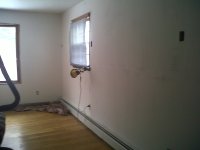
Previous owner used shelf paper for drywall covering. Over the years I've "cleared" a couple of walls with time and moisture.

However SWMBO decided she could help and while I was on travel and proceeded to remove the shelf paper AND patches of the exterior layer of paint AND sometimes drywall paper AND sometimes some of the gypsum core. I've patched some places by removing the old drywall down to the studs and putting up new.

However some have suggested that I just "mud" over the bare patches with thin layers and sand it down.

What does the TBN crowd think is easiest? Mud or tear out? Will mud stay? We plan on just painting over it, not putting up wallpaper.

thanks
 
/ Drywall surface - repair or replace? #2  
You can mud a textured finish on, with the right colors blended it can turn out real nice. Tons of books and info on the net and I believe Home Depot and Lowes also sell various "kits" and products for it. Nice thing is, you can paint over it later if you want the texture but tired of the "tones". Texture may be cheaper and easier over a tear out too, may have to price it and take everything into consideration.

I helped a buddy do a 2 story stair case, only difference was it had only one layer of paint, so we sanded it lightly and went to trowl'n!
 
/ Drywall surface - repair or replace? #3  
You can mud over it in my experience. In areas that the gypsum was knocked out I would fill and then tape over, like a joint. Doing several thin layers will make for a better finish. Feathering out by using increasingly larger blades helps. If you are new to drywall finishing the biggest mistake people make is to put too much mud on per layer.

MarkV
 
/ Drywall surface - repair or replace? #4  
How large of areas to fill are you talking? And is it in a large, lit area where people will be looking down the length of the wall?

Looking straight on at a wall it is harder to detect flaws VS looking down the length of a wall, like a hallway, when you enter someone's great room.
 
/ Drywall surface - repair or replace?
  • Thread Starter
#5  
You can mud over it in my experience. In areas that the gypsum was knocked out I would fill and then tape over, like a joint. Doing several thin layers will make for a better finish. Feathering out by using increasingly larger blades helps. If you are new to drywall finishing the biggest mistake people make is to put too much mud on per layer.

MarkV
If I'm using store bought mud do I thin it w/ water at all? Usually when I'm doing joints I "caress" the last layer lightly with a wet sponge before letting it finally dry to sand.
 
/ Drywall surface - repair or replace? #6  
If you put a heavy texture on the wall, I dont think you would have to bother with imperfections

Look at some of the photos here, the one with the reddish tint and the light looks "neat". Sky is the limit if you do a heavy texture.
 
/ Drywall surface - repair or replace? #7  
Background -
Previous owner used shelf paper for drywall covering. Over the years I've "cleared" a couple of walls with time and moisture.

However SWMBO decided she could help and while I was on travel and proceeded to remove the shelf paper AND patches of the exterior layer of paint AND sometimes drywall paper AND sometimes some of the gypsum core. I've patched some places by removing the old drywall down to the studs and putting up new.

However some have suggested that I just "mud" over the bare patches with thin layers and sand it down.

What does the TBN crowd think is easiest? Mud or tear out? Will mud stay? We plan on just painting over it, not putting up wallpaper.

thanks

I had paneling-nailed and glued to wallpaper glued to sheetrock.When I removed the paneling sometimes the glue seeped through the wallpaper and pulled some of the sheetrock paper off. I removed the wallpaper and glue with lots and lots of hard work. For phase II of III I hired a drywaller to finish up the seems cause I am one of the worst mudders and sanders in the world. He did both walls for 350 bucks-the entire wall so that everything was smooth and seemless. Next week I put on a coat of primary but it looks soooo much better just with the sanded mud on.

I still have one section i need to get the paneling and wallpaper off and asked him for an estimate on the mudding and sanding for that section. What he suggested shocked me which was just to cover up the paneling and wallpaper layers with a layer of new sheetrock. Still thinking about it :)


Sheetrock Proj.JPG
 
/ Drywall surface - repair or replace? #8  
CJ, that sounds like a deal (adding new over old) you would loose what ?1-1/2" of room space, but save allot of work. IF that wont "bother" you later:laughing:
 
/ Drywall surface - repair or replace? #9  
As MossRoad asked...how many boards are you talking about?...just one wall? two walls?

If it was no more than that I would skim them out...the beauty of sheetrock is that it is an imperfect product/art...it's all about the mud...

FWIW...I've never seen a professional finisher BOT add some water to "ready mix" joint compound...and something the real pros do on the final skim coat is add a drop or two of dish soap to the mix...it breaks the surface tension and makes a very slick finish...
 
/ Drywall surface - repair or replace? #10  
I usually use all purpose drywall mud in the 5 gallon buckets for patch work. If I am doing a whole house I use durabond 90 joint ccompound followed by their topping compound. You can certainly skim coat a wall, Just remember not to try to add to much at one time. Most pros will make 3 passes and their done. Me it takes 4 passes and a touch up or 2. If I am skim coating over paint I make sure the wall is clean and wash it down with TSP. I have had no failures with the mud falling out or peeling. Remember put little on and sand a little off.
 
/ Drywall surface - repair or replace? #12  
If I'm using store bought mud do I thin it w/ water at all? Usually when I'm doing joints I "caress" the last layer lightly with a wet sponge before letting it finally dry to sand.

Personally I do not add water, I do use a mixing paddle on the end of a heavy drill to mix things up throughly though. Some do add water but remember as it dries it shrinks and the more water you add the more coats you will have to do.

MarkV
 
/ Drywall surface - repair or replace? #13  
I've done a skim coat over top for a wall that had wallpaper removed. Then just lightly sand.
 
/ Drywall surface - repair or replace? #14  
We are doing this at work all the time. It is a hotel and we are always stripping off old wallpaper, no matter how gently you pull sometimes some of the drywall paper comes off too. We just skim coat it over, sand it smooth, and then seal it with a paint primer. The surface s then good to go for either new wallpaper or paint.
Like you, I add a touch of water to the drywall mud, it makes it easier to work with and forces me to put down thinner coats.
 
/ Drywall surface - repair or replace? #15  
It really depends on how big of an area and the degree of damage to the existing walls. I try to keep what's up there and patch it if I think that's the faster way to fix the wall. I know that if I put in new sheetrock, I have to feather all the edges and build it up to blend it to the exisisting wall, and that's three days drying time.

For the really bad areas, or if you want the best results possible, prime the exposed gypsum with a good quality primer. I like Zinsser 123 for sheetrock. It soaks in and locks it all together. Then it gives you a solid base to work from when adding your mud. I buy the lightweight stuff in the box with the blue trim. It sands the easiest.

I mix a cup of water into the box. I prefer box over buckets. It's cheaper and easier to work with. I never save any left over mud because it starts to smell bad fairly quickly and it's cheap enough to always buy new for each job. First coat is just to seal the tape and start the build up. Second coat gives me the level that I want. I sand after the second coat so I know where to work the third, and hopefully, last coat. Then I sand the third coat and texture.

The best sand paper is at Home Depot. I like the most aggressive paper I can find, and I like to change sheets as soon as I have to start putting effort into the sanding.

Be sure to use a straight edge, or 6 ft level to see where the high and low spots are. Use a pensil to mark those areas so you don't forget where they are.

Same thing with new sheetrock, except be sure to cut out the texture and a layer of paper on the existing wall so that when you put your tape down, it will be flush with what is already there. I only use fiberglass tape.

Good luck,
Eddie
 

Marketplace Items

8ft. Teak Wood Table (A61569)
8ft. Teak Wood...
Hidratrak 8' Rolling Cultivator (A53317)
Hidratrak 8'...
2022 Schulte SMR-800 Multi Rake Landscape Windrower (A63118)
2022 Schulte...
2025 X39 Hydraulic Trencher Skid Steer Attachment (A61567)
2025 X39 Hydraulic...
2013 Chevrolet Silverado 3500HD Enclosed Service Truck (A60352)
2013 Chevrolet...
2018 Bell B30E 30 Ton Articulated Dump Truck (A60352)
2018 Bell B30E 30...
 
Top