Ejector Bucket Design

/ Ejector Bucket Design #1  

RedDirt

Gold Member
Joined
Dec 4, 2007
Messages
469
Location
Northern Idaho
Tractor
Kubota BX23, Wards 16HP HST Garden Tractor, (previous) D2 Logging Cat
General consensus is that narrow BH buckets and compact dirt (clay) don't mix. The problem may be able to be solved with a self ejecting bucket.

Remarks on charlz "narrow bucket" thread (Built it Yourself), and my "build a slim trenching bucket?" thread (Kubota own/operate) indicate the likely possibility that when working in a high clay content soil the dirt sticks to a narrow trenching bucket and doesn't readily evacuate. This lead me on a search of "ejector buckets" and my thanks to pycoed (West Wales UK) for leading me to European designs.

US has little offerings for ejector buckets (that I could find). Some European backhoes seem to have a different bucket style and operation of the curl mechanism.

Here is a picture of a European ejector bucket (Harford) with a flap and levers:
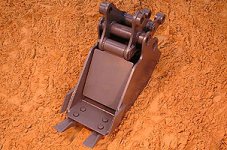
Harford Ejector Bucket.jpg

But this European design (Lackender ) caught my eye for simplicity:
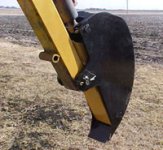
Lackender Ejector Bucket.jpg

The Lackender bucket must have a longer curl cylinder that goes over-center of the bucket pivot to fully curl the bucket. My challenge was to see how to make this "half-round, pivot-at-radius" bucket adapt to our shorter curl cylinders and bucket curl levers.

This is what my initial design looks like. (This is my first posting of pdf's. If they view sideways you should be able to click the "rotate" icon when it opens in Adobe to set it straight) When I reviewed my post this was the case AND they didn't open on the first try. On that (cant' open) screen I "canceled" then clicked the attachment once again and they opened fine. Can someone tell me how to better attach pdf's?

View attachment Ejector Bucket1 Layout1 .pdf

The concept is a 1/3 circle bucket that pivots at the center of the radius. There is a fixed flat plate that is "U" bolted to the bottom of the dipper stick. When the bucket is fully opened the bucket rotates around the fixed plate and ejects the bucket contents.

A modified digging style will be necessary with this bucket. As you begin the trench all the digging must be done with the curl because the fixed plate blocks the opening. This motion must be done a couple of scoops full then I think digging can be resumed in a more familiar manner abet modified somewhat.

This drawing shows the first few scoops being removed on the way to a 3ft deep trench.

View attachment Ejector Bucket1 Layout2 .pdf

An interesting point is the volume of this 7" wide bucket when fully curled (and dirt filled to the ejector plate) is the same as my 12" bucket. This is due to the larger (12"+/-) radius of the ejector bucket (my standard 12" bucket has about a 5" radius back, about 1/3 of a circle. then radiates straight-lined about 5 1/2" beyond the spring points of the curved back).

This is an initial design phase and I'd sure value any feedback and comets before I start a mock-up. I realize the fixed plate attachment needs to be worked out better; it is shown and explained as "U" bolted for concept purpose. The plate is likely to be 1/4" thick with a couple of "L" angles welded on the face for stiffeners.
 
/ Ejector Bucket Design
  • Thread Starter
#2  
After posting I found the pdf drawings opened quicker if I already had Adobe Acrobat running in the background. Maybe this is just my computer; yours may vary.

This bucket is designed for a Kubota BX23. This bucket will have no teeth; I'll add bolt-on's later if I need them.

Further explanation of the first pdf drawing:

I mistakenly drew the curl cylinder with the rod extended when the bucket is fully opened. The rod at this point should be fully retracted.

The bucket with the dimensions represents the fill of the "loaded" bucket. The 8 3/8" is the intersection of the front face of the bucket and the fixed plate (when curled), the 1'-4 7/8" is the fixed plate to the same intersection. With a 7" clear inside width the filled volume (raked) is .77cuft. (BTW, a BX24 8" bucket has a 7" clear width).

On the superimposed bucket the solid green lines are the bucket fully opened and the dashed light blue is for the curled bucket. The 11 1/2" dimension is the "usable" portion of the face of the bucket that is presented to the ditch.

The arc between full open and full curl is less than my standard bucket which has a 180 degree arc. There will need to be some sort of stop incorporated in the curl to keep the the curl lever pin from pushing against the fixed plate.

I tried to work out a mechanism that would allow the fixed plate to pivot, at least at the beginning of the dig, so the plate did not block the opening but the best I've come up with is a series of articulated levers (that I want to avoid for simplicity).
 
/ Ejector Bucket Design
  • Thread Starter
#3  
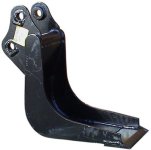
Found this on another post. One way to keep clay from sticking to the sides of a bucket. Get rid of the sides!

...from Great Britain; they must have a lot of sticky clay there.

clay_spade.jpg
 
/ Ejector Bucket Design #4  
In Holland (lots of clay, the polder soil was seabottom untill 80 years ago !!) we call that a banana bucket. ;)

Usually a banana bucket is enough. However when i was 17, i had a holiday job where i had to follow the mini-excavator, to search for cables crossing our trench, and stick the clay out of the banana bucket every 5 cycli.

The operator said that next time he would bring a chain bucket. When i asked what that was, he said that in very sticky clay, the bucket wouldnt have a back plate either, but just chains to hold the ball of clay. But that only works in pure clay, like in excavation pits for brick factories.
In normal trenching conditions, they would attach a chain to the bucket lip and to the boom: When the bucket is fully curled open, the chain would be pulled tight and slit through the clay ball: Once there is a slit through, the two lumps of clay would normally fall out easy.
If not, you could also make a hinged plate in the bucket, which the chain will pull up when the bucket opens.
 
/ Ejector Bucket Design #5  
Hi Ray,
I found your self ejecting bucket quite a neat idea so I thought I might give you and idea to make it a little more unique. I've seen your design and fabricating skills so I don't think this would be out of the question for you to make. My thought stems from the fact that the ejector plate is stationary. My concern is that if you ever wanted to start digging with the bucket fully uncurled (like I do to get maximum reach) then the ejector plate blocks the bucket until you start to curl the bucket. The more you curl, the more you can get into that bucket.

The presumption would be that you would not get a full bucket until almost fully curled since the stationary ejector plate is in the way. However, sometimes I've gotten full buckets with the bucket fully uncurled and only using the dipper stick or boom to dig, without curling the bucket. In that case, the stationary ejector plate might get bent inwards ... maybe not, but it could?

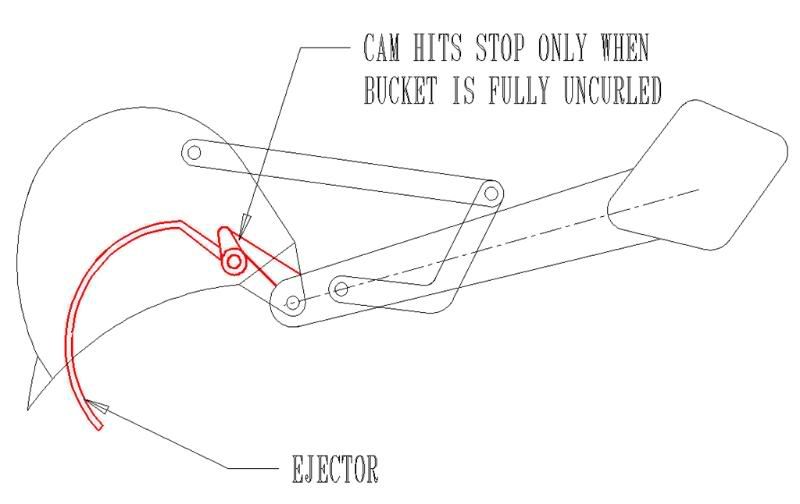
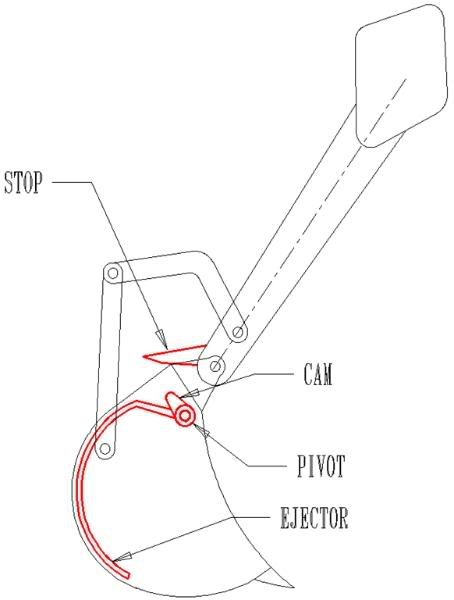
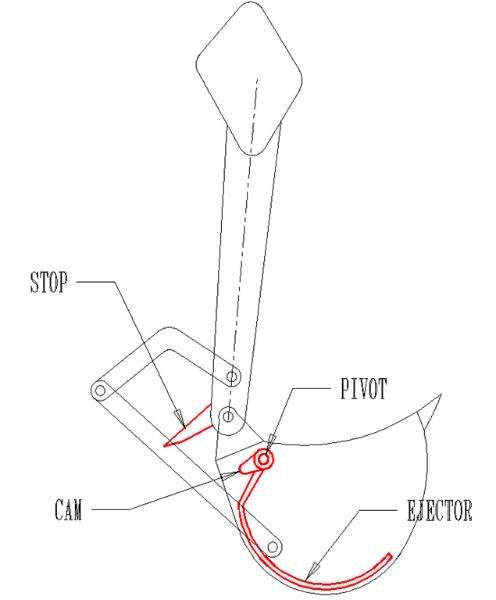
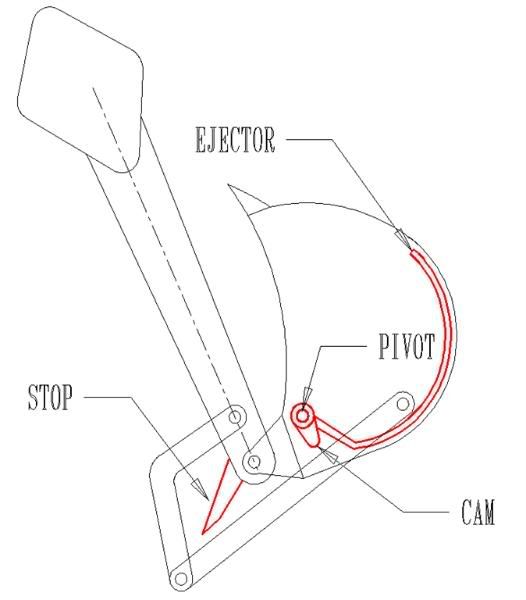
So I was thinking of a pivoting ejector plate that ONLY ejects when the bucket is fully uncurled AND is free floating or rotating as soon as you start to curl the bucket slightly. To me, that would be the way to go.

You can do this with a pivot, a stop and a cam. Below, I've taken a drawing of my (existing) bucket and designed that kind of cam/pivot ejector system. Please keep in mind that I did not spend a lot of time to make it perfect. I would imagine you would want to shape the bucket and ejector plate for maximum performance. I drew these pictures only for an example and to show the concept. You will have to design it to be perfect, of course.:)

These are clickable thumbnails so click on them to enlarge.
They show the concept with the dipper stick and bucket in several positions.

 
/ Ejector Bucket Design #6  
Just to clarify Rob...

That cam is basically on the side of the bucket? Or does the stop go through a slot in the back of the bucket?
 
/ Ejector Bucket Design #7  
For these types of buckets, would you or does it make sense to have the bucket itself with "no back". Since the ejector plate acts as the back, I would be concerned that any material that gets by the plate would be continuously compacted when the bucket is curled. Is this not a concern?
 
/ Ejector Bucket Design #8  
I saw a bucket that was piped for compressed air... don't know where the air would come from... but it was designed so a blast of air would eject the material.
 
/ Ejector Bucket Design #9  
Defective said:
Just to clarify Rob...

That cam is basically on the side of the bucket? Or does the stop go through a slot in the back of the bucket?
Yes, there would be a slot in the back of the sample bucket so the cam and stop could meet. It's just a concept so the actual shape of the bucket and ejector ... even the pivot point and cam size should be customized.
 
/ Ejector Bucket Design
  • Thread Starter
#10  
Renze said:
In normal trenching conditions, they would attach a chain to the bucket lip and to the boom: When the bucket is fully curled open, the chain would be pulled tight and slit through the clay ball: Once there is a slit through, the two lumps of clay would normally fall out easy.
If not, you could also make a hinged plate in the bucket, which the chain will pull up when the bucket opens.
---------------
3RRL
"...the ejector plate blocks the bucket until you start to curl the bucket."
Rob
----------------
BX 24
"For these types of buckets, would you or does it make sense to have the bucket itself with "no back". Since the ejector plate acts as the back, I would be concerned that any material that gets by the plate would be continuously compacted when the bucket is curled. Is this not a concern?"
---------------
ultrarunner
"I saw a bucket that was piped for compressed air... don't know where the air would come from... but it was designed so a blast of air would eject the material."
---------------
3RRL,
"Yes, there would be a slot in the back of the sample bucket so the cam and stop could meet. It's just a concept so the actual shape of the bucket and ejector ... even the pivot point and cam size should be customized." - Rob


Thanks for all the feedback

Renze,
The chain concept is a good one and easy, with or without a hinged plate. Either might be a good "quick-fix" for anyone that has a standard bucket and dirt sticking problems.

Rob,
Yes, that is a shortcoming of my design and why I mentioned the modified digging process. I like your cam/lever concept and will probably try to develop it for my fit. Great idea. I tried similar before my first post but it wasn't so neat. See later in this post for pics of another lever action ejector plate similar to your idea.

BTW- I am going to send you a PM regarding your posting style. I like the thumbnails and I have questions about that and also your drawing >jpg conversion; my attempts did not go as expected.

BX24,
Good observation, thanks. Maybe I just need a couple/few straps across the back to hold the shape of the bucket and leave the rest of the space empty. Somehow though I think a back may be needed for efficient digging but, for sure, a "clean-out" bolt-on plate might be a necessity.

ultrarunner,
It would probably work (air) but you'd likely need a good volume (and I have no air available on board).

Rob,
One of the inherent problems with the lever actuated ejector flap is this is a very narrow bucket and the cross tube of the curl cylinder rod fills the space between the bucket attachment "ears". At least it does on mine. The bucket itself is not much wider than the curl rod pin. Then, if a slot is in the back of the bucket for the lever, the lever it hits the curl rod. See below for side levers.
----------------
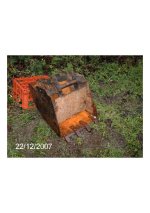
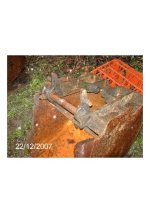
Here are some additional photos from John in "Wet Wales"

First two are his ejector bucket. Notice the actuating levers on the side of the ejector flap (seen best in second photo). I also notice that the bucket has a large opening in the back similar to what BX24 mentioned.

ejector1_sm.jpg ejector2_sm.jpg

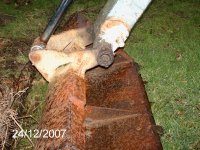
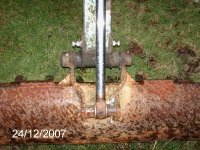
Here is the dipper stick. Note the bolts protruding from the sides to catch the ejector activating levers. (The bucket in these pictures is not the ejector bucket. BTW- his buckets do not have our typical scissors arm on the curl rod)


dipper3_sm.JPG

dipper2_sm.JPG

So I'm back to the drawing board for some modifications, maybe total redesign. Thanks again for all the good suggestions.
 
/ Ejector Bucket Design #11  
Hi Ray,
I responded to your PM. Hope it is helpful?
Your concern for the narrowness of your bucket is a good one and there is no reason the cam should be on the inside. Obviously those ones you posted have that feature on the outside.

However, if located strategically, I thought an internal lever for a narrow bucket might be better as opposed to the external cams having to be way out there to actuate? Can you find a spot on the dipper stick where the cross tube does not interfere? Everything would (could) be more compact if you design the location well. Don't forget that this is a "helper" ejector plate and it may not need to be as large or long as you think in order to empty the bucket successfully.

Another thing to consider is to use the cross tube as part of the cam system. I guess I'd have to see your hoe curl and dipper stick and how it enters the back of your bucket to see if it could be done? Just a thought anyway?:)

I wasn't sure if you are installing this feature into an existing bucket or will you be making a custom bucket? If making one, you could design an unconventional bucket specifically in mind to accept that feature. Maybe design the cam feature around your curl and dipper stick locations on and associated movements... and then design the bucket around it?
 
/ Ejector Bucket Design
  • Thread Starter
#12  
Rob,
Good points and I'm sure the lever can find a home. I need to do another drawing. But but right now I have my rear blade attached and doing mock ups on that for some upgrades (end plates, ripper bar & gauge wheels). Ordered parts yesterday!

After that I'll build the BH bucket. Since I'm starting from scratch design applications are almost limitless.

Another thing that I like about your design concept is that the ejector flap has its own pivot pin. This means it can be easily removed if and when not needed. Also means less space needed on the main bucket pivot for the extra ears so bucket can stay as narrow as possible. I'm shooting for 7", 8" wide.

Sometimes I spend as much time on design as I do construction..... because I like it and it normally means the finish product meets expectations. I should say "most of the time". One of these days I'll post a great one cylinder lift/gravity dump loader that "didn't quite work".
 
/ Ejector Bucket Design
  • Thread Starter
#14  
Well I spent a lot of yesterday afternoon with CAD trying to draw something similar to Rob's concept. Gave up on that and switched to tracing paper (from photos) to track the range of motion. Failed to come up with anything.

This afternoon's efforts were more promising. A full scale mock-up was a much better design tool to run the bucket through its full range of motion and find what windows of opportunities existed to fit an ejector flap actuator mechanism.

The "window" is small indeed which is why it probably eluded me in the previous processes. There is a slim area between bucket pivot pin and bucket arm pin to fit a curved push arm that pushes on the back of the ejector flap. I think this push arm could be something like 1/2" thick 1 1/4" to 1 3/4" wide. I'm thinking I can weld it on a 3/8" thick plate and bolt it to the top of the dipper stick with 3/8" dia "Thread-Serts". These will hold the arm on the dipper stick but not strong enough to resist all the exerted force so I'll probably need a small thrust block welded on the dipper stick too.

There will be a cutout in the bucket back for the arm to access the back of the ejector plate. And like bx24 mentioned, the back of the bucket will need to be at least partially open so dirt is not compacted behind the flap.

The area of the flap that is pushed by the arm will need to be plenty strong as it is so close to the pivot the forces here will be tremendous.

Next challenge will be to figure out a return spring so as the bucket is curled a bit to begin digging, the flap goes to the rear of the bucket. I need to find a source for a flat spring (like a leaf spring only lighter duty).

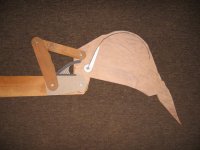
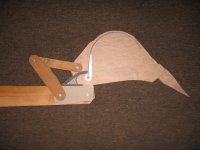
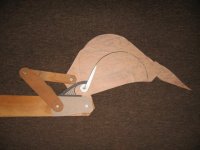
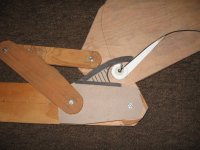
Here is how the 2-D mock-up came out. I'll likely to do a 3-D mock before I commit to building because the clearances are so small and there may also be some obstructions with pins or bucket levers that aren't apparent in 2-D. And I'm still investigating adding some cam assembly to quicken the flap rotation compared to the bucket rotation.

Detail - Push arm before engagement

Detail-B4 engage.JPG


Bucket rotation - Before push arm engagement

Full-B4 engage.JPG


Bucket Rotation - Begin engagement

Full-Begin engage.JPG


Bucket Rotation - 1/3 ejector rotation

Full-1_3 engage.JPG


Bucket Rotation - Push arm fully engaged - Ejector flap fully opened

Full-Fully engaged.JPG


Detail - Push arm Fully engaged

Detail-Fully engaged.JPG

BTW - The push arm fits between the two outermost bucket lever arm. These arms are outside the dipper stick. The inner bucket arms are tied together as an "H" assembly (the pencil block-out on the template arms). When bucket is fully curled there seems to be clearance for the ejector push arm. But that's why I'll do the 3-d mock-up..... to make sure.

I may try to spread the distance between the bucket/dipper stick pin and the bucket/arm pin to get a bit more clearance for the ejector push arm. But it's tricky because they are so closely spaced a minor adjustment can have a major rotational effect on the bucket. I mocked-up my existing bucket and I'd like to keep that if possible. I'm sure some Kubota engineer spent a lot of time getting the geometry "just right".

I'm still undecided if the ejector plate needs to be as long as the mock-up or can be cut shorter so there is not as much curve at the free end.
 
/ Ejector Bucket Design #15  
Does the pivot point of the ejector need to be an additional pin? I would think that making it pivot on the same pin as the bucket itself would make the design simpler. This would also move the push point further from the pivot (which I would expect to lessen strain).
 
/ Ejector Bucket Design
  • Thread Starter
#16  
Defective said:
Does the pivot point of the ejector need to be an additional pin? I would think that making it pivot on the same pin as the bucket itself would make the design simpler. This would also move the push point further from the pivot (which I would expect to lessen strain).

What is not evident in the mock-up is that the pivot of the ejector flap is actually a structural cross member of my original bucket. On the original this is a 1 3/4" OD pipe that runs from side to side and is welded onto the thickened side plates. I'm guessing it was found to be a necessary structural component for bucket strength.

The 1 3/4" pipe did not allow enough space to get a beefy enough push lever so I reduced it to 1 1/4" OD. After all, this trenching bucket is destined to be only 7" to 8" wide. My 1 1/4" OD pin is actually 3/4" ID shaft bushing stock so I'll make the shaft solid (#8 bolt) and the bushing will slice into three pieces. The two ends welded to the bucket, the middle piece is the pivot connection for the ejector. I'll test the ejector with the 3/4" shaft pinned so I don't have to cut it apart if trials demand modifications.

To answer your question, I'd really would like to have the pivot farther away from the lever. The stress here, as noted, will be very high and components will need to be built accordingly. The ejector could also be removed if/when not needed. The problem is that when the pivot point is moved further away, the lever arm needs to become longer, and thus the bucket needs to rotate further for the ejector to fully open. It's a geometric chain reaction. If I put the ejector pivot on the bucket main pivot I'd need to loop the ejector plate around the structural pipe and the push arm would need to be really long.

Tomorrow I am going to see if I can spread the pins some with out affecting my bucket 180 degree rotation too much. If I can gain an additional 3/4" to 1" in spread it will give more clearance for the push arm, get the push arm further from the pivot, and not substantially increase the push arm length.

I was trying to make Rob's lever/cam system work, to no avail, when this push lever showed itself as an opportunity. I ran with that to see where it would lead (mock-up #1, above).

This is a design in progress and I'm sure it will continue to evolve. I'm likely still not done investigating the lever being attached to the ejector plate like Rob's concept. My problem is that my arms and pins are much closer than Rob's and his solution, a good one, does not fit my bucket....yet.
 
/ Ejector Bucket Design #17  
OK...

I think I see some of your design trends now...

Since you're building the bucket from scratch (at least that's what I thought you were doing...) you don't need to follow the design of your existing bucket too close.

If you look at the bucket Charles built, the back of the bucket is pretty simple. Ears for 2 pins, a fairly flat back & basically not much extra structure in the way. (Look at it in this post) I'd pivot the ejector off the main pivot pin on his design & give it some reinforcement where the pin hits it.
 
/ Ejector Bucket Design
  • Thread Starter
#18  
Tonight I did a couple more renditions of the ejector flap activation mechanism.

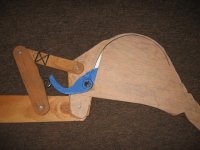
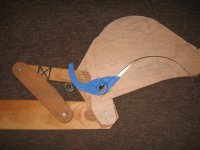
First I attached a lever to the flap that engages a roller bearing mounted on the dipper stick.

This is that lever beginning to engage

Lever on flap-begin engage.JPG


Here it is fully engaged

Lever on flap-full engage.JPG


BTW - The shape of the curved lever is dictated by the clearance needed when further curled in order to miss an "H" tie between the two bucket arms, the "X" in the photo.

Lever on flap - Clearance @ H.JPG


Due to the constraints of the curved lever I was not able to get any cam action to increase the rotational speed to the flap and I lost some bucket opening angle because the lever binds against the upper pin of the bucket.


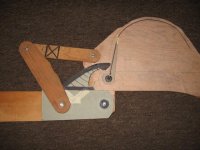
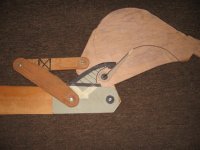
Next I experimented spreading the bucket pins to gain more clearance for yesterday's direct push lever. I lost too much bucket opening and curl angles when I spread the pins one inch. But spreading them by 3/4 inch I only lost 5 degrees of full open and 9 degrees of full curl. I though this would be acceptable if it allowed more clearance and be able to move the lever a bit further from the pivot pin. Here's how it turned out:

Lever on dipper- begin to engage.

Lever on dipper2-Begin engage.JPG


Full engagement

Lever on dipper2-Full engage.JPG

At this point I think the later may be the best solution. Two items of merit above the flap mounted lever. 1. It takes less rotation of the bucket to fully engage the ejector. 2. If I don't want or need the ejector I can just not attach the dipper lever. In this scenario I'd bolt the flap to the back of the bucket.

I've got one more idea to try tomorrow night based on Defective's comment then I'm just going to have to pull the trigger on one of the designs and get on to the next step.
 
/ Ejector Bucket Design #19  
For most of these designs, it involves more work building it, than to scrape the clay out of the bucket every now and then.
Also, a curled ejector plate would still give sticking problems.
I have been digging trenches as summer holiday jobs, but we never really had the need for a complicated bucket like this. As a Dutchman, i dont think you guys can have much worse soil than we have, because large parts of our country were sea bottom untill about 50 years ago, which is allmost virgin clay.

IMHO, its a bit over the top to put this much work in an ejector bucket, a banana bucket works good in 99.5% of the soils.
 
/ Ejector Bucket Design
  • Thread Starter
#20  
I had a discouraging discovery after my last post. My favored design (last photos) failed when I brought the bucket through full curl. The push arm conflicts with the bucket rod at the end of the curl. I hadn't noticed it before because the rod was not part of my mock-up. I felt like I came back from shopping not buying something that was needed because it wasn't on the shopping list. Dumb.

I ran through a whole 'nuther series of design ideas and the only promising mechanical concepts were ones I couldn't fit into the tight physical package including following Defective's suggestion of designing a completely different bucket. Most of the simple mechanisms failed in the standpoint that it took too much bucket curl rotation to completely engage the ejection flap. Since I could not find a way to dis-engage the ejector (trip latch) these designs had the same flaw as my initial drawing in that the bucket needed to be somewhat curled in order to start digging. Attempts at devising non-linear scissors levers, push rods, cams, etc just took up too much space in the confined area.

I'm about to concede round one. It hasn't been a knock-out but I am staggering. I've learned a bunch the past few evenings. Thanks to all that gave suggestions.

I think I am going back to my original plan and simply build a duplicate of my bucket only narrower and like Charles, try it and see. I'll increase the draft of the sides and see if that works well enough. If I run into sticking problems I may try out a banana bucket. After all this whole ejector idea was trying to solve a problem I don't even know I have. I gave it consideration due to TBN posts expressing concern but I'm now inclined to agree with Renze that it is too complicated and time consuming to design/build (and may not be needed anyway). My notion had been if the flap was an easy add to my bucket project I'd try it out. I should have guessed that answer right off. If it was easy we'd likely see more ejector buckets on the market, or they're impractical or they're not needed, a, b, c, or, d all the above.....

If you have experienced dirt sticking to your narrow bucket I like to hear about it including the conditions at which it occurs, soil type, etc. I'm not adamant there won't be a round two somewhere along the line. And if not me then maybe someone else.
 

Marketplace Items

1986 Trailmobile F71T-6UJA 40ft. 32 Ton T/A Flatbed Trailer (A64194)
1986 Trailmobile...
MASSEY FERGUSON 5 BOTTOM PLOW (A64278)
MASSEY FERGUSON 5...
2006 Mack CXN613 T/A Gardner Denver Kill Truck (A64194)
2006 Mack CXN613...
2006 Cadillac GM Superior Coach 6-Door Limousine - Only 21,567 Miles (A63689)
2006 Cadillac GM...
2015 Mack GU713 T/A Wet Kit Day Cab Truck Tractor (A64556)
2015 Mack GU713...
2022 Kubota Z422-54 Zero Turn Mower (A63689)
2022 Kubota...
 
Top