electrical nightmare

/ electrical nightmare #1  

lakespirit

Silver Member
Joined
Jul 9, 2006
Messages
244
Location
Idaho Panhandle
Tractor
2004 KAMA TS254C
KAMA TS 254C is murdering batteries. What is the minimum wiring need to start tractor, charge battery and maybe a set of headlamps?
 
/ electrical nightmare #2  
First step I would try would be to connect an ammeter between the battery and the + cable, the start pulling fuses until the amp draw stops...

Aaron Z
 
/ electrical nightmare
  • Thread Starter
#3  
Will a multi meter work for this? What will I be able to determine from this test, and then what next?
 
/ electrical nightmare #4  
If it has a Ammeter it will. It will show what circuit is drawing Power.
 
/ electrical nightmare #5  
Will a multi meter work for this? What will I be able to determine from this test, and then what next?
It depends on the anticipated amp load. Ideally you would want a DC amp clamp on the positive battery cable.
 
/ electrical nightmare #6  
What is the minimum wiring need to start tractor, charge battery and
maybe a set of headlamps?

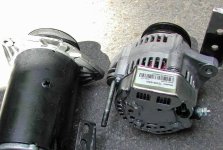
I just upgraded a 50s car with DC generator to a modern alternator. I elected to use a so-called
racing alternator, a self-exciting 35A unit with internal regulator/rectifier. All you need to use this
unit is a connection to the battery. You can wire your headlights directly to the battery. This
alternator (a Denso clone) cost me only $78. Works great.
 

Attachments

  • alt_gen.jpg
    alt_gen.jpg
    89.1 KB · Views: 197
/ electrical nightmare #7  
I'd suggest getting a new alternator with adequate output to charge your battery fully. A Delco 10 or 12-Si alternator has an integral voltage regulator and will put out between 40 and 80 amps, depending on which one you get. They are simple units using either one or two wires and are very affordable. I installed a 65 amp Delco 12S1 on my Jinma and like it very much. I can now run everything I need and no worries about charging the battery. No more voltage regulator problems, either. It meant that the existing ammeter was out of the loop and I had to add a voltmeter, but that was fine with me. I also added a relay in the key switch start circuit so the solenoid is being supplied by an 8 gauge wire through the relay and now it starts every time within two seconds. The Chinese tend to undersize on wiring and so you need to add relays and heavier wire for high-draw items like lights and starters.
 
/ electrical nightmare #8  
It depends on the anticipated amp load. Ideally you would want a DC amp clamp on the positive battery cable.

Depends on what the expected amp draw is. An amp clamp might not show a tiny battery killing draw very well. Where a small volt ohm meter that has current measuring capicity will frag it's internal fuse if you turn on the glow plugs or try to crank the engine with it in the circuit...

My first questions for Lakespirit would be:
How long does it take to kill a charged battery? Is it delivering proper voltage when the engine is running(14.0-15.0)? If it is killing the battery while running I would first suspect a charging issue before a loading issue. If it is killing the battery when the tractor is shutoff, then the time it takes to discharge should give you an idea what kind of current is being drawn out of the battery and what tool you need to troubleshoot further... Of course another way to troubleshoot this with just a volt meter is to connect up a fully charged battery, one that has been allowed to set for a while after charging, till it's voltage stabelizes. Then pull ALL the fuses but one. Come back in a few hours and measure the voltage at the battery. If it hasn't dropped, pull that fuse and insert another fuse and come back in a few hours again looking for the voltage drop at the battery caused by a current drain. Once you find the one sucking the current, then you can isolate the items powered by that fuse...

Also it is real hard on a battery to let it stay below 11 VDC. This causes the sulfur absorbed into the plates from the electrolyte to harden and "sulfate" on the surface of the lead. When this happens it forever covers those parts of the lead, preventing the lead from contacting the electrolyte and reducing surface area/battery capacity. Like mold on bread or cheese, it eventually spreads to the entire surface permanently killing the battery. The "mold" only grows when the battery is at low voltage so always keep lead acid batteries charged...
 
/ electrical nightmare
  • Thread Starter
#9  
Thanks for all the information...I did not clearly state what I am trying to accomplish. The wiring on the tractor is a mess, with stuff hanging all over the place. I would like to pretend there is no wiring on the tractor and just wire it from scratch to 1. Start the tractor. 2. Charge the battery. 3. Run headlights. That being said, anyone able to show me what to do?

I'm thinking it would require just a few wires, maybe new alternator, and starter switch or button. Am I out to lunch?
 
/ electrical nightmare #10  
/ electrical nightmare #12  
KAMA TS 254C is murdering batteries.
"Murdering batteries" suggests excessive charging voltage. First thing needed is voltage measurements at the battery; at idle, at half throttle, and at full throttle. Your problem - other than dangling wires - may be nothing more complicated than a bad alternator and/or voltage regulator. Set the multimeter to measure DC voltage, in the lowest range that includes 12 volts and report your findings. Or does "murdering batteries" mean something else to you?

What is the minimum wiring need to start tractor, charge battery and maybe a set of headlamps?
You realize going that route means giving up most of the instrumentation, right? Plus the state of Idaho might have something to say about minimum lighting as well. Have you considered a new wiring harness?

//greg//
 
/ electrical nightmare
  • Thread Starter
#13  
Never use on highway. Don' care about the gauges either. Don't want entire new harness. I simply want what I asked about.
 
/ electrical nightmare #14  
Never use on highway. Don' care about the gauges either. Don't want entire new harness. I simply want what I asked about.
Use the diagram I posted a link to then and ignore the gauge part. If it shut off when you turned off the key, it would be more tricky, but as it uses a knob to shutoff, the above diagram should work.

Aaron Z
 
/ electrical nightmare #16  
Yeah - I'm kinda fond of knowing what is happening with my engine and those little gauges sure do make it easy to tell. So much nicer to have a gauge tell me it is starting to overheat than to have it simply seize up and die.
 
/ electrical nightmare #17  
Few things can ruin an engine better than seizure from overheating or seizure from no oil pressure. Maybe just drop a bomb on it?
That mentality gets no sympathy from me.
 
/ electrical nightmare
  • Thread Starter
#18  
The tractor is so trashed it is almost ready for the junk heap...yea it is true that I have abused, misused and sorta let it go to ****. I am nearly ready for a new one, so I am simply trying to get it to run so I can move some junk into a dumpster and maybe plow a little snow this winter.
 
/ electrical nightmare
  • Thread Starter
#19  
OK, so maybe I should try to fix this mess properly. Where could I find a wiring harness and can someone tell me how to install it?
 
/ electrical nightmare #20  
Only one I know still carries KAMA/TaiShan parts is Chip Uren at ARTRAC. You'll find his contact info in the site Dealers section.

//greg//
 

Marketplace Items

2018 LARK UNITED MANUFACTURING S/A GUARD SHACK (A55745)
2018 LARK UNITED...
500 BBL FRAC TANK (A60736)
500 BBL FRAC TANK...
Quick Attach Forks (A60463)
Quick Attach Forks...
2020 Deere 317G (A60462)
2020 Deere 317G...
2006 Ford F-350 Pickup Truck, VIN # 1FTWX31P16EB57079 (A61165)
2006 Ford F-350...
Drive Over Portable Scales w/ Monitors (A60462)
Drive Over...
 
Top