Electrical wiring question

/ Electrical wiring question #1  

Gary_in_Indiana

Elite Member
Joined
Apr 22, 2002
Messages
3,373
Location
Fort Wayne, IN
Tractor
John Deere 4200 MFWD HST w/ JD 420 FEL w/ 61" loader bucket & toothbar & JD 37 BH w/ 12" bucket
Does anyone have any experience with or knowledge of whole house GFCI's or whole house surge/spike protectors? I've heard these things exist, but know nothing more about them. How expensive are they for a 200 amp service panel? How difficult are they to install? Are they worth having?
 
/ Electrical wiring question #2  
Gary,
I am not familiar with whole house Ground Fault protection. In my opinion, it will come about soon, but will not be as sensitive as those required for outdoor, kitchen and bath outlets. Those will trip at 6ma. Ground fault protection for equipment is set to trip at 30ma. A whole house GF protector set at 6ma. will kick off whenever things get damp or wet, and may cause nusance tripping. You could find yourself getting up in the morning with the freezers not working, etc. Not a good thing.
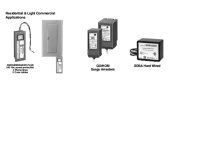
As far as surge protection, they are great add-ons to an electrical system. They dissipate transient voltage to ground before harming sensitive electronic equipment. I will attach a pic of 3 types made for residential systems manufactured by SquareD Co.
 

Attachments

  • 8-160647-Picture1.JPG
    8-160647-Picture1.JPG
    80 KB · Views: 122
/ Electrical wiring question #3  
If you are planning on using any X-10 style control units, you will need to investigate surge control units to see what is compatable. I have been using Intermatic panel mount surge suppressors with good results. BTW - Don't forget to put surge units on your phone and cable/tv lines. Just like leaving a back door open if you don't protect every line entering the premises.
 
/ Electrical wiring question #4  
I have used GFCI breakers on individual circuits. I use electric demand water heaters and like to have the added protection. I haven't had any problems with them. Oh, these are 240V, but the breakers are also available in 110v.

The breakers have a test button, just like the outlet types. I only have one appliance on the breaker. These heaters require a bunch of amps, and have the water in pretty close proximity to that juice, I can't imagine what it would do to you if the two got too friendly with each other...

I also use the whole house surge protectors. They wire into a spare breaker.

Also with any of this, in addition to the other comments, make SURE you have good grounds. Remember that the code is the minmum standard, it is beat to make certain they're good.
 
/ Electrical wiring question #5  
Ask your service provider, they'd be happy to sell you any equipment you might want.
 
/ Electrical wiring question #6  
Yes Gary, I just installed one last year on a home. Its made by Intermatic, it cost about $800 and protects everything 120 or 240V on the panel. It installs via a 30 amp circuit breaker next to the main panel. Go to Intermatic and check for whole house GFCI protection. Rat...
 
/ Electrical wiring question #7  
Rat,
Did I look in the wrong place or what....? The only thing similar I could find at Intermatics site was TVSS not GFCI.
 
/ Electrical wiring question #8  
Hey Jerry, sorry, I had 2 things going on in my brain at the same time. He asked about a whole house surge protector as well as a whole house GFCI. No, never seen a whole house GFCI (other then 240V 30 amp GFCI's which could power a sub panel (Square D has them)) and I don't think we would want to. Refrigerators etc. would be without power if a hair dryer fell into a sink with water. Prefer to have the GFCI indidvidualized. There is a whole house surge protector though from Intermatic. If you would like I will get the model number we put in. sorry about the confusion. Rat...

When you build your house, put in 20 amp circuits in the garage not 15 amp. Many things from 120V welders, table saws, electric pressure washers need more then 15 amps
 
/ Electrical wiring question #9  
Rat,
Thats ok, no need for the TVSS model number. I'm reall familiar with them. Thanks anyway
 
/ Electrical wiring question
  • Thread Starter
#10  
While we're talking electrical here I have another question. How about a a line conditioner or power conditioner? Anyone familiar with those?
 
/ Electrical wiring question #11  
How good or BAD is your electrical service you have now? Do you need any protections? Are you seeing brownouts or power surges? A whole house protector is a nice idea, just dont get any idea that its really going to protect the house from lighting or brownouts.

A for whole house GFCI, Even if one exist, I would never want one. Put them on the circutis that need them and let the breaker cover the rest.

As for conditioners, what is it conditioning? Can it hold 200amps during a brownout. Again, what do you need to protect vs what it would could to put such a device in.

Your computers, TV and AV equipment can be handled with a local UPS. most the rest of the house is going to be lights and inductive loads that usually dont need help.

Again, direct lightnight your NOT going to stop with any device. Minimize the damage maybe, not a direct strike is not going to be stopped by a little device.
 
/ Electrical wiring question
  • Thread Starter
#12  
Gary, I don't know how good or bad the service is. This'll be new service for me and it's just for the barn. Am I getting a little over enthused (a/k/a ****) about all of this?
 
/ Electrical wiring question #13  
Gary,
A power conditioner is not going to be worth the money in the barn, IMO. The main use for them is for sensitive electronic equipment. But I'd make sure, if it was my barn, that all outlets had GFCI protection in some manner.
 
/ Electrical wiring question #14  
Do use GFCI outlets, do it at the breaker panel. Each GFCI outlet uses power even if nothing is plugged in.
 
/ Electrical wiring question #15  
Gary, I much prefer to use a good quality GFCI outlet rather then a GFCI breaker. Not only is it far more conveniant then going outside or to a subpanel inside to reset, but many calls I have made have simply been a triped GFCI breaker. A good GFCI outlet is less costly then a GFCI breaker as well. In California, we are not required to use a GFCI on commercial garage type installs but I always do. As an electrician, electricity still scares me to death. Rat...
 
/ Electrical wiring question #16  
I just hate to pay all that money just to have outlets protected that spend most of their time unused. If I can centralize it to a breaker and as you pointed out a close by breaker I would prefer that. If your poping CFCI that often then you need to work on other issues first
 
/ Electrical wiring question #17  
Hey Gary, not quite sure what you meant by having to pay all that money for GFCI outlets going unused. You can centralize it to one GFCI outlet just like a breaker as well, it simply needs to be the first outlet in the circuit. I typically do the entire kitchen this way or at least those that require GFI protection. Garages and /or outside outlets will be completely wired off one GFI outlet as well. At any rate, the important thing is too put them in, even if they were not there when the home was built. Rat...
 
/ Electrical wiring question #18  
I agree with GWS on this one. For a pool, I'd prefer the breaker type. A GFCI only kills the power downstream from it, so, in an electrical box out in the yard on a post for the pool pump if you put the GFCI outlet out there, it will only kill the power on the outside of the outlet. All of the wires in the electric box are still hot, because the breaker in the house hasn't tripped. You could still get zapped if there was water in the box, poor insulation, etc. I know you would put a GFCI outlet first in the line, possibly back by the house, to protect the rest of the outlets in the line. This is the way my bathrooms are set up. But with a heavy appliance like this, I would use a dedicated circuit and run a seperate one for lights and accessories, also GFCI at the breaker.

But, like you said, and we all agree, use of some type of GFCI device is mandatory. /w3tcompact/icons/smile.gif

Also, you should have a way to disconnect power for servicing the filter. Most above ground pool pumps don't come with a switch, so you should incorporate one in the line near the outlet box, or you will have to unplug the pool pump everytime you need to backwash, etc... It is very tempting to grab the plug and pull it when you are wet and working on the filter. And you don't want to walk back to the house to flip the breaker. That's why I went with the heavy duty X10 appliance outlet and a keychain remote and a GFCI breaker. I never have to touch any of the electrical stuff and that makes me feel a little safer.

Edited by me.

So, you're wondering why I'm talking about a pool.... because I replied to the wrong post /w3tcompact/icons/blush.gif.

You are correct that in a house, a breaker would be a pain. Outdoors, I prefer a breaker type GFCI.

Again, sorry for the confusion on my part. /w3tcompact/icons/smile.gif
 

Marketplace Items

2017 Mercedes Benz GLA SUV (A56859)
2017 Mercedes Benz...
500 BBL FRAC TANK (A58214)
500 BBL FRAC TANK...
HYDRAULIC TILTING BUCKET FOR MINI EXCAVATOR (A58214)
HYDRAULIC TILTING...
Giyi PG72 QA 72" Grapple (A60463)
Giyi PG72 QA 72"...
2014 Chevrolet Silverado1500 Pickup Truck, VIN # 1GCNCPEH0EZ393232 (A61165)
2014 Chevrolet...
2025 Pabreak 84in. Hydraulic Rotary Tiller Skid Steer Attachment (A61567)
2025 Pabreak 84in...
 
Top