Electricity usage

   / Electricity usage #41  
Our co-op recently implemented monthly demand charges. They reduced kwh rates but added the monthly on and off peak demand service fees. In theory the bill should be about the same if your using any amount of electricity but I'm pretty sure this was all about getting money out of their 10% of customers on solar. Prior to the change we rarely paid more than the connection fee of $46. Now even if we are a net producer and sending more back to the grid than we use we still get hit with the demand charge. They take your highest 1 hour kwh usage of the month during on peak time and multiply it by $7.50 and highest 1 hour of usage during off peak by $1.50. There are times we are getting billed an extra $100 or more a month for demand charges even though we may send more to the grid than we use.
This is why adding batteries pencils out for many…

Run the peak 5 hours on battery.
 
   / Electricity usage #42  
This is why adding batteries pencils out for many…

Run the peak 5 hours on battery.
I looked the tesla powerwalls for this reason. It just doesn't math out unfortunately. Our monthly peak demand service charge is about $80 per bill/month. So $960/year. It would take 12 years to break even assuming no repair costs.
 
   / Electricity usage #43  
I looked the tesla powerwalls for this reason. It just doesn't math out unfortunately. Our monthly peak demand service charge is about $80 per bill/month. So $960/year. It would take 12 years to break even assuming no repair costs.
I agree, they aren't cheap, though some places do have local incentives.

Those have a warrantee for ten at the moment.

I would point out that your demand charge is unlikely to go down with time.

FWIW: We put our solar in with a pre-install estimated payback time of 7-8 years. With the post install utility price increases, the breakeven ended per up being 4.5 years. (N=1)

The breakeven on Powerwalls here was even shorter, but we did have the benefit of a utility grant. (due in part to the number times that they had cut off our power, and to our being on a well.)

All the best,

Peter
 
   / Electricity usage #44  
Not only do I get to pay for electricity services I do use in Massachusetts, I get to pay for services others use that I don't such as solar and EV's.

electric bill.jpg
 
   / Electricity usage #45  
I've been looking at alternative energy sources on and off for the last decade. So far, the break even point for the systems I've priced is the same as their life expectancy. I guess it would be the "green" thing to do, but the capital outlay, even with rebates and incentives, is pretty steep.

One of the things that keeps me on the grid is our ability here in PA to shop for the best electric rates. Right now, I'm paying 7.6 cents per KWH with the national average at around 17.5 cents. This is the reason the break even point for alternatives is so far out.

The economy depends entirely where you live.
 
   / Electricity usage #46  
BHDS - where are you in PA and are you on PPL service? I cannot believe its $7.6 cents per KWH delivered anywhere in PA unless you are a commercial user?

Looking up rates for the Pocono region its $7.9 cents per KWH then another $8.0 cents for delivery or 16 cents a KWH.

We installed solar in 2014 when rates were .18 cents kwh delivered in NH, which equated to a 9 year ROI - well with rate increases the ROI was 8 years. And in year 11 now they are still producing 8200 KWH a year (current value .25/kwh or $2000)
 
   / Electricity usage #47  
One of the things that keeps me on the grid is our ability here in PA to shop for the best electric rates. Right now, I'm paying 7.6 cents per KWH with the national average at around 17.5 cents. This is the reason the break even point for alternatives is so far out.

The economy depends entirely where you live.
We also have the ability to choose "alternate suppliers", but a little research a few years ago turned up no bargains, especially with the relatively small amount of electricity we use. Plus, it wouldn't change the delivery fees the local utility charges, which make up over half my bill each month.
 
   / Electricity usage #48  
BHDS - where are you in PA and are you on PPL service? I cannot believe its $7.6 cents per KWH delivered anywhere in PA unless you are a commercial user?

Looking up rates for the Pocono region its $7.9 cents per KWH then another $8.0 cents for delivery or 16 cents a KWH.

We installed solar in 2014 when rates were .18 cents kwh delivered in NH, which equated to a 9 year ROI - well with rate increases the ROI was 8 years. And in year 11 now they are still producing 8200 KWH a year (current value .25/kwh or $2000)
I'm in the northeast corner of PA in the PPL service area. The $7.9 cents is just per KW and does not include distribution charges or taxes. The supplier is Major Energy. It's a 3 month introductory rate for new customers only.

The delivery or distribution rates don't change frequently, so I generally don't include them when making comparisons. I did include them however when calculating the break even point on alternative energy systems.

One factor often overlooked in making these calculations is, even with incentives, the interest lost on the capital investment over the life of the system. Another factor for solar installations is the amount of insolation (sunshine) you get in your area. Snow covering on the panels also needs consideration in northern climates. Not easy to clean off when roof mounted.

In addition to the break even point, there were other factors that made me give up on solar systems.

1 - A roof installation would void the warranty on my new shingles.
2 - Of the 5 companies that gave me estimates, only one is still in business.
3 - In this rural area, there are very few contractors that will work on these systems.
4 - A tree fell on a neighbors ground rack installation and he can't find replacement panels with the same dimensions.
5 - His home owners insurance would only cover around half the loss and it is unlikely he will recoup his investment.

I'm not trying to discourage anyone from going off grid or supplementing their energy use with these systems. I think they are a great idea and I'm glad it's working for you. All I'm saying is, you need to look at the big picture.

A BIG YMMV.
 
   / Electricity usage #49  
We also have the ability to choose "alternate suppliers", but a little research a few years ago turned up no bargains, especially with the relatively small amount of electricity we use. Plus, it wouldn't change the delivery fees the local utility charges, which make up over half my bill each month.
Again, this all depends on where you live, how much electricity you use and the number of suppliers competing for business in your area.

I've been shopping for the best electric rates for almost 20 years now. I save between $20 and $40 per month, even with the occasional distribution rate increases.

I suppose I should consider what my time is worth in doing the online shopping, but it only takes around 10 minutes, perhaps 3 or 4 times per year.
 
   / Electricity usage #50  
One of the things that keeps me on the grid is our ability here in PA to shop for the best electric rates. Right now, I'm paying 7.6 cents per KWH with the national average at around 17.5 cents.
17.5 cents looks like the national average of total electric rate, and your 7.6 cents that you chose is probably just the energy company charge. Most states allow picking the energy company, but you still use your local utility that owns the physical hardware, for the distribution, and transmission charges.
Are you sure you’re comparing apples to apples with those numbers?
 
   / Electricity usage #51  
17.5 cents looks like the national average of total electric rate, and your 7.6 cents that you chose is probably just the energy company charge. Most states allow picking the energy company, but you still use your local utility that owns the physical hardware, for the distribution, and transmission charges.
Are you sure you’re comparing apples to apples with those numbers?
Yes, my error. The national electricity only rate is $11.23 cents per KWH, not $17.5.

Thanks for pointing this out.
 
   / Electricity usage #52  
In NH the cost of delivery has risen dramatically over the last three years. Our September bill for 400 kWh for the house is $112 this month or $.28 per KWH. $.11 KWH for electricity and $.17 KWH for delivery.

Electric Supply Services $45.23
Delivery Services $67.02
Total Current Charges $112.25

Our garage has the solar and a separate service with net metering at the current rate $.28, they send us a check for overproduction so it's offset $ for $ to what we pay for the house, so its a wash.

The "new" solar installations only get overproduction credit at the cost of energy rate, not the distribution, so that would make the ROI much different in our case.
 
   / Electricity usage #53  
What pencils out in a high cost market may not in a market with low cost electricity.

I’m very pleased with my modest system that was self installed…

Part is simply the satisfaction quotient which is hard to put a price on.

Each year I receive a modest check… my 6kW system produces more than I use for 3200 square feet of home.
 
   / Electricity usage #54  
What pencils out in a high cost market may not in a market with low cost electricity.

I’m very pleased with my modest system that was self installed…

Part is simply the satisfaction quotient which is hard to put a price on.

Each year I receive a modest check… my 6kW system produces more than I use for 3200 square feet of home.
Again, this will vary by location. PPL, my electric provider here in PA uses net metering. They use your surplus elecrticity to offset future bills. They do not pay you for it directly.
 
   / Electricity usage #55  
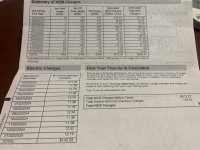
By law we have annual True Up which is tracked monthly.

I’m a daily producer…

Last December I did end up owing $1.29 for the month due to peak use.

Attached billing summary showing 12 months of my usage. Had to post lower resolution due to bandwidth limitations here in the boondocks.
 

Attachments

  • 3EED3DAE-27B8-4C76-AB0C-D6DE8C1AA536.jpeg
    3EED3DAE-27B8-4C76-AB0C-D6DE8C1AA536.jpeg
    206.9 KB · Views: 33
Last edited:
   / Electricity usage #56  
The answers are all over the place. And why not, we all live in different places and individual power bills are being posted. To post a power bill from your place is meaningless.

I was hoping people would share ways to reduce the bill and live better.
 
   / Electricity usage #57  
The answers are all over the place. And why not, we all live in different places and individual power bills are being posted. To post a power bill from your place is meaningless.

I was hoping people would share ways to reduce the bill and live better.
On that note, over the last year we have been insulating the crawlspace, sealing the house against air leaks, (together about a 50+% reduction in heating costs), and increasing the insulation in some of the walls as we add fire resistant siding (TBD reduction, but probably in the 15-20% range). We anlso added improved dampers on exhaust vents. All part of improving wildfire resistance and home hardening. We can now keep the indoor AQI below ten, even when the outdoor AQI is 150.

We also switched to an induction stove that uses less energy (faster cooking times, less wasted heat), and a better insulated oven.

All of this is also part of move away from LPG because of the supplier's past behavior.

As we are on solar, it will take some time to nail down the differences in detail. We do use batteries to cover 100% of our peak power usage. The electrical bills really only line up annually, and even then a warm winter or a cold windy one can significantly impact both our power use and our power generation. So, we may not have a solid answer for a few years.

FWIW: We recently priced an add-on ground mount solar (no export), that came out to be about $0.18/kWh over 20 years.

All the best,

Peter
 
   / Electricity usage #58  
The answers are all over the place. And why not, we all live in different places and individual power bills are being posted. To post a power bill from your place is meaningless.

I was hoping people would share ways to reduce the bill and live better.
No way to do that. I swapped everything to led to save money, so dud most other people around here. Than the power companies sold less power, so complained delivering the power was losing money, so they increased rates.


Net zero change
 
   / Electricity usage #59  
Same happened here but also said it’s a matter of equity?

Water conservation led to steep price increases because the actual gallons flowing through the pipes mean little to overall operating costs…

The treatment plants, pipes, meters, reservoirs, etc, have a fixed cost.

Water company actually said big users were offsetting costs for those that use very little.

Conservation changed the business model.
 
Last edited:
   / Electricity usage #60  
Year round the folks family home is 12 kWh a day… or 360 a month.
Whoa! This year, thanks to some LED conversion and using wood and oil for primary heating, we have our electric usage down to 1800 to 3700 kWh per month. We used to be regularly over 4000 kWh, back in the days of all incandescent and CRT monitors and TV's.

Our biggest months are July and August, thanks to air conditioning. But our rate is much lower than yours, so cost is only $340 to $750/month.

I couldn't imagine running this house on $.50/kWh electric! :oops:
 

Tractor & Equipment Auctions

2018 Forest River Flagstaff Pop Up Trailer (A59231)
2018 Forest River...
2018 PRINOTH PANTHER T14R ROTATING CRAWLER DUMPER (A60429)
2018 PRINOTH...
2019 INTERNATIONAL LT625 TANDEM AXLE SLEEPER (A59575)
2019 INTERNATIONAL...
CAT CB34 (A60462)
CAT CB34 (A60462)
CHALLENGER MT525B TRACTOR (A59823)
CHALLENGER MT525B...
2009 Mariah SC23 23ft. Cabin Cruiser with T/A Boat Trailer (A59231)
2009 Mariah SC23...
 
Top