Exhausting The PT-425

   / Exhausting The PT-425 #1  

SnowRidge

Elite Member
Joined
Jul 4, 2003
Messages
2,818
Location
East Tennessee
Tractor
Power Trac PT-425 / Branson 3520
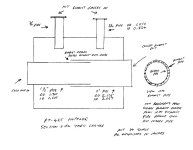
While I had my engine out, I took a close look at the PT built muffler--see attached sketch. I discovered it has a rather restricted outlet diameter--enough so, that I thought it warranted discussion.

I took measurements of the Kohler and the muffler. The Kohler's exhaust ports have an I.D. of 1.04 inches. They appear to be designed to mate up with Sch. 40, 1" pipe, which has an I.D. of 1.049". The muffler's two exhaust port manifold pipes appear to be Sch 40, 3/4" pipe, with an I.D. of 0.824". On mine, the mounting flanges do not align well with the pipe.

The manifold pipes enter the muffler chamber where the gasses are bounced off of some sort of curved deflector (or perhaps the pipes themselves curve inside the chamber).The muffler has a large exhaust pipe constructed of what appears to be Sch. 40, 2" pipe, with an O.D. of 2.375" and an I.D. of 2.067". There is also a cold air intake pipe constructed of what appears to be Sch. 40, 1 1/2" pipe, with an O.D. of 1.900" and an I.D. of 1.610".

The muffler is constructed in such a manner that the cold air intake pipe enters through the left side of the chamber, and is concentric with the exhaust pipe, which exits through the right side of the chamber. In other words, the cold air intake pipe goes into the exhaust pipe. Exhaust enters the exhaust pipe by flowing around the outside of the air intake pipe. That is the only opening into the exhaust pipe, except for the inside of the cold air intake pipe. I hope that makes sense.

My math (always suspect) calculates the following areas:

Kohler exhaust port 0.86 sq. in.
Muffler inlet pipe 0.53

Exhaust outlet pipe (I.D.) 3.36 sq. in.
Cold air inlet pipe (O.D.) 2.84
Effective outlet area 0.52

The effective outlet area is represented by the xxxx's on the sketch.

These numbers concern me. The choking down of the exhaust ports into small diameter pipes doesn't seem like a normal way to design an exhaust system, and while the effective outlet area is only 0.01" less than the choked down exhaust inlet pipes, it still seems awfully small to me.

Beyond the design concerns, there is the manner of actual construction. As I noted earlier, the exhaust mounting flanges are poorly aligned with the 3/4" pipes, which will cause an additional restriction. Worse, the inside end of the cold air intake pipe doesn't look like it was ever cleaned up after being cut and before being welded into place.

The rough edges from the cut clearly increase the O.D. of that pipe, which in turn reduces the effective outlet area. The inside end of the exhaust outlet pipe may well have the same problem, but I have no way of seeing that point without tearing the muffler apart.

The thrust of all this boils down to this: I think these mufflers (at least the one on our PT-425) are choking the Kohler engines, and may be making them run hotter than necessary, and may be reducing available power to a significant degree.

I am seriously considering either modifying the muffler, building an entirely new one along the same design, but with different pipe sizes, or installing a Kohler muffler instead.

So, what do you all think?

SnowRidge
 

Attachments

  • 424589-PT-MufflerBW.jpg
    424589-PT-MufflerBW.jpg
    50.6 KB · Views: 405
   / Exhausting The PT-425 #2  
</font><font color="blue" class="small">( I am seriously considering either modifying the muffler, building an entirely new one along the same design, but with different pipe sizes, or installing a Kohler muffler instead.

So, what do you all think?

SnowRidge
)</font>

Wow. That's a good analysis, my friend. I suppose the thing to do is to simply bolt up a Kohler muffler and try some empirical testing. Now how to test the PT - not like you can just hook it up to a dyno. Or can you?

Hmmm.

-Rob /forums/images/graemlins/grin.gif
 
   / Exhausting The PT-425 #3  
Snowridge,

Great observations. The thing sounds fairly heavy, is it all supported off of the kohler engine?

I believe by measuring intake manifold vacuum at various RPMs you can tell if the exhaust is a constriction to normal engine breathing. Try an internet search on about catalytic converter plugging, and it will yield some tests to determine if the exhaust is a restriction. Just a thought, let us know what you find out.

Duane
 
   / Exhausting The PT-425
  • Thread Starter
#4  
Further info that got omitted in the original post:

The two pipes aren't perfectly concentric. This doesn't reduce the effective outlet area, but it does mean the gap isn't uniform. At a couple of the narrow points, I can see bits of carbon caught in the restriction. Of course, they do reduce the area.

In one of the other threads, there is mention of watching the interior of the muffler glow in the twilight. Perhaps this is the reason why.

SnowRidge
 
   / Exhausting The PT-425
  • Thread Starter
#5  
</font><font color="blue" class="small">( The thing sounds fairly heavy, is it all supported off of the kohler engine? )</font>

It is very heavy. I wish I had a scale to measure it.

It is supported by braces from below as well as the maniflold bolts.

</font><font color="blue" class="small">( I believe by measuring intake manifold vacuum at various RPMs you can tell if the exhaust is a constriction to normal engine breathing. )</font>

The references to that all give figures for automotive engines--and I don't have a vacuum gauge. Still, it would be interesting to see what a gauge says. I may pick one up if I can find a place to hook it up.

SnowRidge
 
   / Exhausting The PT-425 #6  
Engines are my area of least knowledge on these contraptions, so what I say may sound totally ignorant! Don't you want some back-pressure? Isn't that necessary for torque or something like that (up to a point)? A neighbor told me that not enough back pressure causes the fuel mixture to become too lean, causing a loss in hp and/or torque. Can anyone explain this to me (and everyone else)?

TIA!
Dave
 
   / Exhausting The PT-425 #7  
Dave:
Backpressure is almost invariably a bad thing. Basically, the exhaust system needs to get the hot gases out of the cylinder as quickly and thoroughly as possible. In race or high output engines, a lot of study and experimentation is done to get the entire system, from beginning of intake to end of exhaust, to pack as much air in as possible and get as much exhaust out as possible. Valve overlap even gives you time where the outgoing exhaust pulses scavenge and lower the cylinder pressure so more cold air/fuel mixture comes in the intake port/valve. If the length, diameter or shape is wrong, and a high pressure pulse coincides with exhaust valve opening, the power is reduced.
Often, on two-stroke motorcycles, for instance, the engine develops a lot more power when a can with a small appearing outlet is put on, rather than a large straight pipe. This is due to resonant waves in the can being properly tuned to the frequency of the engine exhaust port openings in the power band, reducing exhaust pressure when the port is open, not to back pressure.
What does this have to do with the low RPM 4-strokes on the PTs? /forums/images/graemlins/confused.gif Not a whole lot, /forums/images/graemlins/grin.gif but a proper length and diameter exhaust will deliver more power than no exhaust pipe, or a mismatch. In these engines, the difference won't be a lot, and considerations of noise and heat shielding are probably more important.
 
   / Exhausting The PT-425 #8  
Is that why you don't see expansion chambers on 4 cycle engines? /forums/images/graemlins/wink.gif

(I loved the sound of mine on my RD400)
 
   / Exhausting The PT-425
  • Thread Starter
#9  
Moss, do you have any problems with that rear exhaust Kohler muffler on your PT? No melting the battery or anything like that? Any disadvantages to the rear exhaust that you are aware of?

Do you know the Kohler part number for it?

Thanks,

SnowRidge
 
   / Exhausting The PT-425 #10  
<font color="red">Is that why you don't see expansion chambers on 4 cycle engines? </font>

We have some tuned 4-stroke race exhausts that increase in diameter. They don't choke back down, but do go to a collector to try to pulse match with other cylinders. I don't know if you could get a high peak at some rpm with a 2-stroke type chamber. (The guys who do know are engine developers who won't tell anyone but the people paying their salaries. - /forums/images/graemlins/tongue.gif)
 
   / Exhausting The PT-425 #11  
Hey Snow Ridge - I agree with Charlie - I have not worked that much on small 4 cycle engines like the PT, but I kave worked extensively on race engines (a long time ago) and I have to believe that (as in regular engines) partially blocked exhaust ports are a bad thing. As Charlie says, it will retain heat, create backpressure and reduce power - ALL BAD

Call Kohler Tech support and get their input - they were very helpful when I called

I think it would be best (and look cool) to take a pipe right out the side and then up through a muffler - kind of like the muffler pipes you see sticking out of the hood of some CUTs.

I thought someone posted a recent picture on a new PT that had the pipe come out the side and into a muffler (but it didn't go up)


I have to believe that the situation you describe may be causing some problems - Who Knows, maybe the added heat contributed to the push rod failure - lots of heats makes those things much softer and easier to bend.
 
   / Exhausting The PT-425
  • Thread Starter
#14  
</font><font color="blue" class="small">( This looks like the appropriate muffler - I'm sure other places have them.. )</font>

I believe that is it, Rob. Thanks for the link. /forums/images/graemlins/cool.gif

SnowRidge
 
   / Exhausting The PT-425 #15  
The Koher 25 and Robin 25 allow up to 28" water as max back pressure at 3600 RPM. I ask PT about this and was told it was around 24" on the PT transvector muffler. I tested my 425 and found it to be only 21" water at 3600 RPM.
I agree too much back pressure can cut HP or burn exhaust valves, but PT does not have a problem with this muffler. The heat is held in the muffler with the wrap and with the fresh air entering the oposite side moves the heat out of the engine compartment. When the engine is turned off and no fresh air moving the heat inside the wrap and muffler causes heat soak which causes the muffler temp to raise very high which is what you see. The temp probally doubles for a few minutes soon after the engine is turned off.
Remember, all the new carb regs that recently went into effect forces engine manufactures to run all engines a lot leaner which increases exhaust gas temps. I have seen a 50% increase in exhaust gas temps in the last two years.
Enjoy you PTs,
EB
 
   / Exhausting The PT-425
  • Thread Starter
#16  
</font><font color="blue" class="small">( I have to believe that the situation you describe may be causing some problems - Who Knows, maybe the added heat contributed to the push rod failure - lots of heats makes those things much softer and easier to bend. )</font>

The pushrod failure was due to the valve seat departing the head. What caused that is unknown, but heat may have been a factor.

Even if it wasn't a direct cause for the valve seat failure, it can't be doing the engine any good in the long term. I agree it is probably causing some problems. I just need to decide how I'm going to rectify it.

I should have the engine back in the PT tomorrow, if all goes well. I really don't want to run it hard with that muffler, so I guess I'm going to have to do something pretty quickly--the grass here is getting loooooong.

SnowRidge
 
   / Exhausting The PT-425
  • Thread Starter
#17  
</font><font color="blue" class="small">( The Koher 25 and Robin 25 allow up to 28" water as max back pressure at 3600 RPM. I ask PT about this and was told it was around 24" on the PT transvector muffler. I tested my 425 and found it to be only 21" water at 3600 RPM. )</font>

I'm curious as to how you were able to test your machine. Where did you hook up the manometer? Could you describe the procedures for us?

</font><font color="blue" class="small">( The heat is held in the muffler with the wrap and with the fresh air entering the oposite side moves the heat out of the engine compartment. )</font>

Our version of the PT-425 did not include the muffler wrap. I believe one of the group with a like machine queried Terry about this and was told it wasn't needed.

</font><font color="blue" class="small">( Remember, all the new carb regs that recently went into effect forces engine manufactures to run all engines a lot leaner which increases exhaust gas temps. )</font>

Yes, and that is why I am concerned about the design and construction of this muffler. The engines are already running very hot, and I don't think there is any room for excessive exhaust restrictions--if in fact, that is what I have.

In particular, I'm not sure how I could accurately measure back pressure when the first restriction is right at the exhaust port itself (the necking down into 3/4" pipe).

Any ideas?

SnowRidge
 
   / Exhausting The PT-425 #18  
No problems with the rear exhaust. It points straight back.

I'll try to get the part number tomorrow. It's late. /forums/images/graemlins/smile.gif
 
   / Exhausting The PT-425 #19  
</font><font color="blue" class="small">( Our version of the PT-425 did not include the muffler wrap. I believe one of the group with a like machine queried Terry about this and was told it wasn't needed. )</font>

SnowRidge,

I was the one who called and asked Terry about the muffler wrap - he mentioned that the new design - with both pumps in front, steel tank in the lid, etc. - necessitated the addition of a thermal wrap - I wanted to know if I could buy one, as I noted that the muffler does get mighty hot, and he said "The older design, like yours, doesn't need it - there isn't the concern with muffler temp on yours - besides, the wrap is really expensive, like over $100 dollars - believe me, you don't want it - it won't do anything for ya."

I figured Terry was being honest, and took him at his word.

Sincerely,

Rob /forums/images/graemlins/grin.gif
 
   / Exhausting The PT-425 #20  
I quess I'm curious what the actual benefit is for the cold air intake. Snowridge mentions that grass will burn on the exhaust, so it does not sound like the muffler shell is running that much cooler than a normal muffler. I suspect the expelled gases might be a little cooler, but the older vintage PTs with the normal mufflers seem to expel the gases to outside the engine cover. I thought the cold air intake was to reduce the shell temperature to reduce the overall heat input in the engine compartment.

Duane
 

Tractor & Equipment Auctions

John Deere 5090GN (A60462)
John Deere 5090GN...
MORBARK WOOD HOG 6400 XT HORIZONTAL GRINDER (A60429)
MORBARK WOOD HOG...
2020 FORD F-150 XL CREW CAB TRUCK (A59823)
2020 FORD F-150 XL...
2019 MACK PINNACLE (A55745)
2019 MACK PINNACLE...
UNUSED FUTURE 40" HYD TILTING BUCKET (A52706)
UNUSED FUTURE 40"...
2016 Ford Explorer AWD SUV (A59231)
2016 Ford Explorer...
 
Top
