FEL Lift capacity

/ FEL Lift capacity #1  

Geotech

Silver Member
Joined
Jul 6, 2018
Messages
199
Location
Ben Wheeler, Texas
Tractor
Kubota L2501,
I have a question about FEL capacity - might be a dumb question....

Is the FEL lift capacity based completely on available power from the hydraulics, or does the rating including a tipping factor?

Near the beginning of a Youtube video, a tractor salesman makes the statement that the tractor could lift much more than its FEL rating if the tractor had ballast. The statement is 28 seconds into this video: Kioti CK4:) & CK351 Tractor Loader w/ Snowblower Review - YouTube

I understand that track loader capacities involve tipping capacities, so I wondered if this was also true for CUTS...
 
/ FEL Lift capacity #2  
I'm not sure what a tipping factor is or what that salesman is talking about.

If I try and lift something heavy without ballast on either of my Kubota tractors, the rear wheels will come off the ground before the FEL will lift it's rated capacity.

AFAIK, the published FEL lift ratings (at least for Kubota tractors) are measured with a properly ballasted tractor and the hydraulic pressure set to factory spec.
 
/ FEL Lift capacity
  • Thread Starter
#3  
Tipping factor is a rating of how much a machine (say, a skid steer) can lift to a given height before the machine starts tipping forward. Skid steers don't publish a maximum lifting capacity, rather a tipping factor.
 
/ FEL Lift capacity #4  
Tipping factor is a rating of how much a machine (say, a skid steer) can lift to a given height before the machine starts tipping forward. Skid steers don't publish a maximum lifting capacity, rather a tipping factor.

A tipping factor rating may exist for CUT tractors but I've never seen them posted (at least for Kubota anyway).
 
/ FEL Lift capacity #5  
I have a question about FEL capacity - might be a dumb question....

Is the FEL lift capacity based completely on available power from the hydraulics, or does the rating including a tipping factor?

Near the beginning of a Youtube video, a tractor salesman makes the statement that the tractor could lift much more than its FEL rating if the tractor had ballast. The statement is 28 seconds into this video: Kioti CK41 & CK351 Tractor Loader w/ Snowblower Review - YouTube

I understand that track loader capacities involve tipping capacities, so I wondered if this was also true for CUTS...

Example of tipping factor: My 2400 has a very fast hydraulic system and feathering a heavy load is tricky. With a bucket moderately full of something like sand or gravel, even with rear weights, I get a lifting reaction on the rear from height changes of the bucket, serious enough to jostle me in the seat. So, the normal calculations for hyd pressure x area of piston/length of lift arm thing just may be modified by weight of the tractor in determining the safe lifting capability, or may not. Dunno!
 
/ FEL Lift capacity #6  
I had a Bobcat S130 several years ago. The 130 stood for the operating capacity of 1300 lbs. The tipping load was 2 times the operating capacity, or 2600 lbs.
The model numbers are different now but the specs haven't changed much. S45 Skid-Steer Loader Specs & Options - Bobcat Company

I believe you all are correct. The lift capacity is determined by the pressure and proper ballast. I've never heard of tipping load on a tractor.
 
/ FEL Lift capacity #7  
It's rated on what the machine can do....assume if it were anchored to the ground. There will be variation from machine to machine, so just because your spec sheet says X, the actual absolute most you can lift will be +/-.

Note HOW the measurement on spec sheet was taken. Some are very vague or only give capacity at pivot pins. In center of curled bucket - or farther out with load spread over pallet forks it will be much less. There is also a huge difference in what you can just get off the ground vs what you can get more than a few feet up.

In general, any major brand modern machine is going to handle a full loader scoop of material and take that to full height. Will need rear ballast to do it w/o worry of tipping forward. It's when you need to lift to full height (like higher pallet racks for storage), or need to use pallet forks or some thing similar that gets the weight way out past the pivot pins where you start running into capacity issues most times.

Also note - what he could have been describing in video.....some machines can lift more with loader than tractor with no ballast can handle. Sitting still, some machines you can get the rear tires coming off the ground but the load not lifting. In that case, you could lift more with ballast. The loader is still capable of X lbs either way, just rest of machine won't balance it and the rear will come up vs the bucket. Regardless, you need counterbalance on the rear - can still tip forward once moving or raising load higher.
 
/ FEL Lift capacity #8  
I believe it is rated for the hydraulic capacity. The user configures the counterbalance with loaded tires, attachments etc. My tractor will lift the rear tires off the ground easily.
That being said, heavy loads should always be kept as near to the ground as possible because the geometry can change in an instant if you drive into a depression, rut, or create a static load by rapidly raising or lowering the load.
 
/ FEL Lift capacity
  • Thread Starter
#9  
CMV,

In the video, he stated the loader capacity of about 1800+ lbs, which is the capacity rating spec of the loader (1835 lbs), and then states it could be over 2000 with ballast. So, he was stating that it could lift more than its spec rating given ballast. Anyway, probably not a big deal, just got me wondering about ratings and how they are determined. For example, Kubota states 1130 lbs lift for their L2501, 033 and 039 series. But that is at the pin at full lift height. Kioti and LS advertise 1835 and 1700 lbs, respectively, but that is at pin at 1.5 meters off the ground. Sounds astronomically higher than Kubota, but if you find Kubota's rating at 1.5 meters, it is 1490 lbs. So not as big a discrepancy. THEN, I hear this guy on the Youtube video going off on something else. I have seen some of this guy's other videos and he seems like a relatively legitimate source of information, but this is the first time I've heard or read anyone say the lift capacity would be higher than the advertised rating given some ballast...
 
/ FEL Lift capacity #10  
I have 1550 pounds of Rim Guard in the rear tires and a heavy 1050 pound Rhino 950 rear blade on the 3-point. Even with all that rear ballast - I still can't lift the max that the FEL is rated for. I can lift right at 3100 pounds - more than enough for anything I need. Also right at the edge of my "fear factor rating".

I've never heard of a "tipping factor". Sounds like some jargon concocted by a tractor salesman. Without something heavy on the 3-point - I can easily and dangerously lift the rear tires.
 
/ FEL Lift capacity #11  
Neal (Messick's) recently did a video on it describing how different companies advertise their loader specs differently and how that can make X look better than Y on paper. Would be a good one to watch.

Anyway, yeah, sounds like you got it....what are they measuring and from where to get that # on the spec sheet. If not apples:apples, that # doesn't really tell you which one will/won't do your task in the real world.

Geometry plays a part too - in general a loader that can't go as high or reach out as far can move more weight. It's a tradeoff. Best thing you can do is if you know you need to lift a pallet of widgets to 6' height or move round bales of X diameter is to test that out when shopping. Either the machine can do what you need or it cannot regardless of what the marketing guys had printed in brochure.
 
/ FEL Lift capacity #12  
I have always considered my weight ratings on my tractor to be everything loaded, I should be able to lift my max front loader weight with the max 3 point hitch weight on at the same time, and visa versa. And I should be able to safely operate the tractor fully loaded on both ends, manual doesn’t say I cannot.
 
/ FEL Lift capacity #13  
Here are some older ASAE FEL Lifting specs for Ag tractors and I do not see any reference to "tipping factor"
 

Attachments

  • FEL Lifting Specs.pdf
    53.4 KB · Views: 359
/ FEL Lift capacity #14  
Tipping load is a specification on every skid-steer, track loader and wheel loader. In nearly all cases the loader hydraulics are more powerful than the chassis weight/ balance and therefore the tipping load is the actual working load. On articulated wheel loaders, the tipping load changes based upon full articulation, substantially less than straight ahead.

From the factory, these machines are designed with a fixed ballast (some have removable/optional rear weights). But generally not as "changeable" as a tractor.

I believe they are designed to provide that power so that they have the needed breakout force to dig effectively.
 
/ FEL Lift capacity #15  
I'll bet you could take the cylinder pressure, multiply it times the area of the cylinder face, then take those foot/lbs, and slide it out from the pin and get a close number.. ie... 2000 ft/lbs over 5 ft = 400 lbs of lift (times 2 cylinders) = 800 lbs total lift
 
/ FEL Lift capacity #16  
Tipping Factor is real term used with machines that lift loads. I think you will find the term is used rather widely by many. There are many things I think of as tipping factors: ballast can be one depending on the machine such as tractor can have additional ballast added to it where as fel (the machine not the attachment) cranes and such are not normally design for removing or adding ballast so they are firmer on some numbers.

On a tractor with fel on it low air pressure in a tire, hitting the brakes when driving forward, taking a dip into hole or ditch, load shifting, sudden stopping of load being lower some have been mentioned and others are all "tipping factors". One thing that has been pointed out in talking about load being measured from pins is as a load moves out the lift capacity or the tipping changes greatly.

I use to run test (load capacity and tipping) on cranes and a machine that would lift 20,000 pounds would tip with say 4,000 with just moving the radius out maybe 40 to 50 feet.
 
/ FEL Lift capacity #17  
I have always considered my weight ratings on my tractor to be everything loaded, I should be able to lift my max front loader weight with the max 3 point hitch weight on at the same time, and visa versa. And I should be able to safely operate the tractor fully loaded on both ends, manual doesn't say I cannot.

Manual probably doesn't say you shouldn't light yourself on fire before operating either so not sure I get the point you're trying to make? No one is saying you can't lift max loads or do it safely. But your manual most likely does - in multiple places - caution about how to work with loads.

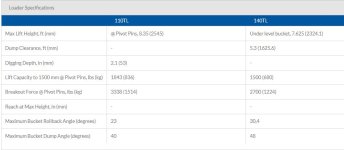
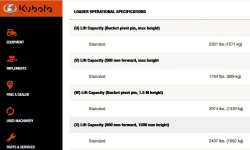
What we're talking about is how specs can be advertised vs real world performance and the confusion that can cause comparing spec sheets. Attached are NH loader specs for example. IF you had the 110TL loader and read those specs you'd think "I can lift 1843 lbs". But since that's at the pivot pins and to a ~5' height, someone needing to lift a 1700lbs pallet and put it on a 7' high rack might read that and think 110TL loader can do it. In reality, it might not since that weight would be centered a couple feet beyond the pins and needing to go a couple feet higher. However a competing model may only say it can lift 1700 lbs, but that number is taken at full height and 500mm forward of the pins, so even though it is rated "lower capacity" by the spec sheets it is actually more capable of performing the task.

Also attached is example from Kubota LA1055 loader specs - it is an excellent example and from it you can really gauge what the machine can do vs something like mine that only give X lbs at max height at pivot pins and breakout force - leaving you to guess what you really could do with a load.

Capture99.JPG
Capture999.JPG
 
/ FEL Lift capacity #18  
My reference to the manual was strictly for the weight specs, I’m not saying to be one of those “the manual says this so i can’t do that” types.
 
/ FEL Lift capacity #19  
Here is a picture of my tipping load. :D

P7150045.JPG
 
/ FEL Lift capacity #20  
The maximum capacity of a loader is when the operator unceremoniously ends up w/ a TWO piece tractor. Consult Humpty Dumpty self help videos for corrective remedies.
 

Marketplace Items

500 BBL FRAC TANK (A58214)
500 BBL FRAC TANK...
2022 KOMATSU D71PXI-24 CRAWLER DOZER (A60429)
2022 KOMATSU...
2025 Stump/ Trench Bucket Mini Skid Steer Attachment (A56857)
2025 Stump/ Trench...
WOLVERINE PT-16-01C 3PT HITCH ADAPTER (A60432)
WOLVERINE...
GIYI SF60-60" HYD SIDE SHIFT FORKS (A60430)
GIYI SF60-60" HYD...
MODEL 14C SCRAPER (A58214)
MODEL 14C SCRAPER...
 
Top