Felling a leaning tree to the side of the lean

   / Felling a leaning tree to the side of the lean #1  

s219

Super Member
Joined
Dec 7, 2011
Messages
8,607
Location
Virginia USA
Tractor
Kubota L3200, Deere X380, Kubota RTV-X
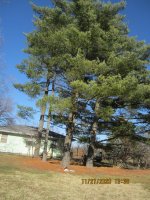
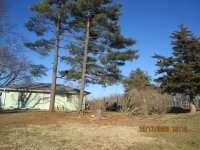
So today I finally took care of a tree I had been meaning to tackle for a long time. It had about a 20-25 degree lean on the bottom and then curved to vertical. Due to some desirable trees in the direction of the lean, I didn't want to do a normal Coos-Bay cut and drop it that way (for those not familiar, the Coos-Bay cut avoids a barber chair situation). So I used a more obscure (and risky) method to drop it to the side of the lean. This doesn't always work and can be dangerous, so you want to make sure you can deal with the possibility that the tree will fall anywhere in that 90 degree zone between the lean and the side. And you don't want to finish the cut with the saw, you want to do it with a pull while out of harm's way.

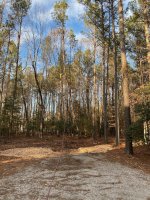
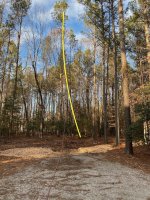
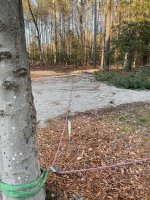
Here is the tree, highlighted in yellow in the 2nd photo:
IMG_4422.jpeg

IMG_4422x.jpeg

I got lucky with my throw rope and snagged a small broken limb high on the tree, and was able to attach my bull rope about 50' up the tree for very good leverage. The rope ran down to a big beech with a pulley, then turned 90 degrees to my driveway where the tractor was (safely out of range).

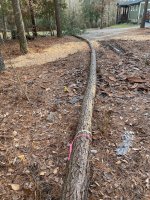
I made a shallow "open" face cut, then an angled back cut that left a wedge-shaped hinge. Then I got the heck out of there and pulled on the tree with the tractor. The cut worked extremely well, and the tree dropped perfectly to the side of the lean (it almost never goes that well). Here's that big skinny banana of a tree on the ground.

IMG_4426.jpeg

IMG_4424.jpeg

I made a short video that discusses the cut while looking at the stump:

 
   / Felling a leaning tree to the side of the lean #2  
Looks like that turned out very well. You were fortunate, in that, it is REALLY TALL but not so really big. I've wanted to try that - more than once. But my ancient Ponderosa pines are gigantic. Always scared that the tree will fall the wrong way and pull the tractor right back to the snatch block.

So ..... I make the cut as best as I can and hope for the best. Some times the tree HAS fallen the wrong way. Fortunately - I've never had to fall a big one that was near my house or any outbuildings. I HAVE had to drag "chunks of trunk" from some pretty odd places though.

Estimated weight from log weight chart - green Ponderosa pine - 36" on the butt - 120 feet tall - 22,500#. Makes a 10K pound tractor look pretty small.
 
   / Felling a leaning tree to the side of the lean #3  
Gotta love it when plan comes together. :thumbsup:
 
   / Felling a leaning tree to the side of the lean #4  
So today I finally took care of a tree I had been meaning to tackle for a long time. It had about a 20-25 degree lean on the bottom and then curved to vertical. Due to some desirable trees in the direction of the lean, I didn't want to do a normal Coos-Bay cut and drop it that way (for those not familiar, the Coos-Bay cut avoids a barber chair situation). So I used a more obscure (and risky) method to drop it to the side of the lean. This doesn't always work and can be dangerous, so you want to make sure you can deal with the possibility that the tree will fall anywhere in that 90 degree zone between the lean and the side. And you don't want to finish the cut with the saw, you want to do it with a pull while out of harm's way.

Here is the tree, highlighted in yellow in the 2nd photo:
View attachment 682461

View attachment 682462

I got lucky with my throw rope and snagged a small broken limb high on the tree, and was able to attach my bull rope about 50' up the tree for very good leverage. The rope ran down to a big beech with a pulley, then turned 90 degrees to my driveway where the tractor was (safely out of range).

I made a shallow "open" face cut, then an angled back cut that left a wedge-shaped hinge. Then I got the heck out of there and pulled on the tree with the tractor. The cut worked extremely well, and the tree dropped perfectly to the side of the lean (it almost never goes that well). Here's that big skinny banana of a tree on the ground.
View attachment 682459

View attachment 682460

I made a short video that discusses the cut while looking at the stump:


That was a very impressive analysis/solution to felling that tree! I'd say your skill is way over the average loggers level. Congrats on a job well done.
 
   / Felling a leaning tree to the side of the lean #5  
Thanks for the info & video.
 
   / Felling a leaning tree to the side of the lean #6  
Thanks s219,

I have been working on a group of five White Pine which are about 80 feet tall. So far I have dropped three, but the last two are leaning toward the house with a lot of top growth that way also. I may chicken out and hire the pros to do them.

Cheers,
Mike
001.JPGCONFIG]682472[/ATTACH]View attachment 682473005.JPG
 
   / Felling a leaning tree to the side of the lean #7  
If it's within range of a building or utility, I don't touch it unless I take take the height off with trimming or a pole saw. I've done that a few times and was able to get the main trunk down to 20' or less before the final cut. No way I'd try anything very tall.


And I just don't trust ropes to take any kind of strain.
 
   / Felling a leaning tree to the side of the lean #8  
When dealing with leaners, I use this directional falling method:
Start with an aiming notch nonmore than 25% of the diameter on the face of the tree, this will ensure the tree falls where you intend
Then make a bore or plunge cut leaving the appropriate amount of hinge [about 10% of tree diameter] and a "holding" tab on the back side of the tree.
Insert wedges to the sides of the holding tab and drive them in solidly.
Once the wedges are loaded you can safely cut the holding tab and continue driving in the wedges thus jacking the tree against the lean.
I have sometimes doubled or tripled up the wedges depending on the amount of lean you need to overcome.
As reference, a 1 inch thick wedge can jack a 60 foot tall tree 3 feet against lean.
In a situation where the tree could possibly hit something if it fell wrong, I will put a chain on the tree, then through a snatch block and then to the tractor winch for safety.
 
   / Felling a leaning tree to the side of the lean #9  
So today I finally took care of a tree I had been meaning to tackle for a long time. It had about a 20-25 degree lean on the bottom and then curved to vertical.

Was there a reason you wanted it down? It looks fairly healthy and not a real risk, but we can't see the whole situation.
 
   / Felling a leaning tree to the side of the lean #10  
Ha, ha. I tried the "saw down" technique once. Strap my small chain saw to my belt. Start climbing this humungous pine tree. It was 38" on the butt and 127' tall. Got up about 20' off the ground. At this point I noticed - the chain saw had pulled my pants down around my ankles.

I was 35 years younger than now and fortunately my wife couldn't find our camera in time.

One great idea right down the crapper .................
 
   / Felling a leaning tree to the side of the lean #11  
When dealing with leaners, I use this directional falling method:
Start with an aiming notch nonmore than 25% of the diameter on the face of the tree, this will ensure the tree falls where you intend
Then make a bore or plunge cut leaving the appropriate amount of hinge [about 10% of tree diameter] and a "holding" tab on the back side of the tree.
Insert wedges to the sides of the holding tab and drive them in solidly.
Once the wedges are loaded you can safely cut the holding tab and continue driving in the wedges thus jacking the tree against the lean.
I have sometimes doubled or tripled up the wedges depending on the amount of lean you need to overcome.
As reference, a 1 inch thick wedge can jack a 60 foot tall tree 3 feet against lean.
In a situation where the tree could possibly hit something if it fell wrong, I will put a chain on the tree, then through a snatch block and then to the tractor winch for safety.

The problem with GOL style of cutting is there’s not feedback from the tree about what that top is actually doing. If I was in the same situation as the OP I would of skipped the rigging and put a Dutchman in on the sweep side of the tree to pull it around. Another option that’s common on the west coast are jacks which involve putting your back cut in first you can do with with wedges as well. What I’m trying to get at is why work so hard back boring a tree when you really don’t need to.
 
   / Felling a leaning tree to the side of the lean #13  
LOL, once was asked to fell a birch that was threatening a client's roof.
I tied a good rope as high as possible and attached the other end to my 3/4 ton 4 x 4 in order to direct the fall.
I cut a proper notch , handed the saw to a helper and told him how and where to cut when I blew my horn.

Blew the horn, he completed the cut, tree fell and pulled my truck back and tree stopped when it hit the roof overhang.

LOL, I forgot to engage the 4 x 4! (and a PU is very light on rear end)
Fortunately the builder had used 2 x 6's under the facia so there was no roof damage.

(I'd used that method often and when properly done I have seen trees actually leap up and away.)
 
   / Felling a leaning tree to the side of the lean #14  
A technique I have used on a leaner: Rig a guy or "preventer" against the lean and perpendicular to the intended direction of fall. Place the line as high as practicable to try to hold the mass of the top where it has the least leverage to fall away from the guy. Hopefully the line will be in tension and therefore controlling the tree during the entire fall.
 
   / Felling a leaning tree to the side of the lean #15  
I have some 70-90 foot ash leaners. Unfortunately they are dead due to EAB.
For one, I took down a 90 footer next to it at an angle towards the leaner.
This pushed the leaner down a bit, and dropped some huge dead branches, so now I don't have to worry about those branches.
Leaner and other large branches now leaning over forested area.

I had a crew with a cherry picker come out to get the dead Ashes close to the house and garage, expensive, but either of those trees was big enough to do very significant damage at quite a few tons of wood.

Have a few more big ones to go and need to figure out what to do with so many widow makers high up.
 
   / Felling a leaning tree to the side of the lean #16  
The problem with GOL style of cutting is there’s not feedback from the tree about what that top is actually doing. If I was in the same situation as the OP I would of skipped the rigging and put a Dutchman in on the sweep side of the tree to pull it around. Another option that’s common on the west coast are jacks which involve putting your back cut in first you can do with with wedges as well. What I’m trying to get at is why work so hard back boring a tree when you really don’t need to.

There are other methods and each has it place. In my case most trees are 16" and smaller and primarily white pine so boring is easy.
I also use various notch and boring angles to counter specific tree attitudes and crown configurations.
 
   / Felling a leaning tree to the side of the lean #17  
I have some 70-90 foot ash leaners. Unfortunately they are dead due to EAB. <snip>
Leaner and other large branches now leaning over forested area. I had a crew with a cherry picker come out to get the dead Ashes close to the house and garage, <snip>
Have a few more big ones to go and need to figure out what to do with so many widow makers high up.

Ash decays fairly rapidly. If you have decade or so, those widow makers may likely fall on blustery days. Being in a forested area, the risk to life, limb, and property is considerably reduced. BUT, the longer you travel down the "let it rot" route, the more dangerous deliberate removal becomes. One of my "Oh S***" days was watching a dead tree fall 45ー from my intended direction when I was too inexperienced to recognize the hinge wood was unsound.
 
   / Felling a leaning tree to the side of the lean #18  
...
And I just don't trust ropes to take any kind of strain.

With old technology ropes, you are correct to be untrusting, but there are ropes made with modern fibers that have unreal strength, wear resistance and low weight.

As an example, AMSTEEL-BLUE - Samson Rope. Dyneema is the name of the fiber. There are others brands and various grades with in brands as well. Some could be strong, some weaker, depends on what one needs.

Example:

1/4 inch galvanized wire rope has a breaking strength around 7,000 pounds and will weigh in around 11 pounds per 100 feet.

Amsteel Blue 1/4 inch rope has an average breaking strength of 8,600 pounds, with a minimum of 7,700 pounds, and have a weight of 1.6 pounds per 100 feet.

Later,
Dan
 
   / Felling a leaning tree to the side of the lean #19  
Thanks s219,

I have been working on a group of five White Pine which are about 80 feet tall. So far I have dropped three, but the last two are leaning toward the house with a lot of top growth that way also. I may chicken out and hire the pros to do them.

Cheers,
Mike
View attachment 682475CONFIG]682472[/ATTACH]View attachment 682473View attachment 682474

I've been running saws and falling trees since 1968. Only once did I try a "hazard tree" (one that will do serious damage) Large Black locust about 30" butt diameter, slight lean oveer a trailer house (occupied). Rigged to cable from anchor to pulley about 15" up the trunk and back to and anchor tree gives a 2 to one mechanical advantage. Loose end of cable to my comealong which works from come-along to a pullet with hook attached to the cable from the tree. Anohter 2 to 1 which combinded gave a 4-1 pull on the tree, cable from truck to pulley on achor to the comealong. Did my normal felling cuts to pull it 180 degree from lean. First attempt at pulling it only gained a minor amount, mostly slack in the rigging. Cranked on come-along, pull - nothing, deepen cut, pull - nothing except gain a little on the come a long each pull. Finally asked the people to leave the trailer house as i was sweating blood over a total failue.

They refused. Repeat the deepen cut, pull, crank on come along, pull. It finally went where I plannedf but I worked on that thing for at least a half hour. Never again.

I have also called pros to take down 3 trees so far around my house.
 
   / Felling a leaning tree to the side of the lean #20  
A technique I have used on a leaner: Rig a guy or "preventer" against the lean and perpendicular to the intended direction of fall. Place the line as high as practicable to try to hold the mass of the top where it has the least leverage to fall away from the guy. Hopefully the line will be in tension and therefore controlling the tree during the entire fall.

Mosst people rigging to pull a tree forget that onece it starts to fall the pull is gone as the pull vehicle isn't fast enough to keep the slack out of the cable.
 

Tractor & Equipment Auctions

NIPPON HYD THUMB (A52706)
NIPPON HYD THUMB...
Unused 78" Bucket Attachment (A55272)
Unused 78" Bucket...
2025 Ariens IKON 42 42in Zero Turn Commercial Mower (A59228)
2025 Ariens IKON...
2015 Ford F350 XL (A57148)
2015 Ford F350 XL...
2018 KOMATSU D65EX-18 CRAWLER DOZER (A60429)
2018 KOMATSU...
2016 JOHN DEERE 135G (A58214)
2016 JOHN DEERE...
 
Top